Contra Islam Part One: The Hadith
Posted: March 24, 2026 Filed under: Contra Islam, Etcetera | Tags: Abd al-Malik and the institutionalization of Islam, contractions between the Hadith and the Qur'an, Muhammed, plagiarism in the Hadith, problems with isnads, problems with the Hadith, Robert Spencer, The Hadith, the Hadith and biographical information about Muhammed, The Qur'an, the six canonical Hadith collections Leave a commentFor the entirety of this century, Islam has been in the spotlight and under the microscope. In this ongoing examination it is my observation that there are two camps: There are those who insist on overlooking the glaring problems with Islam, and those who seek to demonize every Muslim on the planet. With my initial posting on the subject of Islam, I first wish to clearly state that a Muslim can be a good friend, neighbor, and coworker. Thus, there is no reason to bring prejudice into any given encounter with a Muslim, or bear any inherent ill will. Yet, Islam cannot go unquestioned and unchallenged, and is to be honestly examined given its increasingly radical presence in much of the western world. Presently, I am in the process of my own critical examination of Islam. To be forthcoming, I am stating up front that I have a set bias against Islam — I am not neutral on this subject, and none of my postings will pretend to be sympathetic to this religion.
Over the past several decades there is a large and growing body of contemporary scholarship looking at the origins of the Qur’an, the person of Muhammed, and the traditional collection of works called hadiths. The Hadith will be the topic of this posting.
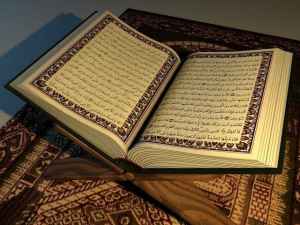
A Qur’an in Arabic
The Qur’an is the book of scriptures for Islam, and was written in an ancient form of Arabic. This book of scriptures has been translated into nearly every language on earth. Yet, it is often difficult to understand even for Arabic speakers and scholars of the Qur’an. The Hadith, then, aid Muslims to better understand the book.
Added to Qur’anic interpretation, there is the subject of their prophet who is himself a bit of a mystery. It must be stated that it is important to note that the name / title of Muhammed is found only four times in the Qur’an. Thus, the Qur’an gives scant biographical information about him. As Islam spread from its place of origin, its converts wanted more and more knowledge about him. To fill in the blanks, the hadiths were created by Muslims. This process began about 70 years after his death in 632 AD. The contemporary scholar Robert Spencer provides information on the problematic nature of the Hadith as they developed over the following centuries:
Compounding this [the methods concerning how to inform a conquered people about this imposed foreign religion] are the shaky historical foundations of the Hadith, the voluminous accounts of Muhammad’s words and deeds. The importance of the Hadith in Islam cannot be overstated. They are, when Islamic scholars deem the accounts authentic, second in authority only to the Qur’an itself. Along with the Qur’an that they elucidate, the Hadith form the basis for Islamic law and practice regarding both individual religious observance and the governance of the Islamic state. And in fact, so much of the Qur’an is obscure and opaque, and explained only in the Hadith, that functionally, if not officially, the Hadith are the primary authority in Islam (Robert Spencer: Did Muhammad Exist? An Inquiry into Islam’s Obscure Origins, Nashville, Bombardier Books, 2021, 67. Hereafter, Spencer).
The hadiths guide Islamic practice (known as sunna). However, their history shows a great deal of manipulation by their authors and compilers as we see in the following:
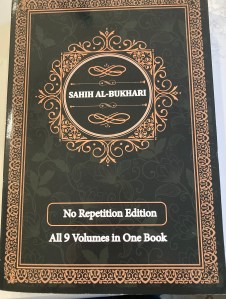
My copy of Sahih Al-Bukhari
Muslims also fabricated hadiths in the heat of political and religious controversies that they hoped to settle with a decisive, albeit hitherto unknown, word from the prophet. Abd al-Malik [a ruler who first began to institutionalize Islam under his rule around 685 AD] at one point wanted to restrict Muslims from making pilgrimages to Mecca, since he was afraid that one of his rivals would take advantage of the pilgrimage to recruit followers. Accordingly, he prevailed upon the hapless al-Zuhri to fabricate a hadith to the effect that a pilgrimage to the mosque in Jerusalem (Bayt al-Maqdis) was just as praiseworthy in the sight of Allah as one to Mecca. Al Zuhri went even further, having Muhammad say that “a prayer in the Bayt al-Maqdis of Jerusalem is better than a thousand prayers in other holy places.” This hadith duly appears in one of the six canonical Hadith collections that Muslim scholars consider most reliable: the Sunan of Muhammad ib Maja (824 – 887). (Spencer, 75)
Thus, Spencer declares,
The consequence of all this was inevitable: utter confusion. Since warring parties were all fabricating hadiths that supported their positions, the Hadith is riddled with contradictions. (Spencer, 79)
With concern for their proliferation — of which Muslims were aware — there had to be sorting processes for the hadiths. To confirm as a “truthful” source (the term for the process is siddiq) coming from the multitude of hadiths, Muslim authorities had to come up with methods to bring some degree of control and order to the problem. Six important “truthful” Hadith collections were named and were given the label sahih. These are in order of acceptance:
-
- Sahih Bukhari (810 – 870)
- Sahih Muslim (by Muslim ibn al-Hahhah 821 – 875)
- The Sunan of Abu Dawud al-Sijistani (818 – 889)
- As-Susan as-Sughra, by Ahmad ibn Shuayb al-Nasai (829 – 915)
- The Jami of Abi Isa Muhammad Al-tirmidhi (824 – 892)
- Sunan of Muhammad in Maja (824 – 887)
The Muslims had criteria to establish “authenticity” / “truthfulness”. First, there is community acceptance. Another criterion examines a “chain of transmission”, or “chain of custody” — such a chain is called isnad.
They claimed to be able to distinguish genuine material about Muhammad from forged hadiths largely by examining the chain of transmitters (isnad), the list of those who had passed on the story from the time of Muhammad to the present. Islamic scholars grade individual traditions according to their chains of transmitters as “sound,” “good,” “weak,” “forged,” and so on…A hadith is considered sound if its chain of transmitters included reliable people and goes back to a recognized authority. (Spencer, 83)
The reliability of the Hadith are shaky at best since the very earliest came into existence, as mentioned above, about 70 years after Muhammad’s death. But, as Spencer points out, the reliability of isnad is equally shaky:
The apparent reliability of the isnad chain was what determined authenticity. It didn’t matter if a hadith was self-contradictory or absurd on its face; so long as its isnad chain was clear of anomalies, and it did not contradict the Qur’an [emphasis added], the tradition had no obstacles to being accepted as reliable…If a hadith could be forged, however, so could its chain of transmission. There are numerous indications that isnads were forged with the same alacrity with which matns — that is, the content of the hadiths — were invented. (Spencer, 84)
The isnads themselves didn’t start appearing until after hadiths had begun circulating (Spencer, 85).
In other words, it appears that nothing can be regarded as historical. Spencer writes this concerning Islamic tradition:
The assumption in Islamic tradition, at least regarding hadiths that are declared to be sahih, is that all this transmission went on with absolute accuracy and no legendary elaboration. But hadiths are not ruled sahih by some criteria for measuring their historical reliability; rather, the principal requirements for sahih status are compatibility with the Qur’anic message [emphasis added] and a sound isnad chain. (Spencer, 94)
Spencer also addresses new concerns — that Hadith can be contrary to the message of the Qur’an. To demonstrate this fact, the subject of miracles comes to the foreground. The absence of miracles by Muhammed is addressed,
The clearest evidence of this comes from the Qur’an’s repeated assumption that the messenger who received its revelations was not a miracle worker…Allah tells his messenger that even if the prophet did come to the unbelievers with a miracle, they would reject him anyway (Spencer, 103).
I present these passages which declare Muhammed only to be a “warner” and a “guide”:
Qur’an 2: 118. “Say those without knowledge: ‘Why speaketh not Allah unto us? Or why cometh not unto us a sign? So said the people before them words of similar import Their hearts are alike. We have indeed made clear the Signs unto any people who hold firmly to Faith (in their hearts).
Qur’an 6: 37. “They say: ‘Why is not a sign sent down to him from his Lord?’ Say: ‘Allah hath certainly power to send down a Sign: but most of them understand not.’”
Qur’an 10: 20. “They say: ‘Why is not a Sign sent down to him from his Lord?’ Say: ‘The Unseen is only for Allah (to know). Then wait ye: I too will wait with you.’”
Qur’an 13: 7. “And the Unbelievers say: ‘Why is not a Sign sent down to him from his Lord?’ But thou art truly a warner, and to every people a guide.”
We read this from the all-knowing Wikepedia:
The Qur’an does not explicitly record Muhammed performing physical miracles liker earlier prophets; instead, it emphasizes that the greatest miracle is the revelation of the Qur’an itself.
We have Spencer’s insight:
The repetition of this theme suggests that one of the primary criticisms the unbelievers brought against the prophet was that he had no miracles to perform; the Qur’an was intended to be sufficient sign in itself: “And is it not sufficient for them that We revealed to you the Book which is recited to them? Indeed in that is a mercy and reminder for a people who believe ([Qur’an] 29: 51). (Spencer, 104)
What follows gives an example how a hadith, though accepted canonically, is undoubtably seen to contradict the Qur’an. Spencer gives this example of the problem:
Yet the Muhammad of Ibn Hisham’s biograpy (sira) is an accomplished miracle worker. Ibn Hisham relates that during the digging of the trench that ultimately thwarted the Meccans’ siege of the Muslims in Medina, one of Muhammad’s companions prepared “a little ewe not fully fattened” and invited the prophet to dinner. Muhammad, however, surprised his host by inviting all of those who were working on the trench to dine at the man’s home. The prophet of Islam solved the problem just as Jesus in the Gospels multiplied bread and fish: “When we had sat down we produced the food and he blessed it and invoked the name of God over it. Then he ate as did all the others. As soon as one lot had finished another lot came until the digger turned from it” (Spencer, 104).
Spencer summarizes the problem with Ibn Hisham and all other hadith accounts of Muhammad:
If Ibn Hisham’s biography is largely or even wholly pious fiction, all the information about Muhammad that is generally regarded as historical evaporates (Spencer, 106).
I conclude the the body of the Hadith are problematic, and in spite of any accepted isnad, must be taken with the proverbial “grain of salt”. Additionally, the Christian will note that the above noted hadith has its New Testament parallel to the Feeding of the Five Thousand which is found all all four of the Gospels (see, for example, St John 6: 1 – 14). Furthermore, the Qur’an includes other allusions and parallels to both the Old and New Testaments. It is therefore evident that many things in the Qur’an and the Hadith are cases of plagiarism and outright invention and fabrication.

Light and Life
Christians are in a war that has enemies many fronts. The escalating conflict with Islam is but one of them, yet is the emerging and primary front of attack as is now seen, for example, in Great Britain. I offer an Orthodox hymn that speaks to this ongoing struggle:
O Lord, save your people, and bless your inheritance. Grant victories to the Orthodox Christians over their adversaries; and by virtue of your Cross, preserver your habitation.
In Christ who is alone the Way, the Truth, and the Life,
Fr Irenaeus
Light Has Dawned
Posted: January 16, 2026 Filed under: Etcetera Leave a comment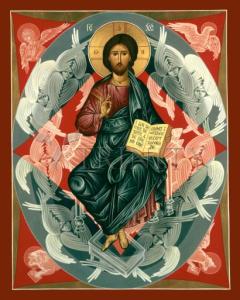 The Sunday after Theophany has as its Gospel reading the text from St Matthew 4: 12 – 17. There is a background for the day’s Gospel: Christ had been baptized in the Jordan River by St John the Baptist. Also, he had just returned from his victorious 40 days in the Wilderness.
Now after Jesus heard that John was arrested, he withdrew into Galilee. And upon leaving Nazareth, he went to dwell in Capernaum along the sea, in the region of Zebulon and Naphtali so that the word of Isaiah the prophet might be fulfilled, saying “The land of Zebulon and Naphtali, along the sea, across the Jordan, Galilee of the Gentiles, the people sitting in darkness saw a great light, and to those sitting in the region and shadow of death — light has dawned upon them (St Matthew 4: 12 – 17).
Regarding those sitting in darkness…in the region and shadow of death, it applied to those in Galilee. And, it applies to this darkened, depraved world today. These verses from St Matthew’s Gospel applied to us before we joined ourselves, and were joined to Christ and his Church by the actions of God working through the sacraments of the Church. We are now in union with his Light and Life.
Following the above verses, Jesus began his ministry.
After this Jesus began to proclaim and to say, Repent! for the Kingdom of Heaven has drawn near (St Matthew 4: 17).
The events that followed today’s reading tell of the call of the first four Apostles: Peter, Andrew, James, and John left their former lives and followed him. With this the company of the Apostles began to form. All those who would become the Apostles entered into Jesus’ ministry and teaching. Upon this, the apostolic faith of the Church is being established. Additionally, into this faith we, too, walk with Christ and his Church.
Next, let’s examine the epistle reading for the day. It applies to our walking in the ways of the apostolic faith:
But grace was given to each of us according to the measure of Christ’s gift. Therefore it is said, “When he ascended on high he led a host of captives, and he gave gifts to men.” (In saying, “He ascended,” what does it mean but that he had also descended into the lower parts of the earth? He who descended is he who also ascended far above all the heavens, that he might fill all things.) And his gifts were that some should be apostles, some prophets, some evangelists, some pastors and teachers, for the equipment of the saints, for the work of ministry, for building up the body of Christ, until we all attain to the unity of the faith and of the knowledge of the Son of God, to mature manhood, to the measure of the stature of the fulness of Christ (Ephesians 4: 12 – 17).
Why are spiritual gifts given? St Paul informs us that they are “for the equipment of the saints, for the work of the ministry, for building up the body of Christ until we all attain to the unity of the faith and the knowledge of the Son of God, to mature manhood, to the measure of the stature of the fulness of Christ. In a word, to do the work of God, that we may follow Christ more fully, and that Christ may be more fully formed in us, the Body of Christ.
We also have this from St Paul’s letter to the Ephesians:
For we are his workmanship, created in Christ Jesus for good works, which God prepared beforehand, that we should walk in them (Ephesians 2: 10).
To outline the Way of Christ in which, and by which we are to live we are given by our Lord the Beatitudes and the teachings from Sermon on the Mount:
Blessed are the poor in spirit, because the Kingdom of Heaven is theirs. Blessed are those who are mourning, because they will be comforted. Blessed are the meek, because they shall inherit the earth (or the land). Blessed are those who are hungering and thirsting after righteousness, because they shall be satisfied. Blessed are the merciful, because they shall obtain mercy. Blessed are the pure in heart, because they shall see God. Blessed are the peacemakers, because they shall be called the sons of God. Blessed are those who are persecuted for the sake of righteousness, because the Kingdom of Heaven is theirs. Blessed are you when men insult you, persecute you, and speak falsely all manner of evil against you for my name’s sake. Rejoice and be glad for your reward is great in heaven, for thus they persecuted the prophets who came before you (St Matthew 5: 3 – 12).
As these spiritual qualities and attributes are built up in us we have this reality established in us:
You are the light of the world. A city set on a hill cannot be hidden. Nor do men light a lamp and put it under a bushel, but on a stand, and it gives light to all in the house. Let your light so shine before men, that they may see your good works and give glory to your Father who is in heaven (St Matthew 5: 14 – 16).
So, let live by faith and do the works of faith. Let us have the spiritual qualities of the Beatitudes be worked into our lives. Let us become by faith with its struggles salt and light to this darkened and depraved world.
In Christ,
Fr Irenaeus
Walking Upright
Posted: December 2, 2025 Filed under: Etcetera, The Eucharist and Living the Eucharist | Tags: 1 Corinthians 4: 14 - 16, begotten of God, St Andrew the First Called, St John 1: 35 - 51, St Luke 13: 10 - 17, St Paul calls himself "Father", St Paul fathered the church of Corinth, the cursed serpent's realm, The healing of the bent over woman, The thematic focus of St John's Prologue 1: 11 - 13 1 CommentThe Gospel text for the 25th Sunday after Pentecost comes from St Luke 13: 10 – 17. From the text we read about the healing of a woman who was bent over double by a spirit for 18 long years. She was suffering due to the work of the enemy:
And he [Jesus] was teaching in one of the Synagogues on the Sabbath. And behold there was a woman who was having a spirit of weakness for 18 years, and she was bent over double and was unable to completely straighten up (St Luke 13: 10 – 11).
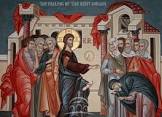 Her posture was bent down at an approximate angle of 90 degrees. Thus, her gaze was essentially always downward unless she inclined her head upward to see (and perhaps that was done with difficulty). She looked to the ground to the stones and dirt. Thus, her gaze was directed to decay: the earth and soil are made from the breakdown, or decay of stone and organic substances. She looked down upon the byproducts of death. Therefore, spiritually speaking, her gaze was set to the realm of the serpent:
The Lord God said to the serpent, “Because you have done this, [the deceiving of Eve] cursed are you above all cattle, and above all wild animals; upon your belly you shall go, and dust you shall eat all the days of your life (Genesis 3: 14).
Although the woman’s condition was a physical ailment the spiritual parallel is evident: Apart from Christ and a life of faith and repentance we are all bent over double with our eyes fixed upon the Serpent’s realm of decay and death. But Jesus intervened,
Upon seeing her, Jesus called and said to her, “Woman, you are released from your weakness.” And he placed his hands on her and immediately she straightened up and glorified God (St Luke 13: 12 – 13).
With this healing her gaze was in a forward direction. She now clearly saw our Lord and praised God for her healing. She could now look upon God’s creation around her, and look up to the heavens. She now moved and lived without pain.
So, we come to our spiritual condition — apart from Christ we are bent over double and gaze down upon death and decay; upon sin, darkness, and alienation. By being in Christ by faith and Sacrament we stank upright and can look upon him with the eyes of faith. But, when we look away from his ways and stray from him we have begun to be doubled over and gaze upon death and decay once more. But, we are given the Sacrament of Confession’s spiritual chiropractic treatment to set us straight again.
 Every year, on November 30, we also commemorate the Apostle Andrew — the First Called of the Apostles (St John 1: 35 – 51 is the Gospel text for his feast day). He too, as he walked with our Lord, was spiritually straightened up. In Christ, with Christ, and for Christ he gazed upon him and learned from him. He, together with the other apostles, gave us the Apostolic Tradition which has guided the Orthodox Church for 2,000 years.
By the Apostolic Tradition we are taught by the Scriptures and those who interpret them by this holy Tradition. This Apostolic Tradition gives us other gifts. We worship The Triune God in the Divine Liturgy and all the services of the Church. We enter into the Sacramental life of the Faith, especially by receiving the Body and Blood of our Lord in and by the Eucharist. We are given examples of godly, holy living by the lives of the saints. In the epistle set for the day, St Paul has written this for us:
I do not write this to make you ashamed, but to admonish you as my beloved children. For though you have countless guides in Christ, you do not have many fathers. For in Christ Jesus through the Gospel I begot [egenneesa] you. Therefore, I exhort you — become imitators of me (1 Corinthians 4: 14 – 16).
St Paul’s use of the verb translated begot / fathered can take us back to the Prologue of St John’s Gospel. The Prologue is found in the Gospel’s first chapter and consists of verses 1 – 18. These verses are constructed in a very specific way to lead us to the center and focus of the Prologue’s message:
Unto his own things [ta idia – the things of creation] he came, and his own [oi idioi – his fellow Jews] did not receive him. But as many as received him, he gave to them authority to become children of God, to those who believe in his name. They, not from blood, nor the from the will of the flesh or the will of a man, were begotten [egenneetheesan] from God (St John 1: 11 – 13).
These verses inform us that we are the children of God. We are the children of a spiritual family of faith. And as any family has defining appearances and characteristics, so are we to have defining spiritual characteristics that, for example, are found in the Beatitudes (see St Matthew 5: 1 – 12).
By being in Christ we stand up straight. We look forward to clearly see and follow along the path of Christ. Also, in addition to the Scriptures, we can take the guidance of the Apostles and the saints as we move confidently in the ways of the Apostolic Tradition which, in part, was set out by St Andrew the First Called.
Here is the corresponding sermon given at St Jacob of Alaska Orthodox Church in Bend, Oregon on 11/30/25:
In Christ,
Fr Irenaeus
Commemorating the Birth of Mary
Posted: September 10, 2025 Filed under: Etcetera | Tags: "For behold, Ezekiel 44: 1 - 4 and Mary's perpetual virginity, henceforth all generations will call me blessed, Mary is Queen Mother, Mary is the New Eve, Mary's obedience undoes Eve's disobedience, Mary's statement "I am not knowing a man", St Luke 11: 27 - 28, the Annunciation, the Birth of the Mother of God, The Nativity of the Theotokos, the perpetual virginity of Mary, the role of Queen Mother in the Ancient Near East Leave a comment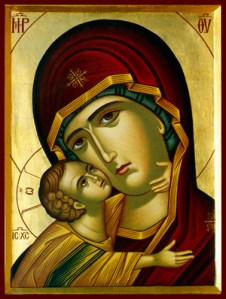 In the Orthodox Church, the birth of Mary, the Theotokos (which means God Bearer, or Mother of God), is celebrated every year on September 8. A hymn for the day’s liturgy reads,
By your nativity, O Most Pure Virgin, Joachim and Anna [Mary’s parents] are freed from barrenness; Adam and Eve from the corruption of death. And we, your people, freed from the guilt of sin, celebrate and sing to you: the barren woman gives birth to the Theotokos, the nourisher of our Life!
If you come from a Protestant background, the Church’s teaching regarding Mary may have presented many challenges to your Protestant sensibilities as you moved into the Church. Let’s tackle a few teachings for reinforcement. The subjects come from all the readings set for this day.
HER PERPETUAL VIRGINITY
One of the primary Old Testament sources of this teaching comes from Ezekiel 44: 1 – 4:
Then he brought me back to the outer gate of the sanctuary, which faces east; and it was shut. And he said to me, “This gate shall remain shut; it shall not be opened, and no one shall enter by it; for the Lord, the God of Israel, has entered by it; therefore it shall remain shut. Only the prince may sit in it to eat bread before the Lord; he shall enter by way of the vestibule of the gate, and shall go out by the same way” (Ezekiel 44: 1- 4).
The vision of Ezekiel has been interpreted by the Church in a typological / allegorical manner. The gate and vestibule, anatomically, refer to female reproductive anatomy.
Regarding the Archangel’s declaration to Mary:
And the angel said to her, “Do not fear, Mariam: For you have found grace with God. And behold, you shall conceive, and shall bear a son, and you shall call his name Jesus” (St Luke 1: 31).
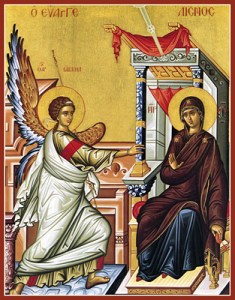
Icon of the Annunciation
Mary replies and questions the angel: “And Mariam said to the angel, ‘How shall this be, since I am not knowing a man [ginosko]?” (St Luke 1:34). The Greek verb in this passage, ginosko, is a verb in the present active tense, or aspect. Though this aspect, or tense, means the action is occurring in the “here and now,” it can also mean that the action is ongoing and has no intended ending, it keeps on going, or is continuous. Given the prophecy quoted above from Ezekiel, and its interpretation, the ongoing meaning best fits the translation to be, “I am not knowing a man” — she will never have sexual relations with Joseph. St Gabriel’s answer also refers back to the words from Ezekiel: “In answering, the angel said to her, ‘the Holy Spirit shall come upon you, and the Power of the Most High will overshadow you. Because the One being born of you shall be called the Son of God” (St Luke 1: 35). It is only the Son of God who has entered and exited her reproductive tract.
Regarding this first subject of discussion, we have Mary presented as the Ark of the Covenant in St John the Apostle’s vision on the island of Patmos:
And the Temple of God was opened in heaven, and the Ark of the Covenant of the Lord was seen in his Temple. And lightning, sounds, and thunder occurred, and great hail fell. And a great sign was seen in heaven, a woman clothed with the sun, and the moon beneath her feet, and upon her head a crown of twelve stars (Rev 11: 19 – 21:1).
Granted, these verses and the ones that follow can also refer to the Church. But St John writes in a manner in which any verse, or verses, he writes — even these verses examined are not an “either / or,” but a “both this and that.” Therefore, we can determine that he means both. Hence, she is the Ark of the Covenant and stands for the Church! Furthermore, the Ark of the Covenant could not be touched by just anyone. We read this from 2 Samuel (2 Kingdoms) 6: 6 – 7,
And when they came to the threshing floor of Nacon, Uzzah put out his hand to the Ark of God and took hold of it, for the oxen stumbled. And the anger of the Lord was kindled against Uzzah; and God struck him there because he put forth his hand to the Ark; and he died there beside the Ark of God (2 Samuel 6: 6 – 7).
Therefore and again, the strength of Ezikiel’s words and the translation of Mary’s statement, “I am not knowing a man,” is upheld as the Church has understood her place in our salvation.
Finally, regarding the matter of her perpetual virginity, we read from a portion of St John’s account of the crucifixion:
…But standing by the cross of Jesus were his mother, and his mother’s sister, Mary the wife of Clopas, and Mary Magdalene. When Jesus saw his mother, and the disciple whom he loved standing near, he said to his mother, “Woman, behold, your son!” Then he said to the disciple, “Behold, your mother!” And from that hour the disciple took her to his own home (St John 19: 25 – 27).
The point here is this — if Mary had another son of her own it would have been unlawful to put his mother into the care of St John. Jesus upheld and fulfilled the Mosaic Law. Thus, Mary had no other sons or children.
QUEEN MOTHER AND INTERCESSOR:
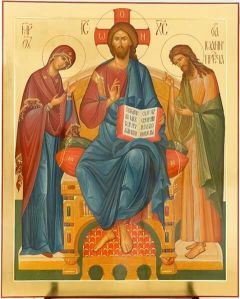 In the Ancient Near East (ANE) kings had queens, but their queens were not their wives. The queen in the ANE was the mother of the king — a queen mother. This was her job: to intercede before the king about his subjects’ concerns. This brings us to Bathsheba. She was a wife of King David. She was the mother of King Solomon. Therefore she was the queen mother. We read this concerning her role as intercessor to Solomon:
So Bathsheba went to King Solomon, to speak to him on behalf of Adonijah. And the king rose to meet her, and bowed down to her; then he sat on his throne, and had a seat brought for the king’s mother; and she sat on his right. Then she said, “I have one small request to make of you; do not refuse me.” And the king said to her, “Make your request, my mother; for I will not refuse you” (1 Kings / 3rd Kingdoms) 2: 19 – 20.
The antitype of Bathsheba is Mary. She is the Mother of the King of kings; Lord of lords. Thus, Mary is the Queen Mother of all queen mothers. We understand that she, like Bathsheba has a seat at our King’s right side. We see this in the Proskomede rite where bread and wine undergo preparation for the Divine Liturgy where they will become the Body and Blood of Christ. In this rite, a certain, small triangular shaped piece of bread is cut from a larger loaf. It is placed at the right side of a larger cube-shaped piece of bread called the Lamb (which will become the Body of Christ). By the words presented below and the action of the priest, the Church acknowledges her to be our Queen Mother:
In honor and memory of our most blessed Lady Theotokos and ever-Virgin Mary. Through her prayers, O Lord, accept this sacrifice upon Thy heavenly altar. The Queen stood on Thy right side, arrayed in golden robes, all glorious. (With these final words the triangular piece of bread is placed at the right side of the Lamb).
This next hymn presented is generally sung in the Divine Liturgy. It also declares our understanding of Mary’s intercessory role:
Steadfast Protectress of Christians, constant advocate before the Creator — despise not the entreating cries of us sinners, but in your goodness come speedily to help us who call on you in faith. Hasten to hear our petitions and to interceded for us, O Theotokos, for you always protect those who honor you!
THE NEW EVE AND THE ANNUNCIATION:
To understand this we must go back to the third chapter of Genesis (Genesis 3: 1 – 7). In the Garden we find the serpent (a spiritual being) who approaches Eve and deceives her. Eve eats of the forbidden fruit and disobeys the one and only commandment given to them by God. She gives the fruit to her husband. When he eats he capitulates, meaning he hands over their authority and power to the deceiving serpent. The cosmos is undone. Death via sin enters into creation. With sin and death come darkness and alienation. These are the results of Adam’s capitulation
So, for our salvation, we must have an undoing of the curse. A recapitulation must occur — the authority, power, and order lost must be regained. From here holiness, life, light, relationship must re-enter creation. The Archangel Gabriel (a spiritual being) approaches Mary (also a virgin as was Eve in the Garden before the Fall) in the Temple (which can be seen as the re-presentation of the Garden). St Gabriel addresses Mary: “Hail, who has been graced” (kecharitomene, a perfect, passive participle). The perfect tense, or aspect of a Greek verb means that an action occurred in the past, but the action continues into and beyond the present. Thus, Mary had been “graced’ long before this day: “Now when the fullness of time came, God sent his Son born of a woman (Galatians 4: 4). St Gabriel reveals God’s plan for our salvation. Mary replies, “Behold the handmaid of the LORD. May it be done to me according to your word” (Luke 1: 38). Mary’s obedience undoes Eve’s disobedience, and the core of the knot of sin and death is released. Now Christ enters her uterus by the Holy Spirit to become our Savior. He is the New Adam and recapitulation occurs!
We have a wonderful hynm, a Theotokion, near the beginning of the First Hour which pulls together all the themes discussed so far in this posting:
What shall we call you, O Full of Grace? Heaven — for you did shine forth the Sun of Righteousness; Paradise — for you have blossomed forth the Flower of Incorruption; Virgin — for you have remained incorrupt; Pure Mother — for you have held in your holy embrace a Son who is God of all. Beseech him to save our souls.
AN EXAMPLE FOR SPIRITUAL LIVING
Of course Jesus Christ is our one, true Examplar. But the Scriptures give other examples to imitate. We have, for example, St Paul: “I urge you, then, to be imitators of me” (1 Corinthians 1: 16). But, we also have Mary. Mary was the first to walk in the ways of Christ, and to walk along the paths of Christ by denying herself, emptying herself of self, and carrying Christ within her uterus. Thus, Mary was the first to receive Christ into her being and life in the most profound, complete, and unique way possible. A portion of the Gospel reading for this day reads,
And it happened while he was speaking these things, a certain woman from the crowd lifted up her voice and said to him, “Blessed is the womb which bore you, and the breasts which nursed you!” But, he said to her, “More than this [menounge], blessed are those who hear the word of God and keep it” (St Luke 11: 27 – 28).
The Greek word, menouvge, can be translated “on the contrary”, or “rather.” This translation of the word has been interpreted by Protestant traditions to be a negation of his mother — a put down. It is not a put down of his mother — he would not dishonor her — he upheld the Law. But, he with, “more this,” places those who keep the word of God in company with her. We, thus, are of the family of God if we, as did Mary, hear and keep God’s word.
So it is that we honor her and bless her! By doing so we keep the word of God when we read St Elizabeth’s words:
And when Elizabeth heard the greeting of Mary, the child leaped in her womb; and Elizabeth was filled with the Holy Spirit and she exclaimed with a loud cry, “Blessed are you among women, and blessed is the fruit of your womb! And why is this granted me? that the mother of my Lord should come to me?” (St Luke 1: 41 – 43).
Next, we have Mary’s reply to St Elizabeth. A portion of the Magnificat reads:
And Mary said, “My soul magnifies the Lord, and my spirit rejoices in God my Savior, for he has regarded the low estate of his handmaiden. For behold, henceforth all generations will call me blessed; for he who is mighty has done great things for me, and holy is his name” (St Luke 1:46 – 50).
We commemorate and celebrate the birth of Mary as we continue to bless the Mother of God — as has the Orthodox Church for all generations:
Your nativity, O Virgin, has proclaimed joy to the whole universe! The Sun of Righteousness, Christ our God, has shone from you, O Theotokos! By annulling the curse, he bestowed a blessing. By destroying death, He has granted us eternal life!
The following is a sermon given at Holy Resurrection Orthodox Church, Tacoma, Washington on September, 8, 2025:
In Christ,
Fr Irenaeus
The Account of the Rich Young Man
Posted: September 1, 2025 Filed under: Etcetera | Tags: Jesus and the Rich Young Man, Seek first the Kingdom of God, St Hilary of Poitiers commentary on the Rich Young Man, St Hilary of Poitiers on possessions and wealth, St Matthew 19: 16 - 26 Leave a comment
Jesus and the Rich Young Man
There is a saying: “comfort the afflicted; afflict the comfortable.” There are numerous passages from the Scriptures that can accomplish this goal. Today’s Gospel reading from St Matthew 19: 16 – 26 is one such passage: the account of the Rich Young Man (Ruler). He approaches Jesus and asks him, “Teacher, what good deed must I do to have eternal life?” (St Matthew 19:16). Concerning the young man’s spiritual condition, Jesus informed him of the one thing he must do,
“If you would enter life keep the commandments.” He said to him, “Which?” And Jesus said, “You shall not kill, You shall not commit adultery, You shall not steal, You shall not bear false witness, Honor your father and mother, and, You shall love your neighbor as yourself.” The young man says to him [Jesus], “All these things [the commandments of the Law of Moses] I have kept from my youth. What do I lack?” Jesus said to him, “If you wish to be complete, go, sell your possessions and give to the poor, and you will have treasure in heaven. And come, follow me.” But, the young man upon hearing the word went away grieved — for he had many possessions (St Matthew 19: 17 – 22).
Upon his sad departure we have commentary from our Lord:
Now, Jesus said to his disciples, “Truly I say to you, it will be difficult for the rich to enter into the Kingdom of Heaven. Again I say to you that it is easier for a camel to pass through the eye of a needle, than the rich to enter into the Kingdom of God” (St Matthew 19: 23 – 24).
His disciples were shocked by these words: “Who then is able to be saved?”. They ask this because it was thought that the wealthy had God’s favor, not the poor.
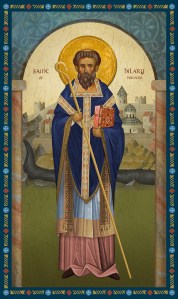
St Hilary of Poitiers
So what was at play within the heart and mind of the young man? St Hilary of Poitiers states this:
To possess things is not a crime; rather, the issue is about how one is supposed to preserve his possessions. How are we supposed to share, and how are we supposed to hold things in common if we do not relinquish those material things to be shared and to be held in common? It is, therefore, a worse crime to possess things for their own sake than [merely] to possess things. But it is a dangerous burden of being occupied with accumulating wealth.
St Hilary’s commentary regarding the state of the rich young man adds this: that he placed typical confidence in keeping the Mosaic Law. Thus, the young man could only understand the spiritual life in external, outward, even legalistic terms. He could not, and ultimately, would not grasp our Lord’s conditions for his discipleship and enter into the inner dimension of what was demanded by Christ. Again, his trust in the Law demonstrates this external orientation as does his inability to relinquish his material, external trust in who he was in Israel’s own external and legalistic understanding of spirituality and salvation.
So, what about this illustration of the camel and the eye of the needle? St Hilary explains in this way. Simply, this the camel is a “beast of burden,” and as such the camel’s burdens must be lifted off that me may become smaller. So it is to be with us. I quote St John the Baptist: “He [Jesus] must increase, but I must decrease” (St John 3: 30).
Once more, this is one of those sections from the Scriptures that should afflict the comfortable. As Westerners in this time in history, we are exceedingly wealthy when compared to other areas and eras of the world. We worry about our investments, properties, and possessions. If this is misplaced and becomes our focus, then we are likely in the same place as the rich young man.
I will ask three questions of us. Is our self identity wrapped up on monetary wealth, position in society, and other externals? What do we treasure to the extent that we may be unwilling to give them away to follow Christ more completely? And regarding our possessions — do we possess them, or do they possess us?
Jesus is to have the last word:
Do not lay up for yourselves treasures on earth, where moth and rust consume and where thieves break in and steal, but lay up for yourselves treasures in heaven, where neither moth nor rust consumes and where thieves do not break in and steal. For where your treasure is, there will your heart be also…But seek first his Kingdom and hi righteousness, and all these things shall be yours as well” (St Matthew 6: 19 – 21, 34).
In Christ,
Fr Irenaeus
The Scandalous Actions of the Unmerciful Servant
Posted: August 25, 2025 Filed under: Etcetera | Tags: 1 Corinthians 9: 2 - 12, blessed are the peacemakers, Christ indwells us, Elder Thaddeus of Vitovnika, humility and fasting, humility and obedience, humility and peacefulness, meekness and humility, obstacle and scandal, Parable of the Unmerciful Servant, Purity of heart, St Matthew 18: 23 -35 Leave a comment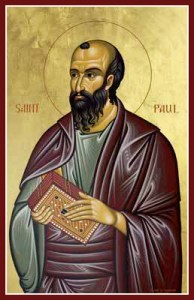 The subject matter of this posting concerns, in part, the Parable of the Unmerciful Servant found in St Matthew 18: 23 – 35 (the Gospel reading for the 12th Sunday of Matthew in the Orthodox Church). But, it is needed to first look at St Paul’s words from the days Epistle reading from 1 Corinthians 9: 2 – 12. The Corinthian church was a “problem child” for him. In these verses he reminds them that as an Apostle he has the right to earn a living from his apostolic ministry. He makes his case from the Old Testament:
For it is written in the Law of Moses [Deuteronomy 25:4], “You shall not muzzle an ox when it is treading out the grain.” Is it for oxen that God is concerned? Does he not speak entirely for our sake? It was written for our sake, because the plowman should plow in hope and the thresher thresh in hope of a share in the crop. If we have sown spiritual good among you, is it too much to reap your material benefits? If others share this rightful claim upon you, do not we still more? Nevertheless, we have not made use of this right, but we endure anything rather than put an obstacle in the way of the Gospel (1 Corinthians 9: 9 – 12).
To put up an obstacle, or hinderance is similar to causing a scandal. In the Scriptures a scandal means to create a cause for stumbling, a turning away from faith, or to be led into sin.
The Parable of the Unmerciful Servant tells of an occasion of scandalous behavior. We should all know the story. The servant of a king is called in to settle his debt with the king. The servant owes such a huge debt that it cannot be paid back, but he begs the king for mercy, and assures him he will be repaid. Out of pity for his servant he is released and forgiven the debt. However, the newly forgiven servant did not learn a lesson from his master. He comes upon a fellow servant who owes him money — a tiny fraction of what he owed the king. This wicked servant would not forgive his fellow servant’s debt and has him thrown into prison. The act of cruelty was witnessed by their fellow servants and was reported to the king. Jesus related the fate of the wicked servant:
In anger the king delivered this servant to the jailers till he should pay all his debt. So, also my heavenly Father will do to each one of you unless you forgive your brother’s sin from your heart (St Matthew 18: 34 – 35).
Of course, the big picture is that the extent of our sins is similar to the massive, unpayable debt of the unmerciful servant. Yet, through Christ, all is forgiven. Our debt is cancelled. Hence, as we move in forgiveness as did Christ our Savior, we must forgive others as we were forgiven by God.
More can be learned from this parable. The wicked servant did not exhibit either both mercy or humility. On the contrary, he exhibited pride and arrogance. These hideous traits brought about scandal and his own demise.
There are consequences for bringing about causes for stumbling and obstacles to the formation of faith and its continuation of formation in the Christian. Our Lord informs us:
Whoever humbles himself like this child, he is the greatest in heaven. Whoever receives one such child in my name receives me; but whoever causes one of these little ones who believe in me to sin, it would be better for him to have a millstone fastened round his neck and to be drowned in the sea. Woe to the world for temptations to sin! For it is necessary for temptations to come, but woe to the man by whom the temptation comes! St Matthew 18: 4 – 7).
It is good that our words and actions do not bring about obstacles to faith, or causes of stumbling into sin. St Paul advises this: “Avoid every appearance of evil” (1 Thessalonians 5: 22). Better it is that our words and actions draw people to the Faith:
You are the light of the world. A city set on a hill cannot be hidden. Nor do men light a lamp and put it under a bushel, but on a stand, and it gives light to all in the house. Let your light so shine before men, that they may see your good works and give glory to your Father who is in heaven (St Matthew 5: 14 – 16).
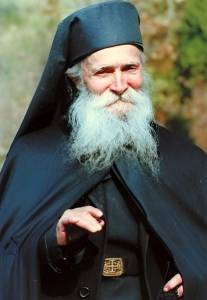
Elder Thaddeus
Christ, of course, is the Light of the World. He is Light and Life. He indwells us, so any light we shine has him as its source. The Beatitudes immediately precede those words of Christ (St Matthew 5: 1 – 12). Let’s look at three of these spiritual virtues. In so doing I will be quoting from Our Thoughts Determine Our Lives (St Herman of Alaska Brotherhood, 2009, 2022) which is a collection of the sayings of Elder Thaddeus of Vitovnika.
Meekness / Humility. “Blessed are the meek, for they will inherit the earth” (St Matthew 5:5). The Elder instructs us:
I had a desire to learn about the inner life of those who had lived a perfect life here on earth and who were glorified by God both here and in eternity. It was then that I realized, as the Holy Fathers themselves explained, that the perfection of the Christian life consist of extreme humility (p 87).
Meekness means having a heart that is humbled and peaceful…A proud person is never satisfied; everything bothers him, and he follows his own will. We must be obedient to the will of God in order to learn humility and meekness while we are still in this life, while there is still time. A heart that is full of love thinks not of itself, but of others. It prays for all living things and for the whole world (p 89).
The Elder makes the connection between humility and peacefulness:
When we can stay calm when someone attacks us from all sides, when we can keep our inner peace in spite of that person’s rudeness, then our soul will become meek and humble and we will live this life with a full understanding of it (p 88).
He makes a connection between humility and obedience:
Humility is a Divine property and the perfection of the Christian life. It is attained through obedience. He who is not obedient cannot have humility…Our humility is in proportion to our obedience (p 89).
There is a connection between humility and fasting:
When the body is humbled, our thoughts become more peaceful too. This is the purpose of fasting…It is impossible to unite with God when the stomach is full, for full stomach causes many cares and worries. All our thoughts, all our emotions, and all our will must be concentrated. When they are not, we are restless and lose our peace (p 136).
Peacefulness. “Blessed are the peacemakers, because they will be called the sons of God” (St Matthew 5: 9).
The Elder is asked what is the most important this in one’s spiritual life? He answers,
To guard the peace in our hearts. Do not let this peace be disturbed at any cost. Peace should reign in our hearts — peace and silence…practice standing before the Lord. This means being unceasingly aware that we are standing in the presence of the Lord and that He is watching us all the time. We must learn to awake with the Lord and go to sleep with Him, and eat, work, and walk with Him. The Lord is present everywhere in all things (pp 142 – 143).
Control of our thoughts is the key to such peace:
Our life depends on the kind of thoughts we nurture. If our thoughts are peaceful, calm, meek, and kind, then that is what our life is like. If our attention is turned to the circumstances in which we live, we are drawn into a whirlpool of thoughts and can have neither peace nor tranquility (p 63).
Purity of Heart. “Blessed are the pure in heart, because they will see God” (St Matthew 5: 8). From the Prayer of the Hours we read, “Sanctify our souls, purify our bodies, set aright our minds, and cleanse our thoughts.” Thus, our thoughts bring not only peace, but purity into our hearts, minds, and lives. With this said, we must understand that humility, peacefulness, and purity come from communion with God. The Elder states this,
Communion with God means that God has made His abode in us and that His energy is working in us. Our spirit puts on God and He governs all our feelings, our will, and our mind. We are then like a tool in His hands. He moves our thoughts, desires, and feelings and directs our words and the work of our hands (p 143).
Even though we are not as spiritually advanced as Elder Thaddeus, we now, in this hour, lack nothing. For Christ indwells us. The Holy Spirit and the Father indwell us. This is an ontological union and reality, and it exists in us all at this present hour. All we have to do is participate in his ways. We are participants in the divine nature, and it is active in us — if we so yield ourselves to his will and walk in his ways.
This brings us to the concept of theosis — the spiritual process of divinization where we become godlike. We do NOT become God, but godlike. We become the true image bearers of God we were, and are, intended to be from the moment of humanity’s creation. I offer the words of Archimandrite George Kapsanis,
All this [theosis], does not come about immediately. If an Orthodox Christian gradually struggles throughout his life with the Church, with humility, repentance, prayer, and the Holy Sacraments, by the Grace of God he may be sanctified and deified.
This, however, is the purpose and the great aim of our lives. How far we get is not the most important thing. What is important is the struggle itself, which God blesses abundantly, both in the present age and in the age to come.
As always I offer the very helpful words of St Paul which I, imperfectly, try to follow and by which conform my sinful life:
Rejoice always. Pray constantly. Give thanks in, with, and for all things for this is the will of God for you in Christ Jesus (1 Thessalonians 5: 16 -18).
Presented here is the corresponding sermon given at Holy Resurrection Orthodox Church, Tacoma, Washington on August 24, 2025:
In Christ,
Fr Irenaeus
Old LPs and New Discoveries
Posted: August 19, 2025 Filed under: Etcetera, Music and Guitars | Tags: ABBA, discovering new music and new experiences, LP collection, move out of your comfort zone, Robert Frost's "The Road Not Taken", The band Poco, Yogi Berra quote Leave a comment
Poco’s “Under the Gun”
It is quite possible that I am dating myself with this posting. For those far younger than me, and who listen to music via a digital streaming platform, I want you to know this is not always the method for playing recorded music (I could go on about smart phones, but I won’t do so). In my youth the only forms of recorded music were from vinyl LPs (standing for “long playing”), cassette tapes, and 8-track tapes (the latter being unbelievably annoying).
Recently, my wife and I inherited the bulk of my late brother-in-laws large collection of LPs. Some of them were purchased when he was a teenager. He continued to add to his collection for decades. I am now sorting through his collection, and I am selling the great majority of them on EBay. Some are in such bad shape that they must be tossed out. Others that are in sound condition we have kept, and those being the recordings of artists we know and, thus, are familiar with their music. Among his collection are artists and groups whose names and music are unknown to me. Concerning the mystery bands my initial plan was to sell every LP in good to excellent condition. However, as I continued in the process of listing them for sale, I began to become curious about them: “Why not research the bands and listen to them?”

Poco circa 1969 -70
Poco is one such band. My brother-in-law was obviously a huge fan of their music: he owned many of their recordings, even multiple copies of some of them. The band’s musical genre is a blend of country rock, pop rock, and folk rock. The original lineup of the band consisted of Richie Furay (from Buffalo Springfield), Jim Messina (later of Loggins and Messina), Randy Meisner (later of the Eagles), Rusty Young, and George Grantham. Their musical career began in 1969, and continues, it seems, to the present day. My wife and I remember two of their songs for the late 1970s: “Heart of the Night,” and “Crazy Love,” from the album “Legend.” My youngest son, now aged 28, began listening to Poco’s music, and is now himself a fan of their work. We have since kept several of their LPs which we now appreciate.
We are all creatures of habit: we gravitate to what we already know and of which we are familiar. We stick with the known commodity. We make choices based upon what has proven to be satisfying to us in the past. We frequent well proven restaurants, and order satisfying dishes from the known menus. We take the familiar route to a familiar destination. Additionally, when in church, I know where every person and family will likely position himself, herself, or themselves in the nave on any given Sunday morning.

Yogi Berra
But, it’s good to shift away from the habitual and seek new experiences. I have to urge myself to do so and seek sources of inspiration. Yogi Berra gave this advice, “When you come to a fork in the road — take it.” Robert Frost was a bit more precise (and I paraphrase his words in summary): “Take the road less travelled.” Even the Swedish pop band ABBA gave sage advice: “Take a chance on me!”
Life, especially the life of faith lived in Christ is to be a life of discovery. Discovery demands taking the road less travelled. Discovery and growth demand stepping boldly out of our comfort zones. Discovery and growth demand taking a chance from time to time. I return to Robert Frost’s poem, “The Road Not Taken,” and I quote from its ending: “…I took the one less traveled by, and that has made all the difference.”
The following link takes you to Poco’s “Crazy Love”: https://www.google.com/url?sa=t&source=web&rct=j&opi=89978449&url=https://www.youtube.com/watch%3Fv%3D8GY_orHl_sI&ved=2ahUKEwjUx4CUz5ePAxXXLTQIHdQ5Nt4Q78AJegQIFRAB&usg=AOvVaw02YJ5VjvjC0avdt-I0jC0K
In Christ who leads us along the way,
Fr Irenaeus
Overcoming Spiritual Paralysis
Posted: July 21, 2025 Filed under: Etcetera | Tags: Elder Thaddeus of Vitovnika, Overcoming Spiritual Paralysis, Spiritual Gifts in Romans 12: 6 - 13, St Matthew 9: 1 - 8, Take Control of Thoughts, Thinking About What Is Pure in Philippians 4: 8 Leave a comment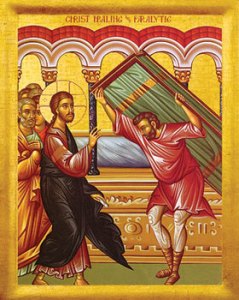 There are a number accounts of Jesus healing paralytics in the Gospels. In St Matthew 9: 1- 8 we read of such a healing. This miracle takes place after he casts our demons from two men in the region of the Gadarenes (St Matthew 8: 28 – 34). Our Lord crosses the water and comes to his own city, being Capernaum (St Matthew 9: 1). We then have this passage set for the day’s Gospel:
And behold, they brought to him a paralytic placed upon a cot. And seeing their faith, he said to the paralytic, “Take courage, child, your sins are forgiven you. And behold, certain scribes said among themselves, “This is blasphemy!” And Jesus knowing their thoughts said, “Why do you think such evil in your hearts? For what is easier to say, ‘Your sins are forgiven’: or to say, ‘Get up and walk?’ But, in order that you may know that the Son of Man has authority upon earth to forgive sins — then he says to the paralytic — “After you get up, take up your cot, and go to your home.” And after he got up he went to his home. Now, the crowd seeing this marveled, and they glorified God who gave such authority to men (St Matthew 9: 2 – 8).
Now I want to move from physical paralysis to the subject of a more common paralysis: spiritual paralysis. Here, one must also get up from a figurative cot, or sick bed, and then move into the life of faith, and acts of faith. This is the praxsis of faith.
What are the causes of a spiritual (or even a psychological) paralysis? The causes are numerous, but allow me to list a few. Could it be guilt? Fear? Regret? the experience of a rejection? A sense of worthlessness or unworthiness (no one is worthy — God acts through us in spite of us)? Could it be a habitual sin? Is it doubt of ability or a lack of “credentials?” — “Who am I to attempt to do that?” Any of these can result in confusion, or indecisiveness, and we are “crippled.” Then we have a spiritual paralysis which keeps us on the sick bed and out of action. In such a state one is like the foolish servant who hid his master’s talent. He made no use of it and received his master’s severe rebuke and loss of what he had (see St Matthew 25: 24 – 28).
We are all in some state of spiritual paralysis because we are sinners. We are in the hospital of the Church and Christ is our physician. But whatever our degree of such paralysis might be, we are to take to heart the words of our Lord as quoted above: “Take courage, child, your sins are forgiven you…After you get up, take up you cot, and go to your home.” Or we could say, “Get on with it!”
Perhaps this is too easy to state. We all have our personal histories which have produced memories that persist in our minds. Unpleasant and painful memories exist for all of us. A recollection from past history can be a source of torment. But, we must ask, “Where does the past exist?” It exists only in one place: in our minds!
Elder Thaddeus
Thus, we must order our thoughts and memories. They must be sorted and controlled. We are to take seriously this snippet of prayer from the Prayer of the Hours: “…Set aright our minds; cleanse our thoughts.” It needs to be stated that each one of us is the captain of our consciousness: we control our thoughts. Our monastic brothers and sisters will agree with that statement. Elder Thaddeus of Vitovnika wrote these words for our instruction:
Our life depends on the kind of thoughts we nurture. If our thoughts are peaceful, calm, meek, and kind, then that is what our life is like. If our attention is turned to the circumstances in which we live, we are drawn into a whirlpool of thoughts and can have neither peace nor tranquility.
When thoughts and memories that hinder and cripple us come into our minds — catch them and throw them away. Then, replace them with prayer (especially the Jesus Prayer), words from the Scriptures, and words of blessing. On top of this, we can throw away the disturbing thought and replace it by thinking of a task that needs to be done. To whatever we turn our minds, we are to be mindful of these words of St Paul:
Finally, brethren, whatever is true, whatever is honorable, whatever is just, whatever is pure, whatever is lovely, whatever is gracious, if there is any excellence, if there is anything worthy of praise, think about these things (Philippians 4: 8).
With all of this stated, let’s consider again these words of Jesus:
After you get up take up your cot and go to your home. And after he got up he departed to his home (St Matthew 9: 6 – 7).
The paralytic got on with his life now forgiven, whole, and complete. And so we are to act and begin our praxsis. We are to exercise the spiritual gifts given to us for the benefit of one another. St Paul encourages us with these words from the day’s appointed epistle reading:
Having gifts that differ according to the grace given to us, let us use them: if prophecy, in proportion to our faith; if service, in serving; he who teaches, in his teaching; he who exhorts, in his exhortation; he who contributes, in liberality; he who gives aid, with zeal; he who does acts of mercy, with cheerfulness. Let love be genuine; hate what is evil, hold fast to what is good; love one another with brotherly affection; outdo one another in showing honor. Never flag in zeal, be aglow with the Spirit, serve the Lord. Rejoice in your hope, be patient in tribulation, be constant in prayer. Contribute to the needs of the saints, practice hospitality (Romans 12: 6 – 13).
We are to act as God has gifted us. Furthermore, we are to understand who and what we are in Christ: We are “…to be a holy priesthood…” (1 Peter 2: 5). A priest bears God to all of creation by holy words and actions, and bears all creation to God by prayer. I offer one of my favorite axioms: “To become, we must do.” If we “get on with it” and act as the holy priest — the saint — we are to be, our efforts will be worked into us by the Holy Spirit.
Additionally, I offer another axiom: To prove God is to live God; to live God is to prove God. In other words, by acting according to the Faith, by living out the Faith before all and all things we make God evident in our lives and to others.
By overcoming spiritual paralysis, and by expressing our gifts through action, we can become a cause of marvel to all by the working of Christ within us.
The following is a corresponding sermon given 7/20/25 at St Brendan’s Orthodox Mission, Astoria, Oregon:
In Christ,
Fr Irenaeus
Possession and Control
Posted: July 15, 2025 Filed under: Etcetera | Tags: "Hail full of grace", demonic possession as a mockery of the Incarnation, Excorcism of the Gadarene Demoniacs, Greek perfect passive participle, self-control vs control of others, St Luke 1: 38 "Behold I am the handmaid of the Lord; let it be done to me according to your word Leave a comment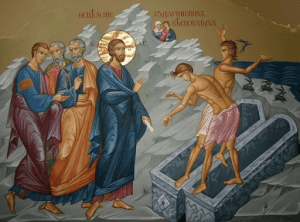 We read of Jesus exorcising two demon possessed men in the eighth chapter of St Mattew’s Gospel:
And when he came to the other side, to the country of the Gadarenes, two demoniacs met come, coming out of the tombs, so fierce that no one could pass that way. And behold, they cried out, “What have you to do with us, O Son of God? Have you come here to torment us before the time? (St Matthew 8: 28 – 29)
Jesus, of course, casts out the demons from the men, and the demons then enter into the nearby herb of swine. The now possessed swine run off a cliff and drown in the awaiting water (St Matthew 8:30 – 32).
Many Christian sources of all traditions state that demonic activities are increasing in western countries. Given the state of our culture, perhaps this is very true. As a priest in the Orthodox Church I have performed three exorcisms of homes. Those living in them came to me with the complaint of disturbing experiences encountered over an extended period of time. The power and authority of God removed the disturbing sources of their troubling experiences. Thankfully, I have had no other such experiences — yet.
Returning to the above gospel account, and all such occurrences, it could be stated that the possession of a human by a demon is a mocking of the Incarnation. I will present my case by the following brief contrasts.
The holy Incarnation came about by Mary’s obedient consent to God’s plan for the Incarnation presented to her by St Gabriel:
Behold, I am the handmaid of the Lord; let it be done to me according to your word (St Luke 1: 38).
A demon possession likely does NOT come about by consent. Though the person possessed may have been steeped in wicked and depraved practices.
In stark contrast Mary was steeped in faith and obedience to the One True God, for she was prepared for this most holy service long before the day of the Annunciation: “Hail, full of grace, the Lord is with you!” (St Luke 1: 28). The Greek phrasing is, literally, “…having been graced…” and is a translation of the verse’s perfect passive participle. The use of such a verbal tense means an event or action took place in the past, but the effect of the action continues into the present. Thus again, God’s preparation of Mary occurred long before St Gabriel’s greeting, and long before her birth.
The Incarnation occurred for our salvation which has love — God’s love — as its source.
The demon possesses for the destruction of the person. It is done out of hatred and contempt. Not only hatred of humanity is its source, but their hatred is extended to the entirety of material creation. Hence, also the destruction of the herd of swine. They fell to their death. Death is the realm of Satan and his demons:
The LORD said to the serpent, “Because you have done this cursed are you above all wild animals; upon your belly you shall go, and dust you shall eat all the days of your life” (Genesis 3: 14).
Dust is the product of death and resulting decomposition.
Christ is all powerful: He calms storms, heals diseases, and raises the dead. We read of his power and authority:
And Jesus came and said to them, “All authority in heaven and on earth has been given to me” (St Matthew 28: 18).
The power and works of Satan and demons but a forgery or immitation however convincing they may appear. They have a limited power and authority unlike Christ.
From the service of Baptism — the Second Exorcism — we have this excerpt which explains their limited strength:
Come out of the man, and in nowise enter a second time into him: Depart! Acknowledge the vainness of your might, which has not power even over swine…
These enemies are neither omniscient, nor omnipresent.
Christ is in us by our consent arising from our faith in him. He acts within us only by our invitation, and his actions which lead to our sanctification.
The demon controls without consent as a vile, defiling tyrant. The demon hijacks the will and desires to take the possessed to their destruction.
I now shift gears and move to the subject of control. The desire to control exists in contrast to the desire to influence, exhort, or encourage. I use to words influence, exhort, and encourage when such words and actions address the true need to direct someone to proper decisions and good conduct which would lead to a healthy, wholesome outcome.
Control: The only proper control is self-control. This is a disciplining of the self, of the will, for the gain of goodness, holiness, health, etc. The human attempt to manipulate and control another human being is a parallel to demonic possession. We have observed,
The controlling spouse
The controlling parent
The controlling child
The controlling and abusive bully
The manipulative controlling employer or supervisor
The controlling co-worker
All such control is for self-gain and the attaining of power over another human being. It is never for the well being of another. Hence, it is demonic! Hence, there needs to be an exorcism of repentance!
How we are to act with one another? St Paul gives us many examples. I present two such examples from his epistles:
Now we urge you brethren, to warn the idle, encourage the faint-hearted, help the weak, and to be patient with all. Do not repay evil for evil, but always pursue the good both for one another and for all. Rejoice always. Pray constantly. Give thanks in, with, and for all things for this is the will of God for you in Christ Jesus (1 Thessalonians 5: 15 – 18).
Put on then, as God’s chosen ones, holy and beloved, compassion, kindness, lowliness, meekness, and patience, forbearing one another and, if one has a complaint against another, forgiving each other; as the Lord has forgiven you, so you must also forgive. And over all these put on love, which binds everything together in perfect harmony. And let the peace of Christ rule in your hearts, to which indeed your were called in the one body. And become thankful. Let the word of Christ dwell in you richly, as you teach and admonish one another in all wisdom, and as you sing psalms and hymns and spiritual songs with thankfulness in your hearts to God. And whatever you do, in word or deed, do everything in the name of the Lord Jesus, giving thanks to God the Father through him (Colossians 3: 12 – 17)
May the Holy Trinity’s love guide and indwell in us that we may influence, exhort, and encourage one another to the gain of purity and salvation.
In Christ,
Fr Irenaeus
Sanctification Under Our Rooves
Posted: July 11, 2025 Filed under: Etcetera, The Eucharist and Living the Eucharist | Tags: 1 Thessalonians 5: 15 - 24, becoming god-like, becoming whole and complete, divination, experiencing God, The centurion's confession of faith in Mt 8: 5 - 13, The Centurion's faith, Theosis Leave a commentSANCTIFICATION UNDER OUR ROOVES
In the sixth chapter of his letter to the Church in Rome, St Paul notes the contrasts between their lives before coming to faith in Christ and their lives after faith and baptism in Christ. The contrast shows their previous lives as Roman pagans bound them as slaves to sin, but their union with Christ binds them as slaves to righteousness (Romans 8: 18). St Paul continues,
When you were slaves of sin, you were free in regard to righteousness. But, then, what return did you get from the things of which you are now ashamed? The end of those things is death. But, now that you have been set free from sin and have become slaves of God, the return you get is sanctification and its end, eternal life (Romans 8: 20 – 22).
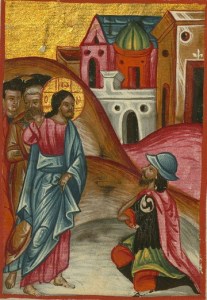 Sanctification, or the attainment of holiness, is the primary theme of this posting. But, I present a slight detour: the Fourth Sunday of St Matthew’s Gospel readings informs us of the faithful Centurion who approaches Jesus asking that he heal his servant who is paralyzed and is suffering terribly (St Matthew 8: 5 – 6). Jesus agrees to heal the servant. The Centurion then says these words to our Lord:
Upon answering, the Centurion said, Lord, I am not worthy that you should enter under my roof, but only say the word and my servant shall be healed (St Matthew 8: 8).
Jesus marvels at his answer and says, “Truly I say to you, not even in Israel have I found such faith (St Matthew 8: 10).

St Photini
“I am not worthy!” No one is worthy. No one is ever worthy of the salvation and grace given to us by Christ. In the Gospels we find example after example of the unworthy whom Christ called, healed, showed mercy, and to whom he extended his salvation and holiness. We can recall the woman with an ongoing menorrhagia who unworthily was healed by touching the hem Jesus’ garment. We read of the unworthy and sinful tax collectors who were called by Jesus to follow him (Matthew the Apostle and Zacchaeus who became a bishop). We know the sinful and unworthy Samaritan woman who entered into our Lord’s renewing, life-giving water — she would become an evangelist and martyr whom we know as St Photinia. We are to remember St Peter who said, “Depart from me, for I am a sinful man, O Lord!” St Luke 5: 8b).
There are numerous others, and we are to count ourselves among them, for we too are unworthy sinners who can echo the Centurion’s words: “I am not worthy that you should enter under my roof!” Isn’t it the case that we hesitate to have people come to our homes because of accumulated clutter, dirty dishes in the sink, or the miraculous breeding of “dust bunnies” in the unswept corners? In spite of the fact that the maid never shows up to tidy up for us, our Lord already knows the condition both of our homes and our souls. More importantly, he is not afraid of the situation of our “interior domestic environment.” He is ready to go to work to clean us up and make us a fitting habitation for his presence in our lives — no matter how many cleanings it takes.
No one is ever worthy, but we must ready ourselves for the work that he will do in our lives — the works of sanctification of purification. “Blessed are the pure in heart, for they shall see God” (St Matthew 5: 8). The Beatitudes — the listing of spiritual attributes — are not to be seen as lofty, unattainable ideals. Rather, they are all to be worked into us as evidence of the sanctifying work God is to be doing in our lives — if we allow this work to be done.
I continue with the subject of sanctification, especially those who came from a Protestant tradition where we first encountered Christ. While a student at a Protestant seminary, I took a course on the writings and theology/soteriology of Martin Luther. In one of his works he wrote this to describe our spiritual state as he understood it: “We are piles of dung covered over with pure snow.” For him, that was the Christian’s condition, apparently to be understood to be static, unchanging. Orthodoxy sees the picture differently: We are piles of dung covered by pure snow which is to penetrate the dung and transform it to a top soil which is to bring forth the Fruits of the Spirit (see Galatians 5: 22 – 24).
Luther was quite nuanced, but the majority of Protestants understand salvation to be in essence a juridical pronouncement of innocence: When Jesus took upon himself the penalty of our sins, it was to declare our legal innocence before God the Father. This is for the Protestant what is called justification. The problem is that this can become an abstraction where sanctification is optional. Most Protestants properly deny this, but the constructed bifurcation of salvation between justification and sanctification is not easily resolved. Salvation can become static and reduced to a bumper sticker: “Christians aren’t perfect, they are simply forgiven.” Our Lord tells us the opposite: “You, therefore, must be perfect (or whole / complete) as your heavenly Father is perfect (whole / complete)” (St Matthew 5: 48). This is why St Paul gives us this from his letter to the Philippians: “…work out your own salvation with fear and trembling; for God is at work in you, both to will and to work for his good pleasure” (Philippians 2: 12b – 13). This does not mean we earn our salvation by works of the Law, but we are to cooperate with God’s working in our lives so that the pure snow of salvation transforms us into valuable top soil which, in turn, produces the Fruits of the Spirit.
This brings us to the salvific model of theosis. Theosis — this process of salvation — means that we human sinners become god-like. We do NOT become God, just god-like. Divinization is a process of purification. It is an ongoing spiritual work of the Holy Spirit to restore us to be pure and true image bearers of God.
As a process there are steps to be taken as we “work out our own salvation with fear and trembling.” In his book Theosis: the True Purpose of Human Life, Archimandrite George Kapsanis informs us of the required conditions and steps for engaging this process. The first is humility (which is an ongoing process itself):
Thus, the beginning of the path towards theosis is humility, i.e., the acknowledgement that the purpose of our life is outside ourselves, and that it is with our Father, our Maker and Creator. Humility is likewise needed to see that we are sick, that we are full of weaknesses and prey to passions (p. 43).
The next he outlines is the need for asceticism:
The Holy Fathers also tell us that theosis proceeds in stages, from the lowest to the highest. Once we have acquired humility [a process itself] we embark, with repentance and much patience, on the daily struggle in Christ, putting into practice His holy commandments in order to cleanse ourselves from the passions (p. 44).
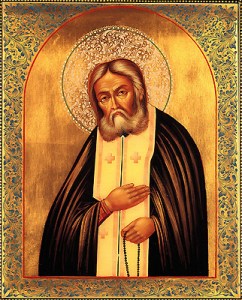
St. Seraphim of Sarov
The Archimandrite tells us that there are three parts of the soul to be cleansed of the passions: 1) the intellect which is cleansed by a watchfulness and guarding of the mind where we are “keeping the good thoughts and rejecting the bad” (p. 47). We are to understand that we are the captains of our consciousness, and we are to take every thought captive that would bring damage to our souls. 2) The passionate part of the soul is cleansed by love. 3) “Finally, the desiring part is cleansed by self-control” (p. 44). Self denial is to take place. We are to deny ourselves excessive food and drink, and other sensual activities which could bring harm to us.
The third requirement involves participation in the life of the Church, the Holy Sacraments of Confession and the Eucharist. Both Sacraments cleanse us, but the Eucharist additionally gives us Jesus’ victory over sin, darkness, alienation, and death when we consume his Body and Blood. Then, also, the prayers of the Church — primarily the Jesus Prayer which we can employ in any setting: “Lord, Jesus Christ, Son of God, have mercy on me a sinner.”
None of here today at Holy Resurrection Orthodox Church are monastics [where the sermon was given]. We do not have such a calling, though some present may be called to that in the future if it is God’s will. But, we can enter into this process of theosis in our “secular lives” at home, school, work, or the market place. Acknowledging this fact Archimandrite George offers this to the non-monastic Christian:
This [theosis], however, is the purpose and the great aim of our lives. How far we get is not the most important thing. What is important is the struggle itself, which God blesses abundantly, both in the present age and in the age to come (p.57).
In conclusion St Paul offers this regarding sanctifying activities, and God’s pledge to bring about our sanctification and purification:
See that no one repays evil for evil, but always pursue the good both for one another and for all. Rejoice always. Pray constantly. Give Thanks in, with, and for all things for this is the will of God for you in Christ Jesus. Do not restrain the Spirit; do not despise prophecy. Test all things; hold fast the good, avoid every appearance of evil. Now, may the God of peace himself sanctify you completely, and keep your spirit, soul, and body sound and blameless in the presence of our Lord Jesus Christ. the one who is calling you is faithful, and he will do this (1 Thessalonians 5: 15 – 24).
The following is the corresponding sermon given 7/6/25:
In Christ who calls us to sanctification,
Fr Irenaeus
Regarding Poppies
Posted: June 12, 2025 Filed under: Etcetera | Tags: numbering our days, Psalm 51, Psalm 90, Psalm 90: 12, the passing of vitality, the symbolism of an orange poppy, wisdom of heart Leave a commentPsalm 90 / LXX 89 is attributed to Moses, and it addresses humanity’s mortality, but that of all creatures as well:
You sweep men away; they are life a dream, like grass which is renewed in the morning: in the morning it flourishes and is renewed; in the evening it fades and withers (Psalm 90/89: 5 – 6).
 On my property we have quite a variety of trees, fruit trees, flowering bushes and fruit-bearing bushes, and flowers. My wife and I observe them as we and they go through the seasons of each year. Of course throughout the spring they are renewed and flourish with blossoms, but then they fade and fall away to the ground. Of this process of nature, none seems more dramatic than that of the poppy.
Poppies are of the botanical Papaveraceae family. They are found throughout the Northern Hemisphere and in varied climates and terrains. This flower is full of symbolic significance. The symbolism, or meaning, attached to the poppy varies according to its color. The more famous red poppy is taken to signify remembrance, sacrifice, and honor — especially of those who died in battle. But, other colors bring other meanings to the flower.
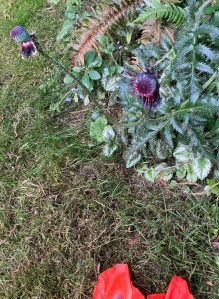 In one of our garden areas we have orange poppies which are associated with enthusiasm, creativity, and vitality. Their striking, bold color and size grab my attention, and almost every year I photograph their beauty. Then the brilliant, beautiful petals fall to the ground quite quickly, seemingly overnight. Their petals fall to the ground with only their seed pods remaining on the stems while their petals begin to decompose. Their vibrant orange color, again, represents enthusiasm, creativity, and vitality. The poppies’ brief span of vitality reminds me of how brief our lives’ enthusiasm, creativity, and vitality can be.
I turn again to Psalm 90/89:
…Our years come to an end like a sigh. The years of our life are threescore and ten, or even by reason of strength fourscore; yet their span is but toil and trouble; they are soon gone, and we fly away (vv 9 – 10).
Nearer its beginning this Psalm offers these sobering words:
You turn man back to the dust, and say, “Turn back, O children of men!” For a thousand your in your sight are but as yesterday when it is past, or as a watch in the night (vv 3 – 4).
Our short lives have their seasons. The enthusiasm, creativity, and vitality of youth change as we age: They mature and, hopefully, age well like wine. This will occur if we walk in the ways of Christ and mature in him, and as we cultivate our relational union in him. We are to abide by faith and sacrament in Christ while we also abide in his Church. Thus, as move through the seasons of life with him, I believe these words of David can assist us if we take them into our hearts and make them into a prayer:
Behold, you desire truth in the inward being; therefore teach me wisdom in my secret heart…Create in me a clean heart, O God, and put a new and right spirit within me. Cast me not away from your presence, and take not your Holy Spirit from me. Restore to me the joy of your salvation, and uphold me with a willing spirit (Psalm 51/50: 6, 10 – 12).
So, keep the poppy in mind (and our fate as well) as we read this: “So teach us to number our days that we may get a heart of wisdom” (Psalm 90/89: 12).
In Christ,
Fr Irenaeus
Contending for the Faith
Posted: June 3, 2025 Filed under: Etcetera | Tags: 1 John 1: 1 - 4, 1 John 2: 22 - 24, Acts 20: 28 -32, alchemy, ancient heresies, biological alchemy, definition of antichrist, immutability of sex, Jesus' High Priestly Prayer, Jude 3 - 5, Rev 2: 2- 5, sexual identity, St John 17: 1 - 13, St John 1: 1, Synod of the Bishops of the Orthodox Church in America, The Church of Ephesus, The Council of Nicea I, The First Ecumenical Council Leave a commentCONTENDING FOR THE FAITH
 The seventeenth chapter of St John’s Gospel contains what is commonly called the High Priestly Prayer of Jesus. Its themes contain the prayers of the priest who is about to offer a sacrifice to God. Such prayers contain four elements: glorification, remembrance of God’s saving works, intercession for those for whom the sacrifice is made, and then declaring the sacrifice itself. In this chapter it is, of course, Jesus himself who is both the High Priest and the Offering. (It is interesting to note that these same elements of priestly prayer are found the the Anaphora — the prayers that precede the bloodless sacrifice of praise — of the Eucharist.)
The Seventh Sunday of Pascha commemorates the First Ecumenical Council which dealt with the Arian Heresy in the fourth century. The Gospel reading for the day comes from St John 17: 1 – 13, and in these verses he prays for the Apostles:
I have manifested your name to the men whom you gave me out of the world; they were yours, and you gave them to me, and they have kept your word. Now they know that everything that you have given me is from you; for I have given them the words which you gave me, and they have received them and know in truth that I came from you; and they have believed that you sent me…And now I am no more in the world, but they are in the world, and I am coming to you. Holy Father, keep them in your name, which you have given me, that they may be one, even as we are one (St John 17: 6 – 8, 11).
The Apostles are those chosen by Jesus, and who have heard and have kept Jesus’ words, and witnessed his Resurrection. Though not present with Jesus at this time, St Paul is counted among them, and he too was also a keeper and guardian of the Apostolic Faith. St Paul knew of the dangers and the threats that would come to the leaders of the Church and the Apostolic Faith. St Luke recorded his words in these verses:
And from Miletus he sent to Ephesus and called to him the presbyters of the Church…Take heed to yourselves and to all the flock, in which the Holy Spirit has made you guardians, to feed the Church of the Lord which he obtained with his own blood. I know that after my departure fierce wolves will come in among you, not sparing the flock; and from among your own selves will arise men speaking perverse things, to draw away the disciples after them. Therefore be alert…And now I commend you to God and to the word of his grace, which is able to build you up and to give you the inheritance among all those who are sanctified (Acts 20: 17, 28 – 32).
St Paul called them to proclaim and defend the Faith of the Church. Yet, a generation later, while in exile on the island of Patmos, St John records Jesus’ words to its leaders:
I know your works, your toil and your patient endurance, and how you cannot bear evil men but have tested those who call themselves apostles but are not, and found them to be false; I know you are enduring patiently and bearing up for my name’s sake, and you have not grown weary. But I have this against you, that you have abandoned the love you had at first. Remember then from what you have fallen, repent and do the works you did at first (Revelation 2: 2 – 5).
It is clear that the Apostolic Faith is not only doctrine and dogma, but also consists of works of love.
Heresies and apostasies plagued the early Church and they do in our day. St John the Apostle battled against gnostic heretics, and others who denied the physical aspect of our Lord. To the gnostics the material existence of Christ was both disgusting and meaningless. St John addresses the incarnational reality of Christ with these words, and declares his authority and that of his fellow Apostles:
That which was from the beginning, which we have heard, which we have seen with our eyes, which we have looked upon and touched with our hands, concerning the Word of Life — the Life was made manifest, and we saw it, and testify to it and proclaim to you the eternal Life which was with the Father and was made manifest to us — that which we have seen and heard we proclaim to you, so that you may have fellowship with us; and our fellowship is with the Father and with his Son Jesus Christ. And we are writing this that our joy may be complete (1 John 1: 1 – 4).
Though gnosticism in its original form was defeated, heretics and heresies continued, especially in the person of the false bishop Arius. He taught that Jesus was a created being — he, too, thought it impossible that God could take on human flesh. He denied the Apostolic teaching that the Son and the Father are consubstantial — that they are of the same essence. St John would call Arius an antichrist:
Who is the liar but he who denies that Jesus is the Christ? This is the antichrist, he who denies the Father and the Son. Anyone who denies the Son does not have the Father. He who confesses the Son has the Father also. Let what you heard from the beginning abide in you. If what you heard from the beginning abides in you, then you will abide in the Son and in the Father (1 John 2: 22 – 24).
St John states that the one who denies the unity of being of the Father and the Son is an antichrist. One cannot have the Father without having the Son; one cannot have the Son without having the Father. St John teaches us of this unity of being — the same essence of being — in his Gospel: “In the beginning was the Word, and the Word was with God, and the Word was God (St John 1: 1).
So, we come to the First Ecumenical Council. Its first paragraph puts forward the essential declaration of the Apostolic Faith which itself affirms the teaching of St John as noted above:
I believe in one God, the Father Almighty, maker of heaven and earth, of all things visible and invisible. And in one Lord Jesus Christ, the only-begotten Son of God, begotten of the Father before all ages; Light of Light, true God of true God, begotten not made, of one essence [homooousion] through whom all things were made…
The Orthodox Church has confronted and overcome other pernicious heresies since then: those who denied the deity of the Holy Spirit; the Nestorians; the monophysites; the monothelites; the iconoclasts and more. Unfortunately, those ancient heresies still manifest themselves today in various forms, and they still bring about damage to humanity. Thus, we all have to be vigilant in our days. St Jude, the brother of James wrote these words to the Church:
Beloved, being very eager to write to you of our common salvation, I found it necessary to write appealing to you to contend for the faith which was once for all delivered to the saints. For admission has been secretly gained by some who long ago were designated for this condemnation, ungodly persons who pervert the grace of our God into licentiousness and deny our only Master and Lord, Jesus Christ (St Jude 3 – 4).
When the one, holy, catholic and apostolic faith is proclaimed boldly the Light of Christ shines out in the darkness and calls people to the Church. These days the Orthodox Church is growing, and growing, and growing. We see it locally and it is occurring throughout this country, and throughout the world. I read of an Orthodox parish, Church of the Twelve Apostles, in Hatfield, Hertfordshire, England where nearly 200 people were baptized this past Lazarus Saturday (the Saturday before Palm Sunday)!
I return to the subject of contending for the faith. It is not just the clergy who are to contend for the faith — it is every Orthodox Christian. In our days, though theological heresies and errors abound, it appears the greatest and most damaging errors involve sexual immorality and sexual identity. The Synod of Bishops of the Orthodox in America made this standing declaration in 2022:
The Orthodox Church teaches that the union between a man and a woman in marriage reflects the union between Christ and his Church (Eph 5). As such, marriage is by this reflection monogamous and heterosexual. Within this marriage, sexual relations between a husband and wife are an expression of their love that has been blessed by God. Such is God’s plan for male and female, created in his image and likeness, from the beginning, and such remains his plan for all time…
That said, the Holy Synod of Bishops expresses its pastoral concern and paternal love for all who desire to come to Christ and who struggle with their passions, temptations, and besetting sins, whatever those might be. The Church is a hospital for the sick; Our Lord has come as a physician to heal those who are ailing. Imitating our Savior, who stretched his arms wide on the Cross, we welcome with open arms all who desire the life of repentance in Christ.
We call upon all clergy, theologians, teachers, and lay persons within the Orthodox Church in America never to contradict these teachings by preaching or teaching against the Church’s clear moral position…We reject any attempt to create a theological framework which would normalize same-sex erotic relationships or distort humanity’s God-given sexual identity (Statement on same-sex relationships and sexual identity July 21, 2022).

St. George
With this stated by our bishops, I wish to state this about the present confusion regarding sexual identity. Let me state this clearly: God loves all, and every human bears the image of God. Thus, all are to be treated with respect and appropriate compassion. Let me also state this clearly: a male remains a male and this biological fact cannot be changed; a female remains a female and this biological fact cannot be changed. The chromosomal makeup of male and female is unalterable. Every mention of changing sexuality by drugs or surgery is simply this: biological alchemy. The first alchemists of centuries ago tried to alter base metals into a more precious state. Also, many sought out immortality apart from the eternal life only offered by God. Again, as tin cannot be made into gold, a boy or man cannot be made into a girl or a woman, and a girl or a woman cannot be made into a boy or a man. The practitioners of alchemy in the ancient times, and those of the following Medieval and Renaissance eras the were frequently drawn into the occult and the demonic. So it is today with the present practitioners of biological alchemy — they promote and practice the anti-human and anti-life teachings of demons which lead only to mutilation, sterility, and despair! Furthermore, the practice of such biological alchemy does not lead to the betterment of mental health for the altered victim, but to even greater despair and the continued potential for suicide. I quote from The Journal of Urology, September, 2021:
Rates of psychiatric emergencies are high both before and after gender affirming surgery. Although both the phalloplasty and vaginoplasty patients have similar overall rates of psychiatric encounters, suicide attempts are more common in the later. In fact, our observed rate of suicide attempts in the phalloplasty group is actually similar to the general population, while the vaginoplasty group’s rate is more than double that of the general population.
When confronted by the teachings of the apostles of depravity, know that in confidence we can turn to the teachings, wisdom, and life of the Orthodox Church to guide us. We are to proclaim the one, holy, catholic and apostolic faith in both truth and love. I quote St Innocent of Alaska:
As we labor in the vineyard of the Lord, let us remember that our primary task is to bring the light of Christ to those who are in darkness. The Gospel is a message of hope, redemption, and eternal life. It is our duty to share this message with all people, regardless of their background or circumstances, and to do so with a spirit of humility and compassion.
The following is the corresponding homily:
In Christ,
Fr Irenaeus
Icons, Veneration, Presence, and Contact
Posted: March 10, 2025 Filed under: Etcetera, The Eucharist and Living the Eucharist | Tags: iconodules, icons offer contact to the spiritual realm, Icons offer presence, reverence of icons, Sunday or Orthodoxy, the Iconoclastic controversy, Triumph of the Church over iconoclasm, veneration of icons is not idolatry Leave a commentChrist Enthroned
The Sunday of Orthodoxy is the first Sunday of Lent. This is an annual commemoration of the triumph of the Orthodoxy Church over the heresy of iconoclasm. Iconoclasm involved the destruction of the icons of the Church. Those who destroyed icons were called iconoclasts, or “icon breakers.” Those who preserved and defended the Church’s use of icons were the iconodules, meaning “venerators of icons.” This controversy lasted over 120 years, and it wasn’t pretty.
For non-Orthodox Christians, and even some Roman Catholics this is no big deal: Icons are not found in, for example, Protestant churches. Protestant history involved, and still is involved in some form of iconoclasm. Here, they are foreign, and are objects of suspicion. Hence, Orthodox Christians are accused, falsely, of idolatry.
For several years now, there has been thousands of conversions to the Orthodox Church. Those who begin to explore the Church have many questions. Among them are questions about icons. Protestant objections to icons and their purpose in the Orthodox Church must be explained. Let me be clear: Orthodox Christians do NOT worship icons. We do not worship wood and paint. We worship only the Triune God: Father, Son, and Holy Spirit. St John of Damascus explains this point for us:
Concerning the charge of idolatry: Icons are not idols but symbols [in ancient understanding, the symbol contains within itself that which is symbolized], therefore when an Orthodox venerates an icon, he is not guilty of idolatry. He is not worshipping that pictured, but merely venerating it. Such veneration is not directed toward wood, paint or stone [mosaics], but towards the person depicted. Therefore, relative honor is shown to material objects, but worship is due God.
Icons…protect the full and proper doctrine of the Incarnation. While God cannot be represented in his eternal nature [his essence]…He can be depicted simply because he took on human flesh. Of him who took a material body, material images can be made. In so taking a material body, God proved that matter can be redeemed. He deified matter, making it spirit-bearing, and so if flesh can be a medium for the Spirit, so can wood and paint, although in a different fashion.
I do not worship matter, but the Creator of matter, who for my sake became material and deigned to dwell in matter who through matter effected my salvation.
Venerate and veneration are not commonly used words. A definition is put forth. When someone is venerated, respect and honor are shown to the person. The act of veneration of an icon is done by making the Sign of the Cross before, bowing toward it, and then kissing the icon (generally the right hand of the one depicted in the icon).
 Recently, a young Protestant man visited St Nicholas Orthodox Church in Tacoma, Washington. He was troubled by these actions and asked me to explain them to him. I used the illustration of a young child and a photograph of her grandfather. Such a young child may kiss the photo of her grandfather. She is expressing her love for the man; she is not worshipping him. Even at a young age she knows that the photograph is not her grandfather, but, simply, his image presented to her by the photograph. Again, she is expressing her love for him. In like manner, an Orthodox Christian’s veneration of an icon shows one’s love for the person presented to him, or her, by the icon.
I used purposefully the word presented. The one depicted by the icon, whether Christ, his Mother, or a saint, is presented to the one venerating the image. Its presentation offers presence. When Christ is depicted by an icon there is a sacramental presence of him which is offered to the one who venerates his icon. It involves a touch-point: the love and honor expressed by the act of veneration is passed along to Christ. There is a spiritual communication from the material of the icon to Christ himself, or to anyone presented by an icon.
Let me develop this idea with another illustration. I am writing this posting using, of course, the word processing program of my computer. To access this program, I touched the “icon” which presents the program to me. I have accessed the electronic workings of the program. So, as with the computer icon, so it is analogous with the icon of Christ: I have a point of contact with him, and my honor and love are passed on to him in this sacramental manner of contact.
Note the two tears under the eye.
This sacramental, or spiritual, communication is not just a one-way road. Christ and his saints, especially Mary his Mother, communicate to the faithful via their icons. These communications are understood as miracles. For example, at St Anne Orthodox Church in Corvallis, Oregon (where I have served the Diving Liturgy many times), an icon of Mary brought forth a physical, liquid tear from her left eye. This event was captured by a photograph which is placed next to the actual miraculous icon.
Let me add this. Quantum physicists tell us that an electron, or some part of an atom (which is material), can occupy two places at once, and have some degree of communication across this separation in space and time. Furthermore, that which is spiritual and that which is material are not separated from each other in some dualistic existence as taught by some theologians and philosophers from past centuries. Rather, the spiritual and the material are in constant communication, contact, and in continual relationship with each other. Thus, we can understand the Sacraments and sacramental objects such is icons.
In conclusion, reality is not confined to the explanations offered by philosophers, false prophets, naturalists, and materialist. And I can’t resist…I quote Cat Stevens, “Oh baby, baby, it’s a wild world!”
In Christ who became matter for our salvation,
Fr Irenaeus
That We Might See
Posted: January 19, 2025 Filed under: Etcetera | Tags: Colossians 3: 12 - 16, Healing of the blind man of Jericho, Prayer Before the Gospel Reading, Proper spiritual clothing, Spiritual Sight, St Luke 18: 35 -43, St Marcarius the Great of Egypt Leave a commentIn every Divine Liturgy, before the Gospel reading, The Prayer of the Holy Gospel is read:
Illumine our hearts, O Master who loves mankind, the pure light of your divine knowledge, and open the eyes of our mind that we may comprehend the proclamations of your Gospels. Implant in us also reverence for your blessed commandments so that, having trampled down all carnal desires, we may lead a spiritual life, both thinking and doing all those things that are pleasing to you. For you, Christ our God, are the illumination of our souls and bodies, and to you we offer up glory, together with your Father, who is without beginning, and your all-holy, good and life-creating Spirit, and and forever and to the ages of ages.
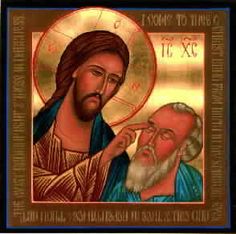 The Gospel reading for January 19, 2025 relays the account of the healing of the Blind Man of Jericho. The text comes from St Luke 18: 35 – 43. Jesus is on his way to Jerusalem, and he passes through Jericho. There is a blind man sitting along the way, and he is begging. He hears the crowd coming to him, and asks what is happening. The crowd informs him that Jesus is passing by with his disciples. A portion of the narrative reads,
Those going before him rebuked him so that he might be silent. But he cried out all the more, “Jesus, Son of David, have mercy on me!” Jesus stood and ordered him to be brought to him. And as he was drawing near, he asked him, saying, “What do you want me to do for you?” And he said, “Lord, that I might see!” And Jesus said to him, “See. Your faith has saved you.” And immediately he had sight, and he followed him glorifying God. And all the people seeing [this] gave praise to God (St Luke 18: 39 – 43).
As the text reads, with his regained sight he followed Jesus and gave glory to God. Hopefully, he was also now following with an illumined heart and with the eyes of his mind opened to walk along the path that leads to salvation. With such spiritual sight, and being led and empowered by the Holy Spirit, one will not wander from the path required by Christ:
Enter by the narrow gate; for the gate is wide and the way is easy that leads to destruction, and those who enter by it are many. For the gate is narrow and the way is hard that leads to life, and those who find it are few (St Matthew 7: 13 -14).
With such new, spiritual sight, we also need new and proper clothing for this journey with Christ. But first, we must discard improper clothing, clothing unfit for walking along the narrow path: “…and seeing that you have taken off the old man with his practices…put on the new man who is being renewed in knowledge after the image of his Creator”…(Colossians 3: 9 – 10). Thus, we see the need for a new wardrobe. From the day’s epistle reading St Paul tells us what we are to be wearing as we follow Christ:
Put on then, as God’s chosen ones, holy and beloved, compassion, kindness, lowliness, meekness, and patience. Forbear one another and if one has a complaint against another, forgiving each other; as the Lord has forgiven you, so you must also must forgive. And over all these put on love, which binds everything together in perfect harmony. And let the peace of Christ rule in your hearts, to which indeed you were called in the one body. And, become thankful. Let the word of Christ dwell in you richly, as you teach and admonish one another in all wisdom, and as you sing psalms and hymns and spiritual songs with thankfulness in your hearts to God (Colossians 3: 12 – 16).
Let me list the articles of clothing we are to wear: compassion, kindness, lowliness, meekness, patience, forbearance, forgiveness, love (as an overcoat), the peacefulness of Christ, and thankfulness.
There is a saying, “The clothes make the man.” How are these new clothes to be put on, or better, worked into our lives to make us the man, or woman, of God? The suit is put on by doing, or practicing, them. I offer a favorite axiom: “To become, you must do.”
Therefore, with renewed sight and new holy garments, we must have a new volition — a will that the Holy Spirit can use to accomplish our sanctification. St Macarius the Great of Egypt informs us:
For those truly believing in Christ, it is necessary to change and transform the soul from its present degraded nature into another, divine nature, and to be fashioned anew by the power of the Holy Spirit…He grants to everyone’s free will the grace of the Holy Spirit, which operates in an individual and directs the life of all who yearn to be saved.
I repeat the axiom: “To become, you must do.” We put on these garments of light and life by choosing to “do” them. As we choose and “do” these garments, these virtues will be worked into our souls — into our very being — by the Holy Spirit. These holy clothes will be seen and recognized by those who observe them when displayed by our lives of faith.
In closing, I present this prayer which is found near the conclusion of the First Hour:
O Christ, the True Light that enlightens and sanctifies every man that comes into the world, let the light of your countenance be signed upon us, that in it we might behold the Unapproachable Light. Guide our footsteps in the keeping of Your commandments, by the prayers of your most pure Mother and of all your saints. Amen.
The following is the corresponding sermon:
In Christ,
Fr Irenaeus
Gear Review of Two Yoke Capos: Shubb Fine Tune Royale F1g VS D’Addario Cradle Capo
Posted: January 1, 2025 Filed under: Etcetera, Music and Guitars, The Eucharist and Living the Eucharist | Tags: D'Addario Cradle Capo reviewed, Review of Shubb Fine Tune F1 yoke capo vs D'Addario Cradle Capo, Shubb Fine Tune F1 capo reviewed, varieties of guitar capos, Yoke-style guitar capos reviewed Leave a commentAs I have reviewed a number of capos over the years I have learned a good deal about them. The primary lesson learned is that not all capos are alike. There are capos of inferior and superior design. I have found that a good capo is determined by its design — specifically how a given capo applies pressure on the strings to the fretboard.
There are functionally four styles of capos:
-
- Strap and Toggle Capos. A strap or toggle using an elastic strap is wrapped around the guitar’s neck to apply the downward pressure on the strings.
- Trigger / Spring Capos. This class of capo is likely the most commonly used capo. A spring mechanism applies the needed downward pressure. With the trigger and spring capos there is the additional lateral pressure which brings the strings out of tune.
- Adjustable Screw Capos. This style offers a “clasping” mechanism for attachment to the neck. After application, a screw is tightened to apply direct square pressure onto the strings.
- Yoke Capos. These are very similar to the adjustable screw capos. They have an arm which is released for application to the neck. This style, too, is tightened by the screw to supply pressure on the strings. The yoke style offers direct, square pressure on all strings.

Top: Shubb Fine Tune Royale F1g, Bottom: D’Addario Cradle Capo
As the title states, I will compare two yoke-style capos: the Shubb Fine Tune Capo Royale F1g, and D’Addario’s Cradle Capo. I add the manufacturers’ claims and descriptions for both capos.
Shubb Fine Tune Royale F1g:
…We are confident that it is the most accurate capo in the world…it can remain on the guitar (behind the nut) when not in use.
Its innovative adjusting knob makes it the most ergonomic screw-operated capo. The knob maintains a fixed relationship with the frame, for improved ease of use, and for the lowest profile when stored behind the nut. The knob’s six surfaces are numbered, providing a visual reference to more easily and accurately reproduce your ideal pressure. Greater contact area between screw, frame, and knob ensures that the fit will never become loose and sloppy. Specially developed rubber padding adds resilience to the capo’s closing action for finer control, and being absolutely inert, it will not mark an instrument. Improved jeweler’s style latch prevents accidental opening. Carefully machined to the closest thread tolerance.
D’Addario Cradle Capo:
Even tension. Always ready…With its stainless steel, self-centering design, the Cradle Capo ensures even tension across the fretboard. Its adjustable micrometer lets you dial in the perfect pressure, while allowing the freedom for quick transitions and the ability to stay on the guitar, even when not in use.
Hypothesis: Given identical design and mechanism I posit that both capos will offer near identical tuning stability as well (as no string buzzing). A two-tail T-test will be used to “objectively” test my hypothesis. Both T and P values will be presented for assessment. The meaning of both values will be explained.
Material and Methods: I put the capos to the test on three different guitars. The same Snark “Super Tight” electronic tuner is used for all testings. All three guitars were tuned to standard tuning. Each capo was placed sequentially on frets 2, 5, and 7 on all three guitars. All six stings were plucked to assess tuning stability. Each guitar was retuned before repositioning each capo at the above mentioned frets. Any “distuning” caused by the capos was noted for each capo at each position (on all six strings) by the number of “minute” increments (flat and/or sharp noted by, for example, -1 for flat, or +2 for sharp) from the “12 o’clock” (the “in tune” position) on the tuner. There were a total of 108 testings. Also, both Rainsong guitars possess the N2 style neck.
Results: Here are the results in terms of total “distuning minutes” at all three fret positions (again 2, 5, and 7).
Rainsong N-JM1100N2 (Nashville Series) acoustic jumbo:
Shubb: +8 (at fret 2 = +1, 5 strings in tune; fret 5 = +3, 3 in tune; fret 7 = +4, 2 in tune)
D’Addario: +8 (at fret 2 = +1, 5 strings in tune; fret 5 = +4, 2 in tune; fret 7 = +3, 3 in tune)
Rainsong BI-JM1000N2 (Black Ice Series) acoustic jumbo:
Shubb: +11 (at fret 2 = +2, 4 strings in tune; fret 5 = +4, 2 in tune; fret 7 = +5, 1 in tune)
D’Addario: +12 (at fret 2 = +4, 2 strings in tune; fret 5 = +4, 2 in tune; fret 7 = +4, 2 in tune)
Paul Reed Smith (PRS) SE Starla solid body electric:
Shubb: +6 (at fret 2 = +2, 4 strings in tune; fret 5 = +2, 4 in tune; fret 7 = +2, 4 in tune)
D’Addario: +16 (at fret 2 = +3, 3 strings in tune; fret 5 = +6, none in tune; fret 7 = +7 none in tune)
Total “minutes” sharp:
Shubb: +25 of 54 total string position testings
D’Addario: +36 of 54 total string position testings
T = – 1.94: This states that a moderate difference exists in tuning stability between the two yoke-style capos. My hypothesis that there would be no tuning difference is to be rejected.
P value = 0.054: For a proven statistical difference, the P value has to be </= 0.05. The value of 0.054, though it approaches statistical significance, only indicates that the difference in tuning stability shows a “trending” to a superior tuning stability. Thus, it also informs me that I am to reject my hypothesis.
Discussion and Conclusion:
First, neither yoke capo caused any string buzzing at any position tested. Given the difference in the number of “sharp minutes” between the two yoke capos, I am to conclude that the Shubb Fine Tune Royale F1g capo shows a trend to be moderately superior to the D’Addario Cradle Capo in terms of tuning stability.

The winner: Shubb Fine Tune Royale F1g
What, then, might explain this trend? The “rubber / plastic” material that comes in contact with the strings is identical in width (7 mm). Their lengths differ by 1.0 mm, (Shubb 48 mm, D’Addario 49mm). Subjectively, the density of the rubber material feels the same. Could weight cause the difference affecting results? The Shubb capo weighs 38 grams while the D’Addario capo weighs 23 grams. I am uncertain about the significance of this difference. The only other variable that could explain this difference could be the tightening mechanism which presses upward from the back of the neck: the Shubb mechanism feels more sturdy, and likely offers a more secure pressure.
Given the two yoke-style capos, I will choose to use the Shubb Fine Tune Royale capo on my guitars. Both capos are more expensive than any of the other varieties of capos noted above: Shubb = $80 – 85 (Shubb direct purchase); D’Addario = $69.99 (Reverb), but as it is said, “You get what you pay for,” if you find it necessary to add either capo to your gear bag.
Keep on playing!
Fr Irenaeus
Every Good and Perfect Gift
Posted: December 24, 2024 Filed under: Etcetera, The Eucharist and Living the Eucharist Leave a comment Near the conclusion of every Divine Liturgy is “The Prayer Before the Ambo.” A portion of it reads, “For every good gift and every perfect gift is from above, coming down from you, the Father of Lights.” This, of course, has as its source St James 1: 17.
Gifts and gift giving are part of the Christmas tradition, but any gift given by a human being to another pales in comparison to the Gift that is truly good and perfect which came down from the Father of Lights, that is his gift of Jesus:
For God so loved the world that he gave his only-begotten Son, that whoever believes in him should not perish but have eternal life (St John 3: 16).
The Father’s Gift, his Son, is God of God, Light of Light, true God of true God, begotten not made, of one essence with the Father.
Gifts are to give delight, joy, and gratitude. That is certainly the case when one thinks of a gift given from a parent, spouse, or friend. Yet, isn’t it also the case, though, that such gifts are generally and eventually forgotten. They are no longer valued, and ultimately discarded.
“For every good gift and every perfect gift is from above, coming down from you, the Father of Lights.” However, some gifts that may come from the Father of Lights may not be received by us initially with delight, joy, and gratitude.
Can a good and perfect gift from the Father of Lights be difficult to receive with delight, joy, and gratitude? The answer is, yes. But, the wisdom of faith must alter our perspective and perception. With the eyes of faith and wisdom a difficult and troubling gift can be received into one’s heart. I recall two such gifts. One was very challenging, the other was less difficult to receive, but both gifts permanently changed my life for the better.
During the Fall of October, 1997 I received a challenging and harsh gift. I was working as a clinical pharmacist at a hospital located in south King County in Washington State. For much of my life I had a problem with anger. Occasionally, such anger flashed for a moment and then receded. But in one case, anger exploded. I was, rightly, called on the carpet. I was suspended without pay for five days, then had to have repeated counseling sessions for an indefinite time. My first reaction was to reject this gift. I applied for another position at another area hospital. I justified myself not realizing that anger, once and for all, had to dramatically diminish in my life. St James informs us:
Know this, my beloved brethren. Let every man be quick to hear, slow to speak, slow to anger, for the anger of man does not work the righteousness of God (St James 1: 19 – 20).
But, while I was suspended and grumbling, I received a message: “Submit, then you will have victory.” And, so I did. And, of course, I entered into victory — the monster was reduced to a tiny mouse (well, in my case, at least a modestly sized rat). The counseling sessions came to an early end. Relationships were mended, and I moved through the rest of my time at this hospital with joy and humor.
The second gift also occurred while working at the same hospital in May, 2002. I had just completed my seminary education. During this time I sensed an inconsistency in my life. I had discovered the Eucharist and embraced it whole heartedly. But, I was missing something: What I had in my head had not yet moved truly into my heart. I did not yet receive all things into my being with thanksgiving.
The day was beautiful in the morning sun. As I was walking from my car to the hospital, I asked God to help connect my head to my heart. For some reason I had to work in the central pharmacy with all of its given challenges. It was an exceptionally stressful day. The phones were ringing off their hooks. I felt the tension and stress all others felt. The phone by my desk rang and and I engaged the surrounding irritation. But, another message came my way: “Say thank you!” I said thank you for the annoying phone call which was a gift in disguise. At the other end of the phone was the most annoying nurse in the hospital. I listened to her express her trouble. I went to the medical floor she worked on and solved her problem. Not only was the problem solved, but my attitude about her changed — she suddenly became “delightful”, or as close as she could be to this state of being. My head and heart were united by this gift’s insight to the Eucharist (which means thanksgiving) — I am to give thanks for all things, circumstances, and people.
With this spiritual insight, all events, situations, and people — however difficult — can be received as gifts from the Father of Lights. Even, pain, illness, etc., can be received as gifts, and the power of prayer and thanksgiving transforms them to empowering gifts. We have this instruction from St Paul to his spiritual son, Timothy:
For everything created by God is good, and nothing is to be rejected if it is received with thanksgiving, for it is consecrated through the word of God and prayer (1 Timothy 4: 4 – 5).
All things, thus, can be seen as gifts from the Father of Lights. For all matters and circumstances that come our way, I present words for St Paul by which I try to live every day. I use them to guide me that I might walk in the ways of our Lord:
Rejoice always. Pray constantly. Give thanks in, with, and for all things; for this is the will of God for you in Christ Jesus (1 Thessalonians 5: 16 – 18).
And so it is Christmas! We have prepared ourselves once more to receive the Divine Infant — the Good and Perfect Gift from the Father of Lights into our hearts. We do this so that Jesus can be formed within. Thus, all things can be seen as gifts for the Father of Lights. All such gifts when received from the Father of Lights with gratitude will further form Christ in us, so that we might bear Christ into all settings of life. If we do this, then every day will offer a touch of Christmas!
Christ is born! Glorify him!
Here is an abbreviated homily that corresponds to this posting:
In Christ, and in every good and perfect gift from the Father of Lights,
Fr Irenaeus
Your Neighbor is Here, There, and Everywhere
Posted: November 11, 2024 Filed under: Etcetera, The Eucharist and Living the Eucharist | Tags: living the Beatitudes, loving your neighbor as yourself, Parable of the Good Samaritan, spiritual bandages and medicines Leave a commentThis posting examines the parable of the Good Samaritan which is found in St Luke 10: 25 -37. It begins with a dialogue between Jesus and an expert in the Mosaic Law.
The lawyer tests Jesus: “What must I do to inherit eternal life?”
Jesus in reply (also testing him): “What is written in the law? How do you read it?”
The lawyer gives his reply: “You shall love the Lord your God with all your heart, with all your soul, with all your strength, with all your mind, and your neighbor as yourself.
Jesus: “You have answered correctly. Do this and you shall live.”
The lawyer, wishing to justify himself, asks, “And who is my neighbor?”
 We now move to a brief summary of the parable. As we all know, those who occupy a similar religious office as the lawyer, are cast as the villains because they ignore and pass by the injured man in need of rescue. Then Jesus gives a twist to the plot; the hero is an unexpected and despised — in the mind of the lawyer — Samaritan who stops to help to the man.
The despised Samaritan exhibits compassion: He binds his wounds, and also medicates the wounds with oil and wine. He then takes him to an inn for further care, and extends the care of the injured man with his own money to compensate the innkeeper.
The epistle reading that accompanies the Gospel reading from St Luke comes from Galatians 1: 11 – 19. The subject is St Paul’s calling to be an Apostle. From Galatians 1: 15 – 16 we read this: “But he who set me apart from my mother’s womb, and had called me through his grace, revealed his Son to me that I might preach the Good News of him to the Gentiles.” He was set apart, and called to be an Apostle and given a defining ministry that continues for us to this day.
Though we are not called to be an Apostle as he, the 12, and the 70 were called, we have a calling! In his first epistle, St Peter writes,
But as he who called you is holy; be holy yourselves in all your conduct; since it is written, “You shall be holy, for I am holy (1 Peter 1: 15 – 16).
St Paul informs us of our ministry that results from our baptism — a ministry of works of faith. Regarding works that arise from faith in Christ, St Paul informs us of this in Philippians 2: 12b – 13:
Work out your own salvation with fear and trembling; for God is at work in you, both to will and to work for his good pleasure.
He writes this as well in his letter to the Ephesians:
For by grace you have been saved through faith; and this is not of your own doing, it is the gift of God — not because of works, lest any man should boast. For we are his workmanship, created in Christ Jesus for good works, which God prepared beforehand, that we should walk [peripataesomen] in them (Ephesians 2: 8 – 10).
When St Paul uses the word walk it is to be understood that it refers to how a Christian is to be conducting his / her life, and how we are to conform our thoughts and actions to match and imitate Christ. Essentially, as the lawyer correctly notes, “We are to love our neighbors as ourselves.”
I pose a question: Where do we find our neighbor? As Sir Paul might answer, they are here, there, and everywhere. The walking wounded are all around us — here, there, and everywhere.
What are our bandages, oils, and wines? Before I offer my attempt to answer this question, let me put forward this admonition from St Paul, “Now, I urge you brethren, to warn the idle…” (1 Thessalonians 5: 14). With this, let the focus be on spiritual idleness. There is a saying: “Comfort the afflicted; afflict the comfortable. Also, there are times we need to be lovingly disturbed in a way to move us more deeply into the ways of Christ. However, we are to cause no one and no thing distress by acting or speaking out of anger, irritation, or annoyance. Rather, you and I are to seek to relieve the distress of others, and all things, by living according to the Beatitudes:
The Beatitudes — they are not given by Christ to be spiritual ideals — they are to be embodied. They are to be worked into our lives by living them. As per one of my favorite axioms: We must do to become.
I return to my question posed above. What are our bandages and medicines? The are love, kindness, prayer, mercy, humility, giving assistance (among many other treatment options). Yes, even smiling can provide a soothing balm.
Do this, and we shall live!
In Christ,
Fr Irenaeus
The Healing of the Demoniac of Gadarenes and Advice for the “Last Days”
Posted: October 31, 2024 Filed under: Etcetera, The Eucharist and Living the Eucharist | Tags: Are we in the Last Days?, Healing of the Gadarene Demoniac, spiritual preparations for difficult and troubling times, St Hilary of Poitiers' commentary of St Matthew 14: 22 - 33 Leave a comment St Luke’s Gospel tells of the casting out of demons (“Jesus then asked him, ‘What is your name?’ And he said, ‘Legion’; for many demons had entered him”, St Luke 8: 30) from a possessed man who lived in a predominantly Gentile region called the Gadarenes. We read about his condition:
Then they arrived at the region of the Gadarenes which is opposite of Galilee. And as he stepped out onto the land, there met him a man from the city who had demons; for a long time he had worn no clothes, and he lived not in a house but among the tombs…For many a time it had seized him; he was kept under guard, and bound with chains and shackles, but he broke the bonds and was driven by the demon into the desert (St Luke 8: 26, 27, 29).
Even in this hideous condition he bore the image of God. The demons hated him. They humiliated him, physically harmed him, and gave him an unnatural, terrible strength. He was tormented by these evil beings who desired to destroy him.
This can be seen as a spiritual parallel for our days. If not outright possession of some, there is a horrific demonic influence taking place in much of popular culture and secular society. In these days, and those days that may be coming for us, just as Christ came to set the possessed man free, so we must ask Christ to more completely free us from the corruption and darkness of sin that remains in us. We must shun every form of evil (“Perverseness of heart shall be far from me; I will know nothing of evil” (Psalm 101/100: 4). And, as the liberated man was clothed and in his right mind, let us more completely be clothed in Christ and have his mindset. As the Prayer of the Hours asks of God, so let us ask, “…Sanctify our souls, purify our bodies, set aright our minds, and cleanse our thoughts.”
 In these days, these challenging and troubling days I turn to the words of St Hilary of Poitiers’ commentary on St Matthew’s account of Jesus walking on the waters of the Sea of Galilee (St Matthew 14: 22 – 33). This miracle occurs immediately after the Feeding of the Five Thousand. Jesus tells his disciples to cross to the other side while he spends time alone in prayer. But the disciples struggle greatly in the crossing being buffeted by wind and waves. At the fourth watch of the night, Jesus comes to them on the water. He calms the wind and waves. The disciples are delivered from potential shipwreck and death.
St Hilary takes the focus of this miracle to Last Days. (However, the Incarnation ushered in the Last Days.) He sees the disciples’ struggles paralleling the struggles of the Church. He writes,
In the fourth watch of the night, the Lord came, for it was at that point be returned to an errant and foundering Church. In fact, in the fourth watch of the night is an appropriate number that represents his concern. The first watch is that of the Law, the second of the prophets, the third of his bodily advent, so the fourth is in his glorious return. But will he find the Church exhausted and buffeted about by the spirit of Antichrist and by all the world’s troubles? For he will come especially to these who are anxious and in anguish. Because it is typical of the Antichrist to harass by using every new kind of temptation, they will panic at the Lord’s coming, fearful of the false and insidious images of things which deceive the eyes. But the good Lord will immediately speak to them, drive away their fear, and say, “It is I,” banishing their fear of a certain shipwreck with faith at his coming.
Once the Lord boarded the boat, the wind and sea became calm, which indicates the peace and tranquility of the Church eternal after his return in glory. And because he will come manifested to all, the entire world will rightly be amazed and declare: “Truly he is the Son of God.” For then the confession of all humanity will be both unqualified and public. Now the Son of God will appear no longer in the humility of the body but in his heavenly glory, having restored peace to the Church.
Again, the Church has been in the “Last Days” since the Incarnation. Where are we today? Are we approaching or in the final chapter, or perhaps a trial run? I do not know. I do know that we find ourselves buffeted by the raging of the world system and its powerful — both seen and unseen. I do know that at all times we are to hold firm to Christ as the Church and as individual Christians. I do know that as we reach out to Christ he comes to us. I do know that we must be in preparation at all times to be in the presence of our Lord. We are to live a life of faith.
In these times I offer terse advice:
Be aware. Be in prayer. Prepare. Do not despair.
Offered, too, are these words of St Paul:
Do not repay evil for evil, but always pursue the good both for one another and for all. Rejoice always. Pray constantly. Give thanks in with and for all things, for this is the will of God for you in Christ Jesus. Do not restrain the Spirit. Do not despise prophecy. Test all things, and hold fast what is good. Avoid every appearance of evil. Now, may the God of peace himself sanctify you completely; and your spirit, soul, and body be kept sound and blameless in the presence of our Lord Jesus Christ. The one who calls you is faithful, and he will do this (1 Thessalonians 5: 15 – 24).
 Finally, consider the Eucharist — for which we must prepare, and in which Christ himself is present. Christ again gives himself to us in and by his Body and Blood. He calls us to himself to receive him in and by his Body and Blood of Holy Communion. Having prepared ourselves we come to receive our Lord. We are not to come mindlessly to the Chalice, but with faithful intent to receive his cleansing and forgiveness, his Light and Life, and the calming of any storm we may be experiencing. By the Eucharist we receive into ourselves — into every part of our being — the Existing One who conquers for us. Glory to Christ our Lord!
Here is the link to the corresponding sermon:
In Christ,
Fr Irenaeus
The Seventh Ecumenical Council and Being an Icon
Posted: October 14, 2024 Filed under: Etcetera, The Eucharist and Living the Eucharist | Tags: Being an icon, humans are living icons, humans bear the image of God, iconoclast, iconodules, Icons declare the Incarnation, Orthodox Christians venerate icons, Orthodox Icons are not idols, St John of Damascus, the Seventh Ecumenical Council, venerating icons Leave a commentThe seventh ecumenical council was convened in 787 by Emperor Contantine VI and Empress Irene. It was attended by 308 bishops and presided by Tarasios of Constantanople. Addressed was the iconoclastic controversy. There were two parties: the iconoclasts, or “icon breakers”, and the iconodules, or the “venerators of icons.”

Christ the Good Shepherd
Many issues were at play, among them the Christian attitude towards matter, and the nature of redemption and salvation. Its history was varied and complex, but was influenced by Muslims and Jews who were profoundly opposed to any expression of “spiritual reality” by “physical, material expressions.” Also there were always “puritans” in the Church who saw all material and physical expressions of the faith as a potential for the occurrence of idolatry.
Here are three quotes from St John of Damascus who informs us of the Orthodox teaching concerning icons:
Concerning the charge of idolatry: Icons are not idols but symbols, therefore when an Orthodox venerates an icon, he is not guilty of idolatry. He is not worshipping that pictured, but merely venerating it. Such veneration is not directed toward wood, or paint or stone, but towards the person depicted. Therefore, relative honor is shown to material objects, but worship is due to God.
We do not make obeisance to the nature of wood, but we revere and do obeisance to Him who was crucified on the Cross…When the two beams of the Cross are joined together I adore the figure because of Christ who was crucified on the Cross, but if the beams are separated, I throw them away and burn them.
Icons are necessary and essential because they protect the full and proper doctrine of the Incarnation. While God cannot be represented in his eternal nature [his essence]…He can be depicted simply because He took on human flesh. Of Him who took a material body, material images can be made. In so taking a material body, God proved that matter can be redeemed. He deified matter, making it spirit-bearing, and so if flesh can be a medium for the Spirit, so can wood and paint, although in a different fashion.
However, the iconoclastic heretics forgot ONE main truth which they seem to have ignored. At the core of the argument for the making and veneration / honoring of icons is this: there has always been a material manifestation of the invisible God. Regarding all humanity we read this from Genesis 1:26, 27:
Then God said, ‘Let us make man in our image [eikon] and likeness…so God created man in his own image, in the image of God he created him; male and female he created them.
Next we have these passages from the New Testament regarding Christ:
In many and various ways God spoke of old to our fathers by the prophets; but in these last days he has spoken to us by a Son, whom he appointed the heir of all things, through whom he created the ages. He reflects the glory of God and bears the very stamp of his nature… (Hebrews 1: 1 – 3)
He is the image of the invisible God…(Colossians 1: 15a)
And the Word became flesh and tabernacled among us, full of grace and truth; we beheld his glory, glory as the only-begotten Son of the Father (John 1: 14).
That which was from the beginning, which we have heard, which we have seen with our eyes, which we have looked upon and touched with our hands, concerning the word of life — the life was made manifest and we saw it, and testify to it, and proclaim to you the eternal life which was with the Father and was made manifest to us (1 John 1: 1 – 2).
St John of Damascus summarizes for us:
I do not worship matter, but the Creator of matter, who for my sake became material and deigned to dwell in matter, who through matter effected my salvation.
Now I bring forward a shift to ethics, or moral theology. Here are words from Exodus regarding both God and images:
I am the LORD your God, who brought you out of the land of Egypt, out of the house of bondage. You shall have no other Gods but me. You shall not make for yourself a graven image, or any likeness of anything that is in the heavens above, or that is in the earth beneath, or that is in the water under the earth; you shall not bow down to serve them…You shall not take the name of the LORD your God in vain; for the LORD will not hold him guiltless who takes his name in vain.
These first three commandments uphold for Israel the integrity of God for them. “You shall love the LORD your God with all your heart, and with all your soul, and with all your mind” (St Matthew 22: 37). The other seven commandments are to uphold the integrity of the image bearers of God and their relationship with one another, and with God their LORD: “You shall love your neighbor as yourself” (St Matthew 22: 39).
Why couldn’t the Jews from an image of God? Because the Icon of God, Jesus, had not yet been revealed to them, “And the Word became flesh and tabernacled among us.” I again quote from St John of Damascus:
I do not worship matter, but the Creator of matter, who for my sake became material and deigned to dwell in matter, who through matter effected my salvation.
 The first iconoclast did not appear in the eastern empire in the 7th or 8th century, but in the Garden of Eden! The serpent was the first iconoclast. Truly, the Serpent was the first iconoclast: he deceived and marred those who were created in the image of God. Though the image of God was not lost, the integrity was lost. Humanity lost communion with God, and with the creation they were to serve as God’s vice-regents and priests. Rather than serving and cultivating creation in love, its exploitation began. Rather than upholding the dignity of humanity, humans began to degrade other humans.
The complaint of the Psalmist truly was the complaint of all humanity:
The enemy has pursued me. He has crushed my life to the ground, and has made me sit in darkness like those long dead” (LXX Psalm142, MT Psalm 143).

Jesus Christ Conquers
We were not left alone to never ending lament and sorrow. God intervened and rescued us from such darkness, bondage, and alienation. We were delivered from sin and its death. We were liberated by the one God-man “commando raid” of the Incarnate God, Jesus Christ, who is the image and likeness of God (“…If you have seen me, you have seen the Father…” John 14: 9). Christ came as our Victor. He liberated us. He re-created us. He restored the image of God in us. He exalted us even beyond our original status.
The image of God has been restored, and is being restored in us as we exist in relational union in Christ, and cooperate with the Holy Spirit who sanctifies us. We are 3-D icons. We are living, moving, breathing icons and priests. As such icons and priests we declare to all of creation, by our actions, what God is like.
Hence, we are given an ethic in the category of an ethic of being. By this ethic we are to understand this: we are to bear God to all creation by holy actions and prayers and words of blessing, and bear creation to God by our prayers and offerings. We are to work with God to uphold, and restore the image of God in one another as we love and serve one another. St Paul instructs us:
Do not repay evil for evil, but pursue the good both for one another and for all. Rejoice always. Pray constantly. Give thanks in, with, and for all things, for this is the will of God for you in Christ Jesus (1Thessalonians 5: 15 – 18).
Thus, we are either truthful icons demonstrating God’s love to humanity and creation, or we are false icons that tell lies about what God is like. We are either iconodules or we are iconoclasts.
Here is the corresponding sermon:
In Christ who is the Icon of the invisible God,
Fr Irenaeus
 Father Irenaeus Williams
Walking in the Way That Is Blameless — a Reflection on Psalm 101 / 100
Posted: March 6, 2026 | Author: Fr. Irenaeus | Filed under: Etcetera | Tags: "Blessed are the merciful", A Commentary on Psalm 101, Psalm 101 refers to the nature of King David's reign, Romans 2: 3-4, seeking to live mercifully, the fate of liars, walking in the way that is blameless, walking with integrity of heart | Leave a commentKing David
Psalm 101 ( Psalm 100 according to the Septuagint, abreviated LXX, accounting of the psalm) is attributed to King David. As king he uses this psalm to speak of his manner of rule which was his service to God. Yet, this psalm also applies to all who bear God’s image: we are all vice-regents, prophets, and priests.
He begins the psalm: “I will sing of mercy and justice to you I will sing.” Mercy and justice are the foundation of his reign, and they speak of the foundation of God’s reign over the entirety of creation as well. One cannot have mercy without justice, and one cannot have justice without mercy. As image bearers we are also to embody these virtues, but especially mercy. Our Lord declares this: “Blessed are the merciful, for they shall obtain mercy” (St Matthew 5: 7). Additionally, we are to consider the just fate of the unjust, unmerciful servant who would not forgive his fellow servant his small debt,
Following upon mercy and faithfulness, St David continues the first verse: “I will give heed to the way that is blameless.” A translation from the Greek LXX is a bit more literal: “I will exhibit understanding of the blameless way of conduct.” The word blameless (amomo) can also refer to being complete, whole, or perfect — to which our calls us: “You, therefore, must be perfect (whole, complete), as your heavenly Father is perfect (whole, complete)” (St Matthew 5: 48).
St David expands upon the blameless way of life and what it entails:
The Book of Proverbs also comments on this theme:
In verses 5 – 7 St David expands on the judgment and the mercy of his reign. Regarding judgment he writes,
Regarding mercy he writes in verse 6,
The Greek of the LXX uses the word leitourgei which here is translated “minister”, but can also refer to religious service, i.e., a liturgy. For King David, minister is a proper understanding of the word, but for we who are Christians it can refer to our worship of God in our liturgies (whether formal as in the Divine Liturgy, or less formal). The use of the word Leitourgei calls for, and demands. the bishops, priests, and pastors of the Church to be themselves seeking blamelessness and holiness.
Verse 7 then returns to the subject of judgment:
Psalm 5: 6 also speaks God’s warning to the liar: “You destroy those who speak lies; the Lord abhors bloodthirsty and deceitful men.” Then Psalm 51 /50: 6 speaks of the blameless way and its truthfulness: “Behold, you desire truth in the inward being; therefore teach me wisdom in my secret heart.”
This psalm concludes with words of King David’s resolve for judgment and consequent cleansing:
Also, his conclusion can be understood to refer to the Final Judgment for those who will not labor to walk in the way that is blameless as is laid out for us in this wonderful psalm. I am reminded of St Paul’s words to the church in Rome:
Therefore, let us look to Psalm 101 / 100 for inspiration and guidance, and then truly strive, by faith in our Lord and his power working in us, to walk in the way that is blameless!
In Christ who is the Blameless One,
Fr Irenaeus