A Reflection on Psalm 17 / 16
Posted: August 2, 2026 Filed under: Etcetera | Tags: Jesus' prayer on the Mount of Olives, King David as prophet, Psalm 17 (16) as prophetic for Christ' resurrection, Psalm 17 reflection, Psalm 51 Leave a comment Psalm 17, or 16 per LXX accounting, is a prayer, or a plea, to God for aid in a time of affliction. Many psalms have this as a theme. And as with all of these psalms they would proceed as if stated before a judge:
Hear a just cause, O Lord; attend to my cry! Give ear to my prayer from lips free of deceit! From you let my vindication come! Let your eyes see the right! (Ps 17/16: 1-2).
So far this would be a reasonable opening, any case would be expected to be made truthfully. However, the one making his case is different from all others:
If you try my heart, if you visit me by night, if you test me, you will find no wickedness in me; my mouth does not transgress. With regard to the works of men, by the word of your lips I have avoided the ways of the violent. My steps have held fast to your paths, my feet have not slipped (Ps 17/16: 3-5).
Only one can make such claims in total truth: Jesus of Nazareth, the God-man who is perfect and without sin. St John quotes Jesus: “And he who sent me is with me; he has not left me alone, for I always do what is pleasing to him” (St John 8: 29). So, this psalm written by the king and prophet David is a vision of his coming Lord and Savior.
Psalm 17/16 then shifts to declare the trouble:
I call upon you, for you will answer me, O God; incline your ear to me, hear my words. Wondrously show your mercies, O savior of those who seek refuge from their adversaries at your right hand. Keep me as the apple of the eye; hide me in the shadow of your wings, from the wicked who despoil me, my deadly enemies who surround me (Psalm 17/16: 6-9).
Since this psalm points to Christ, our minds should shift to his prayer on the night of his betrayal:
And he came out, and went, as was his custom to the Mount of Olives; and the disciples followed him. And when he came to the place he said to them, “Pray that you may not enter into temptation.” And he withdrew from them about a stone’s throw, and knelt down and prayed, “Father, if you are willing, remove this chalice from me; nevertheless not my will, but yours, be done.” And there appeared to him an angel from heaven, strengthening him. And being in agony he prayed more earnestly; and his sweat became like drops of blood falling down upon the ground (St Luke 22: 39-44).
The psalm continues with its vision of Jesus’ arrest:
They close their hearts to pity; with their mouths they speak arrogantly. They track me down; now they surround me; they set their eyes to cast me to the ground. They are like a lion eager to tear, as a young lion lurking in ambush (Psalm 17/16: 10-12).
St Luke’s gospel account gives us the verses’ fulfillment: “Then they seized him and led him away, bringing him into the high priest’s house. Peter followed at a distance: (St Luke 22: 54). “They are like a lion eager to tear…” points us to the scourging by the Romans. The psalm continues and look to other future events with the following imprecatory verses:
Arise, O Lord! confront them, overthrow them! Deliver my life from the wicked by your sword, from men by your hand, O Lord, from men whose portion is life is of the world. May their belly be filled with what you have stored up for them; may their children have more than enough; may the leave something over to their babies (Psalm 17/16: 13-14).
The fulfillment is to be found in the fall of Jerusalem in 70 AD.
As the psalm comes to its conclusion, David prophetically sees Jesus’ victory:
As for me, I shall behold your face in righteousness; when I awake, I shall be satisfied with beholding your form (Psalm 17/16: 15).
Jesus’ vindication comes by his resurrection from the dead. From this He beholds his Father’s form and is satisfied.
 But, what about us who are only fully human born into death and sin? Though this psalm is about Christ, yet it is a call for us to be Christ-like and walk in his ways, and thus have Christ formed in us. Recall our Lord’s words: “You, therefore, must be perfect [whole / complete] as your heavenly Father is perfect” [whole / complete] (St Matthew 5: 48).
Perfection, wholeness, completeness of being may seem a pipe-dream, unattainable. Certainly, this is so with we attempt to attain this by our own power. Yet, the Holy Spirit has been given to us for our sanctification. Sanctification is to be our goal, and is made real when we cooperate with the Holy Spirit. It is a process. It is a struggle. And the important point is that we struggle, becoming as whole and complete as possible given the measure of faith we have received from God. Putting into practice the Beatitudes will be sufficient for the Holy Spirit to form Christ in us. St Paul tells us of this goal:
Now, may the God of peace sanctify you wholly; may your spirit and soul be kept sound and blameless in the coming [or presence] of our Lord Jesus Christ. The one who is calling you is faithful, and he will do this (1 Thes 5: 23-24).
Let’s turn to another psalm that speaks of our reality as sinners and hope for holiness — Psalm 51/50.
Behold, I was brought forth in iniquity, and in sin did my mother conceive me. Behold, you desire truth in the inward being; therefore teach me wisdom in my secret heart. Purge me with hyssop, and I shall be clean; wash me and I shall be whiter than snow. Make me hear joy and gladness; let the bones which you have broken rejoice. Hide your face from my sins, and blot out all my iniquities. Create in me a clean heart, O God, and put a new and right spirit within me. Cast me not away with your presence, and take not your Holy Spirit from me. Restore to me the joy of your salvation, and uphold me with a willing spirit (Psalm 51/50: 6-12).
Psalm 17/16 prophetically points to Jesus. Again, holiness of life and purity of heart are to be our goals as we follow Christ who indwells us. The Holy Spirit has been given to us to bring us to wholeness and compleness. As the Resurrection of Christ is looked to in this psalm’s final verse, it is to be our hope in our own resurrection from the dead: “…I shall be satisfied in beholding your form.”
In Christ,
Fr Irenaeus
Regarding Poppies
Posted: June 12, 2025 Filed under: Etcetera | Tags: numbering our days, Psalm 51, Psalm 90, Psalm 90: 12, the passing of vitality, the symbolism of an orange poppy, wisdom of heart Leave a commentPsalm 90 / LXX 89 is attributed to Moses, and it addresses humanity’s mortality, but that of all creatures as well:
You sweep men away; they are life a dream, like grass which is renewed in the morning: in the morning it flourishes and is renewed; in the evening it fades and withers (Psalm 90/89: 5 – 6).
 On my property we have quite a variety of trees, fruit trees, flowering bushes and fruit-bearing bushes, and flowers. My wife and I observe them as we and they go through the seasons of each year. Of course throughout the spring they are renewed and flourish with blossoms, but then they fade and fall away to the ground. Of this process of nature, none seems more dramatic than that of the poppy.
Poppies are of the botanical Papaveraceae family. They are found throughout the Northern Hemisphere and in varied climates and terrains. This flower is full of symbolic significance. The symbolism, or meaning, attached to the poppy varies according to its color. The more famous red poppy is taken to signify remembrance, sacrifice, and honor — especially of those who died in battle. But, other colors bring other meanings to the flower.
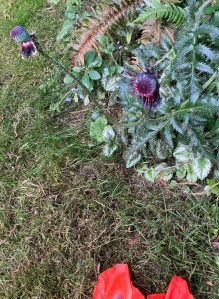 In one of our garden areas we have orange poppies which are associated with enthusiasm, creativity, and vitality. Their striking, bold color and size grab my attention, and almost every year I photograph their beauty. Then the brilliant, beautiful petals fall to the ground quite quickly, seemingly overnight. Their petals fall to the ground with only their seed pods remaining on the stems while their petals begin to decompose. Their vibrant orange color, again, represents enthusiasm, creativity, and vitality. The poppies’ brief span of vitality reminds me of how brief our lives’ enthusiasm, creativity, and vitality can be.
I turn again to Psalm 90/89:
…Our years come to an end like a sigh. The years of our life are threescore and ten, or even by reason of strength fourscore; yet their span is but toil and trouble; they are soon gone, and we fly away (vv 9 – 10).
Nearer its beginning this Psalm offers these sobering words:
You turn man back to the dust, and say, “Turn back, O children of men!” For a thousand your in your sight are but as yesterday when it is past, or as a watch in the night (vv 3 – 4).
Our short lives have their seasons. The enthusiasm, creativity, and vitality of youth change as we age: They mature and, hopefully, age well like wine. This will occur if we walk in the ways of Christ and mature in him, and as we cultivate our relational union in him. We are to abide by faith and sacrament in Christ while we also abide in his Church. Thus, as move through the seasons of life with him, I believe these words of David can assist us if we take them into our hearts and make them into a prayer:
Behold, you desire truth in the inward being; therefore teach me wisdom in my secret heart…Create in me a clean heart, O God, and put a new and right spirit within me. Cast me not away from your presence, and take not your Holy Spirit from me. Restore to me the joy of your salvation, and uphold me with a willing spirit (Psalm 51/50: 6, 10 – 12).
So, keep the poppy in mind (and our fate as well) as we read this: “So teach us to number our days that we may get a heart of wisdom” (Psalm 90/89: 12).
In Christ,
Fr Irenaeus

