The Rich Young Man and the Leave-taking of the Feast of the Dormition
Posted: August 29, 2026 Filed under: Etcetera | Tags: Feast of the Formation, Leave-taking of the Dormition, self-denial, St Hilary of Poitiers on possessions and wealth, the burden of material excess, the burden of the passions and consumptions, the camel and the eye of the needle Leave a comment The Rich Young Man was the topic of the 12th Sunday after Pentecost. He had wealth, privilege, ease, and status — all of this produced his self-identity. To his credit he asks: “Good teacher, what good shall I do, that I might might have eternal life?” (St Matthew 19: 16). Jesus answers: “…if you wish to be whole, go sell your possessions and give to the poor, and you shall have treasure in heaven. And come, follow me” (St Matthew 19: 21). Again, for the rich young man his possession equalled his being. They were his great love and his treasure. Earlier in this Gospel account, Jesus put forward this question to him: “…why do you call me good? No one is good except God” (St Matthew 19:17). With this question, Jesus is not denying he deity. Rather, it is to see if this young man understands who is standing before him. Apparently he did not understand— there was no response to Jesus’ invitation. There was only departure into himself. Here in this desert of self he could not become whole and complete — perfect. He would whither and perish alone with his possessions.
We find a contrast to the Rich Young Man in St Peter: “In answering, Peter said to him [Jesus], ‘Look, we left every thing and followed you, what then shall we have…?’” (St Matthew 19: 27). It is by St Peter’s abandonment of self and following Jesus that he was able to declare: “You are the Christ, the Son of the Living God” (St Matthew 16: 16). Upon him and upon his confession Christ builds his Church, and Christ continued to be formed in him up to the day of his martyrdom.
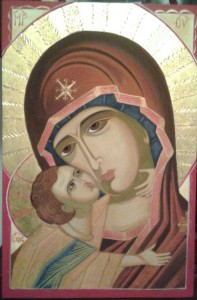 Recently, on August 23, we observed the Leave-taking of the Feast of the Dormition (it is on every August 23 of every year, and concludes the Feast of the Dormition which occurs every August 15). Therefore, we are led to look to Mary, the Mother of God. Let’s go back to March 25, the day of the Annunciation — the day’s event that begins our salvation. Here we have a young, virgin, and unmarried woman. A pregnancy in these circumstances would lead to scandal, shame, and great misfortune. She, of course, understands this, yet she answers St Gabriel: “…behold, the handmaiden of the Lord: may it be done to me according to your word” (St Luke 1: 38). By her self-denial, God become man — our God, Lord, and Savior.
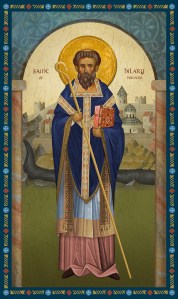
St Hilary of Poitiers
Within this section of St Matthew’s Gospel we have the illustration of the camel passing through the eye of the needle — an impossibility apart from God. St Hilary of Poitiers offers this as an explanation: The camel is a beast of burden. It carries supplies and cargo across land — it is the “ship of the desert”. Then, to move through any challenging passage, and to come to its rest, the camel must be relieved of its burden — what it carries. For us, it would be a picture of certain material possessions that would stifle our growth in Christ. St Hilary goes on to state that material possession are not inherently bad:
It is, therefore, a worse crime to possess things for their own sake than [merely] to possess things. But it is a dangerous burden of being occupied with accumulation of wealth.
He writes that the purpose of possessions, of wealth, is to share with those who lack and are in need. St Paul gives the foundation for his words:
I do not mean that others should be eased and you burdened, but that as a matter of equality your abundance at the present time should supply their want, so that their abundance may supply your want, that there may be equality (2 Corinthians 8: 13-14).
What then is to be said about us? What, or who, is the source of our self-understanding, our source of being? Is it our possessions, our place in the world? Is it our passions? Or is it Christ? The surrendering of self to Christ is a an ongoing affair. Letting go of the things of this world system and following Christ is a process, and it involves struggle. And, how then, do we assess the passions, the burdensome sins, or habitual consumptions that keep us locked inside self, and prevent us from walking more completely in the ways of Christ? I think of the Lord of the Ring’s character of Gollum. The Ring of Power was “his Precious.” The Ring was his obsession, and it possessed Gollum. The Ring’s diabolical hold on him led to his deformation, and ultimate death in the consuming and destroying fires of Mt Doom. Gollum could not let go. The Ring possessed him, and destroyed him.
I turn to St Paul’s words in his letter to the Hebrews:
Therefore, since we are surrounded by so great a cloud of witnesses, let us also lay aside every weight, and sin which clings so closely, and let us run with perseverance the race that is set before us, looking to Jesus the pioneer and perfecter of our faith, who for the joy that was set before him endured the cross, despising the shame, and is seated at the right hand of the throne of God…Therefore,, lift your drooping hands and strengthen your weak kness, and make straight paths for your feet, so that what is lame may not be put out of joint but rather be healed (Hebrews 12: 1-2, 12-13).
God Father, Son, and Holy Spirit are working in us and for our sanctification as we cooperate with the Triune God’s will for our lives. And we have guides and aids to assist us made up of bishops, priests, and deacons. We have each other — all who are in Christ can minister to others. We have our angels, our patron saints, and the Mother of God. I conclude with this hymn to Mary:
Steadfast Protectress of Christians, constant advocate before the Creator: despise not the entreating cries of us sinners, but in your goodness come speedily to help us who call on you in faith. Hasten to hear our petitions and to intercede for us, true Theotokos, for you always protect those who honor you.
In Christ,
Fr Irenaeus


The Account of the Rich Young Man
Posted: September 1, 2025 | Author: Fr. Irenaeus | Filed under: Etcetera | Tags: Jesus and the Rich Young Man, Seek first the Kingdom of God, St Hilary of Poitiers commentary on the Rich Young Man, St Hilary of Poitiers on possessions and wealth, St Matthew 19: 16 - 26 | Leave a commentJesus and the Rich Young Man
There is a saying: “comfort the afflicted; afflict the comfortable.” There are numerous passages from the Scriptures that can accomplish this goal. Today’s Gospel reading from St Matthew 19: 16 – 26 is one such passage: the account of the Rich Young Man (Ruler). He approaches Jesus and asks him, “Teacher, what good deed must I do to have eternal life?” (St Matthew 19:16). Concerning the young man’s spiritual condition, Jesus informed him of the one thing he must do,
Upon his sad departure we have commentary from our Lord:
His disciples were shocked by these words: “Who then is able to be saved?”. They ask this because it was thought that the wealthy had God’s favor, not the poor.
St Hilary of Poitiers
So what was at play within the heart and mind of the young man? St Hilary of Poitiers states this:
St Hilary’s commentary regarding the state of the rich young man adds this: that he placed typical confidence in keeping the Mosaic Law. Thus, the young man could only understand the spiritual life in external, outward, even legalistic terms. He could not, and ultimately, would not grasp our Lord’s conditions for his discipleship and enter into the inner dimension of what was demanded by Christ. Again, his trust in the Law demonstrates this external orientation as does his inability to relinquish his material, external trust in who he was in Israel’s own external and legalistic understanding of spirituality and salvation.
So, what about this illustration of the camel and the eye of the needle? St Hilary explains in this way. Simply, this the camel is a “beast of burden,” and as such the camel’s burdens must be lifted off that me may become smaller. So it is to be with us. I quote St John the Baptist: “He [Jesus] must increase, but I must decrease” (St John 3: 30).
Once more, this is one of those sections from the Scriptures that should afflict the comfortable. As Westerners in this time in history, we are exceedingly wealthy when compared to other areas and eras of the world. We worry about our investments, properties, and possessions. If this is misplaced and becomes our focus, then we are likely in the same place as the rich young man.
I will ask three questions of us. Is our self identity wrapped up on monetary wealth, position in society, and other externals? What do we treasure to the extent that we may be unwilling to give them away to follow Christ more completely? And regarding our possessions — do we possess them, or do they possess us?
Jesus is to have the last word:
In Christ,
Fr Irenaeus