Inappropriate Attire at a Wedding
Posted: September 7, 2026 Filed under: Etcetera, The Eucharist and Living the Eucharist | Tags: cleansing of sins, Eph 1: 9 - 10 defines Recapitulation, taking off the old man and putting on the new man in Ephesians 4: 22-24, test your faithfulness 2 Cor 13: 5, the importance of St John's baptism, The Parable of the Wedding Banquet St Matthew 22: 1-14, The wedding guest without a wedding garment St Matthew 22: 12-14 Leave a commentThis posting deals with Jesus’ parable of the Wedding Banquet. It is found in St Matthew 22: 1-14. Six characters are examined. The first is king: God the Father. The second is the son: God the Son, Jesus. The third; the servants who are the Prophets, and even the Old Testament Scriptures (see St Luke 17: 29).
The fourth group is made up of those who reject the king’s invitation. Here there are three sub-groups. The first sub-group: Those who refused the invitation without excuse (St Matthew 22: 3). Next are those who made light of it and returned to their daily activities (St Matthew 22: 4). Lastly, there are those who seized the King’s servants and treated them shamefully and killed them (St Matthew 22: 5).
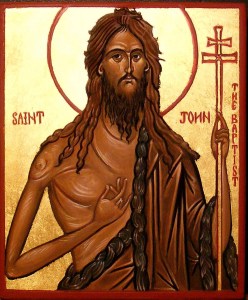 Another account of the faithlessness of the Jewish leaders is found in the Parable of the Two Sons (St Matthew 21: 28-32). Both sons were asked by their father to work the day in his vineyard. The first son answered his father, “‘I will not,’ but afterward he repented and went” (St Matthew 21: 29). The second son answered his father, “‘I go, sir,’ but he did not” (St Matthew 21: 30). The second son represents Jewish religious leadership of the day. Jesus then concludes this parable:
Jesus said to them, “Truly I say to you that the tax collectors and the harlots go before you into the Kingdom of God. For John came to you in the way of righteousness, and you did not believe him. But the tax collectors and the harlots believed him. but you while seeing later you did not change your mind and believe him (St Matthew 21: 31b-32).
What did the tax collectors and harlots (the most despised of that society) accept, and the Jewish leaders reject?
And he [John] went into all the surrounding region of the Jordan, proclaiming a baptism of repentance for the forgiveness of sins (St Luke 3: 3).
Because of their arrogance and hardness of heart which was the cause of their refusal they received this payment for killing the Prophets (and ultimately the Son of God):
The king was angry, and he sent his troops and destroyed those murderers and burned their city (St Matthew 22: 7).
The same fate, destruction, is recorded in the Parable of the Wicked Tenants (see St Matthew 21: 41). Both parables foretell of the Fall of Jerusalem in 70 AD. The Parable of the Wicked Tenants additionally states that all spiritual authority and offices were stripped from the Jews and given to others, being the Church and its Gentiles:
Therefore, I tell you, the kingdom of God will be taken away from you and given to a nation producing its fruits (St Matthew 21: 43).
I now return to the cast of characters. The fifth is composed of those in the highways: The Gentiles and the “unwashed masses.” The evil and the good were both gathered together into the wedding hall. That is an interesting detail, and St Matthew’s Gospel informs us that in the Last Day there will be a sorting of the wheat and the weeds (St Matthew 13: 24-30). All these these were gathered together, “…and the wedding hall was filled with those seated as guests” (St Matthew 22:10). This is a picture of Recapitulation: The gathering together off all and all things into the Person of Jesus Christ (see Ephesians 1: 9-10).
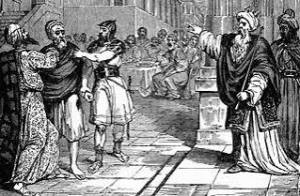 Finally, we come to the mysterious guest who had no wedding garment:
But when the king came in to look at the guests he saw there a man who had no wedding garment; and he said to him, “Friend, how did you get in here without a wedding garment?” And he was speechless. Then the king said to the attendants, “Bind him hand and foot, and cast him into the outer darkness, where there will be weeping and gnashing of teeth.” For many are called, but few are chosen” (St Matthew 22: 12-14).
What about the wedding garment? It was supplied by the king to all the rough and tumble guests. What does the garment represent? The question’s first answer is found in the antiphon from a feast: “As many as have been baptized into Christ have put on Christ. Alleluia.” The wedding garment, then, is Christ himself. Next, we see the pure white baptismal garments worn by the newly baptized and illumined, especially as they approach to receive their first Holy Communion of the Body and Blood of Christ in the Eucharist. We have by this the picture of the reality of our spiritual cleansing which comes by the Sacraments. By Baptism we are joined to Christ — we are born anew by its waters (see St John 3:3), and are cleansed by them. We then have the sacrament of Chrismation — receiving the seal of the Holy Spirit who will work for our sanctification (when we cooperate with his will). Also we have the Eucharist — his Body and Blood —which strengthens our union with Christ and provides the seed of eternal life (see St John 6: 54-56).
In addition we have this insight regarding the wedding garment from St Paul:
Put off the old man that belongs to your former manner of life and is corrupt through deceitful lusts, and be renewed in the spirit of your minds, and put on the new man, created after the likeness of God in true righteousness and holiness (Ephesians 4: 22-24).
Why did the mysterious guest not wear the wedding garment? In his 69th homily on the Gospel of St Matthew, St John Chrysostom notes this about him: Simply put, and in summary, he would not put off the old man and put on the new man. He wanted the Kingdom of God on his own terms. He would not repent of his life in the world. He would not walk in the ways of Christ.
The Wedding Hall and its Banquet are lastly discussed. Those of the parable who were gathered into it were properly clothed to sit at the table. We also are gathered together here into the Kingdom of God. Because we, too were once scattered along the roadsides and alleys when we were lost in sin, death, darkness, and alienation. We were gathered together at at price — the price of the broken Body and the shed Blood of the Lamb of God: Jesus Christ. Therefore, we must take this into account this admonition given to us by St Paul:
Examine yourselves, to see whether you are holding to your faith. Test yourselves. Do you not realize that Christ is in you? — unless indeed you fail to meet the test (2 Corinthians 13: 5).
The test is simple. Having come to faith in Christ, and having been baptized into Christ, are we habitually insisting on our own way? Are we habitually unrepentant, holding on rebelliously to sins we hold dearly? Are we unwilling to struggle and enter into increasing purity of heart? If so, do not come to the Eucharist! But, if we are struggling by faith to put off the old man and put on the new man, then come and receive Christ’s precious Body and Blood! It is for our cleansing, and we receive his victory over sin and death — the corruption that still resides in us.
Remember this: we can take our garment of the Kingdom of the Kingdom to be cleansed of its stains. Here is an illustration: I was recently at a restaurant and spilled coffee on a white, linen shirt. (Honestly, I can’t take myself anywhere!) Of course, I didn’t continue to wear that shirt day in, and day out. I put it in the washing machine, and the coffee stain came out. The shirt was restored. Like my laundered shirt we have the forgiveness of God when we confess our sins. We are cleansed so that we can walk in the beautiful garments of the Kingdom of God — all to the glory of God!
The following is the corresponding sermon given at Holy Resurrection Orthodox Church 9/6/26:
In Christ,
Fr Irenaeus

