Contra Islam: The Hajj and Its Origins
Posted: September 29, 2026 Filed under: Contra Islam | Tags: kissing the Black Stone forgives sins, kissing the Black Stone is heretical, Muhammad authorized the kissing of the Black Stone, the Black Stone, The Hajj is a continuation of pre-Islamic pagan practices, the Kaaba Leave a comment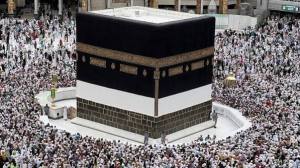
The Kaaba in Mecca
For Islam, Hajj, or pilgrimage, is an annual event occurring during the 12th month of the Islamic calendar called Dhu’l-Hijja. Hajj lasts for five days. It is mandated in by the Quran as seen in, for example, Quran 22: 27-28:
And proclaim the Pilgrimage among men: they will come to you on foot and (mounted) on every kind of camel, lean on account of journeys through deep and distant mountain highways that they may witness the benefits (provided) for them, and celebrate the name of Allah, through the Days appointed, over the cattle which He has provided for them (for sacrifice): then eat you thereof and feed the distressed ones in want.
This pilgrimage is one of the five Pillars of Islam, and every Muslim who is physically able must make the trip to Mecca.
Contained in the Hadith collection of Imam Muslim, Sahih Muslim, is a section devoted to Hajj (pilgrimage). Its opening gives the reader an introduction to this pillar of Islam. (It must be stated that none of this information is found in the book of Genesis.) From its introduction we have,
The word Hajj means, literally, repairing to a place for the sake of visit…, and in the terminology of the Islamic Shariah, it implies repairing to the Bait-Allah (the house of Allah) to observe the necessary devotion…Bait Allah is one of the names by which the Ka’ba [an alternative spelling is Kaaba] is called.
Hajj is not a new institution which Islam has introduced in its Sharia. This institution is as old as the Ka’ba itself which is called in the Holy Quran to be “the first house of Divine Worship appointed for men” (3:95). This verse of the Holy Quran corroborates the hadith which tells us that the Ka’ba was first built by Adam, the first man upon the earth. It was later rebuilt by Hadrat Ibrahim [Abraham] and his illustrious son Hadrat Ismail.
The whole ceremony of Hajj is commemorative of Hadrat Ibrahim and his family’s acts of devotion to God Almighty. This shows that the Holy Prophet [Muhammad]…did not innovate this institution but purged it of all evil practices and made it an obligatory act of piety by which one can develop God-consciousness.
I present my thesis: In this posting I will argue that Muhammad did not purge former idolatrous practices of his ancestors, but simply “baptized” the former pagan practices.
A brief summary of the practices of Hajj is in order. The immediate information concerning the Hajj’s practices comes from islamonline.net. Let’s begin. There are five obligatory practices for the participant’s pilgrimage:
Standing in vigil at Arafat: Arafat is “the plain of recognition,” and is 25km east of Mecca.
Tawaf al-Ifadah: Tawaf is the activity of walking counter-clockwise around the Kaaba seven times. During the tawaf the Black Stone is kissed (this practice will be addressed briefly below).
Ihram: This is a state of consecrated intent. While in Ihram one is prohibited to practice certain deeds that are lawful at other times, for example sexual relations between spouses.
Sa’i: This is the ritual walking between the “hills” called Safa and Marwah. Seven round trips are made, and at the conclusion pilgrims drink from the Zamzam Well. The well was supposedly found by Hagar while she was seeking water for her son Ishmail. (This information is not found in Genesis.)
Shaving or trimming of hair: For women only a trim is done to the ends of their hair.
There are other activities that occur while the Muslim is on pilgrimage, and these are obligatory:
Spending the night at Muzdalifah: Muzdalifah is a place between a location named Mina (the word means “a wish”) and Arafat. Here, the pilgrims rest after leaving Arafat and collect small stones which will be thrown at the three stone pillars of Jamarat. This activity signifies throwing stones at the Devil.
Stoning of the Jamarat: Seven stones are thrown at all three stone pillars.
Shaving or cutting the hair: Again, women just trim the ends of their hair.
Spending nights at Mina during the days of animal sacrifice. During these days the animal flesh is dried in the sun. The sacrifice of camels or cattle is done to copy Abraham’s sacrifice to God. This sacrifice is purely devotional and has no atoning significance.
A farewell tawaf at the Kaaba: This circumambulation concludes the activities of Hajj. To be noted, although the Kaaba is called the House of Allah, Allah does not indwell it: it is a house for devotion to Allah.
There is another pilgrimage called Umrah. It can be performed during other seasons. The activities are at least similar, if not identical, to those of Hajj. Umrah is not a substitute for Hajj for the Muslim.
All of this is both confusing and complicated — even for a Muslim, per islamonline. They are to have a guidebook with them, and refer to it continually during these five days. Plus, having the company of a guide is also encouraged.
I begin the defense of my stated thesis. The Hadith of Sahih Muslim is quoted again: “Hajj is not a new institution which Islam has introduced in its Sharia. The Holy Prophet [Muhammad]…did not innovate this institution but purged it of all evil practices…” Sahih Muslim, thus, declares that the activities of Hajj are not new: They all predate Muhammad. Wikipedia, in its article, “Hajj”, clearly states that all of these activities are “…a series of pre-Islamic rituals.” In addition to this we read Robert Spencer’s words regarding the Hajj’s roots:
The prophet and his new religion faced stiff resistance from his own tribe the Quraysh, who were pagans and polytheists. The Quraysh, according to the Islamic story of the religion’s origins, lived in Mecca, which was a center for both trade and pilgrimage, such that people went there from all over Arabia and from outside Arabia as well. The Quraysh, say the Muslim sources, profited from those who made pilgrimages to the Ka’ba to worship its many idols. Mecca, according to Islamic tradition, was central to both the religion and the commerce of the area (Robert Spencer, Did Muhammad Exist? Revised and Expanded Edition. Hereafter referred to as Spencer).
Imam Muslim declares that Muhammad tore down the many pagan idols and consecrated the Kaaba, although contemporary scholars question the historicity of the consecration (see Spencer, 118). Yet the pagan practices persisted, and persist to this day.
Traditional information about the Hajj is mentioned throughout the entirety of the Hadith, which are collections of writings about the traditional stories of Muhammad’s life and words. I have read some of the hadith regarding Hajj. I note that there is a great deal of confusion regarding what Muhammad may have said, or may not have said; what he did, or did not do. Regarding the practice of Sa’i, i.e., walking between the rocky “hills” (they are described more accurately as mounds of rock) of Safa and Marwa, we have this hadith of Sahih al-Bukhari:
…I asked Aisha [Muhammad’s wife he married when she was six years of age, and consummated their marriage when she was aged nine years], “How do you interpret the statement of Allah, ‘Verily! (The mountains) As-Safa and Al-Marwa are among the symbols of Allah, and whoever performs the Hajj to the Ka’ba or performs Umra, it is not harmful for him to perform Tawaf [here meaning walking between them] between them Safa and Marwa…By Allah! (It is evident from this revelation) there is no harm if one does not perform Tawaf between Safa and Marwa.” Aisha said, “O my nephew! Your interpretation is not true. Had this interpretation of yours been correct, the statement of Allah should have been, ‘It is not harmful for him if he does not perform Tawaf between them.’ But in fact, this divine inspiration was revealed concerning the Ansar who used to assume Ihram [i.e., abstaining from this practice] for worshiping an idol called Manat [a female goddess] which they used to worship in a place called Al-Mushalla before they embraced Islam, and whoever assumed Ihram (for the idol), would consider it not right to perform Tawaf between Safa and Marwa. When they embraced Islam, they asked Allah’s Messender…regarding it, saying, ‘O Allah’s Apostle! We used to refrain from Tawaf between Safa and Marwa.’ So Allah revealed: ‘Verily, (the mountains) As-Safa and Al-Marwa are among the symbols of Allah’” Aisha added, “Surely, Allah’s Apostle set the tradition of Tawaf between Safa and Marwa, so nobody is allowed to omit the Tawaf between them (Sahih al-Bukhari 590/1643).
This hadith presents the problem: The pagan practice of walking between the two rock mounds of Safa and Marwa was originally for the worship of the ancient Arab’s goddess Manat. It then seems that, purely for the sake of convenience, Muhammad reinterprets this when he declares that Allah “said” that the rock piles are symbolic of Allah. This message from Sahih al-Bukhari clearly demonstrates, again, that the pagan practices were reinterpreted and are copies of those earlier practices. Even the original followers of Muhammad were aware of this and were apparently troubled by not only the practice of Sa’i, but others as well. In Sahih al-Bukhari we find another example:
Umar bin Al-Khattab addressed the Corner (Black Stone) saying, “By Allah! I know that your are a stone and can neither benefit or harm. Had I not seen the prophet…touching (and kissing) you, I would never have touched (and kissed) you” Then he kissed it and said, “There is no reason for us to do Ramal [brisk walking] in Tawaf except that we wanted to show off before the pagans, and now Allah has destroyed them.” Umar added, “(nevertheless), the Prophet…did that and we do not want to leave it” (al-Bukhari 577/1605).
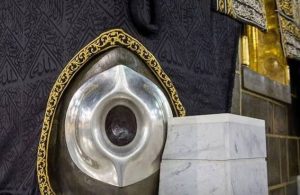
The Black Stone of the Kaaba
Reverence of the Black Stone predates the Islamic era, and thus the devotion has pagan origins. As noted above, Umar is fully aware of the pagan origin of the touching and kissing of the Black Stone, which is done for the forgiveness of sins. To substantiate this I point to a hadith of hasan grading (meaning good, reliable, but lesser than a sahih (sound) grading):
…I do it (clinging to the Stone and corner of the Kaaba) because I heard the Messenger of Allah…saying, “Touching them atones for sins” (Jami at-Tirmidhi, 959).
It appears that Umar would have abandoned the practice had it not been continued and authorized by Muhammad. We have another hadith regarding Muhammad and the Black Stone:
Suwaid bin Gafala reported: I saw Umar…kissing the Stone and clinging to it and saying: I saw Allah’s messenger…having great love for you (Sahih Muslim, 1271a).
That the Black Stone is still considered to forgive sins is contrary to the Quran: only Allah can forgive sins. We have this passage:
Say: O my servants who have transgressed against their souls! Despair not of the mercy of Allah: for Allah forgives all sins; for he is oft-forgiving, most merciful (Quran 39:53).
It must be noted that by this passage from the Quran that the belief that the Black Stone forgives sin is heretical, both per the Quran and Islamic theology. Yet, per the above quoted hadith, their prophet states otherwise.
Umar copied Muhammad’s actions. The questionable practices are justified by a later, more developed teaching of Islam. Islamic monotheism is called Tauhid / Tawhid. It is defined as the “unity of Allah,” meaning none has the right to be worshipped but Allah. However, within this doctrine, there is an additional Tauhid that applies to Muhammad: Tauhid-al-Ittiba.
This is the unity of following Allah’s apostle Muhammad…Muhammad is Allah’s apostle and that none has the right to be followed after Allah’s book or order, the Holy Quran, but Allah’s prophet Muhammad (A Concise Dictionary of Islamic Terms, pp 69-70).
Thus, Muhammad’s baptized pagan practices are cemented in place and are to be unquestioned.
Thus, the Hajj is presented per Islam. It is clear both to me and to many of the critics of Islam, that Muhammad simply adopted and rebranded pagan religious practices which were then, and are now, continued without question by Muslims.
In Christ who is God Incarnate,
Fr Irenaeus

