“Call No Man Father!” Really?
Posted: August 11, 2026 Filed under: Etcetera, The Eucharist and Living the Eucharist | Tags: answering the Protestant objection to the title "father", by the Eucharist Jesus abides in us and we in him, Jesus is the Bread of Life, Protestant objection to the title "father", spiritual fatherhood, St Matthew 23:9, St Paul is father to St Onesimus, St Paul is the father of the Corinthian church, why a priest is called "father" Leave a comment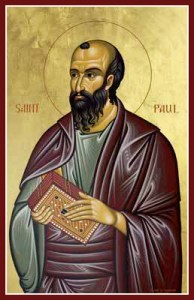 “And call no man your father on earth, for you have one Father who is in heaven” (St Matthew 23: 9). When I was a Protestant, I used this verse from the gospels to combat the Orthodox and Catholic title given to priests. This was my “gotcha” phrase, and it seemed to score points for me in those days. However, the objection I used, and more than a few evangelicals use to this day, was not made without a good measure of ignorance, and a touch more arrogance. The use of this verse when taken to its logical conclusion means that no child could call his or her father, “father.” Yet, St Paul gives instructions to human fathers and rightly writes this: “Fathers [Oi pateres]…” begins the verse (Colossians 3:21). St Paul should then be corrected if the evangelical objection holds true. And this should be considered: Jesus also calls himself the Good Shepherd, or Pastor [o poimen o kalos] (St John 10:11). If we translate “poimen” as pastor, no evangelical could call his or her pastor, “Pastor Mike”. The examples can go on and on, but one way to respond the the objection made by quoting St Matthew 23:9, is to state that no one can call a man father apart from understanding first the universal fatherhood of God: all fatherhood comes from God the Father.
In addition to this we have a very bold declaration made by St Paul in several New Testament passages. In 1 Corinthians’ fourth chapter he writes,
I write these things not to shame you, but to instruct you as my beloved children. For if you have countless teachers in Christ, you do not have many fathers. For in Christ Jesus I begot/fathered [eggenesa] you by means of the Gospel (1 Corinthians 4: 14-15).
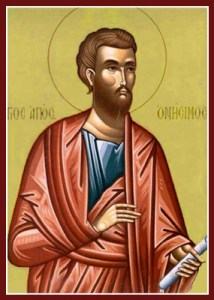
St. Onesimus
Elsewhere in his short letter to his friend Philemon, he writes of his spiritual son Onesimus (Philemon’s s escaped slave who later became a bishop and likely compiled St Paul’s letters): “I exhort you concerning my child whom I begot/fathered [egennesa] while in chains, Onesimus…” (Philemon 10a). Some translations put it this way: “…whose father I have become…”
I have emphasized the Greek verb gennan (its infinitive form)— “to beget,” “to father.” Why is his use of this word important? For the answer we must turn to St John’s Gospel, specifically the Prologue of the first chapter:
He came to his own [people], and his own [people] did not receive him. But, to as many as received him, he gave to them authority to become the children of God, to those who believed in his name. Not from blood, nor from the will of the flesh, nor from the will of a man, but were begotten [egennethesan] of God (St John 1: 11-13).
In verse 13 we again find the use of the verb gennan — the same verb used by St Paul in the two verses previously noted. In St John 1:13, the apostle states that God the Father begets this spiritual life in those who receive Christ by faith. In chapter three of his Gospel we find gennan again, and this usage clarifies for us a bit more clearly what St John teaches: “Jesus answered him [Nicodemus] and said to him, ‘Truly, truly I say to you, unless someone should be begotten/born [gennethe] from above/anew he is not able to see the Kingdom of God” (St John 3: 3).
I’ll get to the point. When St Paul uses the verb gennan, he declares that he is participating in, and cooperating with, the Father’s action of begetting, fathering, spiritual children by means of the Gospel of Christ. Thus, St Paul has spiritual children, begetting them through the Gospel and baptism (see St John 3: 5). Thus he is their spiritual father. This is both a bold claim and the truth.
Recently, a number of young men who are moving from evangelicalism to Orthodoxy asked me why I am called father. I explained the importance of 1 Corinthians 4: 14-15 in the light of St John 1: 11-13. I responded also with this: It is because I, by the gift of priesthood and consequent ministry given to me and my fellow clergy, I am to beget faith in the spiritual children of God. Thus, I am a spiritual father to them: “Fr Irenaeus.” There are other reasons for the honor of the title and its appropriate use, but this is sufficient for now.
To the topic of fathering faith and spiritual growth we all know this: We are all in the family of God. There is also this fact: We are also patients in a Hospital. Here, Christ is our one True Physician:
And he came down with them and stood on a level place, with a great crowd of his disciples and a great multitude of people from all Judea and Jerusalem and the seacoast of Tyre and Sidon, who came to hear him and to be healed of their diseases; and those who were troubled with unclean spirits were cured. And all the crowd sought to touch him, for power came forth from him and healed them all (St Luke 6: 17-19).
We are in the Hospital of the Church. Here, by the Holy Spirit, we are administered the true medicines that heal the entirety of our being: the Scriptures, the Sacraments, the Divine Liturgy, the services, and the hymns, etc. As we are treated, convalesce, and mature in faith we take on the familial traits and mannerisms of the children begotten of God. The familial traits are listed for us in St Paul’s letter to the Galatians. He calls them the fruits of the Spirit:
But the fruit of the Spirit is love, joy, peace, patience, kindness, goodness, faithfulness, gentleness, self-control; against such there is no law. And those who belong to Christ Jesus have crucified the flesh with its passions and desires. If we live by the Spirit, let us also walk by the Spirit. Let us have no self-conceit, no provoking of one another, no envy of one another.
Brethren, if a man is overtaken in any trespass, you who are spiritual should restore him in a spirit of gentleness. Look to your self, lest you too be tempted. Bear one another’s burdens, and so fulfill the law of Christ (Galatians 5: 22 – 6:2).
The Eucharist is our strongest medicine: It is the medicine of immortality as St Ignatius of Antioch called it. St John gives us Jesus’ own words:
I am the Bread of Life. Your fathers ate the manna in the wilderness and died. This is the Bread which is coming down from heaven, that is some one might eat of it also might not die. I am the Bread of Life which came down from heaven: If some one might eat of this Bread, he shall live forever. And the Bread which I shall give is my Flesh, which I shall give for the life of the world…
St Ignatius also refers to himself as a “God-bearer”. We see why as the sixth chapter of St John continues quoting Jesus,
…Truly, truly I say to you, unless you eat the Flesh of the Son of Man and drink his Blood you have no life in yourselves. The one who is eating my Flesh and is drinking my Blood, has eternal life, and I shall raise him in the last day. For my Flesh is true food, and my Blood is true drink. The one who is eating my Flesh and is drinking my Blood abides in me and I in him (St John 6: 48-51, 53-56).
When you come to the Body and Blood of our Lord, come with intention — with the intention that our union with Jesus might be strengthened. His divine and healing presence are in us. This is not just as some wonderful theological and scriptural truth. He is to be allowed to work within us, forming himself and his holy traits within us by the working of the Holy Spirit (who also abides in us). With this working and cooperation — by participating in the divine nature — the fruits of the Spirit will be formed in us. Thus, we can be made complete and whole as is the Father who spiritually begot us (see St Matthew 5: 48).
In Christ,
Fr Irenaeus

