Contra Islam: The Nature of the Qur’an
Posted: May 7, 2026 Filed under: Contra Islam, Etcetera | Tags: Arian heresy, Arius, Christoph Luxenberg, Colossians 2:9, diacritical marks, Gunter Luling, Hebrews 1: 1 -3, Is the Qur'an uncreated and eternal?, John 1:1, John 1:14, Nicene Creed, the Christian understanding of scriputure, the Incarnation, the nature of the Qur'an, The Qur'an an an anti-Incarnation, the Qur'an has a Christian textual background Leave a commentCONTRA ISLAM: THE NATURE OF THE QUR’AN
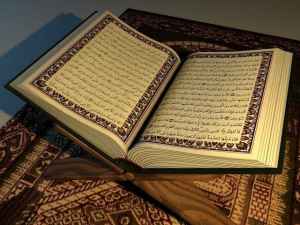 As is well known, the Qur’an is the book of scriptures for Islam. In his book, Exploring Islam: A Christian Perspective on the Life of Muhammad and the Qur’an, its author Lawrence R Farley offers a summary:
Contemporary Islam claims that the Qur’an as currently possessed represents the actual words of Allah as dictated to Muhammad…Muhammad’s role was merely that of a secretary receiving the divine dictation, one who recited the ipsissima verba, the actual words spoken by Allah (Farley, 101).
There is far more to a faithful Muslim’s understanding of their scriptures. We read this from IslamOnLine.net: “The Uncreated Quran: Doctrinal Lessons from Surah [chapter] Az-Zumar”:
Surah Az-Zumar [Qur’an’s chapter 39] provides clear evidence affirming the Uncreated Quran as the eternal word of Allah, a divine attribute that is uncreated. This affirmation is crucial in Islamic creed, emphasizing that Allah’s attributes, including his speech, are not created. Several verses within the Surah highlight this uncreated nature (IslamOnLine, 1).
We have these verses from that surah:
The revelation of this Book is from Allah, the Exalted in Power, Full of Wisdom (Quran 39: 1).
The revelation of the Book is from Allah, the Exalted in Might, the Wise. Indeed, We have sent down to you the Book in truth, so worship Allah, sincerely for Him alone is the religion (Qur’an 39: 41).
Indeed, We have sent down to you the Book in truth to make firm those who believe in the unseen, establish prayer, and rely upon Allah. Yet they would not be guided except for those who should believe (Qur’an 39: 43).
IslamOnLine.net’s article then provides commentary from Muslim scholars on page 2:
Al-Suyuti stated: The Quran is the uncreated word of Allah, existing eternally with Him. It is not a created entity but a divine attribute.
Al-Razi further elaborated: The Quran, as a divine attribute, is inherently uncreated, aligning with Allah’s eternal nature.
Three were those who disagreed stating that Qur’an is not co-eternal with Allah. Among this cohort were the Mu’tazilis and the Jahmiyyahs. Farley informs us,
Opponents of this view, the so-called Mu’tazilis, or “rationalists” who arose in Iraq from the eighth century, objected that to make the Qur’an eternal and uncreated would be to introduce a second divine principle, and would therefore heretically compromise the sole unity of Allah…At length their opponents triumphed, and established the view that the Qur’an was indeed as eternal as Allah Himself. For most Muslims today, this remains the orthodox view of the Qur’an (Farley, 102).
If you are aware of the Church’s history, you will see a surprising parallel to the Arian controversy of the early fourth century. Arius denied that Christ was co-eternal with the Father, stating that Jesus was only a created being. The catholic and orthodox position affirms the opposite: Jesus, the Only-begotten Son, is co-eternal with the Father, being of the same essence of the Father, begotten, not created. The first portion of the Nicene Creed refutes Arius and establishes orthodox, catholic Christology. It reads,
I believe in one God the Father Almighty creator of heaven and earth, of all things seen and unseen. And in one Lord Jesus Christ, the Only-begotten Son of God, begotten of the Father before all ages; Light of Light, true God of true God, begotten not created, of one essence (ὁμοούσιον) with the Father through whom all things were made.
Again, as noted from IslamOnLine.net, we have the Islamic understanding that the Qur’an is the eternal, uncreated word of Allah. Christians have a very different understanding of both the Old Testament (OT) and the New Testament (NT). Our Scriptures are not coeternal with God. They are holy, inspired, truthful and authoritative, but are the product of a synergy between God and man. We read this from St Peter:
First of all you must understand this, that no prophecy of Scripture is a matter of one’s own interpretation, because no prophecy ever came by the impulse of man, but men moved by the Holy Spirit spoke from God (…ἀλλὰ ὑπὸ πνεύματος ἁγίου φερόμενοι ἐλάλησαν ἀπὸ θεοῦ ἄνθρωποι) ( 2 Peter 1: 20 – 21).
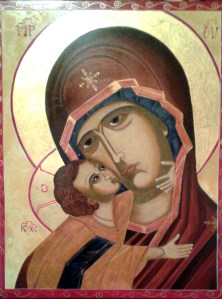
Theotokos Tender Mercy
Once more, the Christian Scriptures are understood in a very different way. Our Scriptures are not the manifestation of God to humanity. Rather, the manifestation of God to humanity is the Logos, or the Word, made flesh. We have this from St John 1: 1,
Ἐν ἀρχῇ ἦν ὁ λόγος, καὶ ὁ λόγος ἦν πρὸς τὸν θεόν, καὶ θεὸς ἦν ὁ λόγος.
(In the beginning was the Word, and the Word was with God, and the Word was God.)
St John continues in the following verse: He writes specifically about the Incarnation, the manifestation of the Logos in human flesh, in St John 1: 14,
Καὶ ὁ λόγος σὰρξ ἐγένετο καὶ ἐσκήνωσεν ἐν ἡμῖν, καὶ ἐθεασάμεθα τὴν δόξαν αὐτοῦ, δόξαν ὡς μονογενοῦς παρὰ πατρός, πλήρης χάριτος καὶ ἀληθείας·
(And the Word became flesh and dwelt among us, and we observed his glory, glory as the Only-begotten from the Father full of grace and truth).
I present two additional, two of many, NT witnesses regarding the Incarnation:
In many and various ways God spoke of old to our fathers by the prophets; but in these last days he has spoken to us by a Son, whom he appointed the heir of all things, through whom also he created the ages. He reflects the glory of God and bears the very stamp of his nature (…χαρακτὴρ τῆς ὑποστάσεως – here translated as nature, or being), upholding the universe by his word of power (Hebrews 1: 1 – 3)
Because in him dwells all the fullness of deity bodily (ὅτι ἐν αὐτῷ κατοικεῖ πᾶν τὸ πλήρωμα τῆς θεότητος σωματικῶς) (Colossians 2: 9).
The Qur’an, then, is Islam’s attempt at countering the Incarnation of the Son of God. Their assertion that the Qur’an is uncreated and eternal must be challenged.
Western orientalists, and other scholars, point out multiple problems with the Qur’an. One such problem is addressed by what follows. Among those concerns are background features that have Christian roots, and some of the sources come from heretical Christian groups. This has been pointed out beginning a few decades ago by the works of Gunter Luling’s A Challenge to Islam for Reformation, and Christoph Luxenberg’s The Syro-Aramaic Reading of the Qur’an. It is well documented by a multitude of scholars that about 20 to 25% of the Qur’an is incomprehensible, even in its classical Arabic text. This information flies in the face of standard Islamic defense of the book. This reminder is given:
Al-Sabuni: The Quran is not a created entity but a manifestation of Allah’s eternal speech, preserved and protected by Him (IslamOnLine.net, 6).
If the Qur’an, then, is Allah’s eternal speech, and a clear witness, why do incomprehensible portions exist? And, why do scholars state that there is a Christian underpinning to some of the Qur’an’s text? In part the answer has its source in the alphabet of Arabic in its form from the seventh century and for about 200 years after this period. The language at that time was made up of only consonants (this was the case at one time for Hebrew as well). Arabic in this period lacked diacritical marks which attach vowel sounds to the consonants, and distinguish identical letters from one another. Thus, the addition of diacritical marks offered two advantages: proper pronunciation of words, and differentiation between different words that have the same consonants. Here is an example: Without vowels we would have this puzzle for the English reader: TH HRT F TH LND
With this phrase there are a few possibilities for intended meaning. Here are two of them.
The first option: The heart of the land, the second: the hart of the land
This shows the problem stemming from the classical Arabic era. Even though the language evolved by attaching diacritical marks, yet, no clarity of meaning was truly imparted. The text’s ambiguity remained a problem. The works scholars Luling and Luxenberg stripped away Arabic diacritical markings in these incomprehensible verses and replaced them with the diacritical markings found in Syriac. The verses found in Qur’an 74: 11 – 17 offer an example of their reworking of the text. These seven Qur’anic verses in English read,
Leave me alone with the one I created alone and to whom I granted extensive wealth and sons to be by his side and spread before him, easing, then he desires that I should add more. No indeed! He has been toward our verses obstinate. I will cover him with arduous torment (Qur’an 74: 11 – 17).
In Robert Spencer’s book Did Muhammad Exist? An Inquiry Into Islam’s Obscure Origins (2021 revised edition) he explains the work of Luling.
To shed some light on this sura [chapter] Luling looks closely at verses 11 – 17. In the traditional rendering, this passage is full of questionable material. Like Qur’an 96: 9 – 19, it denounces an anonymous miscreant. Of whom is Allah, the sole creator and judge of all things, demanding that he be left alone to deal with?…Luling smooths out the difficulties and presents a [Syriac] reconstruction that makes more sense than the standard Qur’anic text. This reconstruction reveals the text as a [heretical Arian] Christological confession (Spencer, 230).
Spencer presents Luling’s reconstruction:
He has created me and the one He has created as a unique being. And He has made him a property obedient to His will. And He has testified to him by witnesses. And He paved for him the way. Then he desired that he might increased. Not at all that he was rebellious against His commandments. So finally He has made him step through death up to the heights (Spencer, 233).
Spencer offers his insight:
And so, he [Luling] argues, this passage begins to become clear as a Christian confession of faith – but not reflecting the theology of the Byzantine Empire of the Church of Constantinople. Rather it is a rejection of Trinitarian Christology (Spencer, 233)…Thus it is entirely possible that the Christian substratum of the Qur’an reflects a Christology that views Christ as a created being (Spencer, 234).
As pointed by Spencer, the Qur’an’s intentional misunderstanding of Christ comes from heretical Arian and anti-Trinitarian sources contemporary with the Qur’an’s development. Spencer confirms this:
As the Islamic faith began to develop as a distinct religion, it decisively rejected this [orthodox, catholic] faith in Christ and reinterpreted the Qur’an to fit its developing new theology…There is a great deal more in the Qur’an that suggests the presence of an original Christian substratum (Spencer, 236, 237).
Practicing Muslims would likely be both unaware and would deny the veracity of the Syriac reconstructions since they contradict Islamic orthodoxy. From what is stated above, I put forward this: The text of the Qur’an is created and non-eternal. It is a developed work of Muslims who, in several cases, utilized certain heretical Arian texts. This was done to create their book, and to develop their theology as it evolved through the centuries. What has been created is an ossified text that can neither breathe nor answer serious and honest questions about the Qur’an’s textual history.
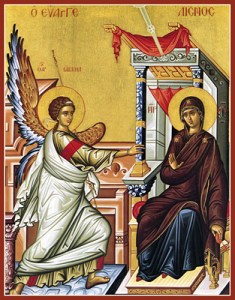
Icon of the Annunciation
In a previous “Conta Islam” posting, I stated that Muhammad is an antichrist: Islam denies that Jesus is the Incarnate Son of God, and that he is God as is his Father is God. To take this a step further Islam has produced an anti-Incarnation when it claims the Qur’an is uncreated and eternal. I will take this another step further. In the Cave of Hira, a demon posing as the Archangel Gabriel appears to Muhammad and forcefully demands that Muhammad read three times to begin the revelation of Allah to Muhammad. This was an anti-Annunciation, the opposite of which peacefully took place between the true Gabriel and Mary. The anti-Annunciation in the Cave of Hira brought about an anti-Incarnation – not the holy one of the flesh, bone, and blood of Jesus Christ – but one which has a defective, and inferior physicality of palm leaf, parchment and ink.
Muslims state that the Qur’an is uncreated, eternal, and complete. To conclude it seems that in truth they should desire Jesus Christ who is eternal, uncreated. He is the Son of God who came to humanity and the cosmos in a fully human body. They do not yet know him, but need to know him as their God, Lord, and Savior.
In Christ who alone is the Way, the Truth and the Life,
Fr Irenaeus

