Contra Islam: The Hajj and Its Origins
Posted: September 29, 2026 Filed under: Contra Islam | Tags: kissing the Black Stone forgives sins, kissing the Black Stone is heretical, Muhammad authorized the kissing of the Black Stone, the Black Stone, The Hajj is a continuation of pre-Islamic pagan practices, the Kaaba Leave a comment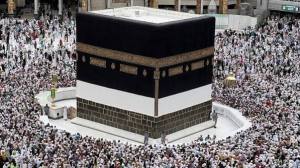
The Kaaba in Mecca
For Islam, Hajj, or pilgrimage, is an annual event occurring during the 12th month of the Islamic calendar called Dhu’l-Hijja. Hajj lasts for five days. It is mandated in by the Quran as seen in, for example, Quran 22: 27-28:
And proclaim the Pilgrimage among men: they will come to you on foot and (mounted) on every kind of camel, lean on account of journeys through deep and distant mountain highways that they may witness the benefits (provided) for them, and celebrate the name of Allah, through the Days appointed, over the cattle which He has provided for them (for sacrifice): then eat you thereof and feed the distressed ones in want.
This pilgrimage is one of the five Pillars of Islam, and every Muslim who is physically able must make the trip to Mecca.
Contained in the Hadith collection of Imam Muslim, Sahih Muslim, is a section devoted to Hajj (pilgrimage). Its opening gives the reader an introduction to this pillar of Islam. (It must be stated that none of this information is found in the book of Genesis.) From its introduction we have,
The word Hajj means, literally, repairing to a place for the sake of visit…, and in the terminology of the Islamic Shariah, it implies repairing to the Bait-Allah (the house of Allah) to observe the necessary devotion…Bait Allah is one of the names by which the Ka’ba [an alternative spelling is Kaaba] is called.
Hajj is not a new institution which Islam has introduced in its Sharia. This institution is as old as the Ka’ba itself which is called in the Holy Quran to be “the first house of Divine Worship appointed for men” (3:95). This verse of the Holy Quran corroborates the hadith which tells us that the Ka’ba was first built by Adam, the first man upon the earth. It was later rebuilt by Hadrat Ibrahim [Abraham] and his illustrious son Hadrat Ismail.
The whole ceremony of Hajj is commemorative of Hadrat Ibrahim and his family’s acts of devotion to God Almighty. This shows that the Holy Prophet [Muhammad]…did not innovate this institution but purged it of all evil practices and made it an obligatory act of piety by which one can develop God-consciousness.
I present my thesis: In this posting I will argue that Muhammad did not purge former idolatrous practices of his ancestors, but simply “baptized” the former pagan practices.
A brief summary of the practices of Hajj is in order. The immediate information concerning the Hajj’s practices comes from islamonline.net. Let’s begin. There are five obligatory practices for the participant’s pilgrimage:
Standing in vigil at Arafat: Arafat is “the plain of recognition,” and is 25km east of Mecca.
Tawaf al-Ifadah: Tawaf is the activity of walking counter-clockwise around the Kaaba seven times. During the tawaf the Black Stone is kissed (this practice will be addressed briefly below).
Ihram: This is a state of consecrated intent. While in Ihram one is prohibited to practice certain deeds that are lawful at other times, for example sexual relations between spouses.
Sa’i: This is the ritual walking between the “hills” called Safa and Marwah. Seven round trips are made, and at the conclusion pilgrims drink from the Zamzam Well. The well was supposedly found by Hagar while she was seeking water for her son Ishmail. (This information is not found in Genesis.)
Shaving or trimming of hair: For women only a trim is done to the ends of their hair.
There are other activities that occur while the Muslim is on pilgrimage, and these are obligatory:
Spending the night at Muzdalifah: Muzdalifah is a place between a location named Mina (the word means “a wish”) and Arafat. Here, the pilgrims rest after leaving Arafat and collect small stones which will be thrown at the three stone pillars of Jamarat. This activity signifies throwing stones at the Devil.
Stoning of the Jamarat: Seven stones are thrown at all three stone pillars.
Shaving or cutting the hair: Again, women just trim the ends of their hair.
Spending nights at Mina during the days of animal sacrifice. During these days the animal flesh is dried in the sun. The sacrifice of camels or cattle is done to copy Abraham’s sacrifice to God. This sacrifice is purely devotional and has no atoning significance.
A farewell tawaf at the Kaaba: This circumambulation concludes the activities of Hajj. To be noted, although the Kaaba is called the House of Allah, Allah does not indwell it: it is a house for devotion to Allah.
There is another pilgrimage called Umrah. It can be performed during other seasons. The activities are at least similar, if not identical, to those of Hajj. Umrah is not a substitute for Hajj for the Muslim.
All of this is both confusing and complicated — even for a Muslim, per islamonline. They are to have a guidebook with them, and refer to it continually during these five days. Plus, having the company of a guide is also encouraged.
I begin the defense of my stated thesis. The Hadith of Sahih Muslim is quoted again: “Hajj is not a new institution which Islam has introduced in its Sharia. The Holy Prophet [Muhammad]…did not innovate this institution but purged it of all evil practices…” Sahih Muslim, thus, declares that the activities of Hajj are not new: They all predate Muhammad. Wikipedia, in its article, “Hajj”, clearly states that all of these activities are “…a series of pre-Islamic rituals.” In addition to this we read Robert Spencer’s words regarding the Hajj’s roots:
The prophet and his new religion faced stiff resistance from his own tribe the Quraysh, who were pagans and polytheists. The Quraysh, according to the Islamic story of the religion’s origins, lived in Mecca, which was a center for both trade and pilgrimage, such that people went there from all over Arabia and from outside Arabia as well. The Quraysh, say the Muslim sources, profited from those who made pilgrimages to the Ka’ba to worship its many idols. Mecca, according to Islamic tradition, was central to both the religion and the commerce of the area (Robert Spencer, Did Muhammad Exist? Revised and Expanded Edition. Hereafter referred to as Spencer).
Imam Muslim declares that Muhammad tore down the many pagan idols and consecrated the Kaaba, although contemporary scholars question the historicity of the consecration (see Spencer, 118). Yet the pagan practices persisted, and persist to this day.
Traditional information about the Hajj is mentioned throughout the entirety of the Hadith, which are collections of writings about the traditional stories of Muhammad’s life and words. I have read some of the hadith regarding Hajj. I note that there is a great deal of confusion regarding what Muhammad may have said, or may not have said; what he did, or did not do. Regarding the practice of Sa’i, i.e., walking between the rocky “hills” (they are described more accurately as mounds of rock) of Safa and Marwa, we have this hadith of Sahih al-Bukhari:
…I asked Aisha [Muhammad’s wife he married when she was six years of age, and consummated their marriage when she was aged nine years], “How do you interpret the statement of Allah, ‘Verily! (The mountains) As-Safa and Al-Marwa are among the symbols of Allah, and whoever performs the Hajj to the Ka’ba or performs Umra, it is not harmful for him to perform Tawaf [here meaning walking between them] between them Safa and Marwa…By Allah! (It is evident from this revelation) there is no harm if one does not perform Tawaf between Safa and Marwa.” Aisha said, “O my nephew! Your interpretation is not true. Had this interpretation of yours been correct, the statement of Allah should have been, ‘It is not harmful for him if he does not perform Tawaf between them.’ But in fact, this divine inspiration was revealed concerning the Ansar who used to assume Ihram [i.e., abstaining from this practice] for worshiping an idol called Manat [a female goddess] which they used to worship in a place called Al-Mushalla before they embraced Islam, and whoever assumed Ihram (for the idol), would consider it not right to perform Tawaf between Safa and Marwa. When they embraced Islam, they asked Allah’s Messender…regarding it, saying, ‘O Allah’s Apostle! We used to refrain from Tawaf between Safa and Marwa.’ So Allah revealed: ‘Verily, (the mountains) As-Safa and Al-Marwa are among the symbols of Allah’” Aisha added, “Surely, Allah’s Apostle set the tradition of Tawaf between Safa and Marwa, so nobody is allowed to omit the Tawaf between them (Sahih al-Bukhari 590/1643).
This hadith presents the problem: The pagan practice of walking between the two rock mounds of Safa and Marwa was originally for the worship of the ancient Arab’s goddess Manat. It then seems that, purely for the sake of convenience, Muhammad reinterprets this when he declares that Allah “said” that the rock piles are symbolic of Allah. This message from Sahih al-Bukhari clearly demonstrates, again, that the pagan practices were reinterpreted and are copies of those earlier practices. Even the original followers of Muhammad were aware of this and were apparently troubled by not only the practice of Sa’i, but others as well. In Sahih al-Bukhari we find another example:
Umar bin Al-Khattab addressed the Corner (Black Stone) saying, “By Allah! I know that your are a stone and can neither benefit or harm. Had I not seen the prophet…touching (and kissing) you, I would never have touched (and kissed) you” Then he kissed it and said, “There is no reason for us to do Ramal [brisk walking] in Tawaf except that we wanted to show off before the pagans, and now Allah has destroyed them.” Umar added, “(nevertheless), the Prophet…did that and we do not want to leave it” (al-Bukhari 577/1605).
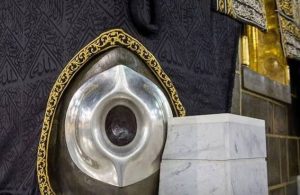
The Black Stone of the Kaaba
Reverence of the Black Stone predates the Islamic era, and thus the devotion has pagan origins. As noted above, Umar is fully aware of the pagan origin of the touching and kissing of the Black Stone, which is done for the forgiveness of sins. To substantiate this I point to a hadith of hasan grading (meaning good, reliable, but lesser than a sahih (sound) grading):
…I do it (clinging to the Stone and corner of the Kaaba) because I heard the Messenger of Allah…saying, “Touching them atones for sins” (Jami at-Tirmidhi, 959).
It appears that Umar would have abandoned the practice had it not been continued and authorized by Muhammad. We have another hadith regarding Muhammad and the Black Stone:
Suwaid bin Gafala reported: I saw Umar…kissing the Stone and clinging to it and saying: I saw Allah’s messenger…having great love for you (Sahih Muslim, 1271a).
That the Black Stone is still considered to forgive sins is contrary to the Quran: only Allah can forgive sins. We have this passage:
Say: O my servants who have transgressed against their souls! Despair not of the mercy of Allah: for Allah forgives all sins; for he is oft-forgiving, most merciful (Quran 39:53).
It must be noted that by this passage from the Quran that the belief that the Black Stone forgives sin is heretical, both per the Quran and Islamic theology. Yet, per the above quoted hadith, their prophet states otherwise.
Umar copied Muhammad’s actions. The questionable practices are justified by a later, more developed teaching of Islam. Islamic monotheism is called Tauhid / Tawhid. It is defined as the “unity of Allah,” meaning none has the right to be worshipped but Allah. However, within this doctrine, there is an additional Tauhid that applies to Muhammad: Tauhid-al-Ittiba.
This is the unity of following Allah’s apostle Muhammad…Muhammad is Allah’s apostle and that none has the right to be followed after Allah’s book or order, the Holy Quran, but Allah’s prophet Muhammad (A Concise Dictionary of Islamic Terms, pp 69-70).
Thus, Muhammad’s baptized pagan practices are cemented in place and are to be unquestioned.
Thus, the Hajj is presented per Islam. It is clear both to me and to many of the critics of Islam, that Muhammad simply adopted and rebranded pagan religious practices which were then, and are now, continued without question by Muslims.
In Christ who is God Incarnate,
Fr Irenaeus
Contra Islam: The Nature of the Qur’an
Posted: May 7, 2026 Filed under: Contra Islam, Etcetera | Tags: Arian heresy, Arius, Christoph Luxenberg, Colossians 2:9, diacritical marks, Gunter Luling, Hebrews 1: 1 -3, Is the Qur'an uncreated and eternal?, John 1:1, John 1:14, Nicene Creed, the Christian understanding of scriputure, the Incarnation, the nature of the Qur'an, The Qur'an an an anti-Incarnation, the Qur'an has a Christian textual background Leave a commentCONTRA ISLAM: THE NATURE OF THE QUR’AN
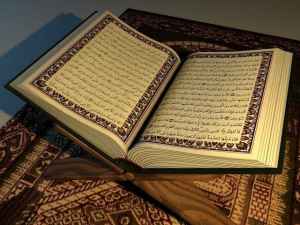 As is well known, the Qur’an is the book of scriptures for Islam. In his book, Exploring Islam: A Christian Perspective on the Life of Muhammad and the Qur’an, its author Lawrence R Farley offers a summary:
Contemporary Islam claims that the Qur’an as currently possessed represents the actual words of Allah as dictated to Muhammad…Muhammad’s role was merely that of a secretary receiving the divine dictation, one who recited the ipsissima verba, the actual words spoken by Allah (Farley, 101).
There is far more to a faithful Muslim’s understanding of their scriptures. We read this from IslamOnLine.net: “The Uncreated Quran: Doctrinal Lessons from Surah [chapter] Az-Zumar”:
Surah Az-Zumar [Qur’an’s chapter 39] provides clear evidence affirming the Uncreated Quran as the eternal word of Allah, a divine attribute that is uncreated. This affirmation is crucial in Islamic creed, emphasizing that Allah’s attributes, including his speech, are not created. Several verses within the Surah highlight this uncreated nature (IslamOnLine, 1).
We have these verses from that surah:
The revelation of this Book is from Allah, the Exalted in Power, Full of Wisdom (Quran 39: 1).
The revelation of the Book is from Allah, the Exalted in Might, the Wise. Indeed, We have sent down to you the Book in truth, so worship Allah, sincerely for Him alone is the religion (Qur’an 39: 41).
Indeed, We have sent down to you the Book in truth to make firm those who believe in the unseen, establish prayer, and rely upon Allah. Yet they would not be guided except for those who should believe (Qur’an 39: 43).
IslamOnLine.net’s article then provides commentary from Muslim scholars on page 2:
Al-Suyuti stated: The Quran is the uncreated word of Allah, existing eternally with Him. It is not a created entity but a divine attribute.
Al-Razi further elaborated: The Quran, as a divine attribute, is inherently uncreated, aligning with Allah’s eternal nature.
Three were those who disagreed stating that Qur’an is not co-eternal with Allah. Among this cohort were the Mu’tazilis and the Jahmiyyahs. Farley informs us,
Opponents of this view, the so-called Mu’tazilis, or “rationalists” who arose in Iraq from the eighth century, objected that to make the Qur’an eternal and uncreated would be to introduce a second divine principle, and would therefore heretically compromise the sole unity of Allah…At length their opponents triumphed, and established the view that the Qur’an was indeed as eternal as Allah Himself. For most Muslims today, this remains the orthodox view of the Qur’an (Farley, 102).
If you are aware of the Church’s history, you will see a surprising parallel to the Arian controversy of the early fourth century. Arius denied that Christ was co-eternal with the Father, stating that Jesus was only a created being. The catholic and orthodox position affirms the opposite: Jesus, the Only-begotten Son, is co-eternal with the Father, being of the same essence of the Father, begotten, not created. The first portion of the Nicene Creed refutes Arius and establishes orthodox, catholic Christology. It reads,
I believe in one God the Father Almighty creator of heaven and earth, of all things seen and unseen. And in one Lord Jesus Christ, the Only-begotten Son of God, begotten of the Father before all ages; Light of Light, true God of true God, begotten not created, of one essence (ὁμοούσιον) with the Father through whom all things were made.
Again, as noted from IslamOnLine.net, we have the Islamic understanding that the Qur’an is the eternal, uncreated word of Allah. Christians have a very different understanding of both the Old Testament (OT) and the New Testament (NT). Our Scriptures are not coeternal with God. They are holy, inspired, truthful and authoritative, but are the product of a synergy between God and man. We read this from St Peter:
First of all you must understand this, that no prophecy of Scripture is a matter of one’s own interpretation, because no prophecy ever came by the impulse of man, but men moved by the Holy Spirit spoke from God (…ἀλλὰ ὑπὸ πνεύματος ἁγίου φερόμενοι ἐλάλησαν ἀπὸ θεοῦ ἄνθρωποι) ( 2 Peter 1: 20 – 21).
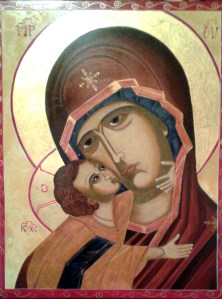
Theotokos Tender Mercy
Once more, the Christian Scriptures are understood in a very different way. Our Scriptures are not the manifestation of God to humanity. Rather, the manifestation of God to humanity is the Logos, or the Word, made flesh. We have this from St John 1: 1,
Ἐν ἀρχῇ ἦν ὁ λόγος, καὶ ὁ λόγος ἦν πρὸς τὸν θεόν, καὶ θεὸς ἦν ὁ λόγος.
(In the beginning was the Word, and the Word was with God, and the Word was God.)
St John continues in the following verse: He writes specifically about the Incarnation, the manifestation of the Logos in human flesh, in St John 1: 14,
Καὶ ὁ λόγος σὰρξ ἐγένετο καὶ ἐσκήνωσεν ἐν ἡμῖν, καὶ ἐθεασάμεθα τὴν δόξαν αὐτοῦ, δόξαν ὡς μονογενοῦς παρὰ πατρός, πλήρης χάριτος καὶ ἀληθείας·
(And the Word became flesh and dwelt among us, and we observed his glory, glory as the Only-begotten from the Father full of grace and truth).
I present two additional, two of many, NT witnesses regarding the Incarnation:
In many and various ways God spoke of old to our fathers by the prophets; but in these last days he has spoken to us by a Son, whom he appointed the heir of all things, through whom also he created the ages. He reflects the glory of God and bears the very stamp of his nature (…χαρακτὴρ τῆς ὑποστάσεως – here translated as nature, or being), upholding the universe by his word of power (Hebrews 1: 1 – 3)
Because in him dwells all the fullness of deity bodily (ὅτι ἐν αὐτῷ κατοικεῖ πᾶν τὸ πλήρωμα τῆς θεότητος σωματικῶς) (Colossians 2: 9).
The Qur’an, then, is Islam’s attempt at countering the Incarnation of the Son of God. Their assertion that the Qur’an is uncreated and eternal must be challenged.
Western orientalists, and other scholars, point out multiple problems with the Qur’an. One such problem is addressed by what follows. Among those concerns are background features that have Christian roots, and some of the sources come from heretical Christian groups. This has been pointed out beginning a few decades ago by the works of Gunter Luling’s A Challenge to Islam for Reformation, and Christoph Luxenberg’s The Syro-Aramaic Reading of the Qur’an. It is well documented by a multitude of scholars that about 20 to 25% of the Qur’an is incomprehensible, even in its classical Arabic text. This information flies in the face of standard Islamic defense of the book. This reminder is given:
Al-Sabuni: The Quran is not a created entity but a manifestation of Allah’s eternal speech, preserved and protected by Him (IslamOnLine.net, 6).
If the Qur’an, then, is Allah’s eternal speech, and a clear witness, why do incomprehensible portions exist? And, why do scholars state that there is a Christian underpinning to some of the Qur’an’s text? In part the answer has its source in the alphabet of Arabic in its form from the seventh century and for about 200 years after this period. The language at that time was made up of only consonants (this was the case at one time for Hebrew as well). Arabic in this period lacked diacritical marks which attach vowel sounds to the consonants, and distinguish identical letters from one another. Thus, the addition of diacritical marks offered two advantages: proper pronunciation of words, and differentiation between different words that have the same consonants. Here is an example: Without vowels we would have this puzzle for the English reader: TH HRT F TH LND
With this phrase there are a few possibilities for intended meaning. Here are two of them.
The first option: The heart of the land, the second: the hart of the land
This shows the problem stemming from the classical Arabic era. Even though the language evolved by attaching diacritical marks, yet, no clarity of meaning was truly imparted. The text’s ambiguity remained a problem. The works scholars Luling and Luxenberg stripped away Arabic diacritical markings in these incomprehensible verses and replaced them with the diacritical markings found in Syriac. The verses found in Qur’an 74: 11 – 17 offer an example of their reworking of the text. These seven Qur’anic verses in English read,
Leave me alone with the one I created alone and to whom I granted extensive wealth and sons to be by his side and spread before him, easing, then he desires that I should add more. No indeed! He has been toward our verses obstinate. I will cover him with arduous torment (Qur’an 74: 11 – 17).
In Robert Spencer’s book Did Muhammad Exist? An Inquiry Into Islam’s Obscure Origins (2021 revised edition) he explains the work of Luling.
To shed some light on this sura [chapter] Luling looks closely at verses 11 – 17. In the traditional rendering, this passage is full of questionable material. Like Qur’an 96: 9 – 19, it denounces an anonymous miscreant. Of whom is Allah, the sole creator and judge of all things, demanding that he be left alone to deal with?…Luling smooths out the difficulties and presents a [Syriac] reconstruction that makes more sense than the standard Qur’anic text. This reconstruction reveals the text as a [heretical Arian] Christological confession (Spencer, 230).
Spencer presents Luling’s reconstruction:
He has created me and the one He has created as a unique being. And He has made him a property obedient to His will. And He has testified to him by witnesses. And He paved for him the way. Then he desired that he might increased. Not at all that he was rebellious against His commandments. So finally He has made him step through death up to the heights (Spencer, 233).
Spencer offers his insight:
And so, he [Luling] argues, this passage begins to become clear as a Christian confession of faith – but not reflecting the theology of the Byzantine Empire of the Church of Constantinople. Rather it is a rejection of Trinitarian Christology (Spencer, 233)…Thus it is entirely possible that the Christian substratum of the Qur’an reflects a Christology that views Christ as a created being (Spencer, 234).
As pointed by Spencer, the Qur’an’s intentional misunderstanding of Christ comes from heretical Arian and anti-Trinitarian sources contemporary with the Qur’an’s development. Spencer confirms this:
As the Islamic faith began to develop as a distinct religion, it decisively rejected this [orthodox, catholic] faith in Christ and reinterpreted the Qur’an to fit its developing new theology…There is a great deal more in the Qur’an that suggests the presence of an original Christian substratum (Spencer, 236, 237).
Practicing Muslims would likely be both unaware and would deny the veracity of the Syriac reconstructions since they contradict Islamic orthodoxy. From what is stated above, I put forward this: The text of the Qur’an is created and non-eternal. It is a developed work of Muslims who, in several cases, utilized certain heretical Arian texts. This was done to create their book, and to develop their theology as it evolved through the centuries. What has been created is an ossified text that can neither breathe nor answer serious and honest questions about the Qur’an’s textual history.
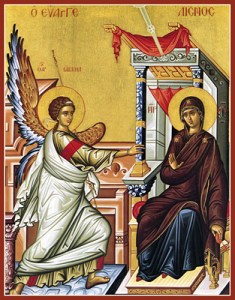
Icon of the Annunciation
In a previous “Conta Islam” posting, I stated that Muhammad is an antichrist: Islam denies that Jesus is the Incarnate Son of God, and that he is God as is his Father is God. To take this a step further Islam has produced an anti-Incarnation when it claims the Qur’an is uncreated and eternal. I will take this another step further. In the Cave of Hira, a demon posing as the Archangel Gabriel appears to Muhammad and forcefully demands that Muhammad read three times to begin the revelation of Allah to Muhammad. This was an anti-Annunciation, the opposite of which peacefully took place between the true Gabriel and Mary. The anti-Annunciation in the Cave of Hira brought about an anti-Incarnation – not the holy one of the flesh, bone, and blood of Jesus Christ – but one which has a defective, and inferior physicality of palm leaf, parchment and ink.
Muslims state that the Qur’an is uncreated, eternal, and complete. To conclude it seems that in truth they should desire Jesus Christ who is eternal, uncreated. He is the Son of God who came to humanity and the cosmos in a fully human body. They do not yet know him, but need to know him as their God, Lord, and Savior.
In Christ who alone is the Way, the Truth and the Life,
Fr Irenaeus
Contra Islam: The Calling of Muhammad
Posted: April 23, 2026 Filed under: Contra Islam | Tags: did Muhammad encounter a demon in the Cave of Hira?, Lawrence Farley, the Archangel Gabriel and Joseph's dreams, the Archangel Gabriel and Mary during the Annunciation, The calling of Muhammad, the calling of Muhammad per al-Bukhari, the calling of the Old Testament prophets, the calling of the Prophet Jeremiah, the Cave of Hira, the Hadith of al-Bukhari 2 CommentsMy critical examination of Islam continues with this posting. Though my words may be taken as confrontational, I bear no ill will for any Muslim. Rather, I pray they are drawn into the Light and Life of Jesus Christ who is God in human flesh, the God who forgives their sins by his death on the Cross, and gives them eternal life by means of his resurrection from the dead.
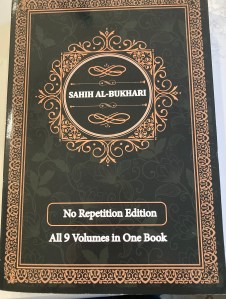 There is this question: How did the work of Muhammad and dictation of the Qur’an come to be? To answer this question, I have turned to Islam’s most trusted collection of the Hadith (collections of the stories about Muhammad): Sahih al-Bukhari. As a biographical note, Muhammad al-Bukhari was an imam, and was born in 810 AD (or 194 AH according to the Islamic dating system) in the city of Bukhara which is in present-day Uzbekistan. He was a devout student of Muhammad’s life via the growing hadith collections of his day. His own compilation, per Islamic tradition, occurred about 200 years after Muhammad’s death (632 AD). Yet, modern western scholars contest this timeline, since the work attributed to him did not have full circulation until the 14th century. Furthermore, the historicity of all the Hadith is more than a bit questionable.
Al-Bukhari provides the traditional overview of Muhammad’s inspiration:
Allah sent down his divine inspiration to his apostle continuously and abundantly during the period preceding his death till he took him unto him. That was the period of the greatest part of revelation, and Allah’s messenger…died after that (al-Bukhari, 1514).
By his collection he informs us how Muhammad began to receive the Qur’an. He provides details for his readers by quoting Aisha, his child bride (she was married to him at age six years, and their marriage was consummated when she was aged nine years!):
Al-Harith bin Hisham asked Allah’s messenger…”O Allah’s messenger! How is the divine inspiration revealed to you?” Allah’s messenger…replied, “Sometimes it is (revealed) like the ringing of a bell, this form of inspiration is the hardest of all and then this state passes off after I have grasped what is inspired. Sometimes the Angel comes in the form of a man and talks to me, and I grasp whatever he says” (al-Bukhari, 2).
She offers her recollection regarding Muhammad’s spiritual practice at the time of his calling:
The commencement of the divine inspiration to Allah’s messenger…was in the form of good dream which came true like bright daylight, and then the love of seclusion was bestowed upon him. He used to go in seclusion in the Cave of Hira where he used to worship (Allah alone) continuously for many days before his desire to see his family…(al-Bukhari, 3).
Given this, we learn that Muhammad piously worshipped the one he knew as Allah. In the same recollection, Aisha gives further information which includes the disturbing initial and fateful encounter with “The Angel”:
…The angel came to him and asked him to read. The prophet…replied, “I do not know how to read.” The prophet…added, “The angel caught me (forcefully) and pressed me so hard that I could not bear it anymore. He then released me and again asked me to read, and I replied, “I do not know how to read.” Thereupon he caught me again and pressed me a second time till I could not bear it anymore. He then released me and again asked me to read but again I replied, “I do not know how to read (or what shall I read)?” Thereupon he caught me for the third time and pressed me, and then released me and said, “Read in the name of your Lord, who has created (all that exists), created man from a clot. Read! And your Lord is the Most Generous [Qur’an 96: 1 – 3 is quoted]…(al-Bukhari, 3).
The hadith continues as it relates Muhammad’s intense distress caused by this encounter:
Then Allah’s messenger…returned with the inspiration and with his heart beating severely. Then he went to Khadija [his first wife]…and said, “Cover me! Cover me!” They covered him till his fear was over and after that he told her everything that had happened and said, “I fear that something may happen to me.” Khadija replied, “Never! By Allah, Allah will never disgrace you” (al-Bukhari, 3).
Khadija relates the encounter Muhammad had with the angel to her cousin, Waraqa. This man identifies “the Angel” to be Gabriel: “This is the one who keeps the secrets, the angel Gabriel whom Allah sent to Moses” (al-Bukhari, 3).
Here is the focus of this posting: Muhammad’s encounter with “Gabriel” is aggressive and confrontational. His experience is contrary to biblical encounters with the Archangel Gabriel, because this encounter frightened Muhammad. In his book Exploring Islam, A Christian Perspective on the Life of Muhamma and the Qur’an, Alhambra, California, Sebastian Press, 2022, Lawrence R Farley presents this information from another hadith:
He was in such agony of mind over the revelation that he became depressed and often wanted to throw himself from a cliff, and was only dissuaded when he heard the spirit say, “O Muhammad! You are Allah’s prophet” (p. 32).
Icon of the Annunciation
Again, “the Angel’s” aggressive, disturbing encounter with Muhammad is the focus of this posting. This is important because this spiritual interaction is the complete opposite of the New Testament’s recording of human encounters with the Archangel Gabriel, and the calling of the major prophets of the Old Testament by God himself. The first contrast examined is the Archangel Gabriel’s interaction with St Mary during encounter called the Annunciation (which is celebrated every March 25).
In the sixth month the angel Gabriel was sent from God to a city of Galilee named Nazareth, to a virgin betrothed to a man whose name was Joseph, of the house of David; and the virgin’s name was Mary. And he came to her and said, “Greetings, you who have been graced, the Lord is with you [Χαῖρε, κεχαριτωμένη, ὁ κύριος μετὰ σοῦ]. But she was greatly troubled at the saying, and considered in her mind what sort of greeting this might be. And the angel said to her, “Do not be afraid, Mary, for you have found favor with God. And behold, you will conceive in your womb and bear a son, and you shall call his name Jesus (St Luke 1: 26 – 31).
Note that St Gabriel’s actions are courtly and respectful. Note also that he calms her fears with his words, “Do not be afraid, Mary.” There is no harsh or violent action directed to her that would cause intimidation or coercion. His actions were not only derivative of his nature, they were demanded because St Mary must willfully consent to becoming the Mother of God:
And Mary said, “Behold, I am the handmaid of the Lord; let it be to me according to your word.” And the angel departed from her (St Luke 1: 38).
We note the angel’s same peaceful interaction by means of a dream with St Joseph the Betrothed:
Now the birth of Jesus Christ took place in this way. When his mother Mary had been betrothed to Joseph, before they came together she was found to be with child of the Holy Spirit; and her husband Joseph, being a just man and unwilling to put her to shame, resolved to send her away quietly. But as he considered this, behold, an angel of the Lord appeared to him in a dream, saying, “Joseph, son of David, do not fear to take Mary for your wife, for that which is conceived in her is of the Holy Spirit; she will bear a son, and you shall call his name Jesus, for he will save his people from their sins” (St Matthew 1: 18 -21).
Again, note there was no intimidation or consequential fear that came about by the angel’s words. Then, about two years later, St Joseph had another dream visitation by the angel after the birth of Jesus. This, too, was a peaceful dream encounter, and is found in St Matthew 2: 13 – 15.
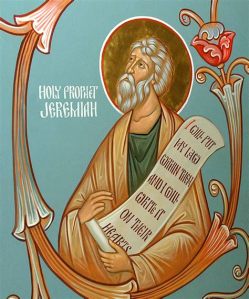 Also, in stark contrast to “Gabriel’s” demands placed upon Muhammad at his commissioning as a “prophet,” we can read of the commissioning of all the Old Testament prophets by God himself. All of them from the call of Samuel (1 Sam 3: 2 – 10) through the calling of all the minor prophets, we find no intimidation or coercion. Let’s examine the call of Jeremiah:
Now the word of the Lord came to me saying, “Before I formed you in the womb I knew you, and before you were born I consecrated you; I appointed you a prophet to the nations.” Then I said, “Ah, Lord God! Behold, I do not know how to speak, for I am only a youth.” But the Lord said to me, “Do not say, ‘I am only a youth’; for to all to whom I send you, you shall go, and whatever I command you, you shall speak. Be not afraid of them, for I am with you to deliver you, says the Lord.” Then the Lord put forth his hand and touched my mouth; and the Lord said to me, “Behold, I have put my words in your mouth” (Jeremiah 1: 4 – 9).
With Jeremiah’s commissioning we find promise and assurance, and there is no element of coercion or manipulation because God loves the man.
What, then, can be concluded? Given the hadith of al-Bukhari we learned that Muhammad was terrified by “the Angel”. We learned that Muhammad’s experience was the polar opposite of the experiences that came from the actions of the true Archangel Gabriel in the New Testament verses noted above, and the Lord God himself with the holy prophets of the Old Testament. I must ask, who was Muhammad worshipping in the Cave of Hira, and who posed as a commissioning angel in that cave? Accounts of demonic oppression, and even possession, generally violate the wills of those who are pressed to do their will. Based upon the interactions between humans and true, holy angels, and of the Lord himself, I must conclude that Muhammad worshipped (albeit unknowingly) a demon (some suggest Satan), and was commissioned violently by another demon posing as the holy Archangel Gabriel.
Violence begets violence. Coercion begets coercion. Fear begets fear. Lies beget lies. From this beginning we have Islam.
In Christ, who alone is the Way, the Truth, and the Life,
Fr Irenaeus
Contra Islam: The Seventh Century Antichrist
Posted: April 13, 2026 Filed under: Contra Islam | Tags: Apostolic Faith, Exodus 3: 14 and Jesus as God, I am the Existing One, Islam and Jesus, Islam is a religion of antichrist, Jesus declares himself to be God, John 8:58 and Jesus' self declaration to be God, Muhammad as antichrist, Quran 112: 1 - 4, Quran 112: 1 - 4 is anti Trinitarian, St John the Apostle, The Word in St John 1: 1 - 2 2 Comments
In the Qur’an Jesus (Isa in Arabic) is both acknowledged and given some degree of respect as a prophet, but only as a prophet who lived before Muhammad. Islam denies the core Christian knowledge and teaching of who Jesus is, and the salvation he gives to humanity. Islam denies Jesus’ deity and consubstantiality with the Father. Islam denies that Jesus is God in human flesh. Thus, I use the term antichrist. To understand Islam’s crucial error we must dive into what the Christian faith has always taught about Jesus. For this understanding, let’s turn to the fourth Gospel.
St John the Apostle, Evangelist, and Theologian is the only Apostle to use the word antichrist in the New Testament. In this posting I discuss how he uses this word, its meaning, and its application to the words of two of the Qur’an’s chapters (surah). These Qur’anic verses are a critical and core source of Islamic false teachings about the Person and nature of Jesus Christ:
Say: He is Allah, the one and only; Allah, the eternal, absolute; he begets not, nor is he begotten; and there is none like unto him (Qur’an 112: 1 – 4).
To him is due the primal origin of the heavens and the earth: How can he have a son when he has no consort? (Qur’an 6: 101a)
The Word Is God
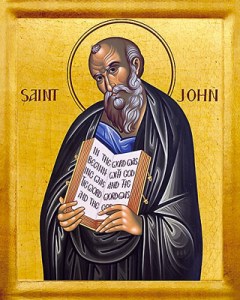 Initially, let’s examine the term theologian as it applies to St John. He is a theologian because he is first to articulate in written form the fact that Jesus is God. This brings us to the first chapter of his Gospel. The Greek text for St John 1: 1 – 2 is as follows:
Ἐν ἀρχῇ ἦν ὁ λόγος, καὶ ὁ λόγος ἦν πρos τoν θεόν, κα θεoς ἦν ὁ λόγος. οὗτος ἦν ἐν ἀρχῇ πρoς τoν θεόν.
(In the beginning was the Word, and the Word was with God, and the Word was God. This one was with God in the beginning.)
A bit of a grammatical deep dive is in order. In the above Greek text we find two uses of the word God: τoν θεόν (ton theon), which uses the definite article, τov (ton), and then θεoς (theos) which lacks the definite article (being anarticular). With the first usage, the definite article, τoν, is used to distinguish toν θεόν from the anarticular θεoς.
What is all of this about, and why is this important? While Greek uses definite articles, being “the” in English, the Greek language lacks an indefinite article, being “a” or “an” in English. Let’s look at this English example. Dolly is the dog. Using the definite article, this means Dolly is one particular dog. In English this sentence can be changed to Dolly is a dog. The use of the indefinite article “a” gives a different meaning: Dolly is one of an infinite number of dogs. In extension of this example, since there is no indefinite article in Greek, I must reword the sentence to Dolly is dog, meaning Dolly is an animal that possesses the quality of being dog. Thus, it would be incorrect to translate καὶ θεὸς ἦν ὁ λόγος as “and the Word was a god,” or one of many gods. The proper way to translate καὶ θεoς ἦν ὁ λόγος is, “and the Word was God.” With St John’s use of the anarticlular θεoς, this means ὁ λόγος (the Word) possesses the ontological quality of God, yet the Word is not τoν θεόν, the Father, the first Person of the Trinity.
St John is not done expressing further how the Word is God, and yet, is distinguished from the Father. He completes this theological distiction with this complementary verse: St John 1: 18,
θεoν οὐδεὶς ἑώρακεν πώποτε· μονογενὴς θεoς ὁ ὢν εἰς τoν κόλπον τοῦ πατρoς ἐκεῖνος ἐξηγήσατο.
(No one has ever seen God: God the Only Begotten who exists in the bosom of the Father made that one known.)
In this verse, St John further identifies the Word of verse one as the Only Begotten (Son) who knows the Father intimately, and makes the Father known to humanity. (I refer you to St John 12: 45 where Jesus says, “The one who perceives me, perceives the one who sent me.”)
The Word Became Flesh
St John continues orthodox and catholic Christology by declaring that the Word (Logos) took on human flesh to demonstrate, in the most compelling way possible, the loving heart of his Father:
Καὶ ὁ λόγος σὰρξ ἐγένετο καὶ ἐσκήνωσεν ἐν ἡμῖν, καὶ ἐθεασάμεθα τὴν δόξαν αὐτοῦ, δόξαν ὡς μονογενοῦς παρὰ πατρός, πλήρης χάριτος καὶ ἀληθείας· (St John 1: 14).
(And the Word became flesh and tabernacled with us, and we observed his glory, glory as the Only Begotten of the Father, full of grace and truth.)
Taken together, the Apostle has made two profound theological assertions. First, the one he calls both the Word and the Only Begotten (Son) is himself God, just as the Father is God. Also, from St John 1: 1 – 2, 18, we see that the Father and the Son have a relational union of being which parallels Jesus’ words in St John 10: 30, “ἐγὼ καὶ ὁ πατὴρ ἕν ἐσμεν (I and the Father are one).” Second, St John states that the second Person of the Trinity, the Word, the Only-begotten Son, took on human flesh.
Jesus Declares Himself to Be God
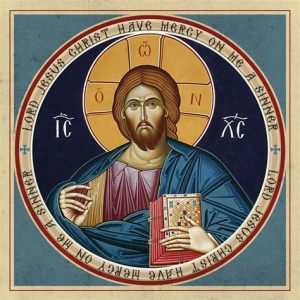 Elsewhere in his fourth Gospel, St John goes beyond his theological assertion, he also includes Jesus’ own words – words that declare he is God. There are many examples in St John’s gospel, but only two verses will be examined.
The background and formative text for this part of the posting comes from Exodus 3: 14. The Greek text of the Septuagint (LXX) is used to show the importance of Jesus’ words as recorded in Greek by St John. Here, Moses has encountered God in the Burning Bush on Mount Sinai:
καὶ εἶπεν ὁ θεος προς Μωυσῆν Ἐγώ εἰμι ὁ ὤν· καὶ εἶπεν Οὕτως ἐρεiς τοῖς υἱοῖς Ισραηλ Ὁ ὢν ἀπέσταλκέν με προς ὑμᾶς.
(And God said to Moses, “I Am the Existing One.” And he said, “Thus, you shall say to the sons of Israel, The Existing One sent me to you”).
God reveals his name to Moses: Ἐγώ εἰμι ὁ ὤν (I am the Existing One) . The words Ἐγώ εἰμι (I am) are used by Jesus to declare that he is the same God now manifested in human flesh.
We are now ready to move to the eighth chapter of St John. Here an adversarial debate takes place between Jesus and the Jewish authorities. Two uses of Ἐγώ εἰμι by Jesus are examined. The first is found in St John 8:24,
This is why I said to you that you shall die in your sins. Unless you should believe that I am (Ἐγώ εἰμι) you shall die in you sins.
In his online essay “The ‘I am’ Sayings in John’s Gospel,” Phander Center for Apologetics & Polemics, 2024, Dr Pat Andrews helps us see the importance of this verse. He directs us to Isaiah 43: 25 to clarify the significance of Jesus’ “I am” statement:
I, I am (Ἐγώ εἰμι) the one who washes away your lawlessness and I shall never remember them.
The contentious dialogue with the Jewish authorities intensifies, Jesus moves the conversation to the concluding two verses and climax of the eighth chapter:
“Your father Abraham rejoiced that he might see my day, and he saw and was glad.” Therefore, the Jews said to him, “You are not yet 50 years old, and you say you have seen Abraham?” Jesus said to them, “Truly, truly I say to you, before Abraham was born, I am (Ἐγώ εἰμι).” Therefore, the Jews took up stones in order that might stone him. But, Jesus hid himself and went out of the Temple passing through the midst of them, and thus [he] passed by [them] (St John 8: 56 – 59).
Commenting on these verses, Andrews notes,
The Jews’ reaction to 8:58 (stoning) clarifies that they understood Jesus as claiming deity – the name YHWH…Here is the ego eimi…and there is no ambiguity in its reference to Ex 3: 14.
Antichrist
St John the Apostle also defines the term antichrist for us. We turn now to his first epistle, or letter:
Who is the liar, except the one who denies that Jesus is not the Christ? This one is the antichrist, the one who is denying the Father and the Son. Everyone who denies the Son does not have the Father (1 St John 2: 22 – 23).
Beloved, do not believe every spirit, but test the spirits to see whether they are of God; for many false prophets have gone out into the world. By this you know the Spirit of God: every spirit which confesses that Jesus Christ has come in the flesh is of God, and every spirit which does not confess Jesus is not of God. This is the spirit of antichrist, of which you heard that it was coming, and now it is in the world (1 St John 4: 1 – 3).
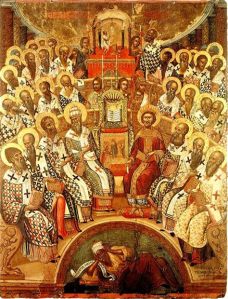
The Fathers of Nicea
Therefore, an antichrist is one who denies that Jesus is the Christ, that is, God in human flesh, and also one who denies the divine union of the Father and the Son which Jesus clearly proclaims in St John 10: 30, “I and the Father are one (ἐγὼ καὶ ὁ πατὴρ ἕν ἐσμεν).” The Nicene Creed defines this shared being of deity, this consubstantiality (ὁμοούσιον), which the Father and the Son both possess. I quote from the first few sentences of the Creed:
I believe in one God the Father Almighty creator of heaven and earth, of all things seen and unseen. And in one Lord Jesus Christ, the Only-begotten Son of God, begotten of the Father before all ages; Light of Light, true God of true God, begotten not created, of one essence (ὁμοούσιον) with the Father through whom all things were made.
Who, then, is the seventh century antichrist? Is it the so-called prophet of Islam, Muhammed? Perhaps, but the Islamic antichrist doctrine probably came from some other ancient source that predated the lifetime of Muhammad. Presented again is this defining and damning text from the Qur’an:
Say: He is Allah, the one and only; Allah, the eternal, absolute; he begets not, nor is he begotten; and there is none like unto him (Qur’an 112: 1 – 4).
By these four verses from the Qur’an, we see that Islam denies both the Son’s existence, and that of the Trinity. With these verses, there is the implied denial of the Incarnation. The defining criteria of antichrist are documented and applied to Islamic doctrine.
What, then, is the source of this passage? Again, it is unlikely that it comes from Muhammed himself, since western critical scholars of Islam conclude that Muhammed was theologically informed by a very limited Abrahamic monotheism. In his book Did Muhammad Exist, an Inquiry Into Islam’s Obscure Origins, (Revised ed., Nashville, Bombardier, 2021), Robert Spencer writes,
During the [years of early] conquest…the Islamic religion possessed only a rudimentary theology, which was probably even more basic among military units (p. 31).
Likely, their antichrist dogma comes from the early non-Nicene sects that were banished from Byzantine territories to Syria and Arabia. Among them were Arians, followers of the deposed bishop Arius who falsely taught that Jesus was a created being – not God in human flesh. Spencer writes about the Arians:
The Arians were by no means the first Christian group to view Christ as created. The Jewish-Christian Ebionites viewed Jesus as the Messiah but not in any sense divine…the Christian substratum of the Qur’an reflects a Christology that views Christ as a created being (p. 234).
Spencer continues,
As the Islamic faith began to develop as a distinct religion, it decisively rejected this faith in Christ and reinterpreted the Qur’an to fit its developing new theology (p. 236).
From another source, Exploring Islam, A Christian Perspective on the Life of Muhammad and the Qur’an, (Alhambra, CA, Sebastian Press, 2022), author Lawrence R Farley gives this insight:
The question of whether or not Muhammad was a true prophet depends upon one’s assessment of his handling of the stories and montheistic message he received from his Jewish and Christian sources. It is possible that his experience of listening to stories from Jews and Christians formed the matrix in which Allah spoke to him (p. 84).
The Qur’an’s “message” about Jesus Christ did not come from any true revelation, but was a simple reapplication of Arian and similar non-Nicene false Christologies, and thus, antichrist heresies.
The Apostolic teaching of St John
St John begins his first letter echoing the opening words of his Gospel’s first verses. But, he also expands on its words by establishing his apostolic authority. He declares that he was a witness of the Incarnate Word together with the other Apostles:
That which was from the beginning, which we heard, which we have seen with our eyes, which we observed, and our hands have touched concerning the Word of Life. The Life was manifested, and we have seen, and we testify, and we declare to you the Eternal Life, who was with the Father, and was manifested to us. That which we have see and have heard, we declare to you, in order that you also might have fellowship with us. And our fellowship is with the Father and with his Son Jesus Christ. And we write these things to you, in order that our joy might be made complete (1 St John 1: 1 – 4).
St John establishes that the Apostles saw, heard, and touched the Incarnate Word, the second Person of the Trinity who is the Only-begotten Son of God. He was no phantom or illusion that the antichrists of St John’s day taught about Christ.
The lies of any antichrist are contrary to the Apostolic faith, and inconsistent with Apostolic fellowship, the life of faith in the Church, and salvation given by the Triune God. Thus, St John gives us these words:
That which you heard from the beginning, let it abide in you. If that which you heard from the beginning should abide in you, you also abide in the Son and in the Father. And this is the promise which he declared to us, eternal life (1 St John 2: 24 – 25).

Light and Life
All of this was true in the days of St John, and all of this is equally true today for us alive in these troubling and dark days. The teachings of antichrists are all around us: Mormonism with its false prophet Joseph Smith, Jehovah’s Witnesses, Judaism, and of course Islam. Yet, there are antichrists found in academia, government, entertainment, and business – any and all who deny the Apostolic Faith. And, of course, one day there will be the final Antichrist who will deceive the nations. St John gives us more:
They are of the world, therefore what they say is of the world, and the world listens to them. We are of God. Whoever knows God listens to us, and he who is not of God does not listen to us. By this we know the spirit of truth and the spirit of error (1 St John 4: 5 – 6).
In Conclusion
This posting is to inform the faithful in Christ of our faith, and to make clear Islam’s doctrine regarding our Lord is of the spirit of antichrist. Although it is popular for the uninformed to object by saying, “But, we worship the same God!” Nothing could be further from the truth. Allah is a false god, and Muhammad, if he existed as Muslims insist, is a false prophet. Hence, Islam is a false religion – a religion of antichrist.
Let me state that we are not to bear ill will to our Muslim neighbors. Rather, it should be every Christian’s prayer that Muslims come to faith in God: Father, Son, and Holy Spirit — the One True God. And, thus, have the joy of fellowship with us who are of the One, Holy, Catholic, and Apostolic Faith.
In Christ who alone is the Way, the Truth, and the Life,
Fr Irenaeus
Contra Islam Part One: The Hadith
Posted: March 24, 2026 Filed under: Contra Islam, Etcetera | Tags: Abd al-Malik and the institutionalization of Islam, contractions between the Hadith and the Qur'an, Muhammed, plagiarism in the Hadith, problems with isnads, problems with the Hadith, Robert Spencer, The Hadith, the Hadith and biographical information about Muhammed, The Qur'an, the six canonical Hadith collections 5 CommentsFor the entirety of this century, Islam has been in the spotlight and under the microscope. In this ongoing examination it is my observation that there are two camps: There are those who insist on overlooking the glaring problems with Islam, and those who seek to demonize every Muslim on the planet. With my initial posting on the subject of Islam, I first wish to clearly state that a Muslim can be a good friend, neighbor, and coworker. Thus, there is no reason to bring prejudice into any given encounter with a Muslim, or bear any inherent ill will. Yet, Islam cannot go unquestioned and unchallenged, and is to be honestly examined given its increasingly radical presence in much of the western world. Presently, I am in the process of my own critical examination of Islam. To be forthcoming, I am stating up front that I have a set bias against Islam — I am not neutral on this subject, and none of my postings will pretend to be sympathetic to this religion.
Over the past several decades there is a large and growing body of contemporary scholarship looking at the origins of the Qur’an, the person of Muhammed, and the traditional collection of works called hadiths. The Hadith will be the topic of this posting.
A Qur’an in Arabic
The Qur’an is the book of scriptures for Islam, and was written in an ancient form of Arabic. This book of scriptures has been translated into nearly every language on earth. Yet, it is often difficult to understand even for Arabic speakers and scholars of the Qur’an. The Hadith, then, aid Muslims to better understand the book.
Added to Qur’anic interpretation, there is the subject of their prophet who is himself a bit of a mystery. It must be stated that it is important to note that the name / title of Muhammed is found only four times in the Qur’an. Thus, the Qur’an gives scant biographical information about him. As Islam spread from its place of origin, its converts wanted more and more knowledge about him. To fill in the blanks, the hadiths were created by Muslims. This process began about 70 years after his death in 632 AD. The contemporary scholar Robert Spencer provides information on the problematic nature of the Hadith as they developed over the following centuries:
Compounding this [the methods concerning how to inform a conquered people about this imposed foreign religion] are the shaky historical foundations of the Hadith, the voluminous accounts of Muhammad’s words and deeds. The importance of the Hadith in Islam cannot be overstated. They are, when Islamic scholars deem the accounts authentic, second in authority only to the Qur’an itself. Along with the Qur’an that they elucidate, the Hadith form the basis for Islamic law and practice regarding both individual religious observance and the governance of the Islamic state. And in fact, so much of the Qur’an is obscure and opaque, and explained only in the Hadith, that functionally, if not officially, the Hadith are the primary authority in Islam (Robert Spencer: Did Muhammad Exist? An Inquiry into Islam’s Obscure Origins, Nashville, Bombardier Books, 2021, 67. Hereafter, Spencer).
The hadiths guide Islamic practice (known as sunna). However, their history shows a great deal of manipulation by their authors and compilers as we see in the following:
My copy of Sahih Al-Bukhari
Muslims also fabricated hadiths in the heat of political and religious controversies that they hoped to settle with a decisive, albeit hitherto unknown, word from the prophet. Abd al-Malik [a ruler who first began to institutionalize Islam under his rule around 685 AD] at one point wanted to restrict Muslims from making pilgrimages to Mecca, since he was afraid that one of his rivals would take advantage of the pilgrimage to recruit followers. Accordingly, he prevailed upon the hapless al-Zuhri to fabricate a hadith to the effect that a pilgrimage to the mosque in Jerusalem (Bayt al-Maqdis) was just as praiseworthy in the sight of Allah as one to Mecca. Al Zuhri went even further, having Muhammad say that “a prayer in the Bayt al-Maqdis of Jerusalem is better than a thousand prayers in other holy places.” This hadith duly appears in one of the six canonical Hadith collections that Muslim scholars consider most reliable: the Sunan of Muhammad ib Maja (824 – 887). (Spencer, 75)
Thus, Spencer declares,
The consequence of all this was inevitable: utter confusion. Since warring parties were all fabricating hadiths that supported their positions, the Hadith is riddled with contradictions. (Spencer, 79)
With concern for their proliferation — of which Muslims were aware — there had to be sorting processes for the hadiths. To confirm as a “truthful” source (the term for the process is siddiq) coming from the multitude of hadiths, Muslim authorities had to come up with methods to bring some degree of control and order to the problem. Six important “truthful” Hadith collections were named and were given the label sahih. These are in order of acceptance:
-
- Sahih Bukhari (810 – 870)
- Sahih Muslim (by Muslim ibn al-Hahhah 821 – 875)
- The Sunan of Abu Dawud al-Sijistani (818 – 889)
- As-Susan as-Sughra, by Ahmad ibn Shuayb al-Nasai (829 – 915)
- The Jami of Abi Isa Muhammad Al-tirmidhi (824 – 892)
- Sunan of Muhammad in Maja (824 – 887)
The Muslims had criteria to establish “authenticity” / “truthfulness”. First, there is community acceptance. Another criterion examines a “chain of transmission”, or “chain of custody” — such a chain is called isnad.
They claimed to be able to distinguish genuine material about Muhammad from forged hadiths largely by examining the chain of transmitters (isnad), the list of those who had passed on the story from the time of Muhammad to the present. Islamic scholars grade individual traditions according to their chains of transmitters as “sound,” “good,” “weak,” “forged,” and so on…A hadith is considered sound if its chain of transmitters included reliable people and goes back to a recognized authority. (Spencer, 83)
The reliability of the Hadith are shaky at best since the very earliest came into existence, as mentioned above, about 70 years after Muhammad’s death. But, as Spencer points out, the reliability of isnad is equally shaky:
The apparent reliability of the isnad chain was what determined authenticity. It didn’t matter if a hadith was self-contradictory or absurd on its face; so long as its isnad chain was clear of anomalies, and it did not contradict the Qur’an [emphasis added], the tradition had no obstacles to being accepted as reliable…If a hadith could be forged, however, so could its chain of transmission. There are numerous indications that isnads were forged with the same alacrity with which matns — that is, the content of the hadiths — were invented. (Spencer, 84)
The isnads themselves didn’t start appearing until after hadiths had begun circulating (Spencer, 85).
In other words, it appears that nothing can be regarded as historical. Spencer writes this concerning Islamic tradition:
The assumption in Islamic tradition, at least regarding hadiths that are declared to be sahih, is that all this transmission went on with absolute accuracy and no legendary elaboration. But hadiths are not ruled sahih by some criteria for measuring their historical reliability; rather, the principal requirements for sahih status are compatibility with the Qur’anic message [emphasis added] and a sound isnad chain. (Spencer, 94)
Spencer also addresses new concerns — that Hadith can be contrary to the message of the Qur’an. To demonstrate this fact, the subject of miracles comes to the foreground. The absence of miracles by Muhammed is addressed,
The clearest evidence of this comes from the Qur’an’s repeated assumption that the messenger who received its revelations was not a miracle worker…Allah tells his messenger that even if the prophet did come to the unbelievers with a miracle, they would reject him anyway (Spencer, 103).
I present these passages which declare Muhammed only to be a “warner” and a “guide”:
Qur’an 2: 118. “Say those without knowledge: ‘Why speaketh not Allah unto us? Or why cometh not unto us a sign? So said the people before them words of similar import Their hearts are alike. We have indeed made clear the Signs unto any people who hold firmly to Faith (in their hearts).
Qur’an 6: 37. “They say: ‘Why is not a sign sent down to him from his Lord?’ Say: ‘Allah hath certainly power to send down a Sign: but most of them understand not.’”
Qur’an 10: 20. “They say: ‘Why is not a Sign sent down to him from his Lord?’ Say: ‘The Unseen is only for Allah (to know). Then wait ye: I too will wait with you.’”
Qur’an 13: 7. “And the Unbelievers say: ‘Why is not a Sign sent down to him from his Lord?’ But thou art truly a warner, and to every people a guide.”
We read this from the all-knowing Wikepedia:
The Qur’an does not explicitly record Muhammed performing physical miracles liker earlier prophets; instead, it emphasizes that the greatest miracle is the revelation of the Qur’an itself.
We have Spencer’s insight:
The repetition of this theme suggests that one of the primary criticisms the unbelievers brought against the prophet was that he had no miracles to perform; the Qur’an was intended to be sufficient sign in itself: “And is it not sufficient for them that We revealed to you the Book which is recited to them? Indeed in that is a mercy and reminder for a people who believe ([Qur’an] 29: 51). (Spencer, 104)
What follows gives an example how a hadith, though accepted canonically, is undoubtably seen to contradict the Qur’an. Spencer gives this example of the problem:
Yet the Muhammad of Ibn Hisham’s biograpy (sira) is an accomplished miracle worker. Ibn Hisham relates that during the digging of the trench that ultimately thwarted the Meccans’ siege of the Muslims in Medina, one of Muhammad’s companions prepared “a little ewe not fully fattened” and invited the prophet to dinner. Muhammad, however, surprised his host by inviting all of those who were working on the trench to dine at the man’s home. The prophet of Islam solved the problem just as Jesus in the Gospels multiplied bread and fish: “When we had sat down we produced the food and he blessed it and invoked the name of God over it. Then he ate as did all the others. As soon as one lot had finished another lot came until the digger turned from it” (Spencer, 104).
Spencer summarizes the problem with Ibn Hisham and all other hadith accounts of Muhammad:
If Ibn Hisham’s biography is largely or even wholly pious fiction, all the information about Muhammad that is generally regarded as historical evaporates (Spencer, 106).
I conclude the the body of the Hadith are problematic, and in spite of any accepted isnad, must be taken with the proverbial “grain of salt”. Additionally, the Christian will note that the above noted hadith has its New Testament parallel to the Feeding of the Five Thousand which is found all all four of the Gospels (see, for example, St John 6: 1 – 14). Furthermore, the Qur’an includes other allusions and parallels to both the Old and New Testaments. It is therefore evident that many things in the Qur’an and the Hadith are cases of plagiarism and outright invention and fabrication.
Light and Life
Christians are in a war that has enemies many fronts. The escalating conflict with Islam is but one of them, yet is the emerging and primary front of attack as is now seen, for example, in Great Britain. I offer an Orthodox hymn that speaks to this ongoing struggle:
O Lord, save your people, and bless your inheritance. Grant victories to the Orthodox Christians over their adversaries; and by virtue of your Cross, preserver your habitation.
In Christ who is alone the Way, the Truth, and the Life,
Fr Irenaeus

