Flesh versus Spirit
Posted: June 30, 2026 Filed under: Etcetera | Tags: Flesh versus Spirit in Romans, overcoming sin, power of the Sacraments, Prayer of the Hours, sanctifying ourselves by the Spirit, spiritual weapons, The Indwelling Spirit of God Leave a comment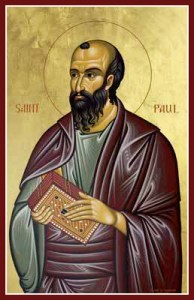 This posting focuses on St Paul’s observed spiritual conflict between flesh and spirit, or that between sinfulness and holiness. The Apostle describes this battle in the seventh chapter of his letter to the first century Roman Christians. He writes about this intense conflict that took place within him while a Pharisee under the Mosaic Law. A portion of his exposition is found in the following verses:
Now, if I do what I do not want, it is no longer I that do it, but sin that dwells [oikousa] in me. So, I find it to be a law that when I want to do right, evil lies close at hand. For I delight in the law of God in my inmost self. But, I see in my members another law at war with the law of my mind and making me captive to the law of sin which exists in my members (Romans 7: 20 – 23).
Yet, with these words, St Paul does not excuse this inner civil war — he gives praise to his Savior:
Wretched man that I am! Who will deliver me from this body of death? I give thanks to God through Jesus Christ our Lord…So there is now no condemnation for those in Christ Jesus. For the law of the Spirit of Life in Christ Jesus set me free from the law of sin and death (Romans 7: 25a – 8:2).
Given this truth, this reality, St Paul then moves on in the eighth chapter of Romans:
But you are not in the flesh but in the Spirit since the Spirit of God dwells [oikei] in you. Now, if someone does not have the Spirit of Christ, this one is not his. But, if Christ is in you, indeed the body is dead on account of sin, yet the spirit lives on account of righteousness. Now, if the Spirit who raised Jesus from the dead dwells [oikei] in you, the one who raised Christ will bring to life even your mortal body on account of his Spirit who is living [enoikouv] in you. So then, brothers we are debtors, not to the flesh, to live according to the flesh — for if you live according to the flesh you are going to die. But, if by the Spirit you put to death the practices of the body you will live (Romans 8: 9 – 13).
This is the teaching of the Church and we are to pray for, and work for our sanctification, or the development holiness of in life. This can be seen from a portion of the Prayer of the Hours. It asks this of God: “Sanctify our souls, purify our bodies, set aright our minds, and cleanse our thoughts.” Elsewhere, in another epistle, The Apostle prays that this godliness may be our reality: “Now, may the God of peace himself sanctify you completely… (1 Thessalonians 5: 23a).” The verbal form “may…sanctify” is stating that this is his hope for them — it is not guaranteed. This sanctification must be attained by ongoing cooperation with, and the leading by, the Holy Spirit. The third Person of the Trinity is to be allowed to operate in our lives:
For as many who are being led by the Spirit of God, these are the sons of God. For you did not receive a spirit of slavery to again fall into fear, but you received a spirit of sonship by which we cry, “Abba, Father!” (Romans 8: 14 – 15).
In a number of the verses noted above, two Greek verbs were highlighted within brackets. These are oikein (to live in) and enoikein (to live as a member of a household). With the verb oikein, St Paul states that both sin and the Spirit live in us. But with the verb enoikein, only the Holy Spirit is to live in us as a member of our households.
I recently had a dream where many people occupied my home (some of them were quite disturbing in appearance). They were trespassers. They had to be thrown out of my house. It was a battle, and I had to use physical force to push them out. So, it was either me or them. The two occupants were incompatible. Similar to my dream, sin and corruption are illegal squatters, foul inhabitants, who must be evicted. As this process of eviction continues, the welcome Spirit of God indwells more, and more of our homes.

Jesus Christ Conquers
So, how do we evict sin from our home? Be sure, we have the rightful power to throw it out. We are given the spiritual weapons. We have the powerful force of the Sacraments of Confession and the Eucharist. We have the spiritual practices of prayer and fasting. We are to accomplish the good works of faith. And we have the inspiring lives of the saints — their tactics and methods of spiritual warfare are to be copied. Additionally, we must have a game plan. We must determine in advance how we will act by faith in certain settings and challenging situations where we know there will be the chance of the attack of sin. Our battle plan is to ensure we win the moment. We need to alter thought practices by replacing them with prayer, words of blessing, and the recitation of Scriptures. And in addition we are to utilize holy exercises that will bring about the eviction of the squatter. For example, we have in our arsenal the posture of prostration before an icon of Christ — we maintain this position of humility coupled with prayer until the temptation passes.
We are all in the same struggle, and we all have the same goal. But remember, as we cooperate with God in this continual battle, God will have the victory: Jesus Christ conquers!
In Christ,
Fr Irenaeus
 Father Irenaeus Williams