Contra Islam Part One: The Hadith
Posted: March 24, 2026 Filed under: Contra Islam, Etcetera | Tags: Abd al-Malik and the institutionalization of Islam, contractions between the Hadith and the Qur'an, Muhammed, plagiarism in the Hadith, problems with isnads, problems with the Hadith, Robert Spencer, The Hadith, the Hadith and biographical information about Muhammed, The Qur'an, the six canonical Hadith collections Leave a commentFor the entirety of this century, Islam has been in the spotlight and under the microscope. In this ongoing examination it is my observation that there are two camps: There are those who insist on overlooking the glaring problems with Islam, and those who seek to demonize every Muslim on the planet. With my initial posting on the subject of Islam, I first wish to clearly state that a Muslim can be a good friend, neighbor, and coworker. Thus, there is no reason to bring prejudice into any given encounter with a Muslim, or bear any inherent ill will. Yet, Islam cannot go unquestioned and unchallenged, and is to be honestly examined given its increasingly radical presence in much of the western world. Presently, I am in the process of my own critical examination of Islam. To be forthcoming, I am stating up front that I have a set bias against Islam — I am not neutral on this subject, and none of my postings will pretend to be sympathetic to this religion.
Over the past several decades there is a large and growing body of contemporary scholarship looking at the origins of the Qur’an, the person of Muhammed, and the traditional collection of works called hadiths. The Hadith will be the topic of this posting.
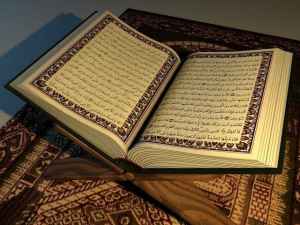
A Qur’an in Arabic
The Qur’an is the book of scriptures for Islam, and was written in an ancient form of Arabic. This book of scriptures has been translated into nearly every language on earth. Yet, it is often difficult to understand even for Arabic speakers and scholars of the Qur’an. The Hadith, then, aid Muslims to better understand the book.
Added to Qur’anic interpretation, there is the subject their prophet who is himself a bit of a mystery. It must be stated that it is important to note that the name / title of Muhammed is found only four times in the Qur’an. Thus, the Qur’an gives scant biographical information about him. As Islam spread from its place of origin, its converts wanted more and more knowledge about him. To fill in the blanks, the hadiths were created by Muslims. This process began about 70 years after his death in 632 AD. The contemporary scholar Robert Spencer provides information on the problematic nature of the Hadith as they developed over the following centuries:
Compounding this [the methods concerning how to inform a conquered people about this imposed foreign religion] are the shaky historical foundations of the Hadith, the voluminous accounts of Muhammad’s words and deeds. The importance of the Hadith in Islam cannot be overstated. They are, when Islamic scholars deem the accounts authentic, second in authority only to the Qur’an itself. Along with the Qur’an that they elucidate, the Hadith form the basis for Islamic law and practice regarding both individual religious observance and the governance of the Islamic state. And in fact, so much of the Qur’an is obscure and opaque, and explained only in the Hadith, that functionally, if not officially, the Hadith are the primary authority in Islam (Robert Spencer: Did Muhammad Exist? An Inquiry into Islam’s Obscure Origins, Nashville, Bombardier Books, 2021, 67. Hereafter, Spencer).
The hadiths guide Islamic practice (known as sunna). However, their history shows a great deal of manipulation by their authors and compilers as we see in the following:
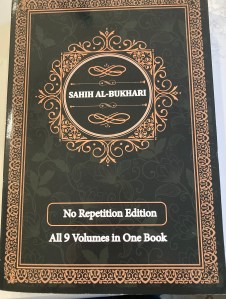
My copy of Sahih Al-Bukhari
Muslims also fabricated hadiths in the heat of political and religious controversies that they hoped to settle with a decisive, albeit hitherto unknown, word from the prophet. Abd al-Malik [a ruler who first began to institutionalize Islam under his rule around 685 AD] at one point wanted to restrict Muslims from making pilgrimages to Mecca, since he was afraid that one of his rivals would take advantage of the pilgrimage to recruit followers. Accordingly, he prevailed upon the hapless al-Zuhri to fabricate a hadith to the effect that a pilgrimage to the mosque in Jerusalem (Bayt al-Maqdis) was just as praiseworthy in the sight of Allah as one to Mecca. Al Zuhri went even further, having Muhammad say that “a prayer in the Bayt al-Maqdis of Jerusalem is better than a thousand prayers in other holy places.” This hadith duly appears in one of the six canonical Hadith collections that Muslim scholars consider most reliable: the Sunan of Muhammad ib Maja (824 – 887). (Spencer, 75)
Thus, Spencer declares,
The consequence of all this was inevitable: utter confusion. Since warring parties were all fabricating hadiths that supported their positions, the Hadith is riddled with contradictions. (Spencer, 79)
With concern for their proliferation — of which Muslims were aware — there had to be sorting processes for the hadiths. To confirm as a “truthful” source (the term for the process is siddiq) coming from the multitude of hadiths, Muslim authorities had to come up with methods to bring some degree of control and order to the problem. Six important “truthful” Hadith collections were named and were given the label sahih. These are in order of acceptance:
-
- Sahih Bukhari (810 – 870)
- Sahih Muslim (by Muslim ibn al-Hahhah 821 – 875)
- The Sunan of Abu Dawud al-Sijistani (818 – 889)
- As-Susan as-Sughra, by Ahmad ibn Shuayb al-Nasai (829 – 915)
- The Jami of Abi Isa Muhammad Al-tirmidhi (824 – 892)
- Sunan of Muhammad in Maja (824 – 887)
The Muslims had criteria to establish “authenticity” / “truthfulness”. First, there is community acceptance. Another criterion examines a “chain of transmission”, or “chain of custody” — such a chain is called isnad.
They claimed to be able to distinguish genuine material about Muhammad from forged hadiths largely by examining the chain of transmitters (isnad), the list of those who had passed on the story from the time of Muhammad to the present. Islamic scholars grade individual traditions according to their chains of transmitters as “sound,” “good,” “weak,” “forged,” and so on…A hadith is considered sound if its chain of transmitters included reliable people and goes back to a recognized authority. (Spencer, 83)
The reliability of the Hadith are shaky at best since the very earliest came into existence, as mentioned above, about 70 years after Muhammad’s death. But, as Spencer points out, the reliability of isnad is equally shaky:
The apparent reliability of the isnad chain was what determined authenticity. It didn’t matter if a hadith was self-contradictory or absurd on its face; so long as its isnad chain was clear of anomalies, and it did not contradict the Qur’an [emphasis added], the tradition had no obstacles to being accepted as reliable…If a hadith could be forged, however, so could its chain of transmission. There are numerous indications that isnads were forged with the same alacrity with which matns — that is, the content of the hadiths — were invented. (Spencer, 84)
The islands themselves didn’t start appearing until after hadiths had begun circulating (Spencer, 85).
In other words, it appears that nothing can be regarded as historical. Spencer writes this concerning Islamic tradition:
The assumption in Islamic tradition, at least regarding hadiths that are declared to be sahih, is that all this transmission went on with absolute accuracy and no legendary elaboration. But hadiths are not ruled sahih by some criteria for measuring their historical reliability; rather, the principal requirements for sahih status are compatibility with the Qur’anic message [emphasis added] and a sound isnad chain. (Spencer, 94)
Spencer also addresses new concerns — that Hadith can be contrary to the message of the Qur’an. To demonstrate this fact, the subject of miracles comes to the foreground. The absence of miracles by Muhammed is addressed,
The clearest evidence of this comes from the Qur’an’s repeated assumption that the messenger who received its revelations was not a miracle worker…Allah tells his messenger that even if the prophet did come to the unbelievers with a miracle, they would reject him anyway (Spencer, 103).
I present these passages which declare Muhammed only to be a “warner” and a “guide”:
Qur’an 2: 118. “Say those without knowledge: ‘Why speaketh not Allah unto us? Or why cometh not unto us a sign? So said the people before them words of similar import Their hearts are alike. We have indeed made clear the Signs unto any people who hold firmly to Faith (in their hearts).
Qur’an 6: 37. “They say: ‘Why is not a sign sent down to him from his Lord?’ Say: ‘Allah hath certainly power to send down a Sign: but most of them understand not.’”
Qur’an 10: 20. “They say: ‘Why is not a Sign sent down to him from his Lord?’ Say: ‘The Unseen is only for Allah (to know). Then wait ye: I too will wait with you.’”
Qur’an 13: 7. “And the Unbelievers say: ‘Why is not a Sign sent down to him from his Lord?’ But thou art truly a warner, and to every people a guide.”
We read this from the all-knowing Wikepedia:
The Qur’an does not explicitly record Muhammed performing physical miracles liker earlier prophets; instead, it emphasizes that the greatest miracle is the revelation of the Qur’an itself.
We have Spencer’s insight:
The repetition of this theme suggests that one of the primary criticisms the unbelievers brought against the prophet was that he had no miracles to perform; the Qur’an was intended to be sufficient sign in itself: “And is it not sufficient for them that We revealed to you the Book which is recited to them? Indeed in that is a mercy and reminder for a people who believe ([Qur’an] 29: 51). (Spencer, 104)
What follows gives an example how a hadith, though accepted canonically, is undoubtably seen to contradict the Qur’an. Spencer gives this example of the problem:
Yet the Muhammad of Ibn Hisham’s biograpy (sira) is an accomplished miracle worker. Ibn Hisham relates that during the digging of the trench that ultimately thwarted the Meccans’ siege of the Muslims in Medina, one of Muhammad’s companions prepared “a little ewe not fully fattened” and invited the prophet to dinner. Muhammad, however, surprised his host by inviting all of those who were working on the trench to dine at the man’s home. The prophet of Islam solved the problem just as Jesus in the Gospels multiplied bread and fish: “When we had sat down we produced the food and he blessed it and invoked the name of God over it. Then he ate as did all the others. As soon as one lot had finished another lot came until the digger turned from it” (Spencer, 104).
Spencer summarizes the problem with Ibn Hisham and all other hadith accounts of Muhammad:
If Ibn Hisham’s biography is largely or even wholly pious fiction, all the information about Muhammad that is generally regarded as historical evaporates (Spencer, 106).
I conclude the the body of the Hadith are problematic, and in spite of any accepted isnad, must be taken with the proverbial “grain of salt”. Additionally, the Christian will note that the above noted hadith has its New Testament parallel to the Feeding of the Five Thousand which is found all all four of the Gospels (see, for example, St John 6: 1 – 14). Furthermore, the Qur’an includes other allusions and parallels to both the Old and New Testaments. It is therefore evident that many things in the Qur’an and the Hadith are cases of plagiarism and outright invention and fabrication.

Light and Life
Christians are in a war that has enemies many fronts. The escalating conflict with Islam is but one of them, yet is the emerging and primary front of attack as is now seen, for example, in Great Britain. I offer an Orthodox hymn that speaks to this ongoing struggle:
O Lord, save your people, and bless your inheritance. Grant victories to the Orthodox Christians over their adversaries; and by virtue of your Cross, preserver your habitation.
In Christ who is alone the Way, the Truth, and the Life,
Fr Irenaeus
 Father Irenaeus Williams