Capo Gear Review: G7th ART Performance 3 vs Dunlop Pivot
Posted: January 27, 2026 Filed under: Music and Guitars | Tags: Review of G7th Performance ART capo vs Dunlop Pivot Capo Leave a commentI have done comparative capo reviews in previous postings. These reviews represent a type of a quest, or search, for the well designed and highly functional capos. The search continues, so now, I am comparing two “clamp style” capos: the Dunlop Pivot capo and the G7th ART Performance 3 capo.
There are good and bad capos, and I have discovered examples of both types. A good capo will offer no string buzz when applied to the fret board, and, more importantly, will maintain a good degree of tuning stability when applied to the guitar’s neck. The all important factor of tuning stability will tested, and then put through statistical analysis to offer an objective decision and determine which will determine the winner. Each manufacturer makes its claim regarding their capo’s advantages to the guitarist.
Let’s begin with the claim set forth by G7th ART Performance 3:
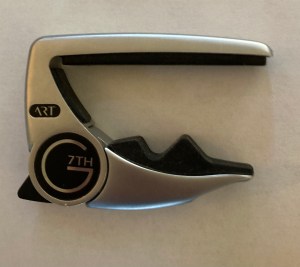
G7th ART Performance 3
The Performance 3 is the culmination of years of designing, tweaking, and improving — but most importantly, listening to guitarists and their views on what a capo SHOULD do. Now, coupling our Unique Tension Control system with the ground-breaking ART [Adaptive Radius Technology] string pad mechanism gives a near-perfect capo experience.
The ART system within the top bar of G7th Performance 3 capos adapts to the true curvature over your strings and fretboard, exerting completely even pressure across all the strings — setting a new standard of in-tune, buzz-free use. It gives you the maximum tuning stability with the minimum possible tension in EVERY position, on ANY guitar neck.
Now, we read Dunlop’s claim coming from the packaging for its Pivot capo:
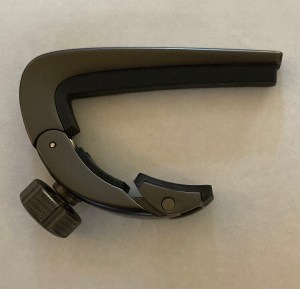
Dunlop Pivot
Precise Intonation: Patented self-centering neck pivot adapts to a variety of neck shapes for even tension and tuning stability.
Easy Adjustment: Low-resistance gear quickly dials in precise pressure.
Clarity & Sustain: Notes ring out longer and more clearly thanks to tone-enhancing mass and dense rubber padding.
Optimized Fret Pad: Accommodates fretboard radius to reduce string buzzing.
Materials and Methods: I put the two capos to the test on four different acoustic guitars. The same Snark electronic tuner is used for all testings. All four guitars were tuned to standard tuning. D’Addario Nickel Bronze acoustic light gauge strings (12 – 53) are on all guitars. (They are amazing strings!). Each capo was placed sequentially on frets 2, 5, and 7 on all guitars. All six strings were plucked in all positions to assess tuning stability. All guitars were retuned before repositioning each capo at the above noted positions. Any “distuning” caused by capo application was noted for each capo at every position on all six strings by the number of “minute” sharp increments (noted by “+”) from the in-tune “12 o’clock” position on the tuner. There was a total of 144 testings. For statistical analysis a paired two-tailed T-test was used, and both T and P values will be presented and explained in the results section found in the text below.
Results:
Rainsong N-JM11002 (Nashville Series) Carbon Fiber Acoustic Jumbo:
G7th ART: a total of +4 minutes sharp (at fret 2 = +2, 4 strings in tune; fret 5 = +1, 5 strings in tune; fret 7 = +1, 5 in tune)
Dunlop Pivot: a total of +5 minutes sharp (at fret 2 = +1, 5 strings in tune; fret 5 = +3, 3 strings in tune; fret 7 = +1, 5 strings in tune).
Rainsong BI-JM1000N2 Carbon Fiber Acoustic Jumbo:
G7th ART: a total of +7 minutes sharp (at fret 2 = +3, 3 strings in tune; fret 5 = +3, 3 strings in tune; fret 7 = +1, 5 strings in tune).
Dunlop Pivot: a total of +6 minutes sharp (at fret 2 = +3, 3 strings in tune; fret 5 = +1, 5 strings in tune; fret 7 = + 2, 4 strings in tune)
Breedlove Pro Series Spruce/Rosewood Acoustic Dreadnought:
G7th ART: a total of +1 minute sharp (at fret 2 = 0, all 6 strings in tune; fret 5 = +1, 5 strings in tune; fret 7 = 0, all strings in tune)
Dunlop Pivot: a total of +3 minutes sharp (at fret 2 = +1, 5 strings in tune; fret 5 = +1, 5 strings in tune; fret 7 = +1 minutes sharp, 5 strings in tune)
Composite Acoustic Legacy Carbon Fiber coustic Dreadnought:
G7th ART: a total of 4 minutes sharp (at fret 2 = 0, all strings in tune; fret 5 = +3, 3 strings in tune; fret 7 = +1, 5 strings in tune)
Dunlop Pivot: a total +1 minutes sharp (at fret 2 = 0, all strings in tune; fret 5 = +1, 5 strings in tune; fret 7 = 0, 6 strings in tune)
Total “Minutes” Sharp:
G7th ART Performance 3: +16 of 72 total string position testings
Dunlop Pivot: +15 of 72 total string position testings
T-Value = 0.234, and P-value = 0.820: Both values state that there is NO objective or significant difference in string tuning stability.
Discussion and Conclusion:
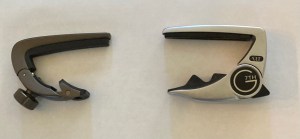
Equally Good Capos
It can noted that the two Rainsong guitars had more minutes sharp than both the Breedlove and Composite Acoustic guitars. T’his is likely due to the strings on Rainsong guitars are older than those on the other two guitars.
What about string buzzing? There was no string buzz noted with either capo for all 144 string testings.
Regarding the important issue of tuning stability, the above noted P value objectively demonstrates that the two reviewed capos offer equal tuning stability. Plus, the total number of mistunings recorded are very minimal given my experience reviewing and testing a variety of capos on a variety of guitars. Capos cause mistunings due to two reasons: 1) the capo’s design — how it grips the fretboard, and 2) the radius of the guitar’s fretboard along with the neck’s overall construction. I own both capos, and consistently use them on my guitars, and both prove to offer solid tuning stability.
Ease of application is to be considered. Here the advantage goes to G7th ART capo. It is easily applied and released by pressing up or down on a triangular knob on the capo’s base. The Dunlop Pivot must be applied and released by turning a wheel on the pivot bar located on its bottom. But, in my opinion, this is not a source of inconvenience for attachment or for release.
Finally, I must add that the Dunlop Pivot capo has a big price advantage, being sold for $31.49 on line while the base model of the G7th ART is selling for $69.99. This added $38.50 offers the overall nod to Dunlop’s Pivot capo (plus it works exceptionally well on 12-string guitars).
Keep on playing (with capos),
Fr Irenaeus
Old LPs and New Discoveries
Posted: August 19, 2025 Filed under: Etcetera, Music and Guitars | Tags: ABBA, discovering new music and new experiences, LP collection, move out of your comfort zone, Robert Frost's "The Road Not Taken", The band Poco, Yogi Berra quote Leave a comment
Poco’s “Under the Gun”
It is quite possible that I am dating myself with this posting. For those far younger than me, and who listen to music via a digital streaming platform, I want you to know this is not always the method for playing recorded music (I could go on about smart phones, but I won’t do so). In my youth the only forms of recorded music were from vinyl LPs (standing for “long playing”), cassette tapes, and 8-track tapes (the latter being unbelievably annoying).
Recently, my wife and I inherited the bulk of my late brother-in-laws large collection of LPs. Some of them were purchased when he was a teenager. He continued to add to his collection for decades. I am now sorting through his collection, and I am selling the great majority of them on EBay. Some are in such bad shape that they must be tossed out. Others that are in sound condition we have kept, and those being the recordings of artists we know and, thus, are familiar with their music. Among his collection are artists and groups whose names and music are unknown to me. Concerning the mystery bands my initial plan was to sell every LP in good to excellent condition. However, as I continued in the process of listing them for sale, I began to become curious about them: “Why not research the bands and listen to them?”

Poco circa 1969 -70
Poco is one such band. My brother-in-law was obviously a huge fan of their music: he owned many of their recordings, even multiple copies of some of them. The band’s musical genre is a blend of country rock, pop rock, and folk rock. The original lineup of the band consisted of Richie Furay (from Buffalo Springfield), Jim Messina (later of Loggins and Messina), Randy Meisner (later of the Eagles), Rusty Young, and George Grantham. Their musical career began in 1969, and continues, it seems, to the present day. My wife and I remember two of their songs for the late 1970s: “Heart of the Night,” and “Crazy Love,” from the album “Legend.” My youngest son, now aged 28, began listening to Poco’s music, and is now himself a fan of their work. We have since kept several of their LPs which we now appreciate.
We are all creatures of habit: we gravitate to what we already know and of which we are familiar. We stick with the known commodity. We make choices based upon what has proven to be satisfying to us in the past. We frequent well proven restaurants, and order satisfying dishes from the known menus. We take the familiar route to a familiar destination. Additionally, when in church, I know where every person and family will likely position himself, herself, or themselves in the nave on any given Sunday morning.

Yogi Berra
But, it’s good to shift away from the habitual and seek new experiences. I have to urge myself to do so and seek sources of inspiration. Yogi Berra gave this advice, “When you come to a fork in the road — take it.” Robert Frost was a bit more precise (and I paraphrase his words in summary): “Take the road less travelled.” Even the Swedish pop band ABBA gave sage advice: “Take a chance on me!”
Life, especially the life of faith lived in Christ is to be a life of discovery. Discovery demands taking the road less travelled. Discovery and growth demand stepping boldly out of our comfort zones. Discovery and growth demand taking a chance from time to time. I return to Robert Frost’s poem, “The Road Not Taken,” and I quote from its ending: “…I took the one less traveled by, and that has made all the difference.”
The following link takes you to Poco’s “Crazy Love”: https://www.google.com/url?sa=t&source=web&rct=j&opi=89978449&url=https://www.youtube.com/watch%3Fv%3D8GY_orHl_sI&ved=2ahUKEwjUx4CUz5ePAxXXLTQIHdQ5Nt4Q78AJegQIFRAB&usg=AOvVaw02YJ5VjvjC0avdt-I0jC0K
In Christ who leads us along the way,
Fr Irenaeus
Gear Review Royale: Shubb Capo Royale vs Shubb Fine Tune Royale F1g
Posted: March 4, 2025 Filed under: Music and Guitars | Tags: Capo review: Shubb Capo Royale vs Shubb Fine Tune Royale Fig, Review of Shubb Fine Tune Royale Capo vs Shubb Capo Royale; Capo review of Shubb Fine Tune Royale F1g; adjustable screw capo vs yoke capo Leave a comment
R: Shubb Capo Royale, L: Shubb Fine Tune Royale F1g
I have done comparative capo reviews in previous postings. These reviews represent a type of a quest — all for the purpose of finding the “perfect capo.” The search continues, so now, I am comparing two previous winners: The Shubb Capo Royale (an adjustable screw capo) and Shubb Fine Tune Royale F1g (a yoke capo). There are good and bad capos, and I have discovered examples of both types. A good capo will offer no string buzz when applied to the fret board, and, more importantly, will maintain a good degree of tuning stability when applied. The all important factor of tuning stability will tested, and then put through statistical analysis to offer an objective decision and determine which will determine the winner.
Regarding the Shubb Capo Royale: It is, again, an adjustable screw capo which offers a clasping mechanism for neck attachment. The screw is tightened after application to apply direct downward pressure on the strings. Shubb offers its claim:
The Shubb Capo is designed to reduce tuning problems. Its custom material presses the strings just like your fingertip. Its unique design closes onto the neck just like your hand. Its pressure is totally adjustable. The result: no retuning is necessary.
Regarding the Shubb Fine Tune Royale F1g, It is a yoke style capo which also has a screw to supply pressure on the strings. The yoke style applies a direct, square downward pressure on the strings. Shubb offers this claim for its yoke capo:
…We are confident that it is the most accurate capo in the world…Its innovative adjusting knob makes it the most ergonomic screw-operated capo. The knob maintains a fixed relationship with the frame, for improved ease of use, and for the lowest profile when stored behind the nut. The knob’s six surfaces are numbered, providing a visual reference to more easily and accurately reproduce : ideal pressure. Greater contact area between screw, frame, and knob ensures that the fit will never become loose and sloppy. Specially developed rubber padding adds resilience to the capo’s closing action for finer control, and being absolutely inert, it will not mark an instrument. Improved jeweler’s style latch prevents accidental opening. Carefully machined to the closest thread tolerance.
Materials and Methods: I put the two capos to the test on four different acoustic guitars. The same Snark “Super Tight” electronic tuner is used for all testings. All four guitars were tuned to standard tuning. D’Addario nickel bronze acoustic light gauge strings (12 – 53) are on all guitars. Each capo was placed sequentially on frets 2, 5, and 7 on all guitars. All six strings were plucked in all positions to assess tuning stability. All guitars were retuned before repositioning each capo at the above noted positions. Any “distuning” caused by capo application was noted for each capo at every position on all six strings by the number of “minute” sharp increments (noted by “+”) from the in-tune “12 o’clock” position on the tuner. There was a total of 144 testings. For statistical analysis a two-tailed T-test was used, and both T and P values will be presented and explained in the results section found in the text below.
Results:
Rainsong N-JM11002 (Nashville Series) Carbon Fiber Acoustic Jumbo:
Shubb Capo Royale: a total of +7 minutes sharp (at fret 2 = +2, 4 strings in tune; fret 5 = +1, 5 in tune; fret 7 = +4, 3 in tune)
Shubb Fine Tune Royale F1g: a total of +2 minutes sharp (at fret 2 = 0, all strings in tune; fret 5 = +1, 5 in tune; fret 7 = +1, 5 in tune).
Rainsong BI-JM1000N2 Carbon Fiber Acoustic Jumbo:
Shubb Capo Royale: a total of +6 minutes sharp (at fret 2 = 0, all strings in tune; fret 5 = +3, 4 in tune; fret 7 = +3, 4 in tune).
Shubb Fine Tune Royale F1g: a total of +5 minutes sharp (at fret 2 = +1, 5 strings in tune; fret 5 = +3, 3 in tune; fret 7 = + 2, 4 in tune)
Breedlove Pro Series Spruce/Rosewood Acoustic Dreadnought:
Shubb Capo Royale: a total of +14 minutes sharp (at fret 2 = +2, 4 strings in tune; fret 5 = +5, 1 in tune; fret 7 = +7, none in tune)
Shubb Fine Tune Royale F1g: a total of +6 minutes sharp (at fret 2 = +2, 4 strings in tune; fret 5 = +1, 5 in tune; fret 7 = +3 minutes sharp, 3 in tune)
Composite Acoustic Legacy Carbon Fiber Acoustic Dreadnought:
Shubb Capo Royale: a total of +4 minutes sharp (at fret 2 = +1, 5 strings in tune; fret 5 = +1, 5 in tune; fret 7 = +2, 4 in tune)
Shubb Fine Tune Royale F1g: a total +3 minutes sharp (at fret 2 = 0, all strings in tune; fret 5 = +2, 4 in tune; fret 7 = +1, 5 in tune)
Total “Minutes” Sharp:
Shubb Capo Royale: +31 of 72 total string position testings
Shubb Fine Tune Royale F1g: +16 of 72 string position testings
T-Value = 2.24, and P-value = 0.027: Both values state that there is an objective and significant difference in string tuning stability. (A P-value < 0.05 shows significance, and the P-value of 0.027 means that there is a 97.3% chance that the result is not due to chance). The advantage goes to the Shubb yoke style capo.
Discussion and Conclusion:
One brief mention of string buzzing is noted. The Capo Royale caused one non-correctable buzz at the seventh fret of the sixth string on the Composite Acoustic Legacy dreadnought.

The winner: Shubb Fine Tune Royale F1g
The Shubb Fine Tune Royale F1g proved to be the superior capo for tuning stability. It appears that Shubb’s claim that “…We are confident that it is the most accurate capo in the world…” holds up to the test. Also, it must be stated that the greatest degree of tuning instability was observed on the Breedlove Pro Series dreadnought made from solid woods. Little difference in tuning stability was seen among the three carbon fiber guitars. It is likely that this is due to the structural stability that comes from carbon fiber construction — especially regarding the neck, though no bowing, etc., can be visually seen with the naked eye down the Breedlove’s neck. This difference in tuning stability found with all wooden guitars has been noted in previous reviews. With all testings, the carbon fiber guitars have consistently provided a superior tuning stability when compared to solid wood acoustics.
Ease of application goes to the adjustable screw capo — the Shubb Capo Royale.
I own Shubb’s Fine Tune F1g yoke style capo, and will be consistently using in on my guitars. I must add that its price tag may dissuade many players from purchasing one: it sells for $80 to $85 dollars. For me, it is worth it since I use capos more than half of the time when I play, whether I use standard capos, or a partial capo (also a Shubb).
Keep on playing,
Fr Irenaeus
Gear Review of Two Yoke Capos: Shubb Fine Tune Royale F1g VS D’Addario Cradle Capo
Posted: January 1, 2025 Filed under: Etcetera, Music and Guitars, The Eucharist and Living the Eucharist | Tags: D'Addario Cradle Capo reviewed, Review of Shubb Fine Tune F1 yoke capo vs D'Addario Cradle Capo, Shubb Fine Tune F1 capo reviewed, varieties of guitar capos, Yoke-style guitar capos reviewed Leave a commentAs I have reviewed a number of capos over the years I have learned a good deal about them. The primary lesson learned is that not all capos are alike. There are capos of inferior and superior design. I have found that a good capo is determined by its design — specifically how a given capo applies pressure on the strings to the fretboard.
There are functionally four styles of capos:
-
- Strap and Toggle Capos. A strap or toggle using an elastic strap is wrapped around the guitar’s neck to apply the downward pressure on the strings.
- Trigger / Spring Capos. This class of capo is likely the most commonly used capo. A spring mechanism applies the needed downward pressure. With the trigger and spring capos there is the additional lateral pressure which brings the strings out of tune.
- Adjustable Screw Capos. This style offers a “clasping” mechanism for attachment to the neck. After application, a screw is tightened to apply direct square pressure onto the strings.
- Yoke Capos. These are very similar to the adjustable screw capos. They have an arm which is released for application to the neck. This style, too, is tightened by the screw to supply pressure on the strings. The yoke style offers direct, square pressure on all strings.

Top: Shubb Fine Tune Royale F1g, Bottom: D’Addario Cradle Capo
As the title states, I will compare two yoke-style capos: the Shubb Fine Tune Capo Royale F1g, and D’Addario’s Cradle Capo. I add the manufacturers’ claims and descriptions for both capos.
Shubb Fine Tune Royale F1g:
…We are confident that it is the most accurate capo in the world…it can remain on the guitar (behind the nut) when not in use.
Its innovative adjusting knob makes it the most ergonomic screw-operated capo. The knob maintains a fixed relationship with the frame, for improved ease of use, and for the lowest profile when stored behind the nut. The knob’s six surfaces are numbered, providing a visual reference to more easily and accurately reproduce your ideal pressure. Greater contact area between screw, frame, and knob ensures that the fit will never become loose and sloppy. Specially developed rubber padding adds resilience to the capo’s closing action for finer control, and being absolutely inert, it will not mark an instrument. Improved jeweler’s style latch prevents accidental opening. Carefully machined to the closest thread tolerance.
D’Addario Cradle Capo:
Even tension. Always ready…With its stainless steel, self-centering design, the Cradle Capo ensures even tension across the fretboard. Its adjustable micrometer lets you dial in the perfect pressure, while allowing the freedom for quick transitions and the ability to stay on the guitar, even when not in use.
Hypothesis: Given identical design and mechanism I posit that both capos will offer near identical tuning stability as well (as no string buzzing). A two-tail T-test will be used to “objectively” test my hypothesis. Both T and P values will be presented for assessment. The meaning of both values will be explained.
Material and Methods: I put the capos to the test on three different guitars. The same Snark “Super Tight” electronic tuner is used for all testings. All three guitars were tuned to standard tuning. Each capo was placed sequentially on frets 2, 5, and 7 on all three guitars. All six stings were plucked to assess tuning stability. Each guitar was retuned before repositioning each capo at the above mentioned frets. Any “distuning” caused by the capos was noted for each capo at each position (on all six strings) by the number of “minute” increments (flat and/or sharp noted by, for example, -1 for flat, or +2 for sharp) from the “12 o’clock” (the “in tune” position) on the tuner. There were a total of 108 testings. Also, both Rainsong guitars possess the N2 style neck.
Results: Here are the results in terms of total “distuning minutes” at all three fret positions (again 2, 5, and 7).
Rainsong N-JM1100N2 (Nashville Series) acoustic jumbo:
Shubb: +8 (at fret 2 = +1, 5 strings in tune; fret 5 = +3, 3 in tune; fret 7 = +4, 2 in tune)
D’Addario: +8 (at fret 2 = +1, 5 strings in tune; fret 5 = +4, 2 in tune; fret 7 = +3, 3 in tune)
Rainsong BI-JM1000N2 (Black Ice Series) acoustic jumbo:
Shubb: +11 (at fret 2 = +2, 4 strings in tune; fret 5 = +4, 2 in tune; fret 7 = +5, 1 in tune)
D’Addario: +12 (at fret 2 = +4, 2 strings in tune; fret 5 = +4, 2 in tune; fret 7 = +4, 2 in tune)
Paul Reed Smith (PRS) SE Starla solid body electric:
Shubb: +6 (at fret 2 = +2, 4 strings in tune; fret 5 = +2, 4 in tune; fret 7 = +2, 4 in tune)
D’Addario: +16 (at fret 2 = +3, 3 strings in tune; fret 5 = +6, none in tune; fret 7 = +7 none in tune)
Total “minutes” sharp:
Shubb: +25 of 54 total string position testings
D’Addario: +36 of 54 total string position testings
T = – 1.94: This states that a moderate difference exists in tuning stability between the two yoke-style capos. My hypothesis that there would be no tuning difference is to be rejected.
P value = 0.054: For a proven statistical difference, the P value has to be </= 0.05. The value of 0.054, though it approaches statistical significance, only indicates that the difference in tuning stability shows a “trending” to a superior tuning stability. Thus, it also informs me that I am to reject my hypothesis.
Discussion and Conclusion:
First, neither yoke capo caused any string buzzing at any position tested. Given the difference in the number of “sharp minutes” between the two yoke capos, I am to conclude that the Shubb Fine Tune Royale F1g capo shows a trend to be moderately superior to the D’Addario Cradle Capo in terms of tuning stability.
The winner: Shubb Fine Tune Royale F1g
What, then, might explain this trend? The “rubber / plastic” material that comes in contact with the strings is identical in width (7 mm). Their lengths differ by 1.0 mm, (Shubb 48 mm, D’Addario 49mm). Subjectively, the density of the rubber material feels the same. Could weight cause the difference affecting results? The Shubb capo weighs 38 grams while the D’Addario capo weighs 23 grams. I am uncertain about the significance of this difference. The only other variable that could explain this difference could be the tightening mechanism which presses upward from the back of the neck: the Shubb mechanism feels more sturdy, and likely offers a more secure pressure.
Given the two yoke-style capos, I will choose to use the Shubb Fine Tune Royale capo on my guitars. Both capos are more expensive than any of the other varieties of capos noted above: Shubb = $80 – 85 (Shubb direct purchase); D’Addario = $69.99 (Reverb), but as it is said, “You get what you pay for,” if you find it necessary to add either capo to your gear bag.
Keep on playing!
Fr Irenaeus
Gear Review: The Glider Capo
Posted: August 4, 2024 Filed under: Music and Guitars | Tags: Dunlop Pivot Capo is excellent for 12 string guitars, Guitar gear review of the Glider Capo, Review of the Glider Capo 1 Comment
My capo collection (to date)
With this review my search for the perfect capo continues. With this ongoing quest (quest sounds more noble), I have accumulated quite a number of capos. There are “crazy cat ladies,” and now with my collection, I guess this makes me a “crazy capo guy” who now posts his fourth capo review.
The capo is an incredibly valuable tool for any guitarist. As any player knows, there are two major concerns about applying a capo to the neck of a guitar: the first is string buzz, and the second is tuning stability. In this posting I am evaluating the Glider Capo (by Greg Bennett), and my findings and opinion will be found below.
Information about the Glider capo can be found on the internet at glidercapo.com. Upon visiting the website we are given this claim:
Glider capo is the world’s most innovative guitar capo. It is recognized for its unique ability to roll up and down the fret board for seamless key changes.
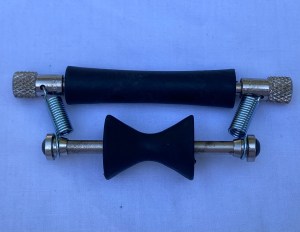
The Glider Capo
Let me first comment regarding the rolling, or gliding, of the capo up and down the neck. There is one video where a guitarist uses the thumb of his fretting hand to move the capo along the fret board. Others show a player using either the fretting hand or the picking hand to alter its position. I found that I need to use my picking hand to smoothly move the capo into proper position. This technique allowed me to keep the capo straight and parallel with the fret. (I could not accomplish this by using my thumb or fretting hand.) When glided into position, the Glider Capo wants to naturally rest about 1/4 inch (0.635cm) above the fret — a perfect position.

Glider Capo in position
The Glider Capo was tested for both string buzz and tuning stability on three guitars: a Rainsong Nashville Series jumbo (a carbon fiber six string), a Breedlove Pro Series dreadnought (solid, traditional woods, six string), and a Rainsong Concert Series 12 string jumbo (carbon fiber). D’Addario nickel-bronze light gauge strings (12 – 53) are on both six string guitars. For all testing, After application, the capo was first placed at position two, then glided to positions five, and seven on all three guitars. Right out of the gate let me state that I find that the Glider Capo CANNOT be used on a 12 string guitar! The problem here is with the capo’s inability to properly compress itself onto the higher gauge octave strings. There is significant buzzing, and these high octave strings go flat — significantly so for the fourth and fifth strings’ pairings. (I give my recommendation for a good capo for a 12 string near the close of this posting.)
String buzz is discussed first. The Glider Capo on the six string Rainsong Nashville jumbo gave no fret buzz at any of the three capoed positions. However, the Glider Capo caused on / off string buzzing on the sixth string at the Breedlove’s frets five and seven.
Tuning stability is next addressed. A Snark electronic tuner was used for all testings. Both the Rainsong Nashville Series jumbo and the Breedlove dreadnought were put in tune before the application of the capo. Placement began at fret two and tuning stability first tested here. The Glider Capo was then rolled to the fifth and then seventh positions where tuning stability was also tested. Using the Snark tuner, “distuning” was noted for both guitars at each position on all six strings by the number of “minute” increments flat or sharp from the “12 o’clock (in tune) position. Here are the results:
Breedlove Pro Series dreadnought:
Fret two: +1 minute sharp on string two (+1 total)
Fret five: +1 minute sharp on strings two and six (+2 total)
Fret seven: +1 minute sharp on strings two and six (+2 total)
Rainsong Nashville Series jumbo:
Fret two: +1 minute sharp on string one (+1 total)
Fret five: +1 minute sharp on strings one, two, and five (+ 3 total)
Fret seven: +1 minute sharp on strings one, two, and six (+3 total)
The total number of “minutes” sharp is quite minimal and proves insignificant when compered to the distunings produced by other capos with various grasping mechanisms that I previously tested and reviewed using very near identical methods. Given the rolling mechanism of the Glider Capo I was surprised with the results. I must conclude that the Glider Capo offers great tuning stability! In fact, it likely offers the best tuning stability of any capo I own. But, again, it cannot be used on a 12 string guitar for the reasons noted above. (I place here, my recommendation for a really good capo for a 12 string guitar. It is Dunlop’s Pivot Capo. The advantage it possesses is that this capo uses a dial-in resistance gear that can be adjusted for pressure at any position on the neck.)
An honest review seems to require note of a downside. Therefore, I must note one drawback, but this is purely my own subjective comment. The application of the Glider Capo to the neck is a bit clumsy given the needed technique by which it is applied. However, given its fantastic tuning stability, I can get over it.
As a “crazy capo guy,” I confidently recommend the Glider Capo for any player’s six string guitars — acoustic or electric. One can be purchased from Amazon for $34.99 USD. More information can be found at glidercapo.com as well as from tonalmusicinc@gmail.com. Tonal Music is located in Franklin, Tennessee.
Keep on playing,
Fr Irenaeus
GEAR REVIEW: DUNLOP PIVOT CAPO vs SHUBB CAPO ROYALE (A “CLINICAL” TESTING)
Posted: June 4, 2024 Filed under: Music and Guitars | Tags: Comparison of two adaptable capos, Dunlop Pivot Capo, Review of Dunlop Pivot Capo and Shubb Capo Royale, Shubb Capo Royale, statistical comparison of Dunlop Pivot Capo and Shubb Capo Royal Leave a commentIntroduction:

Dunlop Pivot Capo
In January, 2021, I reviewed two very, very good capos: Shubb’s Capo Royale and G7th’s Performance ART Capo. Three years later my quest perfect guitar capo is revived in this review of Dunlop’s Pivot Capo. Since January, 2021 I have routinely used Shubb’s Capo Royale on my guitars (both six and 12 string models) with great satisfaction. However, while again haunting Tacoma, Washington’s Ted Brown Music, I noticed the Dunlop Pivot Capo, and assumed it is Dunlop’s take on the adaptable capo. I quote from the capo’s packaging:
Precise Intonation: Patented self-centering neck pivot adapts to a variety of neck shapes for even tension and tuning stability.
Easy Adjustment: Low-resistance gear quickly dials in precise pressure.
Clarity & Sustain: Notes ring out longer and more clearly thanks to tone-enhancing mass and dense rubber padding.
Optimized Fret Pad: Accommodates fretboard radius to reduce string buzzing.

Shubb Capo Royale
I offer up Shubb’s Capo Royale claim:
The Shubb Capo is designed to reduce tuning problems. Its custom material presses the strings just like your fingertip. Its unique design closes onto the neck just life your hand. Its pressure is totally adjustable. The result: no retuning is necessary.
Similar claims, but will there be similar results? Given the similarity of the capos’ descriptions and the similarities between the G7th and the Shubb capos mentioned above, I posit that there will be no significance difference in tuning stability between the two capos. A statistical test will be used to test this hypothesis.
Materials / Methods:
I put the capos to the test on five different guitars using one Snark electronic tuner. All five guitars were tuned (standard tuning for all but one guitar in open D tuning as noted below) using the Snark tuner. Each capo was placed on frets 2, 5, and 7 on all five guitars, and all six stings were plucked. Each guitar was retuned before repositioning each capo at the above mentioned frets. “Distuning” was noted for each capo at each position (on all six strings) by the number of “minute” increments (flat and/or sharp noted by -1, or +2, for example) from the “12 o’clock” (the in tune) position on the tuner. Additionally, strings on the acoustics are of identical light gauge (12 – 53) D’Addario Nickel Bronze. Here are the results in terms of total “distuning minutes” at all three fret positions (again 2, 5, and 7).
Results:
Breedlove Pro Series D25/SRH acoustic dreadnought:
Shubb: +10 (at fret 2 = +1, fret 5 = +3, fret 7 = +6)
Dunlop: +3 (at fret 2 = 0, fret 5 = +1, fret 7 = +2)
Faith FG1RE PJE acoustic dreadnought (open D tuning):
Shubb: +18 (at fret 2 = +1, fret 5 = +4, fret 7 = +13)
Dunlop: +15 (at fret 2 = +2, fret 5 = +8, fret 7 = + 5)
Rainsong N-JM110N2 (Nashville Series) acoustic jumbo:
Shubb: +1 (at fret 2 = 0, fret 5 = 0, fret 7 = +1)
Dunlop: +5 (at fret 2 = +2, fret 5 = +2, fret 7 = +1)
Rainsong BI-JM1000N2 (Black Ice Series) acoustic jumbo:
Shubb: +5 (at fret 2 = +1, fret 5 = +1, fret 7 = +3)
Dunlop: +7 (at fret 2 = +4, fret 5 = +1, fret 7 = +2)
Paul Reed Smith (PRS) SE Starla solid body electric:
Shubb: +18 (at fret 2 = +1, fret 5 = +7, fret 7 = +10)
Dunlop: +17 (at fret 2 = +7, fret 5 = +6, fret 7 = +4)
Total “minutes” sharp:
Shubb: +52
Dunlop: +47
Discussion and Conclusion:

Equally good capos
Could there be a new champion among capos? The Dunlop Pivot Capo had 5 fewer sharps in total. With the above results the difference in count of “minutes sharp” was nearly identical for the Faith dreadnought and the PRS SE Starla. With the two carbon fiber Rainsong acoustics, the Shubb performed modestly better than the Dunlop, while the Dunlop performed better than the Shubb on the Breedlove acoustic.
With the above data, I want to examine the number of “minutes sharp” at the three capo positions on the four fretboards. The Shubb Capo Royale performed very well at fret two, but its performance diminished as this capo moved up the fretboard to higher positions. The Dunlop Pivot Capo also performed better at fret two, but not on the PRS SE. Its performance at frets 5 and 7 varied, but seemed more consistent, with all five guitars.
I am not a statistical nerd (perhaps I should not venture into such territory), but I ran a Two Sample T-test comparing the above results. I present the P-value: P = 0.8262. For a statistical difference to exist a P-value must be >/= 0.95. Thus, there is no statistical advantage for either of the capos. My hypothesis is upheld.
Regarding ease of use the Shubb has the quicker application to the fretboard due to the clamp on bar at the bottom of the capo. Tension adjustment can be altered as needed given the Shubb’s position on the neck, but it can become stiff as you move up a guitar’s neck. The Dunlop Pivot Capo’s mechanism of application and release must take place each time with resistance gear release, but is easily and quickly done.
Is there a new capo champion? Give the above P-value the answer is, “No.” Both are solid capos, and represent ongoing advancement ins capo design and production. Both capos would be an asset to any guitarist.
Keep on playing,
Fr Irenaeus
1988, Phil Keaggy, and My Evangelical Friend
Posted: May 24, 2024 Filed under: Etcetera, Music and Guitars | Tags: Eastern Orthodoxy and Evangelicalism, Phil Keaggy, Phil Keaggy and Sunday's Child, Phil Keaggy's "Blessed Be the Ties, Phil Keaggy's "I've Only Just Begun (Again)" 1 CommentThe year was 1988. I was living in Seattle, Washington. I was engaged to my wife, Janice, and was beginning my career as a clinical pharmacist at an area hospital. At the time I was an evangelical Christian. I had begun to study New Testament Greek at a local Lutheran College in preparation for further theological studies. While leading a “home group” associated with a large evangelical church, I sensed a call to ministry, (and learned I was OK with a guitar).
 Musically, with the exception of U2, the 1980s was a time when I listened primarily to Contemporary Christian Music (CCM). Some of CCM was fluff, some of it held a great deal of depth. Generally, the music was well written and well produced. Among the most gifted of CCM musicians was guitarist / vocalist Phil Keaggy. He was (and still is) a virtuoso guitarist gifted also with a fantastic tenor’s voice. His 1988 release of “Phil Keaggy and Sunday’s Child” (Myrrh Records), was a musical delight for me.
However, changes would soon take place. In the next decade, while studying at a Protestant seminary, I began a theological and spiritual journey that would take me to a “far land.” This journey held exciting and unnerving discoveries. By my studies I was led to sacramental and liturgical expressions of Christianity. I left evangelicalism behind. I also ditched CCM and everything associated with evangelicalism.
Let’s fast forward to April, 2024. While preparing for a trip with my wife, I selected a few CDs (yes…I know…) to play as we travelled more than 300 miles. For some reason I grabbed and dusted off a two volume set of Phil Keaggy’s music — an anthology — entitled “Time.” Included in this anthology were three tracks from his 1988 release noted above. These were “Tell Me How You Feel,” “Sunday’s Child,” and my favorite, “I’ve Only Just Begun (Again).” All three songs were written, or co-written by Mr. Keaggy. Such a selection would not have occurred a few years ago.
 This 36 year old recording of 13 tracks has resurfaced as a favorite CD. My ear picks up on some 60’s pop-rock vibe with jangly six- and 12-string electric guitars. My wife and I also noted a “McCartney-like” quality to his voice. None of the tracks are evangelical “praise songs”, though there is a low level evangelical preaching evident a few of the songs’ lyrics. Other songs comment on the matters of faith as it engages and is challenged by everyday life. Among these tracks, “Blessed Be the Ties,” speaks beautifully to the struggles and joys found in married / family life. I present its lyrics:
Out of the single life, into the family way — So many scripted lines, too many roles to play.ever a pressure pressing, ever an undertow. Why do the ties you’ve chosen slowly pull you low?
Over the things we love, into the still unknown — I had a dream last night I was finally left alone.Nothing to tie me down, no one to kiss goodnight — never again to feel your whisper pull me to your side.
And, oh, an emotion cries. Oh — sing blessed be the ties.
Under the veil He walks through the relentless chill, ever to bear your grief, ever rejected still.Out of the deep He pulls you into the arms you trust.Nothing can separate us from the ties that bind to you.
And, oh, as your spirits rise. Oh — sing, “Blessed be the ties.”
Stay with me. Never let go. Take me to your side. I am dreaming.
Oh — an emotion cries sing, “Blessed be the ties.”Blessed be the ties.
Now, allow me to back up a bit in time to explain why I am writing this posting about Mr. Keaggy, his recording, and my evangelical past. In April, 2023, an old friend sent me a text asking if I would want to renew / restore our friendship which had been neglected for more than a decade. We became estranged because we argued evangelical vs Orthodox theological differences. We were both stubborn and often parted in frustration and anger. I had been wanting to rebuild damaged bridges, but never was sure of how to start the needed conversation. I immediately responded to his text affirming my desire to renew the decades-old friendship. We no longer had any desire to prove who was right and who was wrong. He had begun to study Orthodox theology and came to understand and appreciate Orthodox teaching. I, on my part, since the darkness and deceptions from the COVID-19 debacle had been pored out on western countries, realized that I am to rejoice in light and truth wherever it is found — and yes, also in evangelicalism. I have come to this conclusion because when Christians of all traditions are hauled off to “the Gulag”, such differences will not matter too much.
On one get together, my friend, Colin, asked me, “When will we have unity?” My reply, “when we experience persecution.” This persecution is now upon us and increases monthly. Though ecclesial unity will not occur, bonds of trust and support must take place between those who reach out to one another in goodwill. This will be for survival of my Eastern Orthodox faith and his evangelical faith, and perhaps even our physical lives.
Colin and I get together routinely to play guitar, write an occasional song, and now have respectful and loving discussions of theology, family, and life in general over a few hours of “picking and grinning” and a shared bottle of a good red wine. I rejoice that he is again part of my life, and that his wife and my wife are now also renewing their friendship. Blessed be the ties!
Here are two links to his songs: “Blessed Be the Ties”
And “I’ve Only Just Begun (Again)”
In Christ, and in friendship with all of goodwill,
Fr Irenaeus
Guitar Review: the Enya X3 Pro Acoustic Plus 2.0
Posted: March 13, 2024 Filed under: Music and Guitars | Tags: cantilevered guitar neck, Enya Music USA, Enya X3 Pro vs Rainsong Black Ice and Nashville Series guitars, Guitar Review: Enya X3 Pro Acoustic Plus 2.0 11 Comments
Enya X3 Pro
Reviewed is the new Enya X3 Pro Acoustic Plus 2.0 4/4 carbon fiber guitar. This guitar is made by the Chinese company Enya Music, and is sold directly from Enya Music USA located in Houston, Texas. This guitar model was originally introduced in 2019, but upgraded for this present iteration.
Some physical specs are discussed in this paragraph. The X2 Pro is constructed entirely of carbon fiber. The body style would be akin to Taylor’s Grand Auditorium body. It has a nut width of 1 11/16 inches. The nut and saddle are of the Tusc material. Bridge pins are plastic (I have replaced them with ebony pins). The total length of the guitar is 41 inches (versus the travel sized model’s total length of 36 inches). The width at the lower bout is 15.75 inches. The body depth is 3 3/4 inches at the upper bout, and 4 inches at the lower bout. At its price point, it is surprising to me that the guitar has a cantilevered neck which extends over the upper body without touching its surface (which is the definition of “cantilever / cantilevered”). McPherson guitars also uses this structure on their guitars. According to McPherson, the cantilever design is to increase sustained vibration of the guitar’s top — the sustain of the X3 Pro will be discussed later in this posting. Also, contrary to its price, the frets are smooth as one would expect on a more upscale guitar. The Enya web site states that the neck is to have a zero fret, which my guitar does NOT have (oops!).

Effects control dial
When you pick up the X3 Pro you immediately notice its weight: 6.2 lbs. It is rather heavy for an acoustic guitar (for example, my Rainsong Black Ice jumbo weighs in a slim 4.6 lbs which includes its LR Baggs Stage Pro Element electronics). The Enya’s added weight comes from the electronics — the SP1 Acoustic Plus 2.0 System — which brings with it onboard effects. Each of four effects (reverb, delay, chorusing, and wah) are accessed by a control dial on the base side of the lower bout. You press on the control knob sequentially, and each effect is visually noted by the color coming from the circumference of the knob. The intensity of each effect is also controlled by turning the knob. This feature works nicely and will add some fun for the player.
Does the cantilevered neck add sustain? I now compare the sustain delivered by a total of three six string guitars: The Enya X3 Pro, a Rainsong Black Ice Jumbo, and a Rainsong Nashville Series Jumbo. The sustain of each guitar is measured from the initial play of an Asus2 chord until I no longer hear the sound (its decay). Additionally, all three guitars have identical strings (D’Addario Nickel Bronze 12 – 53), and the Asus2 will be played with an identical pick (Dunlop Flow 0.73mm). Further, care was taken to apply equal force to the chord.
Here are the results:
Enya X3 Pro:16.78 seconds
Black Ice Jumbo:16.43 seconds
Nashville Jumbo:13.9 seconds.
The Enya was the winner by a scant 0.35 seconds. The shorter duration of sustain from the Nashville jumbo could be explained by its pick guard. Does the cantilevered neck improve sustain? Minimally.

Rainsong Black Ice Jumbo
The very subjective quality of tone is next discussed. As I did my preliminary research of the Enya X3 Pro, I turned to two YouTube reviews. I was more than a bit annoyed by both reviewers apparent ignorance of the existence of carbon fiber guitars. Rainsong guitars have been produced since the 1980s (unfortunately, Rainsong has closed up shop), and Ovation’s Adamas line has been around for about the same amount of time. I was equally annoyed by their skepticism of the tonal quality of a carbon fiber guitar when compared to the traditional wooden acoustic guitar. I am an advocate of carbon fiber acoustics. Their tone is every bit as good as that of any wooden acoustic, and, in fact, I prefer the tonal quality of my Rainsongs to all of my wooden acoustics. With first impressions, to my ears, the Enya’s tone is inferior to that offered by the Rainsongs I have mentioned. Again, the sustain is solid. The volume produced by the guitar is substantial (generally a positive quality), but it seems to drown out any of any possible tonal subtleties (if they exist at all)— which all the Rainsongs possess in abundance. Additionally, when compared to my two Rainsongs, the tone is nearly identical to the “woody” and “boxy” tones of some traditionally made guitars. Granted, some players like such a sonic quality, but it doesn’t “make my bunny jump.” Perhaps the tonal qualities, as I find them, come about by the price point of the Enya ($499.99), thus putting it in the “bottom-shelf” or “entry level” category of acoustic guitar.
Now, several months after this original posting, I offer an addendum: after taking the Enya on a couple of road trips, and without the (unfair) comparisons to the Rainsongs, I have come to appreciate this guitar. It is an adequate instrument and has proven itself to be satisfying to play.
I purchased the Enya X3 Pro for only one reason: Travel. I was not interested in the smaller travel versions of the Enya carbon fiber guitars — smaller guitar, smaller tone. I can take it with me and not be overly concerned if it is lost, destroyed, or stolen during a flight, or any form of travel. I can live with its subjectively lesser sonic qualities while on a vacation.
As noted above, Enya guitars are only sold directly by Enya Music USA. But, note, on their Reverb store offers can be made that are readily accepted and bring the price down by as much as 15% (which I received). This is a generous and nice touch by the manufacturer to gain market share.
Keep on playing,
Fr Irenaeus
Guitar Review: Rainsong 12 String Acoustic Guitar (CO-JM3000T)
Posted: October 11, 2022 Filed under: Music and Guitars | Tags: Construction superiority of carbon fiber guitars, Guitar review: Rainsong CO-JM3000T, Rainsong C)-JM3000T 12 string guitar review, Rainsong guitar construction superiority, Rainsong guitars, Review of Rainsong's 12 String CO-JM3000T Leave a comment The 12 string guitar — whether acoustic or electric there is something wonderful about the shimmer, chime, chorusing and overall tones that come from them. They are a delight to hear, but not always to play.
There are complaints about the species, and there are many humorous comments about them. This is my favorite: “A 12 string guitarist spends half his time tuning one, and the other half playing out of tune.” The complaints and jokes can still hold true, but all are more accurate for 12 string guitars constructed of wood.

Rainsong CO-JM3000T
Of course, the wooden guitar is a beautiful instrument, but it comes with innate problems. Wood is structurally susceptible to damage from both excess atmospheric humidity and dryness. It is susceptible to extremes of temperature. It is susceptible to damage from the incredible tension put on the entire instrument by its strings, and this is even more true for the 12 string guitar. The tension brought about by 12 steel strings demands a formidable construction. The formidable feature is the neck. It is wider (12 strings take up more room than six strings), and it is stouter — the circumference is larger than almost any six string acoustic guitar.
Enter carbon fiber/graphite. The material is not susceptible to heat, cold, or any atmospheric condition. Carbon fiber has the strength to withstand the pressures of 12 steel strings that no wooden guitar could withstand. In this review I will compare the characteristics of a Rainsong Concert Series Jumbo 12 string neck to that of an Eastman jumbo 12 string neck, and discuss the Rainsong’s great playability and tone.
Nut Width:
Rainsong CO-JM3000T: 1.875 inches, or 4.125cm
Eastman AC530: 1.875 inches, or 4.125 cm
Distance Between Strings at Nut:
Rainsong CO-JM3000T: 1.75 inches, or 3.85 cm
Eastman AC 530: 1.75 inches, or 3.85 cm
So far, identical measurements for both guitars.
Neck Circumference at Nut:
Rainsong CO-JM3000T: 5.41 inches, or 11.9 cm
Eastman AC-530: 5.64 inches, or 12.4 cm
The advantage goes to the Rainsong.
Neck Circumference at 12th fret:
Rainsong CO-JM3000T: 6.5 inches, 14.3 cm
Eastman AC 530: 6.91 inches, 15.2 cm
Again, the advantage goes to the Rainsong.
I am familiar with both guitars. The ease of play with the Rainsong is very noticeable, is clearly superior to that of the Eastman. The playability advantage that goes to the Rainsong is attributable to only one thing: the smaller dimensions of the Rainsong’s neck. This smaller dimension is due to the carbon fiber construction’s superior strength and stability.

Eastman AC530
Back to the joke quoted above regarding tuning stability. To its credit, the Eastman generally stays in tune between “play dates” (if not detuned after play), but not to the degree that is found with the Rainsong. With my Eastman I had to think about the potential to retune — I generally detune down by at least a whole step after playing it to preserve the integrity of the guitar. So, do I want to take the time to tune it, or pass. I’ll pass. No need with the Rainsong — it can withstand the pressure of 12 strings at standard tuning at all times!
Unfortunately, a carbon fiber guitar is a non-starter for many acoustic guitar traditionalists. The conceptual objection centers around tone: How can a carbon fiber guitar possibly sound as good as a wooden guitar? Subjectively, I find the “Rainsong tone” to be exceptionally pleasing. A Rainsong guitar’s tone sounds like a guitar should sound — there is nothing foreign or alien about it. In fact, I own two Rainsong’s myself, a Nashville series jumbo N-JM1100N2 (see the review:) which possesses a thin spruce layer infused onto the carbon fiber top, and now the 12 string jumbo CO-JM3000T. The complexity of tones that come from these guitars are both wonderful and differ from each other — Rainsong guitars are not clones. (And remember, every wooden guitar also possesses differing qualities that effect tone, and some of them not at all pleasing).

The Rainsong Jumbo 12 String
A Rainsong guitar is inimitable: it cannot be copied due to its qualities of design and construction. I own a number of wooden acoustics, and on any given day I will choose to pick up one of the Rainsong guitars — they are the ones I pick up time and time again. Regarding this jumbo 12 stringer, it is nearly as easy to play as any 6 string acoustic, and there is no hesitancy to play it due to the issue of necessary tuning and fine tuning that would come with the Eastman AC530. The Rainsong CO-JM3000T is truly a winner and a keeper. I give a “hats off” to the Rainsong guitar company (rainsong.com), and am thankful to discover and own my two treasured guitars.
Keep on playing!
Fr. Irenaeus
Guitar Review: Rainsong CO-WS1005NST Acoustic-Electric Guitar
Posted: November 15, 2021 Filed under: Music and Guitars | Tags: Guitar review: Rainsong CO-WS 1005NST, Rainsong CO-WS1005NST guitar reviewed, Rainsong's 12-fret CO-WS1005NST guitar review 1 Comment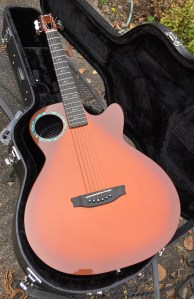 An acoustic-electric guitar is no longer uncommon as it was 50 to 60 years ago. They now make up the majority of acoustic guitars produced. Carbon fiber guitars are no longer an anomaly, more and more manufacturers are emerging, e.g., we have the long established Rainsong brand to the newer Irish made Emerald Guitar brand, and established all-wooden companies are now producing carbon fiber guitars such as McPherson Guitars. Reviewed in this posting is the relatively novel Rainsong CO-WS1005NST. It is novel, in my opinion because it is a “12-fret” acoustic-electric guitar. (To add to this Rainsong’s attributes, it also has a 24.75 inch scale length.)
A “12-fret” model does NOT mean the guitar has only twelve frets. Rather, it means the the neck meets the guitar’s body at the twelfth fret. Although at one time this was typical for acoustic guitar production, at some time about 80 to 90 years ago Martin expanded the acoustic guitar’s construction. With this innovation the neck now met the body at the fourteenth fret. The result was a bolder, and clearer tone. This quickly became the “standard.” Go to any guitar store and you will see the vast majority of guitars are “14 fretters.”
Most major acoustic guitar makers offer a 12-fret model: Taylor, Larrivee, Martin, Takamine, and the list goes on to now include the Rainsong reviewed in this posting (which I now own!). .
 Why did I buy a 12-fret guitar? Let me begin to answer this with my own observation in playing the typical 14-fret acoustic. I have noted that if I capo a 14-fret guitar at the second fret, I have a more comfortable playing experience. I see that I am more articulate with my fretting hand. So, if in any form of tuning (standard or open-D, etc.), why not capo at the second fret and continue the comfort by simply tune-down a whole step and have the same experience? For one reason, a 12-fret guitar has its own unique characteristics. The first tonal difference is volume: a 12-fret acoustic will tend to be a volume canon when compared to most 14-fret acoustics. This is because the bridge is placed lower on the guitar’s top, and the result is more vibration on the surface of the sound board. Notice the distance from the body’s top to the bridge: it is 30.1 cm in distance. This stand in comparison to my Rainsong Nashville Jumbo’s 28.2 cm distance from body top to bridge. This is a notable distance. Volume is also added by the sound whole’s off center position in the upper bout — there is even more surface area created for vibration of the sound board. Again, increased volume is the result.
Additionally, a 12-fret guitar has more mid-range, and this Rainsong is possibly the exemplar of this characteristic. Mid-range plus volume offer can offer a challenge to the guitarist who plays with a pick such as me (“you can have my pick when you can pry it from my cold, dead fingers!”). Hence, I have to overcome the “muddiness” in two ways: use a thin pick, or (a frightening possibility) begin some finger style techniques. (As an admission I have tried the first few bars of Vivaldi’s “Gloria” and was somewhat pleased with my initial, faltering attempts).
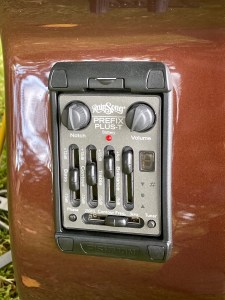 This is the third Rainsong acoustic guitar I have reviewed. Previously, I have reviewed two jumbo body guitars: The Rainsong N-JM1100N2 (Guitar Review: Rainsong N-JM1100N2, AKA the Nashville Series Jumbo) and the Rainsong JM100N2 (Guitar Review: RainSong JM1000N2.) Rainsong’s WS body style is its take on the Auditorium body. This WS body model reviewed is all carbon fiber construction with a copper to orange-burst finish. It comes with Fishman Prefix Plus-T electronics with added built-in tuner. I am no authority on electronics, but when plugged in the control were easy to find and adjust, and seemed fine when played through my Fishman Loudbox Mini-charge.
As with any carbon fiber guitar you have structural advantages. Primarily you never have to worry about humidity – no need to humidify or dehumidify based upon your climate. Carbon fiber means no worries about structural breakdown in commonly encountered temperature extremes. Carbon fiber guitars will hold tune very well when compared to their wooden cousins.
I am a Rainsong fan — sign me up as a card carrying devotee, and I hope to own a 12-string model in the not too distant future. In my humble opinion Rainsong’s are very well made guitars with great acoustic tone, and the carbon fiber construction will bring great longgevity to any guitar you would purchase. Finally, though this 12-fretter will require technique challenges and resulting (albeit painful and frustrating) growth beyond flat-picking, it is a welcome addition to my collection.
Keep on playing,
Fr. Irenaeus
Guitar Shows are back!, with a brief review of the Bright “Bear Cub”
Posted: June 26, 2021 Filed under: Music and Guitars | Tags: 2021 Tacoma Guitar and Drum Fest, Review of the Bright "Bear Cub" small scale guitar, The Bright Bear Cub reviewed Leave a comment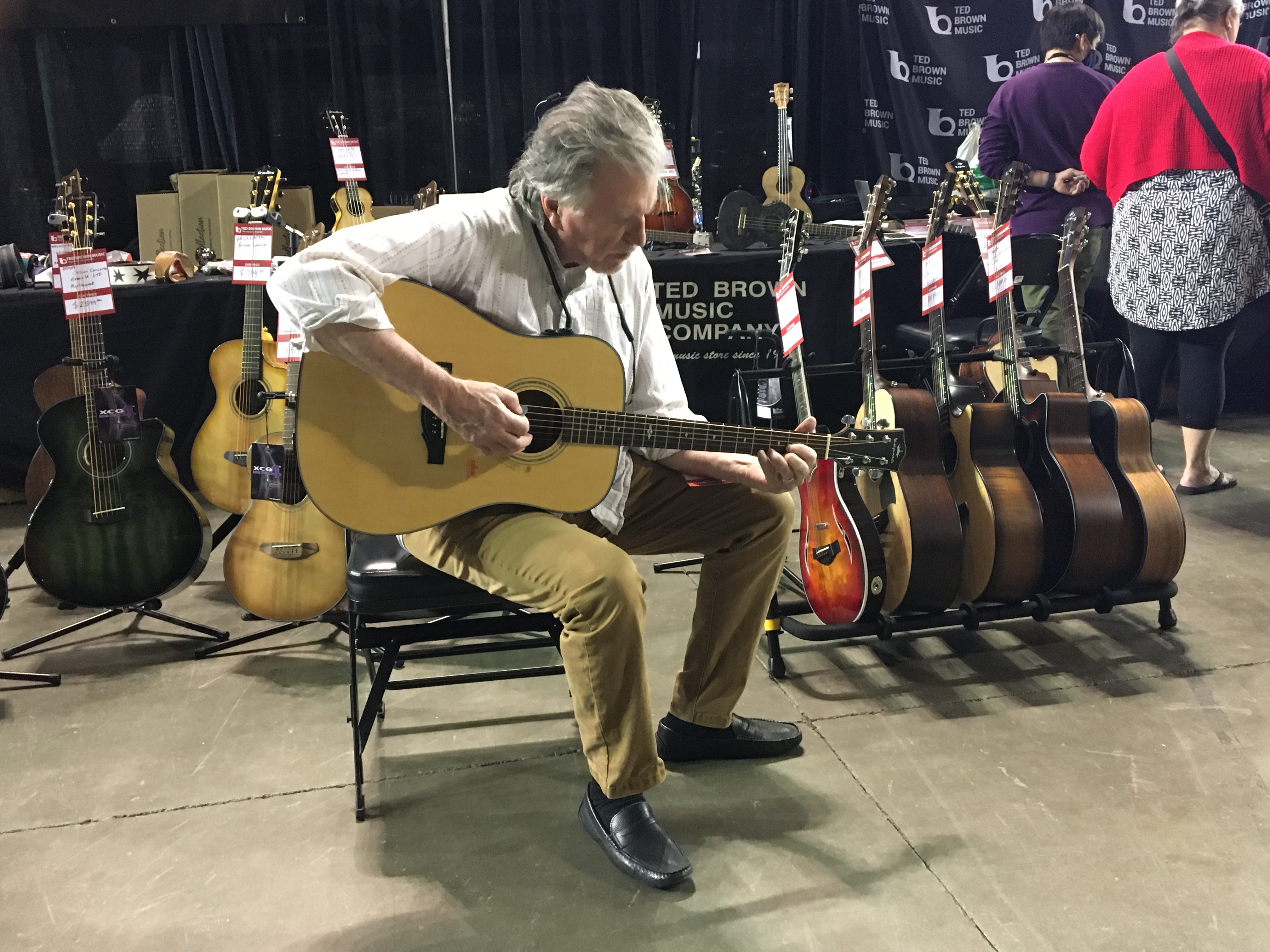 Whether you have called it (or still call it) a pandemic, or a plandemic (as would the more skeptical among us), cultural, social, sporting, and community events were cancelled by state authorities. Washington was among those states locked down in varying phases. Finally, this state is — at least for the time being — opening up to a return to community gatherings. My oldest son, Trevor, and I (pictured to the right) decided to support local and regional luthiers and music stores by attending the 2021 Tacoma Guitar and Drum Fest.
I have attended this festival in the past. It was much larger with more vendors and musicians. But, such trade shows are loud. So, you want to try out an acoustic guitar? Good luck with that — electric guitars take the day with both interest and volume.
However, I made a few discoveries. Among them was meeting Will Bright who is a luthier from Bellingham, Washington. He is the owner of Bright Guitars (www.brightguitars.com). He makes both electric and acoustic guitars, along with an intriguing short scale guitar, the Bear Cub. I quote from his site:
The Bear Cub is an arch top mini travel guitar with a 17 inch scale length. It was designed to be small, playable, and sound great. When I designed the Bear Cub I decided to use a technology that is tried and true with smaller instruments; arched plates. I hand carve the spruce top and maple back just as I would a mandolin or a violin. This, combined with the oval sound hole, gives the guitar warmth, clarity and projection from a very small body. A travel guitar doesn’t have to sound like a tin can or look like a hockey stick, and the Bear Cub proves it.
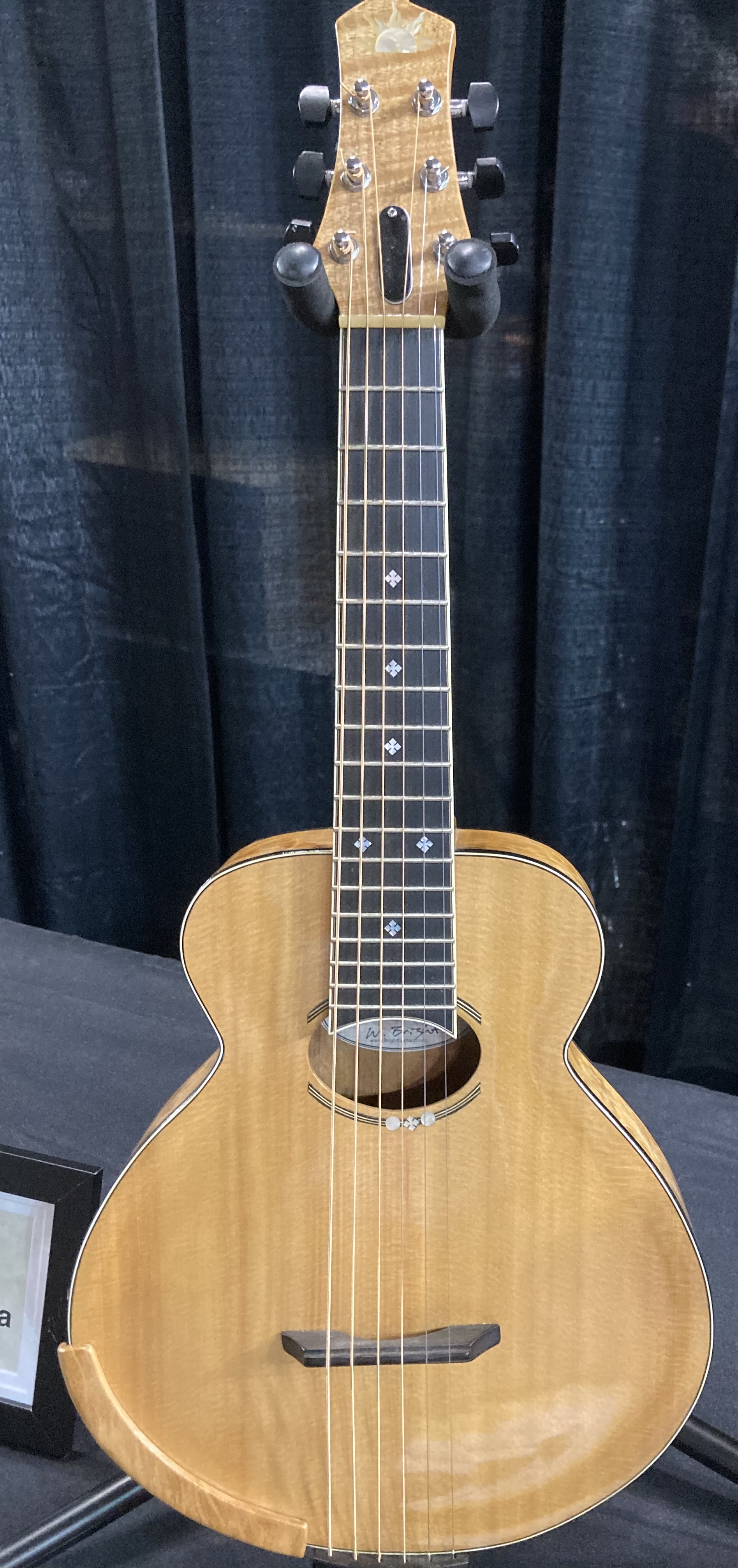
With its short scale, the Bear Cub sounds “mandolinish” when first heard by the player. But, it is, as you see, a six stringed instrument and is tuned as a guitar. With its shorter scale, it would take me a while to adjust to the initial “cramped” feeling (as when you capo up beyond the seventh fret on a guitar), but the tone is bright and pleasing. Will Bright offers two versions of the Bear Cub — the basic, and the more ornate version (as pictured). Production time for the “basic cub” is two weeks; much longer for the more elaborate version.
In comparison, I recently tried a Chinese made Gold Tone F6 Mando Guitar at Tacoma’s Ted Brown Music. It is a similar take: a six stringed small scale guitar that plays like a guitar, but the guitar player doesn’t have to learn the forms required by the mandolin family’s tunings.
The American made Bear Cub is a better build, and as I recall, the neck seemed a bit wider. Further, it simply looks like a small archtop guitar, and did not seem to have the “choppy” tone of the more mandolin structured Gold Tone F6. Well done Mr. Bright!
Keep on playing,
Fr. Irenaeus
Guitar Review: Rainsong N-JM1100N2, AKA the Nashville Series Jumbo
Posted: April 18, 2021 Filed under: Music and Guitars, The Eucharist and Living the Eucharist | Tags: Guitar review of Rainsong N-JM1100N2 the Nashville Jumbo acoustic, Guitar Review: Rainsong Nashville Jumbo (N-JM1100N2), Rainsong's fusion top Nashville Jumbo reviewed Leave a comment
Nashville Jumbo
Inimitable. Now, that is an adjective that is not commonly used in everyday speech. Its definition: “so good or unusual as to be impossible to copy.” I would use this adjective to describe Rainsong’s new Nashville Series Jumbo (N-JM1100N2). I also use the adjective exquisite to describe this guitar in review. Over several years I’ve played three other guitars that I would describe as exquisite in tone and quality: a Breedlove dreadnought, and Breedlove grand auditorium, and a Martin HD-28. All guitars were well above my price range, and I completely shut them out of my mind, thus giving them no further thought or attempt at pursuit of purchase.
Serendipity. Now, that’s a noun not commonly used in everyday speech. Its definition: “the occurrence and development of events by chance in a happy or beneficial way.” (Its adjectival form is serendipitous.) Several months ago at Tacoma, Washington’s Ted Brown Music I had a serendipitous encounter with an inimitable and exquisite Rainsong guitar — the Nashville N-JM1100N2 — a jumbo bodied guitar with a beautiful, glossy tobacco burst finish.
Prior to my serendipitous meeting, I had noticed an ad in Acoustic Guitar for Rainsong’s new Nashville series lineup. This series, as well as the company’s Vintage Series of guitars, has a unique “double top” construction:
“A thin spruce soundboard fused with a unidirectional carbon fiber top [offers] rich crystalline carbon sound subtly colored by spruce…and impervious to temperature and humidity changes.”
I have been aware of, and appreciated Rainsong guitars for many years. In fact I have reviewed this Nashville’s cousin, the Rainsong JM1000N2, elsewhere in this site (Guitar Review: RainSong JM1000N2 ). They are great guitars, and offer many advantages to the traditional wooden guitar. They also come with a price tag that is beyond the reach of many, many guitarists.
 I interject some details on this Rainsong guitar. As previously noted, it is a jumbo bodied instrument: its lower bout measures 17 inches in width. The nut width is 1.75 inches, and scale length is 25.4 inches. It stays in tune between “play dates”, I imagine because, not only due to its tuners, but the overall structural stability offered by carbon fiber. To add, it is incredibly comfortable and its playability is fantastic. The LR Baggs electronics (see the photo) are solid, and the output is great when the guitar was played through my Fishman Loudbox Mini-charge amplifier. But, the tone unplugged is its strength — this inimitable guitar is truly exquisite! It offers sustain and good volume, but also a rich palate of secondary tones not found on the only-carbon Rainsongs displayed.
 Allow me to continue with my serendipitous experience. The Ted Brown store I frequently haunt is a distributor of the Rainsong brand, and they have a sizable portion of one wall in their acoustic room devoted to the brand’s offerings. The Nashville jumbo caught my eye, and she began her call to me. A few strummed chords were followed by a progression of arpeggios, and then some of my favorite chordal riffs. I was stunned — the guitar quite literally took my breath away! Several more minutes were spent thoroughly enjoying it. I compared it to the Rainsong jumbo JM1000N2 also displayed — very good, but no comparison. I compared the Nashville jumbo to some Taylor guitars — all very good, but no comparison. But, then comes the cold slap of reality: the price tag! $3,499. Ouch! Unlike the other noted exquisite guitars, I could not get this one out of my head. What was to be done? Well, why does a guitar player sell a guitar? To buy a new guitar. So a small number of my guitars were sold over a period of time on Reverb.com. Then, a great price was found on a Nashville N-JM1100N2 on Reverb.com, and the purchase was made.
The Nashville jumbo is inimitable due to its construction, and its subsequent voicing is exquisite! I would encourage you to find one and try any Rainsong Nashville or Vintage Series guitar. Sell off the needed number of guitars, save up a bit, and go for it! I am thankful to own this treasured instrument!
Here is a link to Rainsong’s fusion top processing:
Keep on playing!
Fr. Irenaeus
Shubb Capo Royale vs G7th Performance ART: A Comparative Review
Posted: January 2, 2021 Filed under: Music and Guitars | Tags: Review of both Shubb Capo Royale and G7th Performance ART capo, Review of G7th Performance ART capo, Review of Shubb Capo Royale Leave a comment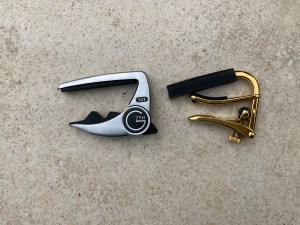
G7th Performance 3 ART and Shubb Capo Royale capos
My quest for the perfect capo continues. I search because the two primary problems with capos still exist: string buzz and loss of tune upon application. A few months ago my first capo review involved a comparison of three G7th capos: G7th Nashville, G7th Performance, and G7th Performance 3 ART. String buzzing when a capo is applied was the problem addressed. The G7th Performance 3 ART makes the claim that its Adaptive Radius Technology provides “…buzz-free use.” The claim was held up when compared to the other G7th capos. With G7th’s most recent product, there was only one buzz recorded which contrasted to multiple buzzes with two other capos made by “The Capo Company.” The string buzz contest was settled, in this posting maintenance of tuning is addressed. Two capos which boast the ability to keep your guitar in tune when applied to the fret board are compared this day: the Shubb Capo Royale, and G7th’s Performance 3 ART
Let’s begin with the claim set forth by G7th:
The Performance 3 is the culmination of years of designing, tweaking, and improving — but most importantly, listening to guitarists and their views on what a capo SHOULD do. Now, coupling our Unique Tension Control system with the ground-breaking ART [Adaptive Radius Technology] string pad mechanism gives a near-perfect capo experience.
The ART system within the top bar of G7th Performance 3 capos adapts to the true curvature over your strings and fretboard, exerting completely even pressure across all the strings — setting a new standard of in-tune, buzz-free use. It gives you the maximum tuning stability with the minimum possible tension in EVERY position, on ANY guitar neck.
Next, we have the Shubb claim:
The Shubb Capo is designed to reduce tuning problems. Its custom material presses the strings just like your fingertip. Its unique design closes onto the neck just like your hand. Its pressure is totally adjustable. The result: no retuning is necessary.
Similar claims, but will there be similar results? I put the capos to the test on five different guitars using one Snark electronic tuner. All five guitars were tuned (standard tuning) using the Snark tuner. Then, each capo was placed on frets 2, 5, and 7 on all five guitars. Each guitar was retuned before repositioning each capo at the above mentioned frets. “Distuning” was noted for each capo at each position by the number of “minute” increments (flat and/or sharp noted by -1, or +2, for example) from the “12 o’clock” position on the tuner. Here are the results in terms of total “distuning minutes” at all three fret positions (again 2, 5, and 7).
Breedlove Pro Series D25/SRH acoustic dreadnought:
Shubb: +9 (all sharp) G7th ART: +6 (all sharp)
Faith FG1RE PJE acoustic dreadnought:
Shubb: +20 (all sharp) G7th ART: +10 (all sharp)
Yamaha A5R ARE acoustic dreadnought:
Shubb: +13 (all sharp) G7th ART: +16 (all sharp)
Taylor Grand Pacific 317e acoustic dreadnought:
Shubb: 0 G7th ART: +4 (all sharp)
Ibanez Talman Prestige solid body electric:
Shubb: +4 (all sharp) G7th ART: +9 (all sharp)
Totals:
Shubb: +46 minutes sharp / G7th ART: +45 minutes sharp
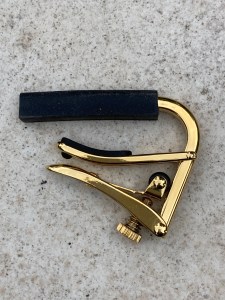
Shubb Capo Royale
In conclusion, I was pleased with the tuning stability provided by both capos. I will NOT run the results through a Chi Square statistical analysis, but I would guess by the results there would be no statistical difference between the two. Further, the minor distunings at all five fret positions would not be audibly noticeable except, perhaps, to someone blessed with perfect pitch. My experience with tuning issues with other capos allows me to express the opinion that both capos live up to their respective claims. However, I would give the Shubb Capo Royale the nod given its price of $20.85 (Amazon) compared to the G7th ART’s price of $49.99 (Amazon). Plus, with its slim gold-plated presentation, the Shubb just looks cooler!
Keep on playing!
Fr. Irenaeus
Guitar Review: Godin Multiac Steel (Natural)
Posted: July 2, 2020 Filed under: Music and Guitars | Tags: Godin Multiac Steel: a true acoustic-electric hybrid guitar, Godin's Multiac Steel is an acoustic guitarist's electric guitar, Guitar review of the Godin Multiac Steel (Natural), Review of Godin Multiac Steel (Natural) 2 Comments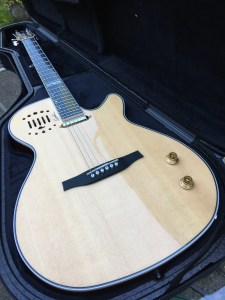
Godin Multiac Steel
There are only two kinds of guitar players in the world…Well actually there are many types of guitar players in the world, but allow me to break it down to what applies to me. There are only two types of guitar players in the world, those who can move between acoustics and electrics with ease, and those who cannot. While my two sons occupy the first position, I, sadly, occupy the latter. I’m an acoustic player. While I appreciate the wonderful tones that come from an electric guitar when played through effect pedals and amplifiers, I am far, far, more comfortable with an acoustic guitar. Part of that comfort comes from the fact that acoustic guitars were the first guitars I owned, and upon which I learned the instrument. Another aspect is that with an acoustic guitar no set up (and take down) of amp, cables, or pedals is part of the music making experience. You pick one up and play. One more admission: I have a relatively “heavy hand” and I find an acoustic far more accepting and forgiving of my touch. So, my three electrics generally languish in their cases and my amps collect dust.
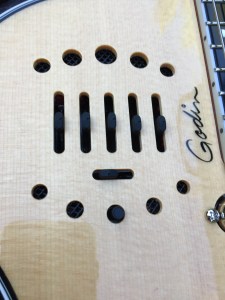 In my explorations, I have tried various acoustic-electric hybrids such as the Taylor T5 and Godin’s Ultra-6 to name a few. Their necks and touch are far too electric in feel, and thus, never purchased. Then early in 2019 I learned about Godin’s new Multiac Steel hybrid. I tried one out at a local store comparing it with a Taylor T5. Hands down the Multiac Steel was the winner. Though heavier, it felt and played far more like an acoustic than an electric. Yet, there were many features that make it also an electric guitar.
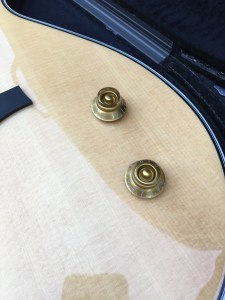
Volume (top) Tone (bottom)
It is an attractive instrument having the appearance of a Les Paul. It is solidly built guitar. It makes a statement of quality. This Multiac has a solid spruce top, mahogany neck with a synthetic fretboard of Richlite (used on some Martin guitars as well), and a chambered wooden body. It has a 25.5 inch scale length and a nut width of 1.72 inches which together add to the acoustic feel I prefer. There are both acoustic LR Baggs pickups and a Seymour Duncan lipstick pickup (this single coil is located just below the fret board). There are two sets of controls and two outputs jacks that allow you to dial in a mix of both acoustic and electric qualities, acoustic only tone, or electric only tone. The control knobs on the body are the true captains of the tone. When you plug into the acoustic output you can blend the acoustic and single coil pickups: the volume knob adds in the single coil to taste while the tone knob dials in the single coils tone (neck to bridge tones). When the single coil output is accessed alone no acoustic blend can occur — it becomes purely electric in character. However — since it is a hybrid — you can plug into both outputs and play through both an acoustic and an electric amp.
 The guitar without any amplification when played has the sound of a hollow body electric when such a guitar is not amplified. But, of course it needs to be amplified to demonstrate its true qualities. The Godin was first played through a Marshall AS50D acoustic amp through the acoustic output jack. Through this amp the Multiac sounded like any amplified acoustic guitar until you blend in the lipstick single coil with the volume control knob. Here, the tone is quite unique.
Next, I went for the pure electric aspect of the Godin. I plugged into a Blackstar HT Club 40 amplifier. The tone produced was truly that of a electric guitar whether played clean or on overdrive. A variety of tones were selected from the amp, and this guitar handled all of it quite steadily.
I truly have the best of both worlds — I now have an electric guitar that has the comfortable feel of an acoustic guitar.
Keep on playing,
Fr. Irenaeus
Gear Review: G7 Performance 3 (ART) Guitar Capo
Posted: February 8, 2020 Filed under: Music and Guitars | Tags: Comparison of G7 Performance 3ART capo to 3 other G7 capos, G7 Nashville capo, G7 Performance 3 ART capo, G7 Performance capo, Is the G7 Performance 3 ART capo a superior capo?, Review of G7 Performance 3 ART capo, review of three G7 guitar capos Leave a commentQuests. Some are factual, some mythical. I have one of my own: the quest for the perfect capo. Some say it doesn’t exist. I have a collection of a variety of capos. Some work well on some of my guitars, but not on others. With any capo there can be the problem of skewing the guitar’s strings upon application of the capo. Then there’s problem of the guitar staying in tune after application. And, of course, there is the issue of a buzzing of strings when the capo is applied. Thus, we guitarists have the never ending quest for the perfect capo.
There have been developments is capo design. One involves application of specific pads which correspond to the guitar’s fretboard radius. This likely solves the problem, but is impractical (I would never take the time to change the pads). Recently I read of the marketing of a new G7 capo in Acoustic Guitar magazine. The new capo is called the G7th Performance 3 Guitar Capo (clamping mechanism). It involves G7’s technology called “Adaptive Radius Technology” (ART). Per G7:
Revolutionary new active string pad infinitely adapts to match any guitar perfectly. The ART mechanism delivers unrivaled tuning stability by applying even pressure across the strings. Suitable for ALL ACOUSTIC and ELECTRIC 6 string guitars.
Guitar Review: Taylor Grand Pacific 317e
Posted: May 9, 2019 Filed under: Music and Guitars | Tags: New Taylor tone of Grand Pacific Dreadnought, review of Taylor Grand Pacify 317e, Taylor Grand Pacific 317e guitar review, Taylor's Grand Pacific dreadnought - fantastic guitar 6 Comments Taylor Guitars is one of America’s premier guitar makers. Their guitars stand shoulder to shoulder with Martin, Gibson, Larrivee, and other great North American guitar manufacturers. They are known for their quality of build and playability. I have owned three Taylor guitars, but have sold all three. I bought them all for their playability. I sold them all due to tone. To me they all were “strident”, and this tone quality always put me off from them. They were set aside, all to be sold to a guitarist who loved that well known “modern Taylor tone.”
I follow the guitar industry. I strive to keep abreast of what is new, and who is doing what. What are the innovations? What are the new models? Of course, Taylor came out with its “V-Class” bracing in 2018. Bracing — you might as well try to discuss particle physics with me (and I’d probably appreciate particle physics more than bracing). “Big deal!” I thought of this innovation. Then, this year (2019) came the new Taylor news — a new type of dreadnought guitar with V-class bracing that offered a completely new Taylor tone. Okay, I might be interested, but I doubted it.
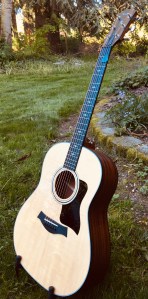 In mid-April I made another trip to Tacoma’s Ted Brown Music. In the store’s properly humidified acoustic guitar room there is a wall of Taylor guitars. In a corner hung a Taylor Grand Pacific 317e. Okay, I’ll bite. I sought to compare it to a Yamaha A5R dreadnought, and my own Faith Legacy Mars dreadnought which I happened to have with me. I compared the Grand Pacific to a Grand Auditorium 414ce, then a Grand Orchestra model. Was there a difference in tone with the Grand Pacific? An emphatic “Yes,” was stated. I have become a fan of Yamaha’s A5 series guitars. They are very playable with great clear tone and fantastic electronics. The Grand Pacific was equally playable, and its electronics, when played through a Fishman Loud Box Mini Charge (by the way, a fantastic acoustic amp!), was equal to the Yamaha system. The 317e was then compared to my beloved Faith Legacy Mars drop shoulder dreadnought. The 317e’s blended tone with strummed and arpeggiated chords held up to the Faith dreadnought, and the quality of tone was equally pleasing. Contrasting the Faith Legacy Mars to the Grand Pacific, the Faith has a more muscular tone, while the Grand Pacific had an airier, but very pleasing tone.
My go-to songs of the Beatles, Kinks, and others were a pleasure to play. The playability is typically Taylor, and of equal ease to the Yamaha A5 and the Faith guitars’ own playability.
 Like the Faith and Yamaha A5 dreads, the appearance of the 317e is simple, tasteful, and classy. The tested Grand Pacific model has a gorgeous bear claw spruce top which puts forth a lovely gloss finish. The sapele back and sides are of a satin finish, as is the mahogany neck. It has an ebony fretboard and bridge. The nut width is 1.75 inches. The lower bout is 16 inches in width. The rounded dreadnought body is not new, but follows Breedlove’s (and now Bedell’s) rounded dreadnought design — this shape is nothing innovative as Taylor may claim. By the way, the case is eye candy. I feel I should buy a case to protect this case!
I was pleased and impressed with this 317e. It is truly a new Taylor sound with all the Taylor quality one is to expect. The Grand Pacific was purchased a week later. This Taylor dreadnought is a “keeper.” Finally, there is a Taylor guitar that rings true to me, and will do so for a new group — yet a more traditionally minded group — of guitarists. Well done Andy Powers and Taylor!
Keep on playing!
Fr. Irenaeus
Guitars Reviewed: Yamaha A4K Limited and A5R ARE
Posted: November 17, 2018 Filed under: Music and Guitars | Tags: Guitar review: Yamaha A4K Limited 2018, Guitar review: Yamaha A5R ARE, Guitars reviewed: Yamaha's A4K Limited 2018 and A5R ARE, Review of two Yamaha A Series guitars: A4K Limited 2018 and A5R ARE, Yamaha A Series guitars reviewed 6 CommentsConfession: I suffer from G.A.S. (Guitar Acquisition Syndrome). I’m not in denial, but I don’t see it as a problem. No one does except my wife (wives must always, in some way, be opposed to their husband’s interests). In fact, those to whom she expresses her misplaced concern see no problem with my G.A.S. (I love enablers!). In this posting is reviewed my latest acquisition: Yamaha’s A4K Limited, as well as its sibling, the A5R ARE. They are both dreadnoughts with built-in electronics, and are all solid wood, and very well made guitars.

A4K Limited
The dreadnought A4K Limited is an all koa guitar — solid top, back, and sides. As you may know, koa is a hard wood, and comes principally from Hawaii. Koa, in my opinion, gives a bright , crisp, and clean tone which is quite pleasant. Other materials of this guitar are mahogany neck, and ebony fretboard and bridge. The binding appears to be mahogany, as is the case for the A5R ARE. The lower bout is a generous 16.25 inches (41.3cm), and the nut width is a typical 1 11/16 inches (43mm) of a dreadnought.

A5R ARE
The A5R ARE sibling has a solid sitka spruce (torrefactioned, or ARE as Yamaha describes the process), and solid rosewood back and sides. It too, has a mahogany neck, with ebony fretboard and bridge. The body and neck dimensions are identical to the A4K Limited.
 Both models have identical electronics which consist of volume, treble, bass, and blend (you can mix mic and under saddle piezo pickups to you taste). The controls are laid out on the upper bout on the bass side of the bodies. A plastic “dear dummy” applique surrounds the controls and labels them for the player. The packaging that comes with the guitars contains smaller decals which are to be applied for identification at each knob. Both models have an attractive pick guard (surprisingly rare these days on many dreadnoughts).
Guitar Review: Faith Mars Legacy Drop Shoulder Dreadnought
Posted: September 12, 2018 Filed under: Music and Guitars | Tags: Faith Guiar's Mars Legacy is reviewed, Guitar review: Faith Mars Legacy, Mars Legacy drop shoulder dreadnought by Faith Guitars is reviewed, Reviewed: Faith Mars Legacy (FG1RE - PJE) 2 Comments The name Faith Guitars is little known in the United States. I discovered the brand just a few years ago. I must admit the name Faith drew my initial interest. Now, I can have a lot of fun with the name since I am a priest in the Orthodox Church, but I’ll spare the world such plays on words. This is my third review of a Faith guitar. Here reviewed is the Mars Legacy.
GUITAR REVIEW: Faith Blood Moon Neptune Acoustic/Electric (FNCEBMB)
Posted: February 26, 2018 Filed under: Music and Guitars | Tags: Faith Guitar Blood Moon Series Neptune, Faith Guitar Blood Moon Series Neptune reviewed, Guitar review: Faith Neptune Blood Moon 3 Comments
Neptune Blood Moon
Trembesi. Interesting name. So, trembesi is not the site of a battle during the Napoleonic Wars. Neither is it a monument, or square, of historical interest in London. It is a tropical hardwood native to Java. It has been used for furniture for years, but recently has been used for guitar tone woods. Britain’s Faith Guitar company now uses trembesi in two of its guitar series: the Trembesi Series (possessing a spruce top), and the Blood Moon Series. The Blood Moon Series consists of three body styles: the Neptune (mini-jumbo), Saturn (square-shoulder dreadnought), and Venus (concert-style body). The Neptune and Venus bodies come with cut-aways and Fishman electronics. As the title indicates, this posting reviews the Neptune model.
 Father Irenaeus Williams
The Kinks’ “Dedicated Follower of Fashion,” Satire, and the Prayer of St Ephraim the Syrian
Posted: March 21, 2024 | Author: Fr. Irenaeus | Filed under: Etcetera, Music and Guitars | Tags: Commentary on the Kinks' "Dedicated Follower of Fashion", humility and satire, The Kinks' "Dedicated Follower of Fashion, The Prayer of St Ephraim the Syrian, true satire | Leave a commentThe Kinks circa 1967 (Ray is standing.)
I have an admission: I love the music of the British Invasion of the 1960s. When the Beatles, Rolling Stones, et al., hit the shores of America I was a little boy in grade school. At that time my only interests were baseball and the space program that involved Mercury, Gemini, and Apollo missions. I didn’t discover the Beatles’ music until after their breakup in 1970 when I heard George Harrison’s “What Is Life”. I then immersed myself in the Beatles’ music and followed their post-Beatles careers faithfully. I soon discovered the Rolling Stones, and the Kinks among other bands. I love the sound of the era, and I have learned to play dozens of songs from that decade on guitar.
Among those songs is the Kinks’ “Dedicated Follower of Fashion.” It was composed by Ray Davies (front man and rhythm guitarist), and was released as a single throughout the world in 1966. It has the flavor of the “Music Hall” era. We, today, would think of it as a “novelty song.”
A little history of this time in London and other urban areas is in order. Some of the youth of the day had one peculiar social division: Mods versus Rockers. As I recall, the Mods followed fashion, and other cultural trends. The Rockers were of a rougher cut, and cared little about fashion, etc. If you could extrapolate these two groups musically into the 1970s, Mods, I would imagine, would lean towards “Glam Rock,” while the Rockers would be fans of the “Punk Rock” scene.
Somewhere in Piccadilly
Clearly, the Kinks’ song is a rather scathing critique of the ephemeral and superficial “dandies” and the “swingers” of London, and those who endlessly shopped Carnaby Street and other trendy locations, perhaps even Piccadilly Circus.
The song is clever and humorous. The song is a satirical jab at other peoples’ foibles.
However, if such (and all) satirical material is only aimed at the “other” without some humility, the humor becomes ridicule and offers only a caricature of those targeted. If one uses satire, one has to accept it when used on “our people”, or us. For satire to be of true value, one has to laugh with those targeted, not just at them. We all have to be able to laugh at ours, and ourselves.
About a decade ago I wrote a less satirical (and worthless too, no doubt!) song I called “Lewis and Clark.” Here is the first verse:
I stumbled upon the file containing its lyrics and chords a short while ago. It prompted me to think of “Dedicated Follower of Fashion.” My thoughts then turned towards me. Though I had a simple four mile commute to work, I, too, at times, spent far too long stuck in freeway traffic in the Puget Sound area of Washington State. Though I never have colored my hair, I, too, have vanity. What was my motivation for those lyrics? Was I willing to see myself as the subject of the jab? I have decided not to resuscitate the song until my motives are properly sorted — perhaps, better, ditch it altogether.
As noted in the title of this posting, this brings me to the Prayer of St Ephraim the Syrian used so frequently by Orthodox Christians, and especially during the season of Great Lent:
In this highly divisive and divided society, where we pick sides and find enemies all around us, St Ephraim’s Prayer should inform our consciences. We need to acknowledge our own weaknesses, foibles, and be charitable about our neighbors’ positions on politics — and even fashion!
Here is a link to “Dedicated Follower of Fashion” (please excuse the brief ad): https://youtu.be/oxYGOSSj9A0?si=ULEvkx-nPd9ysNPy
In Christ with all of my own foibles,
Fr Irenaeus