Commemorating the Birth of Mary
Posted: September 10, 2025 Filed under: Etcetera | Tags: "For behold, Ezekiel 44: 1 - 4 and Mary's perpetual virginity, henceforth all generations will call me blessed, Mary is Queen Mother, Mary is the New Eve, Mary's obedience undoes Eve's disobedience, Mary's statement "I am not knowing a man", St Luke 11: 27 - 28, the Annunciation, the Birth of the Mother of God, The Nativity of the Theotokos, the perpetual virginity of Mary, the role of Queen Mother in the Ancient Near East Leave a comment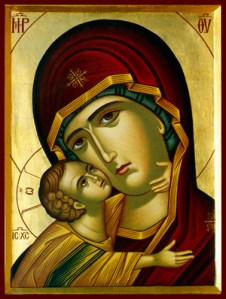 In the Orthodox Church, the birth of Mary, the Theotokos (which means God Bearer, or Mother of God), is celebrated every year on September 8. A hymn for the day’s liturgy reads,
By your nativity, O Most Pure Virgin, Joachim and Anna [Mary’s parents] are freed from barrenness; Adam and Eve from the corruption of death. And we, your people, freed from the guilt of sin, celebrate and sing to you: the barren woman gives birth to the Theotokos, the nourisher of our Life!
If you come from a Protestant background, the Church’s teaching regarding Mary may have presented many challenges to your Protestant sensibilities as you moved into the Church. Let’s tackle a few teachings for reinforcement. The subjects come from all the readings set for this day.
HER PERPETUAL VIRGINITY
One of the primary Old Testament sources of this teaching comes from Ezekiel 44: 1 – 4:
Then he brought me back to the outer gate of the sanctuary, which faces east; and it was shut. And he said to me, “This gate shall remain shut; it shall not be opened, and no one shall enter by it; for the Lord, the God of Israel, has entered by it; therefore it shall remain shut. Only the prince may sit in it to eat bread before the Lord; he shall enter by way of the vestibule of the gate, and shall go out by the same way” (Ezekiel 44: 1- 4).
The vision of Ezekiel has been interpreted by the Church in a typological / allegorical manner. The gate and vestibule, anatomically, refer to female reproductive anatomy.
Regarding the Archangel’s declaration to Mary:
And the angel said to her, “Do not fear, Mariam: For you have found grace with God. And behold, you shall conceive, and shall bear a son, and you shall call his name Jesus” (St Luke 1: 31).
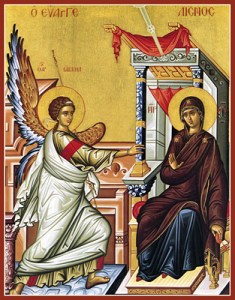
Icon of the Annunciation
Mary replies and questions the angel: “And Mariam said to the angel, ‘How shall this be, since I am not knowing a man [ginosko]?” (St Luke 1:34). The Greek verb in this passage, ginosko, is a verb in the present active tense, or aspect. Though this aspect, or tense, means the action is occurring in the “here and now,” it can also mean that the action is ongoing and has no intended ending, it keeps on going, or is continuous. Given the prophecy quoted above from Ezekiel, and its interpretation, the ongoing meaning best fits the translation to be, “I am not knowing a man” — she will never have sexual relations with Joseph. St Gabriel’s answer also refers back to the words from Ezekiel: “In answering, the angel said to her, ‘the Holy Spirit shall come upon you, and the Power of the Most High will overshadow you. Because the One being born of you shall be called the Son of God” (St Luke 1: 35). It is only the Son of God who has entered and exited her reproductive tract.
Regarding this first subject of discussion, we have Mary presented as the Ark of the Covenant in St John the Apostle’s vision on the island of Patmos:
And the Temple of God was opened in heaven, and the Ark of the Covenant of the Lord was seen in his Temple. And lightning, sounds, and thunder occurred, and great hail fell. And a great sign was seen in heaven, a woman clothed with the sun, and the moon beneath her feet, and upon her head a crown of twelve stars (Rev 11: 19 – 21:1).
Granted, these verses and the ones that follow can also refer to the Church. But St John writes in a manner in which any verse, or verses, he writes — even these verses examined are not an “either / or,” but a “both this and that.” Therefore, we can determine that he means both. Hence, she is the Ark of the Covenant and stands for the Church! Furthermore, the Ark of the Covenant could not be touched by just anyone. We read this from 2 Samuel (2 Kingdoms) 6: 6 – 7,
And when they came to the threshing floor of Nacon, Uzzah put out his hand to the Ark of God and took hold of it, for the oxen stumbled. And the anger of the Lord was kindled against Uzzah; and God struck him there because he put forth his hand to the Ark; and he died there beside the Ark of God (2 Samuel 6: 6 – 7).
Therefore and again, the strength of Ezikiel’s words and the translation of Mary’s statement, “I am not knowing a man,” is upheld as the Church has understood her place in our salvation.
Finally, regarding the matter of her perpetual virginity, we read from a portion of St John’s account of the crucifixion:
…But standing by the cross of Jesus were his mother, and his mother’s sister, Mary the wife of Clopas, and Mary Magdalene. When Jesus saw his mother, and the disciple whom he loved standing near, he said to his mother, “Woman, behold, your son!” Then he said to the disciple, “Behold, your mother!” And from that hour the disciple took her to his own home (St John 19: 25 – 27).
The point here is this — if Mary had another son of her own it would have been unlawful to put his mother into the care of St John. Jesus upheld and fulfilled the Mosaic Law. Thus, Mary had no other sons or children.
QUEEN MOTHER AND INTERCESSOR:
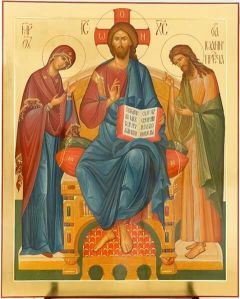 In the Ancient Near East (ANE) kings had queens, but their queens were not their wives. The queen in the ANE was the mother of the king — a queen mother. This was her job: to intercede before the king about his subjects’ concerns. This brings us to Bathsheba. She was a wife of King David. She was the mother of King Solomon. Therefore she was the queen mother. We read this concerning her role as intercessor to Solomon:
So Bathsheba went to King Solomon, to speak to him on behalf of Adonijah. And the king rose to meet her, and bowed down to her; then he sat on his throne, and had a seat brought for the king’s mother; and she sat on his right. Then she said, “I have one small request to make of you; do not refuse me.” And the king said to her, “Make your request, my mother; for I will not refuse you” (1 Kings / 3rd Kingdoms) 2: 19 – 20.
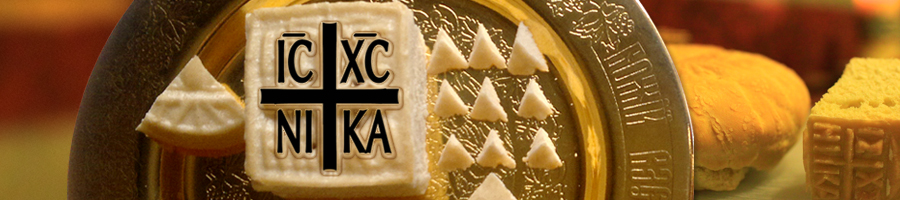
The antitype of Bathsheba is Mary. She is the Mother of the King of kings; Lord of lords. Thus, Mary is the Queen Mother of all queen mothers. We understand that she, like Bathsheba has a seat at our King’s right side. We see this in the Proskomede rite where bread and wine undergo preparation for the Divine Liturgy where they will become the Body and Blood of Christ. In this rite, a certain, small triangular shaped piece of bread is cut from a larger loaf. It is placed at the right side of a larger cube-shaped piece of bread called the Lamb (which will become the Body of Christ). By the words presented below and the action of the priest, the Church acknowledges her to be our Queen Mother:
In honor and memory of our most blessed Lady Theotokos and ever-Virgin Mary. Through her prayers, O Lord, accept this sacrifice upon Thy heavenly altar. The Queen stood on Thy right side, arrayed in golden robes, all glorious. (With these final words the triangular piece of bread is placed at the right side of the Lamb).
This next hymn presented is generally sung in the Divine Liturgy. It also declares our understanding of Mary’s intercessory role:
Steadfast Protectress of Christians, constant advocate before the Creator — despise not the entreating cries of us sinners, but in your goodness come speedily to help us who call on you in faith. Hasten to hear our petitions and to interceded for us, O Theotokos, for you always protect those who honor you!
THE NEW EVE AND THE ANNUNCIATION:
To understand this we must go back to the third chapter of Genesis (Genesis 3: 1 – 7). In the Garden we find the serpent (a spiritual being) who approaches Eve and deceives her. Eve eats of the forbidden fruit and disobeys the one and only commandment given to them by God. She gives the fruit to her husband. When he eats he capitulates, meaning he hands over their authority and power to the deceiving serpent. The cosmos is undone. Death via sin enters into creation. With sin and death come darkness and alienation. These are the results of Adam’s capitulation
So, for our salvation, we must have an undoing of the curse. A recapitulation must occur — the authority, power, and order lost must be regained. From here holiness, life, light, relationship must re-enter creation. The Archangel Gabriel (a spiritual being) approaches Mary (also a virgin as was Eve in the Garden before the Fall) in the Temple (which can be seen as the re-presentation of the Garden). St Gabriel addresses Mary: “Hail, who has been graced” (kecharitomene, a perfect, passive participle). The perfect tense, or aspect of a Greek verb means that an action occurred in the past, but the action continues into and beyond the present. Thus, Mary had been “graced’ long before this day: “Now when the fullness of time came, God sent his Son born of a woman (Galatians 4: 4). St Gabriel reveals God’s plan for our salvation. Mary replies, “Behold the handmaid of the LORD. May it be done to me according to your word” (Luke 1: 38). Mary’s obedience undoes Eve’s disobedience, and the core of the knot of sin and death is released. Now Christ enters her uterus by the Holy Spirit to become our Savior. He is the New Adam and recapitulation occurs!
We have a wonderful hynm, a Theotokion, near the beginning of the First Hour which pulls together all the themes discussed so far in this posting:
What shall we call you, O Full of Grace? Heaven — for you did shine forth the Sun of Righteousness; Paradise — for you have blossomed forth the Flower of Incorruption; Virgin — for you have remained incorrupt; Pure Mother — for you have held in your holy embrace a Son who is God of all. Beseech him to save our souls.
AN EXAMPLE FOR SPIRITUAL LIVING
Of course Jesus Christ is our one, true Examplar. But the Scriptures give other examples to imitate. We have, for example, St Paul: “I urge you, then, to be imitators of me” (1 Corinthians 1: 16). But, we also have Mary. Mary was the first to walk in the ways of Christ, and to walk along the paths of Christ by denying herself, emptying herself of self, and carrying Christ within her uterus. Thus, Mary was the first to receive Christ into her being and life in the most profound, complete, and unique way possible. A portion of the Gospel reading for this day reads,
And it happened while he was speaking these things, a certain woman from the crowd lifted up her voice and said to him, “Blessed is the womb which bore you, and the breasts which nursed you!” But, he said to her, “More than this [menounge], blessed are those who hear the word of God and keep it” (St Luke 11: 27 – 28).
The Greek word, menouvge, can be translated “on the contrary”, or “rather.” This translation of the word has been interpreted by Protestant traditions to be a negation of his mother — a put down. It is not a put down of his mother — he would not dishonor her — he upheld the Law. But, he with, “more this,” places those who keep the word of God in company with her. We, thus, are of the family of God if we, as did Mary, hear and keep God’s word.
So it is that we honor her and bless her! By doing so we keep the word of God when we read St Elizabeth’s words:
And when Elizabeth heard the greeting of Mary, the child leaped in her womb; and Elizabeth was filled with the Holy Spirit and she exclaimed with a loud cry, “Blessed are you among women, and blessed is the fruit of your womb! And why is this granted me? that the mother of my Lord should come to me?” (St Luke 1: 41 – 43).
Next, we have Mary’s reply to St Elizabeth. A portion of the Magnificat reads:
And Mary said, “My soul magnifies the Lord, and my spirit rejoices in God my Savior, for he has regarded the low estate of his handmaiden. For behold, henceforth all generations will call me blessed; for he who is mighty has done great things for me, and holy is his name” (St Luke 1:46 – 50).
We commemorate and celebrate the birth of Mary as we continue to bless the Mother of God — as has the Orthodox Church for all generations:
Your nativity, O Virgin, has proclaimed joy to the whole universe! The Sun of Righteousness, Christ our God, has shone from you, O Theotokos! By annulling the curse, he bestowed a blessing. By destroying death, He has granted us eternal life!
The following is a sermon given at Holy Resurrection Orthodox Church, Tacoma, Washington on September, 8, 2025:
In Christ,
Fr Irenaeus
 Father Irenaeus Williams
The Account of the Rich Young Man
Posted: September 1, 2025 | Author: Fr. Irenaeus | Filed under: Etcetera | Tags: Jesus and the Rich Young Man, Seek first the Kingdom of God, St Hilary of Poitiers commentary on the Rich Young Man, St Hilary of Poitiers on possessions and wealth, St Matthew 19: 16 - 26 | Leave a commentJesus and the Rich Young Man
There is a saying: “comfort the afflicted; afflict the comfortable.” There are numerous passages from the Scriptures that can accomplish this goal. Today’s Gospel reading from St Matthew 19: 16 – 26 is one such passage: the account of the Rich Young Man (Ruler). He approaches Jesus and asks him, “Teacher, what good deed must I do to have eternal life?” (St Matthew 19:16). Concerning the young man’s spiritual condition, Jesus informed him of the one thing he must do,
Upon his sad departure we have commentary from our Lord:
His disciples were shocked by these words: “Who then is able to be saved?”. They ask this because it was thought that the wealthy had God’s favor, not the poor.
St Hilary of Poitiers
So what was at play within the heart and mind of the young man? St Hilary of Poitiers states this:
St Hilary’s commentary regarding the state of the rich young man adds this: that he placed typical confidence in keeping the Mosaic Law. Thus, the young man could only understand the spiritual life in external, outward, even legalistic terms. He could not, and ultimately, would not grasp our Lord’s conditions for his discipleship and enter into the inner dimension of what was demanded by Christ. Again, his trust in the Law demonstrates this external orientation as does his inability to relinquish his material, external trust in who he was in Israel’s own external and legalistic understanding of spirituality and salvation.
So, what about this illustration of the camel and the eye of the needle? St Hilary explains in this way. Simply, this the camel is a “beast of burden,” and as such the camel’s burdens must be lifted off that me may become smaller. So it is to be with us. I quote St John the Baptist: “He [Jesus] must increase, but I must decrease” (St John 3: 30).
Once more, this is one of those sections from the Scriptures that should afflict the comfortable. As Westerners in this time in history, we are exceedingly wealthy when compared to other areas and eras of the world. We worry about our investments, properties, and possessions. If this is misplaced and becomes our focus, then we are likely in the same place as the rich young man.
I will ask three questions of us. Is our self identity wrapped up on monetary wealth, position in society, and other externals? What do we treasure to the extent that we may be unwilling to give them away to follow Christ more completely? And regarding our possessions — do we possess them, or do they possess us?
Jesus is to have the last word:
In Christ,
Fr Irenaeus