Doxology
Posted: February 13, 2021 Filed under: The Eucharist and Living the Eucharist Leave a comment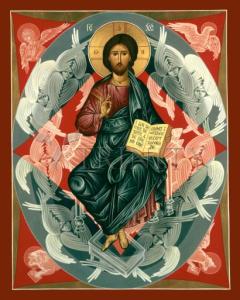 Doxology comes from a Greek word: Doxa. It is generally translated as “glory”, or “splendor”. It can also be translated as “praise” or “honor”. The epistle reading set for the 35th Sunday after Pentecost comes from St. Paul’s first letter to his spiritual son, Timothy. The final verse puts forth a doxology (set forth in italics):
The saying is sure and worthy of all acceptance, “Christ Jesus came into the world to save sinners,” of whom I am the foremost. However, it was for this I received mercy — in order that being the foremost, Christ Jesus might demonstrate all his patience for an example to those who are about to believe in him for eternal life. Now to the King of Ages, immortal, invisible, the only God be honor and glory forever and ever. Amen (1 Tim 1: 15 – 17).
Prior to these three verses, St. Paul lays out his condition to St. Timothy, “…though I formerly blasphemed and persecuted and insulted him; but I received mercy because I had acted ignorantly in unbelief” (1 Tim 1: 13). St. Paul describes not only himself, but every human being’s existence prior to coming to faith in Christ and receiving his mercy and forgiveness. He embraced Christ, “and the grace of our Lord overflowed for me with the faith and love that are in Christ Jesus” (1 Tim 1: 14).
St. Paul’s response to the grace and mercy given to him by Christ was to evangelize a great portion of Rome’s territory. He lived and proclaimed Christ everywhere he went. He also, in response to the grace and mercy he received, gave praise to Christ and to God the Father as we read in the above verses. We too are to be doxological in our lives’ responses to the mercy, forgiveness, light and life given to us in our salvation. This apostle, in his letter to the Ephesians, gives us his guidance:
Look carefully then how you walk, not as unwise men but as wise, making the most of the time, because the days are evil. Therefore do not be foolish, but understand what the will of the Lord is. And do not get drunk with wine, for that is debauchery; but be filled with the Spirit, addressing one another in psalms and hymns and spiritual songs, singing and making melody to the Lord with all your heart, always and for everything giving thanks in the name of our Lord Jesus Christ to God the Father (Eph 5: 15 – 20).
In response to our salvation our lives are to correspond to the ways of Christ in both conduct and attitude — wise, holy living is to be coupled with joy, love and gratitude. A prayer from the First Hour can become a personal prayer: “Let my mouth be filled with your praise, O Lord, that I may sing of your glory and majesty all the day long.” Live doxologically!
The link is to a corresponding homily given 2/7/21:
In Christ,
Fr. Irenaeus
By the Blood of Christ
Posted: February 1, 2021 Filed under: The Eucharist and Living the Eucharist | Tags: Eph 2: 11 -13 and peace by Christ's shed blood, peace is made by Christ's shed blood, unity in Christ by his shed blood, unity in Christ in spite of social and political divisions, unity in Christ in the Church, unity in the Eucharist Leave a comment In his epistle to the first century Christians in Ephesus, St. Paul informs Gentile converts to Christ of their spiritual condition prior to coming to the faith:
Therefore, remember that at one time you Gentiles in the flesh, called the uncircumcision in the flesh by what is called the circumcision, which is made in the flesh by hands — remember that you were at that time separated from Christ, alienated from the commonwealth of Israel, and strangers to the covenants of the promise, having no hope and without God in the world. But now in Christ Jesus your who once were far off have been brought near by the blood of Christ (Eph 2: 11 – 13, emphasis added).
The Gentile Christians of Ephesus now being in Christ have relationship which was gained by the life giving blood shed by Christ on the Cross.
Then, in another epistle written by St. Paul while imprisoned in Rome, he make this declaration:
He is before all things, and in him all things are held in their proper orders. He is the head of the body, the Church. He is the firstborn from among the dead, that in everything he might be pre-eminent. For in him the fulness was pleased to dwell, and through him to reconcile all things to himself, those things on earth and those things in heaven, making peace by the blood of his Cross (Col 1: 17 – 21).
All people and all things are gathered together in Christ, and in him all things once scattered into alienation are drawn into relational union in him. All and all things can now live in peace — in spite of those aspects of life which would otherwise separate us from one another and cause enmity.
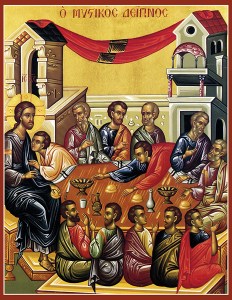 Elsewhere, regarding the shed blood of Christ, St. Matthew records these words of Jesus during the Last Supper: “This is my blood of the Covenant, the [blood] which is being poured [ekchunnomenon] out for many for the forgiveness of sins” (Mt 26: 28). The Greek word in the passage above is a present, passive participle. The present tense, or better aspect, of a Greek verb / participle generally imparts the meaning of ongoing action. In other words the action is without an implied end. Here, Jesus is stating that his blood contained in the chalice in the Upper Room is continually being poured out for the forgiveness of sins, and, by adding in the meaning of St. Paul’s words fund in Ephesians, it is being poured out for our peace and reconciliation with one another. Where, then, do the faithful of Christ encounter this poured out blood of our Lord? This continually poured out blood (and continually broken body of our Lord, see Luke 22: 19 – 20) is encountered in the Eucharist! When the Church, in faith, gathers together in eucharistic worship of our Lord, we are a living picture and reality of the peace won for us by the shedding of his blood.
I return to the epistle to the Ephesians:
But now in Christ Jesus you who once were far off have been brought near by the blood of Christ. For he is our peace, who has made us [Jew and Gentile] both one, and has broken down the dividing wall of hostility…that he might create in himself one new man in place of the two [Jew and Gentile], so making peace, and might reconcile us both to God in one body through the Cross, thereby bringing the hostility to an end (Eph 2: 13 – 16).
In the day of the writing of the New Testament there was no greater social divide in the mind of any Jew, including St. Paul, than that between Jew and Gentile. And throughout the New Testament this division, and its end, is laid out to the reader.
All and all things once in alienation, sin, death, and darkness are gathered together in peaceful relationship, holiness, life, and light in Christ Jesus as St. Paul informs us. But, he knew that this union in Christ must be manifested in the life of the Church: Jewish and Gentile believers must live in loving union — even with all the potential flare-ups of conflict and misunderstanding. Life in Christ means life in union in spite of differences. There is only one Church.
In this third decade of the twenty-first century, societal divisions exist, and they are profound. We as a nation are living on a societal powder keg with far too many people — of all political persuasions — are playing with matches. The political divisions are so great we may face, if a center is not found, a civil war. As a priest I have heard comments such as this: “I don’t even want to be around so-and-so because of his / her politics.” Unbelievable, as if politics can hold any truth or salvation!
 Twenty-first century divisions are to be dissolved in the life of the Church — the Body of Christ — as his Body comes together in peace to receive his Body and Blood of the Eucharist. St. Paul teaches us again from his letter to the Colossians: “And let the peace of Christ rule in your hearts, to which [peace] also you were called in one body. And become thankful [kai eucharistoi ginesthe]” (Col 3: 15). Let me add — become eucharists!
In Christ and in Peace,
Fr. Irenaeus
 Father Irenaeus Williams