
Sunday of the Blind Man — Seeing with New Eyes
Posted: May 24, 2020 Filed under: Etcetera, The Eucharist and Living the Eucharist | Tags: Healing of the man born blind, John 9: 1 - 38 and the man born blind, looking upon nothing base, receiving spiritual eyes, the sacramental healing of the man born blind Leave a comment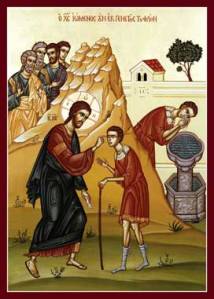 Today is the sixth Sunday of Pascha, and we read from St. John 9: 1- 38, and learn of Jesus’ healing of a man born blind. This restoration of sight is the sixth sign that is reported in St. John’s Gospel. This miraculous sign occurs “that the works of God might be manifested in him.”
His healing takes place in a sacramental manner: Jesus “anoints (chrismates)” him from clay made by the mixing of Jesus’ saliva (the saliva of God) with clay on the ground (we have the union of divine and material). Jesus then instructs him to have his eyes “baptized” by washing off the anointed clay from his eyes in the Pool of Siloam. “He went and washed and came back seeing” (9: 7). With his new vision he encounters Christ:
Jesus heard that they cast him out [of the Synagogue], and when he finds him he said, “Do you believe in the Son of Man?” And he answered and said, “And who is he, Lord, that I might believe in him?” And Jesus said to him, “You have seen him, and the one speaking with you is he.” And he said, “I believe, Lord!” and he worshipped him (9: 35 – 38).
Richard Adams and Animal Welfare
Posted: May 17, 2020 Filed under: Animal Welfare, Speculative Fiction | Tags: Animal welfare in Richard Adams Plague Dogs, Christian animal welfare, Christian animal welfare as advocated by Richard Adams, discussion of animal welfare in Plague Dogs, Richard Adams a Christian animal welfare activist, Richard Adams and animal welfare 2 Comments
Richard Adams
English author Richard Adams is best known for his worldwide best seller, Watership Down first published in 1972, and was subsequently made into an animated movie 1978, and animated television series in England, then recently butchered by Netflix-BBC two years ago. Adams was involved in a number of movements directed toward animal welfare, and was, for a time, director of England’s RSPCA. In Watership Down, Adams’ rabbit characters remark about humanity’s indifference, and even hostility to animals and the environment in general. Perhaps the most striking lament by Adams comes from Chapter 21, “For El-ahrairah to Cry.” Here, Holly (the Bard of the band of rabbits) states:
It [evil] comes from men…All other elil [enemies] do what they have to do and Frith [the rabbits’ god] moves them as he moves us. They live on the earth and they need food. Men will never rest till they’ve spoiled the earth and destroyed animals
 Father Irenaeus Williams