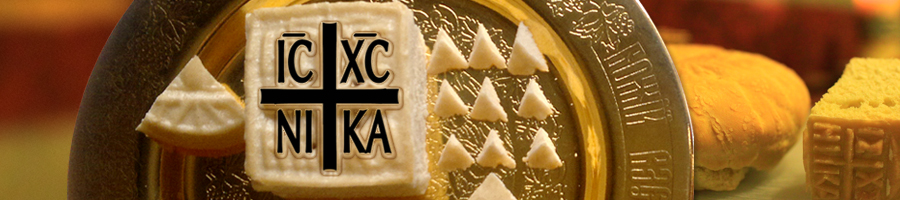
The Meeting in the Temple, St Simeon, and Candlemas
Posted: February 3, 2024 Filed under: Etcetera, The Eucharist and Living the Eucharist | Tags: Candlemas, Light and Life of Christ, St Anna the Prophetess, St Simeon, take the Light of Christ into your life, The Feast of the Meeting in the Temple, the light of the world, you are the light of the world Leave a comment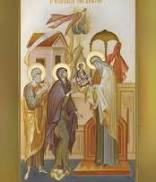
Icon of the Meeting in the Temple
Every February 2 we have the Feast of the Meeting in the Temple. We meet two holy, elderly prophets: St Simeon and St Anna. Yet, apart from the Holy Family, St Simeon’s role in the presentation of Jesus in the Temple as part of the Law is key. This elderly saint and prophet gave the Church a valuable hymn as it is recorded in St Luke’s Gospel:
Now in peace dismiss your servant, because my eyes have seen your salvation which you prepared before the face of all people: A Light for revelation to the Gentiles, and the glory of your people Israel (St Luke 2: 29 -32).
St Simeon said these words as he held his long awaited Savior in his arms as Sts Mary and Joseph took in the moment and his prophecy.
Light is clearly the primary theme of this second major feast of the Church year. Just over 30 years later we have Jesus’ own words about himself:
I am the Light of the world: the who follows me shall never walk in the darkness, but shall have the Light of Life (St John 8: 12).

Light and Life
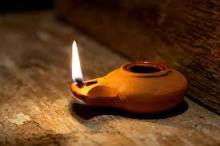
Once, and not too long ago, there was a world lit only by fire — by candle, torch, or fire in the hearth. Darkness likely may have seemed darker, and those who walked and prowled in it even more dangerous. So. light had to have been more precious in those days. The fire for a home had to be maintained and safeguarded. The Light of Christ is by far the most precious Light of all lights, and it is to be maintained and safeguarded with in us with even greater vigor and vigilance.
The Light of Christ has always been sung and praised by the Church. “O Gladsome Light” is one of the oldest hymns of the Church, possibly going back to our earliest days. It is sung as part of every vespers service:
O Gladsome Light of the holy glory of the immortal Father: heavenly, holy, blessed Jesus Christ. Now that we have come to the setting of the sun, and behold the light of evening we praise God: Father, Son, and Holy Spirit. For meet it is at all times to worship you in voices of praise, O Son of God and giver of life. Therefore, all the world does glorify you!
Given this hymn, it is easy to understand why in every Orthodox service candle light is seen throughout the nave and in the sanctuary. These candles made from beeswax (the bees, too, offer their gifts) signify many things. But they always witness to the Light of Christ.
 This feast day is also called Candlemas — candles are blessed this day for their use throughout the year. After the candles are blessed, the faithful in attendance each receive and light a candle. Its flame is kept for the duration of the Divine Liturgy (or at least as long as it lasts). All physical lighting illuminates a room or a house. The Light of Christ is the brilliant Light that dispels the darkness in our souls where sin and lies may find shelter and persist in bringing about spiritual ruin and disease. If permitted to shine, the Light of Christ illumines and brings healing to those formerly dark places. Additionally, Jesus says this as recorded in the Gospel of St Matthew:
You are the light of the world…Thus let your light shine before men, so that they might see your good works, and might glorify your Father who is in the heavens (St Matthew 5: 14, 16).
During the Divine Liturgy of this feast day, the faithful hold their candles. The flame signifies the fire of the Holy Spirit. The flame’s light signifies the life giving Light of Christ. Let us take this Flame and Light into our lives. Let us continually do this to dispel the dark corners remaining in us where sin, corruption, and lies hide. Let his Light shine that these horrors may be excised from our lives. Also, in and by all that we do in Christ Jesus our Lord, God, and Savior, let us bring his Light to this darkened and depraved world.
St Simeon and St Anna, pray for us!
In Christ who is the Light of the world,
Fr Irenaeus
All Will Be Revealed
Posted: November 3, 2023 Filed under: Etcetera, The Eucharist and Living the Eucharist | Tags: be doers of the word, determine to do what is right and true, nothing is hidden that shall not be made manifest, Set aright our minds, St James 1: 22 - 25, St Luke 8: 16 - 18, St Matthew 5: 14 - 16, the battle is in the mind, you are the light of the world 2 CommentsA somewhat alarming passage is found in St Luke’s Gospel:
No one after lighting a lamp covers it with a vessel, or puts it under a bed, but puts it on a stand, that those who enter may see the light. For nothing is hidden that shall not be made manifest, nor anything secret that shall not be known and come to light. Take heed then, how you hear; for to him who has will more be given, and from him who has not, even what he thinks that he has will be taken away (St Luke 8: 16 – 18).
Elsewhere, in St Matthew’s Gospel we read again of light:
You are the light of the world. A city set on a hill cannot be hidden. Nor do men light a lamp and put it under a bushel, but on a stand, and it give light to all in the house. Let your light shine before men, that they may see your good works and give glory to your Father in heaven (St Matthew 5: 14 – 16).
These verses from St Matthews Gospel informs us that we are the light of the world, as is Christ the Light of the world. As he is in us and we in him — so are both true. We are to manifest his light by our good works so that God will be glorified by those who observe them. So we are to live as Christians.
But the alarm given to us is found in St Luke’s words. For nothing is hidden that shall not be made manifest, nor anything secret that shall not be known and come to light. All will be revealed for all is known by God. Our Lord also tells us that what is said in secret will be shouted from the rooftops.
The text also holds this:
Take heed then, how you hear; for to him who has will more be given, and from him who has not, even what he thinks that he has will be taken away.
How we hear what we hear refers to how we hear the teachings of our Lord Jesus Christ. Do we hear, but do not put into practice? Do we know, but not stubbornly not act accordingly? St James gives these words to us:
But be doers of the word, and not hearers only, deceiving yourselves. For if any one is a hearer of the word and not a doer, he is like a man who observes his natural face in a mirror; for he observes himself and goes away and at once forgets what he looks like. But he who looks into the perfect law of liberty, and perseveres, being no hearer that forgets but a doer that acts, he shall be blessed in his doing (St James 1: 22 – 25).
St James instructs us to do the will of Christ — to act positively upon God’s words, and put into practice those works that show Christ’s light — and our light — to the world. But what about those temptations to ignore, disobey, and then enter into sin?
 I will give my illustration of “The Bubble.” This illustration is about the control of our thoughts, especially thoughts that would bring us into error and sin if acted upon. Thoughts are extremely import because thoughts determine outcomes. Thus, they determine reality. Let’s say there is a pond with over hanging trees. Every autumn the leaves fall from the numerous branches and settle to the pond’s bottom. There the leaves decay. This process will often release a bubble of gas which rises to the surface. Such a bubble is a thought that could lead to temptation, or some random memory which, if acted upon would lead us into sin. At this point of awareness there is no error, no sin. But, when the “bubble” rises to our consciousness we have two options: we can allow the “bubble” with its stench to reside on the surface of our consciousness and interact with it. When acted upon, the thought draws us into sin. Or, we can pop the “bubble” and be victorious and advance in our faith.
We will all stand before Christ in judgment in the Last Day. What we have done — good and ill — will be revealed. In our time in this life we must act by faith in holy ways that correspond to the will of Christ. Acting faithfully in this manner will bring us welcome into his Kingdom. This battle between our Lord’s will and our own carnal will takes place in the mind. We read this exerpt from the Prayer of the Hours: “…Set aright our minds; cleanse our thoughts.” This petition sums things up quite well — yes the battle is in the mind.
Jesus Christ conquers
Let me inform you of a particular challenge for me. I can be quite impatient in a check out line in any retail setting, especially with someone who is young. If this impatience is expressed to the employee I have sinned. Therefore, I must determine in advance how I will interact with this person. Will I bless this person who bears the image of God, or will I be an ass? I must choose to be a blessing for her or him, and I generally utter these words from Psalm 38 (37): 22: “Make haste to help me, O Lord, my salvation”. If the “bubble” of impatience arises to the surface of my consciousness I must pop it and be victorious according to our Lord’s will. I, too, must rejoice in this encounter. I must pray for this person, and give thanks for this person and this interaction (see 1Thes 5: 16 – 18).
So, determine in advance what you will do, or not do, in any given situation and with any inappropriate, tempting thought. Determine not to say, speak, or do evil. Be determined to bless with word and action, and what is illumined will bring glory to God and not shame to our souls.
In Christ,
Fr Irenaeus
You Are the Light of the World
Posted: July 17, 2023 Filed under: Etcetera, The Eucharist and Living the Eucharist | Tags: "Let us depart in peace!", Jesus is the Light of the World, Light and Life, shining Christ's light by works of faith, the faithful bear Christ's light to the world, you are the light of the world Leave a comment
Light and Life
On July 16, 2023 I had the pleasure of serving at St Sophia Greek Orthodox Church in Bellingham, Washington. That day’s Gospel reading came from St Matthew 5: 14 – 19. In the first two verses of this passage Jesus tells us this:
You are the light of the world. A city sitting upon a hill is not able to be hidden. Nor does one light a lamp and place it under a basket, but upon a lamp stand, and it gives light to all in the house. Thus, let your light shine before men, so that they may observe your good works, and glorify your Father in the heavens St Matthew 5: 14 – 15).
But there is also one who is a greater Light, and is the source of all light:
Therefore Jesus spoke again saying, “I am the Light of the world. The one who follows me shall never walk in the darkness, but shall have the Light of Life (St John 8: 12).
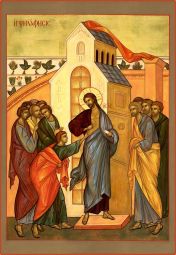
St Thomas touches Christ’s wounds
Jesus’ Apostles and disciples walked most directly and intimately in his Light. Apart from the Divine Light radiating from Jesus on the day of the Transfiguration (which only Peter, James, and John observed), the Apostles and disciples witnessed Christ’s Light by his works. They saw Jesus raise the dead, heal the sick, and give sight to the blind. Moreover, they witnessed his resurrection from the dead. We have St Thomas’ words upon seeing his resurrected body and touching his wounds from crucifixion: “My Lord and my God!” (St John 20: 29). From these experiences St John begins his first letter:
That which was from the beginning, which our eyes have seen, which we beheld, and our hands have touched concerning the Word of Life. And the Life was manifested and we saw it and we testify and declare to you the Eternal Life, who was with the Father, and was manifested to us (1 John 1: 1).
He and the other Apostles have declared who Jesus is. He is God Incarnate. He is the Light of the world. He is Light and Life. By continuing in the apostolic faith and Sacrament the faithful abide in him. For example we have this: “The one who is eating my flesh and is drinking my blood abides in me, and I in him” (St John 6: 56). We bear within us the Light of the world, and it is him we shine forth to the world.
How, then, do we shine forth his Light to the world? By faith’s good works!
Where are we to shine this light? Everywhere! When do we shine this light? At all times! To whom do we shine this light? To everyone. Shining his light does not require grandiose public displays. Shining the light of Christ is best done in our everyday lives before those we know — especially in our homes.
 The city on the hill is, of course, the Church. Cities in the ancient world had no public street lights. The light of the city came almost exclusively from domestic sources — lamps burning both inside and outside of homes. The shining light came from personal sources, but when seen together made the city visible to the traveler in the distance.
Every Divine Liturgy begins its ending with this exhortation: “Let us depart in peace!” We depart back to our homes and to our little corners of the world to shine forth his light to the glory of our Father in the heavens.
In Christ,
Fr Irenaeus
The Light of the World
Posted: July 14, 2019 Filed under: The Eucharist and Living the Eucharist | Tags: Chalcedon - the Fourth Ecumenical Council, Definition of Chalcedon, Hypostatic Union, Jesus is fully God and fully human, John 6:56, Leo the Great, Mt 5: 14 - 15, the Eucharist strengthens our union in Christ, the light of the world, you are the light of the world Leave a comment Annually in the Orthodox Church there are commemorations of the Seven Ecumenical Councils. There were seven of them. This Sunday, July 14, 2019, I served as a substitute priest at St. Sophia Greek Orthodox Church in Bellingham, Washington for Fr. Michael Tervo. The Greek Orthodox Church focused on the Fourth Council — the Council of Chalcedon — and its Definition of Chalcedon, as penned by Pope Leo the Great. The key statement of this Council involved the hypostatic union — that Jesus Christ is fully God and fully human. These two natures (divine and human) exist in the one Person of Jesus Christ in an indissoluble union. These two natures, while in union, are, at the same time, never in confusion. This definition is in response to the false teaching of Nestorius. This heretical bishop essentially made Jesus into two separate persons: one divine and one human. There could be no union of the two natures in his mind. Nestorius tried to give the Church a Christ with a multiple personality disorder. His view was rightly rejected and judged as heresy. Jesus is NOT an “either-or,” he is a “both-this-and-that.”
The gospel reading put forward by the Greek Archdiocese comes from Mt 5:14 – 19. Verse 14 grabbed my attention which quotes Jesus: “You are the light of the world…” Elsewhere, in St. John’s gospel, Jesus declares, “I am the light of the world” (Jn 8: 12). Both statements from the Scriptures are true. It is not an either-or proposition, it is “both-this-and-that.”
 Father Irenaeus Williams