Hungering and Thirsting for Righteousness
Posted: May 20, 2025 Filed under: The Eucharist and Living the Eucharist | Tags: a prayer to live eucharistically before the world, a prayer to live the eucharistic life, Christ is the Water of Life, hungering and thirsting for righteousness, Jesus' conversation with the Samaritan Woman, St John 4: 10 - 15, St Photina (the Samaritan Woman), Water of Life Leave a comment Every year the Orthodox Church commemorates the Samaritan Women, who we now know as St Photina, who encountered Jesus at Jacob’s Well near the Samaritan town of Sychar. She came to the well at midday to avoid the looks of scorn, and the rejection she would experience form those gathered in the cool of the morning to draw from the well. In this privacy her life was changed as she enters into conversation with Jesus: “‘Give me a drink,’” asks Jesus (St John 4: 7). She replies, “‘How is it that you, a Jew, ask a drink of me, a woman of Samaria?’ for Jews have no dealings with Samaritans” (St John 4: 9). A discussion about water, thirst, and eternal life then begins between the two of them:
Jesus answered her, “If you knew the gift of God, and who it is that is saying to you, ‘Give me a drink,’ you would have asked him and he would have given you living water” The woman said to him, “Sir, you have nothing to draw with, and the well is deep; where do you get that living water? Are you greater than our father Jacob, who gave us the well, and drank from it himself, and his sons, and his cattle?” Jesus said to her, “Every one who drinks of this water will thirst again, but whoever drinks of the water that I shall give him will never thirst; the water that I shall give him will become in him a spring of water welling up to eternal life.” The woman said to him, “Sir, give me this water, that I may not thirst, nor come here to draw” (St John 4: 10 – 15).
The hymns from the Mid-feast of Pascha and today also speak of spiritual waters that only come from God. We have this troparion of the Paschal Mid-feast:
In the middle of the Feast, O Savior, fill my thirsting soul with the waters of godliness, as You did cry to all: If anyone thirsts let him come to me and drink. O Christ God, Fountain of our life, glory to You!
Next, we have today’s kontakion:
The Samaritan Woman came to the well in faith: she saw You, the Water of Wisdom, and drank abundantly. She inherited the Kingdom on high, and is ever glorified.
Her interaction with Christ continued and he revealed himself to be the Christ whom she and her fellow Samaritans awaited: “I who speak to you am he” (St John 4: 26). She accepts this, and with this revelation, she takes in her first draw from this Water. New Water brings forth new life, and her journey in, with, and for Christ begins. She takes her leave and informs the inhabitants of Sychar that she has met the Christ.
After she leaves, Jesus’ disciples return and the subject of food arises upon their arrival. Rather than material food purchased in a market, Jesus informs them:
Meanwhile, the disciples begged him, saying, “Rabbi, eat.” But, he said to them, “I have food to eat of which you do not know…My food is to do the will of him who sent me, and to accomplish his work” (St John 31, 34).
Our Lord speaks of such Water and Food in the Sermon on the Mount: “Blessed are those who are hungering and thirsting for righteousness because they will be satisfied” (St Matthew 5: 6).
St Photina, the Samaritan Woman, drank the Water and ate the Food of which Jesus spoke. In Carthage she was an evangelist where she lived with two sons and her sisters — all martyrs and saints. We read of her final witness before Nero:
After this Nero had her brought to him and asked if she would now relent and offer sacrifice to the idols. Saint Photina spit in the face of the emperor, and laughing at him, said, “O most impious of the blind, you profligate and stupid man! do you think me so deluded that I would consent to renounce my Lord Christ and instead offer sacrifice to idols as blind as you” Hearing such words, Nero gave orders to again throw the martyr down the well, where she surrendered her soul to God (oca.org).
Thus, St Photina was victorious. She was nourished by the Food of Christ. She was refreshed by drinking from the Well which is Christ. She, too, as are we, was nourished by our Lord’s all holy Body and Blood of the Eucharist. From this Sacrament we all receive cleansing from sin, and victory over sin, darkness, alienation, and death, and his promise of everlasting which comes only from him.
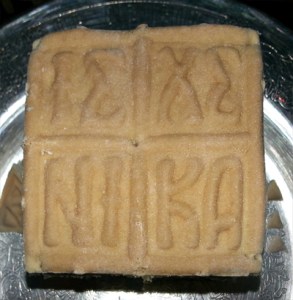 Today, and with every Divine Liturgy, purposefully and prayerfully come to the Eucharist while giving thanks for his miraculous, sacramental presence before us. The Eucharist gives us guidance for our lives as we pursue the satisfaction of Christ’s righteousness which we are to manifest by our lives to this darkened and depraved world. St Paul gives this instruction: “Give thanks in, with, and for all things for this is the will of God for you in Christ Jesus” (1Thessalonians 5: 18). And from this verse I present to you a prayer to assist our living the Eucharist, and thus living Christ, before the world and the cosmos:
Heavenly Father, I pray this day I would be living the eucharistic life which is in accordance with your will for me in Christ Jesus. Thus, by the Holy Spirit may I be giving thanks in, with, and for all things, in order that I might bear Christ to all and for all things, and bear all and all things to Christ Jesus. Also, that I would be self-giving and other-receiving, and come to live as broken bread and poured out wine for the life of the world and the sake of all things, to the praise and glory of your Name. Amen.
Also, here is another hymn for the day’s theme:
Come and let us drink a new drink, not one marvelously issuing from a barren rock, but one that Christ from the tomb pours out, incorruption’s very source. For we are established in him.
St Photina, pray for us that we may be satisfied as we hunger and thirst for righteousness!
The following is the corresponding sermon given at St Sophia Greek Orthodox Church (Bellingham, WA):
In Christ,
Fr Irenaeus
 Father Irenaeus Williams