Icons, Veneration, Presence, and Contact
Posted: March 10, 2025 Filed under: Etcetera, The Eucharist and Living the Eucharist | Tags: iconodules, icons offer contact to the spiritual realm, Icons offer presence, reverence of icons, Sunday or Orthodoxy, the Iconoclastic controversy, Triumph of the Church over iconoclasm, veneration of icons is not idolatry Leave a comment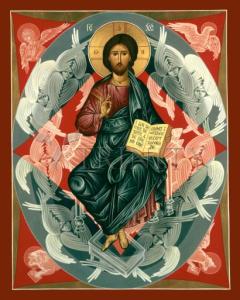
Christ Enthroned
The Sunday of Orthodoxy is the first Sunday of Lent. This is an annual commemoration of the triumph of the Orthodoxy Church over the heresy of iconoclasm. Iconoclasm involved the destruction of the icons of the Church. Those who destroyed icons were called iconoclasts, or “icon breakers.” Those who preserved and defended the Church’s use of icons were the iconodules, meaning “venerators of icons.” This controversy lasted over 120 years, and it wasn’t pretty.
For non-Orthodox Christians, and even some Roman Catholics this is no big deal: Icons are not found in, for example, Protestant churches. Protestant history involved, and still is involved in some form of iconoclasm. Here, they are foreign, and are objects of suspicion. Hence, Orthodox Christians are accused, falsely, of idolatry.
For several years now, there has been thousands of conversions to the Orthodox Church. Those who begin to explore the Church have many questions. Among them are questions about icons. Protestant objections to icons and their purpose in the Orthodox Church must be explained. Let me be clear: Orthodox Christians do NOT worship icons. We do not worship wood and paint. We worship only the Triune God: Father, Son, and Holy Spirit. St John of Damascus explains this point for us:
Concerning the charge of idolatry: Icons are not idols but symbols [in ancient understanding, the symbol contains within itself that which is symbolized], therefore when an Orthodox venerates an icon, he is not guilty of idolatry. He is not worshipping that pictured, but merely venerating it. Such veneration is not directed toward wood, paint or stone [mosaics], but towards the person depicted. Therefore, relative honor is shown to material objects, but worship is due God.
Icons…protect the full and proper doctrine of the Incarnation. While God cannot be represented in his eternal nature [his essence]…He can be depicted simply because he took on human flesh. Of him who took a material body, material images can be made. In so taking a material body, God proved that matter can be redeemed. He deified matter, making it spirit-bearing, and so if flesh can be a medium for the Spirit, so can wood and paint, although in a different fashion.
I do not worship matter, but the Creator of matter, who for my sake became material and deigned to dwell in matter who through matter effected my salvation.
Venerate and veneration are not commonly used words. A definition is put forth. When someone is venerated, respect and honor are shown to the person. The act of veneration of an icon is done by making the Sign of the Cross before, bowing toward it, and then kissing the icon (generally the right hand of the one depicted in the icon).
 Recently, a young Protestant man visited St Nicholas Orthodox Church in Tacoma, Washington. He was troubled by these actions and asked me to explain them to him. I used the illustration of a young child and a photograph of her grandfather. Such a young child may kiss the photo of her grandfather. She is expressing her love for the man; she is not worshipping him. Even at a young age she knows that the photograph is not her grandfather, but, simply, his image presented to her by the photograph. Again, she is expressing her love for him. In like manner, an Orthodox Christian’s veneration of an icon shows one’s love for the person presented to him, or her, by the icon.
I used purposefully the word presented. The one depicted by the icon, whether Christ, his Mother, or a saint, is presented to the one venerating the image. Its presentation offers presence. When Christ is depicted by an icon there is a sacramental presence of him which is offered to the one who venerates his icon. It involves a touch-point: the love and honor expressed by the act of veneration is passed along to Christ. There is a spiritual communication from the material of the icon to Christ himself, or to anyone presented by an icon.
Let me develop this idea with another illustration. I am writing this posting using, of course, the word processing program of my computer. To access this program, I touched the “icon” which presents the program to me. I have accessed the electronic workings of the program. So, as with the computer icon, so it is analogous with the icon of Christ: I have a point of contact with him, and my honor and love are passed on to him in this sacramental manner of contact.
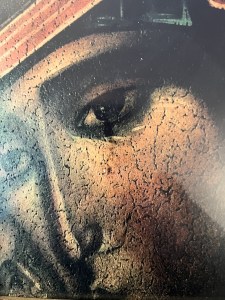
Note the two tears under the eye.
This sacramental, or spiritual, communication is not just a one-way road. Christ and his saints, especially Mary his Mother, communicate to the faithful via their icons. These communications are understood as miracles. For example, at St Anne Orthodox Church in Corvallis, Oregon (where I have served the Diving Liturgy many times), an icon of Mary brought forth a physical, liquid tear from her left eye. This event was captured by a photograph which is placed next to the actual miraculous icon.
Let me add this. Quantum physicists tell us that an electron, or some part of an atom (which is material), can occupy two places at once, and have some degree of communication across this separation in space and time. Furthermore, that which is spiritual and that which is material are not separated from each other in some dualistic existence as taught by some theologians and philosophers from past centuries. Rather, the spiritual and the material are in constant communication, contact, and in continual relationship with each other. Thus, we can understand the Sacraments and sacramental objects such is icons.
In conclusion, reality is not confined to the explanations offered by philosophers, false prophets, naturalists, and materialist. And I can’t resist…I quote Cat Stevens, “Oh baby, baby, it’s a wild world!”
In Christ who became matter for our salvation,
Fr Irenaeus
 Father Irenaeus Williams