St Ephraim the Syrian and His Prayer of Repentance
Posted: January 29, 2024 Filed under: Etcetera, The Eucharist and Living the Eucharist | Tags: Imaging God to all and all creation, Self-judgment not judgment of others, St Ephraim the Syrian, The Prayer of St Ephraim the Syrian, The Prayer of St Ephraim the Syrian is used in Lent 3 CommentsSt Ephraim the Syrian, a teacher of repentance, was born at the beginning of the fourth century in the city of Nisibis in Mesopotamia into the family of poor farmers. His parents raised their son in piety, but from his childhood he was known for a quick temper and reckless actions. He often had fights and was thoughtless in regard for others. Upon imprisonment and then acquittal for the false accusation of stealing a sheep, he chose the path of faith and repentance.
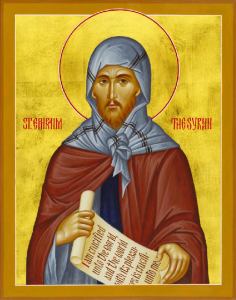
St Ephraim the Syrian
This young man of faith he joined monastic hermits in the surrounding mountains and began a life of asceticism. Here, he was a disciple of St James of Nisibis. After this city was taken by the Persian army in 363, he fled to Edessa and joined a monastery there. Here he combined monastic practice with intense study of the Scriptures. The Holy Spirit gave him a gift of teaching, and was an influential preacher to all people. At some point in his life, he was ordained a deacon by St Basil the Great. He wrote hymns and prayers. The most commonly used is his prayer of repentance said throughout Lent. It will be examined in the body of this posting which begins with the first few verses of the Gospel reading for Sunday, January 28, 2024 (the 34th Sunday after Pentecost):
Then one of them, a lawyer, asked Him a question, testing him, and saying,
Teacher, which is the great commandment in the law? Jesus said to him, “You shall love the Lord your God with all your heart, with all your soul, and with all your mind. this is the first and great commandment. And the second is like it: You shall love your neighbor as yourself. On these two commandments hang all the Law and the Prophets (St Matthew 22: 35 – 40).
By these gospel verses all Christians are to live. All the saints lived by these verses and embodied them, and St Ephraim is in their number.

Light and Life
By sacrament and faith, Christ indwells every Christian, and every Christian is in Christ — a relational union exists. As St Ephraim lived out Christ, Christ’s Light and Life permeated him and interpenetrated him. As he lived out the Gospel, humbled himself, “rejoiced always, prayed constantly, and gave thanks in, with, and for all things” his being interpenetrated Christ, and he had Christ formed in him. As we love God and our neighbor, as we act out our faith, rejoicing always, praying constantly, and giving thanks in, with, and for all things (living eucharistically), we, too, have Christ’s touch coming into us, and we touch Christ who abides in us and we in him. Like all the saint, Christ is to be formed in us.
The Pre-Lenten Sundays are not far away. Lent then follows, and St Ephraim’s writings play an important part in this season. Among his writings is his famous “Prayer of Repentance”. This prayer is a guide for our lives not only during Lent, but for every day of our lives. It is presented here:
O Lord and Master of my life, give me not the spirit of sloth, despair, lust of power and idle talk. But give rather the spirit of chastity, humility, patience and love to your servant. Yes, O Lord and King, grant me to see my own transgressions and not to judge my brother, for blessed are you unto ages of ages. Amen.
I offer a brief commentary:
“Give me not the spirit of sloth, despair, lust of power, and idle talk…”
We are to work with God to empty ourselves of our passions. We are to cut out the corruption that is in our lives, and all those things that snare and entangle us are to be cast off. “Put to death therefore what is earthly in you…” (Col 3: 5). All of our sinful habits and behaviors are to be removed and no longer appear. St Paul is again quoted, “Discard the old man together with his practices” (Col 3: 9).
“But rather give to me the spirit of chastity, humility, patience and love to your servant…”
“Put on the new [man], who is being renewed in knowledge after the image of his Creator” (Col 3: 10). We are to work with God that Christian virtues may replace the corruption of our flesh that still remains in us.
“Yes, O Lord and King, grant me to see my own transgression and not to judge my brother, for your are blessed unto ages of ages. Amen.”
Our Lord gives these words to us: “And he said to them, ‘Take heed what you hear; the measure you give will be the measure you get…” (St Mark 4: 24). If others fall short of our demanding standards, then be sure that we will be assessed by God with the same unit of measure. And when we point the finger of accusation and judgment on another… we are to look at our hands — we have three fingers pointing back at us. St Paul gives this advise: “Do nothing according to selfishness nor according to conceit, but in humility considering / preferring others better than yourselves” (Phil 2: 3). Additionally, Jesus gives us this from St Matthew 5: 7: “Blessed are the merciful — because they shall receive mercy.” How often is it that we want justice to come upon another while wanting mercy for ourselves? We must remember this, “Forgive that you may be forgiven. And somewhere St Paul offers this: “Put up with one another!” By this portion of St Ephraim’s prayer we can begin to love our neighbors (and one another) as ourselves.

Jesus Christ Conquers
we act in love towards each other and our neighbors, then we prove our love for God. In the Divine Liturgy we have “The Passing of the Peace”, and there is this exchange: “Christ is in our midst” says one person, and the other replies, “He is and ever shall be”. With this exchange there is a phrase sung by the choir. We are to think about them and what these words say to us: “Let us love one anther, that with one mind we may confess: Father, Son, and Holy Spirit; the Trinity one in essence, and undivided.” What does this say to us? Our unity with one another in love; our forgiveness of one another in love; our preference for one another in love reflects and declares to the entirety of creation the mutual love and unity of the Trinity! By this we “image” God correctly to the world. If we do not act in peace and in love we do not “image” God — we tell lies about God to creation.
St Ephraim also wrote prayers intended to be said prior to, and in preparation for receiving the Body and Blood of Christ in the Eucharist and participation in the entirety of the Divine Liturgy. Here is an excerpt:
Sanctify me by your Mysteries, illumine my mind with knowledge of you, make your hope to shine out in my heart, hold me worthy to supplicate for it, O God my Father and Lord of my life. Illumine your lamp within me, place in me what belongs to you so that I may forget what belongs to myself…Rig together my impulses for the ship of repentance, so that in it I may exult as I travel over the world’s sea until I reach the haven of your hope. When I am tempted, may my mind take courage from the recollection of you. Illumine before me the path that is dark through the brilliance due to awareness of you.
St Ephraim, pray for us!
The following is the corresponding sermon:
In Christ,
Fr Irenaeus
 Father Irenaeus Williams
The Kinks’ “Dedicated Follower of Fashion,” Satire, and the Prayer of St Ephraim the Syrian
Posted: March 21, 2024 | Author: Fr. Irenaeus | Filed under: Etcetera, Music and Guitars | Tags: Commentary on the Kinks' "Dedicated Follower of Fashion", humility and satire, The Kinks' "Dedicated Follower of Fashion, The Prayer of St Ephraim the Syrian, true satire | Leave a commentThe Kinks circa 1967 (Ray is standing.)
I have an admission: I love the music of the British Invasion of the 1960s. When the Beatles, Rolling Stones, et al., hit the shores of America I was a little boy in grade school. At that time my only interests were baseball and the space program that involved Mercury, Gemini, and Apollo missions. I didn’t discover the Beatles’ music until after their breakup in 1970 when I heard George Harrison’s “What Is Life”. I then immersed myself in the Beatles’ music and followed their post-Beatles careers faithfully. I soon discovered the Rolling Stones, and the Kinks among other bands. I love the sound of the era, and I have learned to play dozens of songs from that decade on guitar.
Among those songs is the Kinks’ “Dedicated Follower of Fashion.” It was composed by Ray Davies (front man and rhythm guitarist), and was released as a single throughout the world in 1966. It has the flavor of the “Music Hall” era. We, today, would think of it as a “novelty song.”
A little history of this time in London and other urban areas is in order. Some of the youth of the day had one peculiar social division: Mods versus Rockers. As I recall, the Mods followed fashion, and other cultural trends. The Rockers were of a rougher cut, and cared little about fashion, etc. If you could extrapolate these two groups musically into the 1970s, Mods, I would imagine, would lean towards “Glam Rock,” while the Rockers would be fans of the “Punk Rock” scene.
Somewhere in Piccadilly
Clearly, the Kinks’ song is a rather scathing critique of the ephemeral and superficial “dandies” and the “swingers” of London, and those who endlessly shopped Carnaby Street and other trendy locations, perhaps even Piccadilly Circus.
The song is clever and humorous. The song is a satirical jab at other peoples’ foibles.
However, if such (and all) satirical material is only aimed at the “other” without some humility, the humor becomes ridicule and offers only a caricature of those targeted. If one uses satire, one has to accept it when used on “our people”, or us. For satire to be of true value, one has to laugh with those targeted, not just at them. We all have to be able to laugh at ours, and ourselves.
About a decade ago I wrote a less satirical (and worthless too, no doubt!) song I called “Lewis and Clark.” Here is the first verse:
I stumbled upon the file containing its lyrics and chords a short while ago. It prompted me to think of “Dedicated Follower of Fashion.” My thoughts then turned towards me. Though I had a simple four mile commute to work, I, too, at times, spent far too long stuck in freeway traffic in the Puget Sound area of Washington State. Though I never have colored my hair, I, too, have vanity. What was my motivation for those lyrics? Was I willing to see myself as the subject of the jab? I have decided not to resuscitate the song until my motives are properly sorted — perhaps, better, ditch it altogether.
As noted in the title of this posting, this brings me to the Prayer of St Ephraim the Syrian used so frequently by Orthodox Christians, and especially during the season of Great Lent:
In this highly divisive and divided society, where we pick sides and find enemies all around us, St Ephraim’s Prayer should inform our consciences. We need to acknowledge our own weaknesses, foibles, and be charitable about our neighbors’ positions on politics — and even fashion!
Here is a link to “Dedicated Follower of Fashion” (please excuse the brief ad): https://youtu.be/oxYGOSSj9A0?si=ULEvkx-nPd9ysNPy
In Christ with all of my own foibles,
Fr Irenaeus