What Are We Thinking?
Posted: April 21, 2024 Filed under: Etcetera, The Eucharist and Living the Eucharist | Tags: Cleanse our thoughts, Fifth Sunday of Lent, Jesus Christ Conquers, Our thoughts determine our lives, Sanctify our thoughts, Set aright our minds, St Thaddeus of Vitovnica, Take every thought captive to obey Christ, the battle is in the mind, the Beatitudes 4 CommentsThe Gospel reading for the Fifth Sunday of Lent begins with Christ proclaiming to his disciples all that would soon happen to him:
Behold, we are going up to Jerusalem and the Son of Man will be handed over to the Chief Priests and Scribes, and they shall condemn him to death, and hand him over to the Gentiles, and they will ridicule him, beat him, spit on him, and will kill him. And on the third day he shall rise again (St Mark 10: 33 – 34).
The reading then comes to James’ and John’s request made to our Lord. They ask that one of them would to sit at his right, and one at his left when Christ comes into the glory of his Kingdom. Our Lord responds to their request,
…You do not know what you ask. Are you able to drink from the cup from which I drink? And the baptism in which I am baptized are you able to be baptized? (St Mark 10: 38)
James and John were attempting to order themselves with Christ according to the world system’s forms of power and authority. This, understandably, was a cause of offense to the other ten Apostles. Our Lord gives them all this instruction:
…You know that those who are supposed to rule over the Gentiles lord it over them, and their great men exercise authority over them. But it shall not be so among you; but whoever would be great among you must be your servant, and whoever would be first among you must be slave of all. For the Son of Man also came not to be served but to serve, and to give his life as a ransom for the many (St Mark 10: 42 – 25).
The Beatitudes also spell out a very different ethos to that of the world system. In the Sermon on the Mount we are informed that a poverty of spirit, mourning, meekness, righteousness, mercy, purity, and peace making are valued, and those exhibiting the qualities will be blessed by Jesus in his Kingdom s(see St Matthew 5: 1 – 11).
Based upon the request of James and John, I come to this point: the battle is in the mind. St Paul writes this: “We destroy arguments and every proud obstacle to the knowledge of God, and take every thought captive to obey Christ” (2 Corinthians 10: 5). We have this proper request from the “Prayer of the Hours: “…Set aright our minds; cleanse our thoughts…” Again, the battle, therefore, is in the mind!
Let me paraphrase Christ’s statement to James and John in the form of questions that can be directed to us: “What are you thinking?” “What am I thinking?” “What are you thinking?” “What are we thinking?”
 The Fifth Sunday of Lent focuses on the life St Mary of Egypt. A battle raged in her mind, her soul, and every part of her being. She was a slave to sin — especially sexual sin. She could be thought of as a sex-addict. Thus, in her mind, dopaminergic and serotonergic neurochemicals came into play which made her sin an addiction to her specific proclivities. She was directed to cross over the Jordan to work out her salvation with fear and trembling (Philippians 2: 12). In the Palestinian wilderness, she waged war against her passions, thought patterns, and habits by the power of the Weapon of the Cross. She, by the working of the Holy Spirit, defeated her sinful thoughts and manner of life, and holiness was worked into every part of her being. We call her a holy warrior, and our venerable mother among the saints.
 I am presently reading a book: Our Thoughts Determine Our Lives (The Life and Teachings of Elder Thaddeus of Vitovnica). Here are some quotes given by the saint who reposed in in Christ in 2003 in Serbia.
Our thoughts determine our whole life. If our thoughts are destructive, we will have no peace. If they are quiet, meek and simple, our life will be the same, and we will have peace within us. It will radiate from us and influence all beings around us — rational beings, animals, and even plants. Such is our ‘thought apparatus,’ which emits thoughts with which we influence all other beings (p 49).
If we have good thoughts and desires, these thoughts will give us peace and joy even in this life, and even more so in eternity (p 56).
Our life depends on the kind of thoughts we nurture. If our thoughts are peaceful, calm, meek and kind, then that is what our life is like. If our attention is turned to the circumstances in which we live, we are drawn into a whirlpool of thoughts and can have neither peace nor tranquility (p 63).
We cannot achieve salvation unless we change our thoughts and make them different…This is achieved by the work of Divine power in us. Our minds thus become deified, free of passions, and holy. Only a mind which has God within it and a constant remembrance of the Lord can be deified. By knowing that He is in us and we are in Him, we can move around like fish in the water. He is everywhere, and we, like fish, swim in Him (p 60).
St Thaddeus would, I think, confirm that the battle is in the mind.
Whether we are of faith or not, we are the captains of our consciousness. We are in control of our thoughts. But we who are in Christ, and have Christ in us, truly have even greater power over our thoughts. In Christ we lack nothing, and have no excuses. “Take every thought captive to obey Christ.” And we pray, “Set aright our minds; cleanse our thoughts!”
 Our minds are constantly active, and can wander seemingly at will. When a remote memory pops into my head, I ask, “Where did that come from?” To many people who are troubled by damaging thoughts I give an illustration I call “The Pond.” Picture a pond that has numerous over-hanging trees on its shore. In the autumn all the leaves fall and sink to the bottom of the pond. There they decompose. The decomposition process will from time to time release a bubble of gas and remain for a while on the water’s surface. Here’s the parallel: “Bubbles” (our thoughts) arise into our consciousness. If these “bubbles” are foul we are to pop them. Such thoughts do not, and should not, remain active in our minds. We have the power to replace them with blessings, prayers, and all that is holy and of God. We cannot let such toxic bubbles exist! This is a battle to engage — even if it occurs 100 times per day! We can successfully enter into this combat because we have the Three Persons of the Trinity indwelling us! Thus we are spiritually empowered and armed! We find this in Psalm 38: 21 – 22:
Do not forsake me, O Lord! O my God, be not far from me! Make haste to help me, O Lord, my salvation!
 We are in this battle, this arena of spiritual combat. Where are our arenas? Where are our battle fields? For me, it is commonly in a retail setting — especially CostCO. (“One does not simply walk into CostCo!”) I can be impatient with the large number of customers that move at a snail’s pace, and with those who collect around the kiosks of food samples. To have victory in this field of battle, I must determine in advance how I will think and conduct myself! Before entering, I must determine to act with patience, and pray for all customers I encounter. Oh, and to smile!
Thus, all of when we enter our arenas, and our battlefields (we know where they are, and what they hold for us), we must determine in advance both thoughts and conduct. We must have a battle plan.
We are not alone in our struggles and battles. Our struggles are not unique to any of us. The saints had the same struggles, and by the power of the Holy Trinity working in them, by the prayers of the Mother of God, and the saints, they won their sanctification. And so can we! Let us call out the Christ, “Do not forsake me, O Lord! O my God, be not far from me! Make haste to help me, O Lord, my salvation!”
Here is a corresponding sermon:
In Christ who gives us victory,
Fr Irenaeus
Progressing in Peace
Posted: July 11, 2023 Filed under: Etcetera, The Eucharist and Living the Eucharist | Tags: 1 Thessalonians 5: 14 - 18, All Saints Day in the Orthodox Church, becoming sons of the Father, becoming whole and complete, Being a peacemaker, bless those who curse you, blessed are the peacemakers, love your enemies, progressing in peace, pursue the good for all, the Beatitudes, the Greek word teleios, turn the other cheek Leave a commentIn the Orthodox Church, the Sunday after Pentecost is All Saints Day. This is appropriate because, upon the sending of the Holy Spirit, the day of Pentecost marks the beginning of the sanctification of the Church. The Gospel reading for the day consists of St Matthew 10: 32 – 33, 37 – 38, and 19: 27 – 30. These verses give us some of the instructions of the way of holiness:
If you confess Christ before men, Christ will confess you before the Father. You cannot love parent of child more than Christ. One must take up your cross and follow Christ. Many who have been first shall be last, and those who have been last shall be first.
Let’s focus on confessing and denying. There are obvious ways of confessing or denying Christ. For example, one can publicly declare or deny ones faith in Christ. There are more subtle ways as well: what we do or not do before humanity and creation. This is like imaging God. All of humanity bears the image of God. If we act and speak in love, peace, or mercy we image God well before creation. If we act or speak sinfully before creation, then we image God poorly, and tell lies about the nature of God.
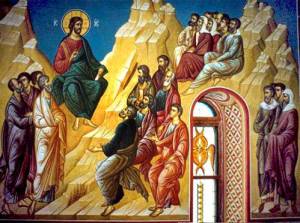 Let’s continue this discussion of confessing and denying concerning our actions, and thus, the ways of the saints. The fifth chapter of St Matthew begins with it the Sermon on the Mount: “Upon seeing the crowd, he ascended the mountain. And after he sat down his disciples approached him. And he opened his mouth and taught them” (St Matthew 5: 1 – 2). In the Beatitudes Jesus tells us who is counted as blessed. It is the poor in spirit; those who are mourning; the meek; those who are thirsting for righteousness; the merciful; those who are pure in heart; the peacemakers; those who are persecuted for righteousness; those who are insulted, persecuted, and are spoken of evilly falsely for the sake of Christ. All these are blessed because they acted in ways contrary to the ways of the world system, but acted in accordance with the ways of Christ.
Our Lord further instructs us that we are to be the salt of the earth, i.e., we are to preserve it from corrupting influences. We are to be the light of the world “…you are to shine your light before men that they might see your good works, and glorify your Father who is in the heavens” (St Matthew 5: 13, 14, 16).
Christ then speaks to his disciples regarding enemies in St Matthew 5:38 – 48. To begin this discussion, we need to know that ultimately our true enemies are not of flesh and blood. St Paul informs us about our true enemies:
Finally, be strong in the Lord and in the strength of his might. Put on the whole armor of God, that you may be able to stand against the wiles of the devil. For we are not contending against flesh and blood, but against the principalities, against the powers, against the world rulers of this present darkness, against the spiritual hosts of wickedness in the heavenly places (Ephesians 6: 10 – 12).
However, we know that there are men and women who wish us ill. Their presence may truly be a source of challenge, and even danger in our lives. The Book of Psalms contains psalms that address such enemies. These are the imprecatory psalms. For example, we have Psalm 17 (LXX 16):
Keep me as the apple of the eye; hide me in the shadow of your wings, from the wicked who despoil me, my deadly enemies who surround me. They close their hearts to pity; with their mouths they speak arrogantly. They track me down; now they surround me; they set their eyes to cast me to the ground. They are like a lion eager to tear, as a young lion lurking in ambush. Arise, O Lord! Confront them, overthrow them! Deliver my life from the wicked by your sword, from men by your hand, O Lord, from men whose portion in life is of the world. May their belly be filled with what you have stored up for them; may their children have more than enough; may they leave something over to their babies (vv 8 – 14).
Note that the psalmist asks God to deal with his enemies, and does not seek to take matters into his own hands. Flesh and blood enemies may do evil. Evil is to be addressed and called out for what it is. But, how we deal with personal enemies determines how well faith and Christ will be formed in us.
In St Matthew 5: 38 – 48, Christ gives his directives to us. We are to turn the other cheek when stricken; go the extra mile when compelled to go one mile. We are to give to those who beg, and lend to those who ask without refusing. We are to love our enemies. We are to bless those who curse us. We are to do good to those who hate us, and pray for those who persecute us. All of his instructions are about overcoming strife, conflict, hatred, and isolation. By pursuing this path of peace we are transformed “…so that you may be sons of your Father who is in heaven” (St Matthew 5: 45). Note how this directly corresponds to Jesus’ words from the Beatitudes: “Blessed are the peacemakers, for they shall be called sons of God” (St Matthew 5: 9).
The ideal of peace and unity, or relational union, always has its source in the Holy Trinity. The Holy Trinity is our exemplar. There is always perfect, whole, complete relational union between the three Persons of the Trinity. There is always perfect love and preference for the other Person. There is no strife, and no conflict. There is only perfection, wholeness, and completeness.
The Greek word is teleios. It can be translated as perfect, but also “whole” and “complete.” Teleios is our call and our goal: “Therefore [if you do / attain this], you shall be perfect / whole / complete just as your Father in heaven is perfect / whole / complete” (St Matthew 5: 48). The saints attained this and they manifested such peace to the world by their lives. Their peacemaking was recognized by their peers.
Progressing in peacemaking is like progressing in forgiveness (Progressing in Forgiveness). We must forgive to be forgiven. But forgiveness can be a difficult process — we must struggle to attain it. Making peace is a similar struggle, but struggle and progress we must! In the first century writing called the Didache (The Teaching) we read this: “…but you, love those who hate you, and you shall have no enemy” (Didache. 1: 3). This is a perspective — the perspective of the saints — and it is to be ours as well if we seek to become whole and complete (even perfect)!
St Paul offers sound advise as we struggle to become peacemakers:
And we exhort you, brethren, to warn the idle, encourage the fainthearted, help the weak, and be patient with all. See that no one pays back evil for evil, but always pursue the good both to one another and to all. Rejoice always. Pray constantly. Give thanks in all things, for this is the will of God for you in Christ Jesus (1 Thessalonians 5: 14 – 18).
The following is a corresponding sermon:
In Christ and in his peace,
Fr Irenaeus
Fishers of Men – the Second Sunday After Pentecost
Posted: June 9, 2018 Filed under: Etcetera | Tags: Fishers of men (Mt 4: 19 -22), Mt 5: 1- 12, the Beatitudes, The Beatitudes and the ethos of the Church, The Sermon on the Mount and Christian ethos 1 CommentThis Sunday’s gospel reading comes from St. Matthew 4: 18 – 23. Here, Jesus calls his first disciples: Simon (Peter) and Andrew, James and John. All four men were by occupation fishermen. Our Lord calls them as we read in Mt 4: 19 – 22:
And he says to them [Peter and Andrew], “Come after me, and I will make you fishers of men.” And immediately they left their nets and followed him. Going on from there he saw two other brothers, James the son of Zebedee and John his brother in the boat with their father Zebedee repairing their nets, and he called them. And they immediately left their boat and father and followed him.
These and the other Apostles, and the whole cohort of Jesus’ first disciples, became fishers of men. Their apostolic ministry gathered Jews and Gentiles alike to Christ, that all may be in Christ, and all may exist in the Ship, the Nave, which is the Church. And it is in this Ship that we are transformed into the image of Christ. (It is interesting to note that though we are likened to fish, yet we are to become like the Fish — the Ixthus — the Greek word for fish which became an acronym meaning “Jesus Christ, Son of God, Savior.”)
 Father Irenaeus Williams