What Are We Thinking?
Posted: April 21, 2024 Filed under: Etcetera, The Eucharist and Living the Eucharist | Tags: Cleanse our thoughts, Fifth Sunday of Lent, Jesus Christ Conquers, Our thoughts determine our lives, Sanctify our thoughts, Set aright our minds, St Thaddeus of Vitovnica, Take every thought captive to obey Christ, the battle is in the mind, the Beatitudes 4 CommentsThe Gospel reading for the Fifth Sunday of Lent begins with Christ proclaiming to his disciples all that would soon happen to him:
Behold, we are going up to Jerusalem and the Son of Man will be handed over to the Chief Priests and Scribes, and they shall condemn him to death, and hand him over to the Gentiles, and they will ridicule him, beat him, spit on him, and will kill him. And on the third day he shall rise again (St Mark 10: 33 – 34).
The reading then comes to James’ and John’s request made to our Lord. They ask that one of them would to sit at his right, and one at his left when Christ comes into the glory of his Kingdom. Our Lord responds to their request,
…You do not know what you ask. Are you able to drink from the cup from which I drink? And the baptism in which I am baptized are you able to be baptized? (St Mark 10: 38)
James and John were attempting to order themselves with Christ according to the world system’s forms of power and authority. This, understandably, was a cause of offense to the other ten Apostles. Our Lord gives them all this instruction:
…You know that those who are supposed to rule over the Gentiles lord it over them, and their great men exercise authority over them. But it shall not be so among you; but whoever would be great among you must be your servant, and whoever would be first among you must be slave of all. For the Son of Man also came not to be served but to serve, and to give his life as a ransom for the many (St Mark 10: 42 – 25).
The Beatitudes also spell out a very different ethos to that of the world system. In the Sermon on the Mount we are informed that a poverty of spirit, mourning, meekness, righteousness, mercy, purity, and peace making are valued, and those exhibiting the qualities will be blessed by Jesus in his Kingdom s(see St Matthew 5: 1 – 11).
Based upon the request of James and John, I come to this point: the battle is in the mind. St Paul writes this: “We destroy arguments and every proud obstacle to the knowledge of God, and take every thought captive to obey Christ” (2 Corinthians 10: 5). We have this proper request from the “Prayer of the Hours: “…Set aright our minds; cleanse our thoughts…” Again, the battle, therefore, is in the mind!
Let me paraphrase Christ’s statement to James and John in the form of questions that can be directed to us: “What are you thinking?” “What am I thinking?” “What are you thinking?” “What are we thinking?”
 The Fifth Sunday of Lent focuses on the life St Mary of Egypt. A battle raged in her mind, her soul, and every part of her being. She was a slave to sin — especially sexual sin. She could be thought of as a sex-addict. Thus, in her mind, dopaminergic and serotonergic neurochemicals came into play which made her sin an addiction to her specific proclivities. She was directed to cross over the Jordan to work out her salvation with fear and trembling (Philippians 2: 12). In the Palestinian wilderness, she waged war against her passions, thought patterns, and habits by the power of the Weapon of the Cross. She, by the working of the Holy Spirit, defeated her sinful thoughts and manner of life, and holiness was worked into every part of her being. We call her a holy warrior, and our venerable mother among the saints.
 I am presently reading a book: Our Thoughts Determine Our Lives (The Life and Teachings of Elder Thaddeus of Vitovnica). Here are some quotes given by the saint who reposed in in Christ in 2003 in Serbia.
Our thoughts determine our whole life. If our thoughts are destructive, we will have no peace. If they are quiet, meek and simple, our life will be the same, and we will have peace within us. It will radiate from us and influence all beings around us — rational beings, animals, and even plants. Such is our ‘thought apparatus,’ which emits thoughts with which we influence all other beings (p 49).
If we have good thoughts and desires, these thoughts will give us peace and joy even in this life, and even more so in eternity (p 56).
Our life depends on the kind of thoughts we nurture. If our thoughts are peaceful, calm, meek and kind, then that is what our life is like. If our attention is turned to the circumstances in which we live, we are drawn into a whirlpool of thoughts and can have neither peace nor tranquility (p 63).
We cannot achieve salvation unless we change our thoughts and make them different…This is achieved by the work of Divine power in us. Our minds thus become deified, free of passions, and holy. Only a mind which has God within it and a constant remembrance of the Lord can be deified. By knowing that He is in us and we are in Him, we can move around like fish in the water. He is everywhere, and we, like fish, swim in Him (p 60).
St Thaddeus would, I think, confirm that the battle is in the mind.
Whether we are of faith or not, we are the captains of our consciousness. We are in control of our thoughts. But we who are in Christ, and have Christ in us, truly have even greater power over our thoughts. In Christ we lack nothing, and have no excuses. “Take every thought captive to obey Christ.” And we pray, “Set aright our minds; cleanse our thoughts!”
 Our minds are constantly active, and can wander seemingly at will. When a remote memory pops into my head, I ask, “Where did that come from?” To many people who are troubled by damaging thoughts I give an illustration I call “The Pond.” Picture a pond that has numerous over-hanging trees on its shore. In the autumn all the leaves fall and sink to the bottom of the pond. There they decompose. The decomposition process will from time to time release a bubble of gas and remain for a while on the water’s surface. Here’s the parallel: “Bubbles” (our thoughts) arise into our consciousness. If these “bubbles” are foul we are to pop them. Such thoughts do not, and should not, remain active in our minds. We have the power to replace them with blessings, prayers, and all that is holy and of God. We cannot let such toxic bubbles exist! This is a battle to engage — even if it occurs 100 times per day! We can successfully enter into this combat because we have the Three Persons of the Trinity indwelling us! Thus we are spiritually empowered and armed! We find this in Psalm 38: 21 – 22:
Do not forsake me, O Lord! O my God, be not far from me! Make haste to help me, O Lord, my salvation!
 We are in this battle, this arena of spiritual combat. Where are our arenas? Where are our battle fields? For me, it is commonly in a retail setting — especially CostCO. (“One does not simply walk into CostCo!”) I can be impatient with the large number of customers that move at a snail’s pace, and with those who collect around the kiosks of food samples. To have victory in this field of battle, I must determine in advance how I will think and conduct myself! Before entering, I must determine to act with patience, and pray for all customers I encounter. Oh, and to smile!
Thus, all of when we enter our arenas, and our battlefields (we know where they are, and what they hold for us), we must determine in advance both thoughts and conduct. We must have a battle plan.
We are not alone in our struggles and battles. Our struggles are not unique to any of us. The saints had the same struggles, and by the power of the Holy Trinity working in them, by the prayers of the Mother of God, and the saints, they won their sanctification. And so can we! Let us call out the Christ, “Do not forsake me, O Lord! O my God, be not far from me! Make haste to help me, O Lord, my salvation!”
Here is a corresponding sermon:
In Christ who gives us victory,
Fr Irenaeus
The Conception of the Theotokos and Freedom in Christ
Posted: December 12, 2023 Filed under: Etcetera, The Eucharist and Living the Eucharist | Tags: determine to do the will of God, enter by the narrow door, fruit of the Spirit, spiritual children of Abraham and Sarah, St Anna's conception of Mary, St Anna's conception of the Theotokos (Mother of God), the battle is in the mind, The Conception of Mary, We are born of the free woman, we are free in Christ Leave a commentEvery year on December 9 the Orthodox Church commemorates the conception by St Anna of the Theotokos (Mother of God), that is Mary. The Gospel reading’s concluding verse for this commemoration is found in St Luke 8:21: “…these are my mother and my brothers: those who hear the word of God are are doing it.” Concerning this day, and pointing to the Incarnation of God the Son in human flesh, St Paul writes these words: “When the fullness of time came, God sent his Son, born of a woman born under the Law in order that those under the Law might be set free” (Gal 4: 4 – 5).
We have this brief history regarding St Anna:
St Anna holding Mary
Saint Anna, the mother of the Virgin Mary, was the youngest daughter of the priest Nathan from Bethlehem, descended from the tribe of Levi. She married Saint Joachim, who was a native of Galilee. For a long time Saint Anna was childless, but after twenty years, through the fervent prayer of both spouses, an angel of the Lord announced to them that they would be the parents of a daughter, Who would bring blessings to the whole human race.The Conception of the Virgin Mary by Saint Anna took place at Jerusalem. The many icons depicting the Conception by Saint Anna show the Most Holy Theotokos trampling the serpent underfoot.

And we have this from the day’s troparion:
Today the bonds of barrenness are broken: God has heard the prayers of Joachim and Anna. He has promised them beyond all their hopes to bear the Maiden of God, by whom the Uncircumscribed One was born as a mortal Man; He commanded an angel to cry to her [Mary]: “Rejoice, you who are full of grace, the Lord is with you.”
Again we read from Gal 4: 4 – 5:
When the fullness of time came, God sent his Son, born of a woman born under the Law [of Moses] in order that those under the Law might be set free.
This epistle reading for the day’s commemoration comes from St Paul:
For it is written that Abraham had two sons, one by a slave and one by a free woman. But the son of the slave was born according to the flesh, the son of the free woman through promise…So, brethren, we are not children of the slave but of the free woman (Gal 4: 22 -23, 31).
The descendants of Abraham were born of the free woman — Sarah. Christians are the spiritual, faith descendants of Abraham, and so, are also born of the free woman. We are also spiritually born of God (see St John 1: 12 – 13). Being so born, we are now in Christ to be free and no longer bound to sin! In Christ we are freed from sin, not just the penalty of sin!
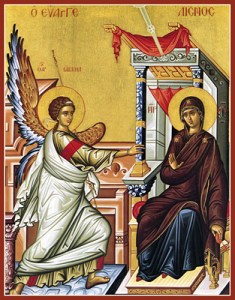
Icon of the Annunciation
We note this holy day for a specific reason: We will come to the Feast of the Annunciation when the Archangel Gabriel comes to Mary and declares to her God’s salvific purpose for her. In responding to the Archangel’s words she replies, “May it be done unto me according to your word.” From Mary’s words come the Incarnation of God the Son in human flesh: “Behold the Lamb of God who takes away the sin of the world” (St John 1: 29). He sets us free from the death of sin. He destroys death by death. He gives to us his Light and Life of his Resurrection. From Mary’s words will also bring he coming of the sanctifying Holy Spirit on the day of Pentecost who, by baptism, joins us to Christ. Thus, we share in Christ’s life, and the life of God in the Holy, Catholic, and Apostolic Orthodox Church.
WE ARE FREE IN CHRIST. “For freedom Christ has set us free; stand fast therefore, and do not submit again to a yoke of slavery” (Gal 5: 1)
We are additionally free to bear the fruit of the Holy Spirit: love, joy, peace, patience, kindness, goodness, faithfulness, gentleness, self-control (Gal 5: 22 – 23). This fruit is the polar opposite to what we were once held in bondage, that is, the fruit of the flesh: immorality, idolatry, sorcery, enmity, strife, jealousy, anger, selfishness, dissension, party spirit, envy, drunkenness, carousing, and the like (Gal 5: 19 – 21). Of this foul, poisonous fruit St Paul warns us: “…as I warned you before, that those who do such things shall not inherit the Kingdom of God” (Gal 5: 19 – 21). St Paul then instructs us, “And those who belong to Christ Jesus have crucified the flesh with its passions and desires” (Gal 5: 24).
I return to our Lord’s words, ““…these are my mother and my brothers: those who hear the word of God are are doing it.” There was another Gospel reading for December 9. We also read from St Luke:
Strive to enter by the narrow door; for many I tell you, you will seek to enter and will not be able. When once the householder has risen up and shut the door, you will begin to stand outside and to knock at the door, saying, ‘Lord open to us.’ He will answer you, ‘I do not know where you come from.’ Then you will begin to say, ‘We ate and drank in your presence, and you taught in our streets.’ But he will say, ‘I tell you, I do not know where you come from; depart from me, all you workers of iniquity! (St Luke 13: 24 – 27).
What about those who were locked out. It all seems a bit unfair at first glance. Consider this — They ate and drank, listened to him, but did not do what they heard from Christ.We must determine what we will do and not do that we might walk on the narrow path and enter through the narrow door. I quote from a portion of the Prayer of the hours: “…Sanctify our souls, purify our bodies, set aright our minds, cleanse our thoughts…”
The battle is in the mind. We have the Holy Spirit; Christ is in us; we have the Father. We are thus empowered — we lack nothing. We have the Eucharist to solidify our union in Christ, and to cleanse us of our sins, and to receive his victory over sin, darkness, alienation from God and all of creation. We have the sacrament of Confession additionally for the forgiveness of sins, and to put us back on the narrow path when we lose our way.
We have all we need “to hear the word of God AND DO IT!
In Christ who frees us,
Fr Irenaeus
All Will Be Revealed
Posted: November 3, 2023 Filed under: Etcetera, The Eucharist and Living the Eucharist | Tags: be doers of the word, determine to do what is right and true, nothing is hidden that shall not be made manifest, Set aright our minds, St James 1: 22 - 25, St Luke 8: 16 - 18, St Matthew 5: 14 - 16, the battle is in the mind, you are the light of the world 2 CommentsA somewhat alarming passage is found in St Luke’s Gospel:
No one after lighting a lamp covers it with a vessel, or puts it under a bed, but puts it on a stand, that those who enter may see the light. For nothing is hidden that shall not be made manifest, nor anything secret that shall not be known and come to light. Take heed then, how you hear; for to him who has will more be given, and from him who has not, even what he thinks that he has will be taken away (St Luke 8: 16 – 18).
Elsewhere, in St Matthew’s Gospel we read again of light:
You are the light of the world. A city set on a hill cannot be hidden. Nor do men light a lamp and put it under a bushel, but on a stand, and it give light to all in the house. Let your light shine before men, that they may see your good works and give glory to your Father in heaven (St Matthew 5: 14 – 16).
These verses from St Matthews Gospel informs us that we are the light of the world, as is Christ the Light of the world. As he is in us and we in him — so are both true. We are to manifest his light by our good works so that God will be glorified by those who observe them. So we are to live as Christians.
But the alarm given to us is found in St Luke’s words. For nothing is hidden that shall not be made manifest, nor anything secret that shall not be known and come to light. All will be revealed for all is known by God. Our Lord also tells us that what is said in secret will be shouted from the rooftops.
The text also holds this:
Take heed then, how you hear; for to him who has will more be given, and from him who has not, even what he thinks that he has will be taken away.
How we hear what we hear refers to how we hear the teachings of our Lord Jesus Christ. Do we hear, but do not put into practice? Do we know, but not stubbornly not act accordingly? St James gives these words to us:
But be doers of the word, and not hearers only, deceiving yourselves. For if any one is a hearer of the word and not a doer, he is like a man who observes his natural face in a mirror; for he observes himself and goes away and at once forgets what he looks like. But he who looks into the perfect law of liberty, and perseveres, being no hearer that forgets but a doer that acts, he shall be blessed in his doing (St James 1: 22 – 25).
St James instructs us to do the will of Christ — to act positively upon God’s words, and put into practice those works that show Christ’s light — and our light — to the world. But what about those temptations to ignore, disobey, and then enter into sin?
I will give my illustration of “The Bubble.” This illustration is about the control of our thoughts, especially thoughts that would bring us into error and sin if acted upon. Thoughts are extremely import because thoughts determine outcomes. Thus, they determine reality. Let’s say there is a pond with over hanging trees. Every autumn the leaves fall from the numerous branches and settle to the pond’s bottom. There the leaves decay. This process will often release a bubble of gas which rises to the surface. Such a bubble is a thought that could lead to temptation, or some random memory which, if acted upon would lead us into sin. At this point of awareness there is no error, no sin. But, when the “bubble” rises to our consciousness we have two options: we can allow the “bubble” with its stench to reside on the surface of our consciousness and interact with it. When acted upon, the thought draws us into sin. Or, we can pop the “bubble” and be victorious and advance in our faith.
We will all stand before Christ in judgment in the Last Day. What we have done — good and ill — will be revealed. In our time in this life we must act by faith in holy ways that correspond to the will of Christ. Acting faithfully in this manner will bring us welcome into his Kingdom. This battle between our Lord’s will and our own carnal will takes place in the mind. We read this exerpt from the Prayer of the Hours: “…Set aright our minds; cleanse our thoughts.” This petition sums things up quite well — yes the battle is in the mind.
Jesus Christ conquers
Let me inform you of a particular challenge for me. I can be quite impatient in a check out line in any retail setting, especially with someone who is young. If this impatience is expressed to the employee I have sinned. Therefore, I must determine in advance how I will interact with this person. Will I bless this person who bears the image of God, or will I be an ass? I must choose to be a blessing for her or him, and I generally utter these words from Psalm 38 (37): 22: “Make haste to help me, O Lord, my salvation”. If the “bubble” of impatience arises to the surface of my consciousness I must pop it and be victorious according to our Lord’s will. I, too, must rejoice in this encounter. I must pray for this person, and give thanks for this person and this interaction (see 1Thes 5: 16 – 18).
So, determine in advance what you will do, or not do, in any given situation and with any inappropriate, tempting thought. Determine not to say, speak, or do evil. Be determined to bless with word and action, and what is illumined will bring glory to God and not shame to our souls.
In Christ,
Fr Irenaeus
Lamp of the Body, Lamp of the Mind
Posted: October 4, 2022 Filed under: Etcetera | Tags: are you not more valuable than these, Ephesians 6: 12 - 13, James 2: 6 - 7, Mt 6: 24, Mt 6: 25 - 27, Prayer of the Hours, Principalities and Powers, proper perspective on wealth, Seek first the Kingdom of God, the battle is in the mind, the darkened age, The eye is the lamp of the body, the mind is the lamp of the soul, the power elite, the power elite's hatred of humanity, the rich who oppress you, the whole armor of God 1 CommentIn St Matthew’s gospel we read this statement from Jesus: “The eye is the lamp of the body (Mt 6: 22).” This is not a scientific statement — it will not be found in any textbook of anatomy or physiology. Our Lord continues his statement, “If your eye is healthy, your whole body is filled with light.” This is what is to be understood: vision directs the actions of the body to proper movement, work, and activity. In contrast, if one is blind, then the actions of the body are conducted in darkness. With blindness proper action, work, and activity are altered. In the ancient world’s realities, blindness generally led to impoverishment and want.

Light and Life
The Fathers of the Church made this connection: As the eye is to the body, so the mind is to the soul. Thus, if the mind is filled with the light of Christ there will be proper action, work, and activities that are pleasing to God. If the mind is darkened by sin and worldly understanding one will be governed by passion and such works will be displeasing to God.
Hence, the battle is in the mind. The Prayer of the Hours contains in its central portion this petition: “…sanctify our souls, purify our bodies, set aright our minds, cleanse our thoughts…” With a healthy eye there is a healthy body. With a holy mind there is a healthy and holy soul.
How will the purified, properly oriented mind lead to proper perceptions and actions in our lives regarding the needs of the body and money? In the verses that follow Mt 6:22 our Lord speaks of wealth, and the need for food and clothing. Christ declares this about the mind obsessed with wealth:
No one can serve two masters; for either he will hate the one and love the other, or else he will be loyal to one and despise the other. You cannot serve God and wealth (Mt 6: 24).
One may have wealth and serve God first if one has a healthy mind. Such a person can follow this directive of Christ: “Store up treasures in heaven…for where your treasure is, there also is your heart!” (Mt 6: 20 — 21). In contrast, if one clamors for wealth and relentlessly seeks it without any thought for God, one will have gained the whole world, yet will have lost one’s soul.
In following verses (Mt 6: 25 — 34) our Lord speaks of everyday needs and the anxieties that do arise from these cares,
Therefore, I say to you, do not worry about your life, what you will eat or what you will drink; nor about your body, with what you will clothe yourself. Is not life more than food and the body more than clothing? Look at the birds of the air, for they neither sow nor reap nor gather into barns; yet your heavenly Father feeds them. Are you not of more value than these? Which of you by worrying can add one cubit to his statue? (Mt 6: 25 — 27)
Jesus continues this teaching:
Therefore, do not worry, saying, “What shall we eat? or, “What shall we drink?” or “What shall we wear?” For after all these things the nations seek. For your heavenly Father knows that you need all these things. But seek first the Kingdom of God, and all these things shall be given to you (Mt 6: 31 — 33, emphasis added).
In all honesty, though, such anxieties and worries can afflict the faithful. Such matters can weigh heavily on the mind. We find ourselves in the grip of runaway inflation caused by foolish and terrible monetary policies. This, in turn, has brought upon many very hard choices and understandable concern. Day to day choices are now made that may not have been necessary in recent years. These choices must be made not only for self-interest, but also for one’s neighbor. Many consumptive habits are to be altered, decreased, and even eliminated in some cases. Though such changes of habits have come about by ill conceived governmental policies and dictates, such lifestyle alterations may be of benefit to the soul.
However, I bristle at the mandated demands for change made by secular powers. It is my opinion that they are not for the good of humanity or the environment, but are mandates placed upon us for their own further empowerment and enrichment. I recall the cynical definition of the Golden Rule: “Those with the gold make the rules.” The wealthy, powerful elite make the rules only to strengthen their “hold on the gold.”
In the past two years I find it ironic that the power elite are calling on our sacrifices to protect — primarily — the environment. I am suspicious. If they are not “doing for the children” so much anymore, they are doing in “for the environment.” I am for the environment! I am for its protection and healing. I am for the welfare and well being of every human and every creature. We are to bless God’s creation, cultivate, and nurture it. We are never to exploit any creature or any part of the creation. But, I am suspicious of the true motives of the power elite of the West. A British commentator recently summed up their mindset quite clearly: “It’s not that they love the environment so much as it is that they hate humanity.” In all of this that is set before us in these days, we are not to think that such manipulation is new. St. James gives us his wise and holy perspective from the first century:
…Is it not the rich who oppress you, is it not they who drag you into court? Is it not they who blaspheme that honorable Name by which you are called? (James 2: 6b — 7)
Yet, we do not need to vilify them. We are to have eyes wide open. We are to be perceptive — very perceptive and alert. Ultimately, it is not the power elite that are our enemies. St. Paul clarifies,
For we are not contending against flesh and blood, but against the principalities, against the powers, against the world ruler of this present darkness, against the spiritual hosts of wickedness in the heavenly places. Therefore, take the whole armor of God, that you may be able to withstand in the evil day, and having done all, to stand (Ephesians 6: 12 — 13).
Jesus Christ Conquers
The battle is in the mind. We are to see with eyes of wisdom, peace, and holiness. With a healthy eye and a holy mind, we must come together to meet the common needs of each other when they arrive. Every sacrifice we may be forced to make — we are to make to the glory of God — not to appease those who hold oppressive power. In all these matters, though meant to work against us, we can redeem them in and by Christ to the good of all and all things. Every abasement that we may have to endure is to be seen for our salvation that Christ may be more fully formed in us. By the utilization of truth, righteousness, the Gospel, peace, faith, salvation, prayer, and perseverance we will stand in Christ with and for one another by a wise, peaceful, and holy vision (see Ephesians 6: 14 — 18). And being thus armored, when necessary, faithfully, and peacefully, resist our oppressors who do the bidding of dark powers.
Once more, as we find in the Prayer of the Hours, we are to ask God to “set aright our minds and cleanse our thoughts.” Thus, we will have a healthy mind and a sound spirit to face every challenge that will come our way to the glory of God!
In Christ,
Fr. Irenaeus
 Father Irenaeus Williams