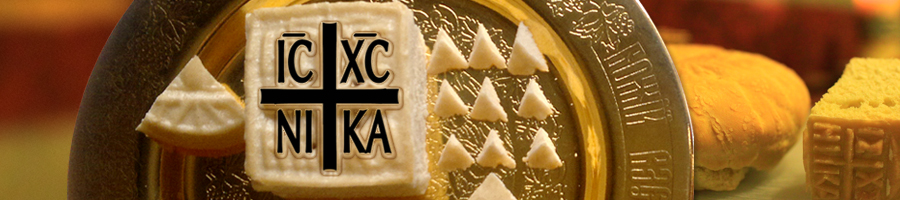
This Is My Body…This Is My Blood
Posted: February 26, 2025 Filed under: The Eucharist and Living the Eucharist | Tags: anamnesis, Christ continually gives his Body and pours out his Blood via the Eucharist, Christ re-presents himself in the Eucharist, entrance into the Kingdom of God, Eucharistic presence of Christ, St John 6: 50 -51, St Luke 22: 19 - 20, St Luke's account of the Last Supper, the present Greek participle, The Words of Institution Leave a commentThe words and actions of Jesus in the Last Supper are examined in this posting. St Luke’s account will be the Gospel examined since it contains the greatest amount of detail and information. Of primary interest is Jesus’ use of two Greek verbal participles which are highlighted by italics and underlined:
And after taking bread and giving thanks, he broke it and gave it to them saying, “This is my body which is being given (didomenon) in behalf of you: do this in my remembrance (anamnesin). And likewise the cup after the dinner, saying, “This is the cup of the new covenant in my blood, which is being poured out (ekchunomenon) in behalf of you (St Luke 22: 19 – 20).

The Last Supper
St Luke uses two present, passive participles in the above passage: didomenon (is being given), and ekchunomenon (is being poured out). Participles are “semi-verbs” — they occupy a middle ground between verbs and nouns/adjectives/adverbs. Regarding the verbal significance of the above participles, Greek verbs (and subsequently, participles) tell far more than when an action occurred, that is, in the past, or in present, or will occur in the future. Greek verbs also inform us of the quality of action. This quality of action is called aspect. In these verses we have present passive forms. Regarding the present aspect, we are to know that the quality of the action implies an ongoing action:
The present tense is basically linear or durative, ongoing in its kind of action. The durative notion may be expressed graphically by an unbroken line ( _____ ), since the action is simply continuous (James A. Hewett, New Testament Greek — A Beginning and Intermediate Grammar, Henderiskson, 1986).
The above two participles impart a number of meanings to the two verses. At first glance, the ongoing quality is necessary to correspond to the continual, repetitive tradition of offering the Eucharist (Communion) to Christians over the centuries since Christ’s institution of this Sacrament — his Body is continually being given, and his Blood continues to be poured out to the faithful.
However, the continual giving of his Body and pouring out of his Blood represent far more than a simple memorial. Jesus’ words signify a re-presentation of himself to the Church with every Eucharist. How do we know this? To answer this question, let’s turn to St John’s Gospel, and specifically the sixth chapter:
This is the bread which is coming down (katabainon) from heaven, in order that if someone might eat of it might also not perish. I am the living bread which came down (katabas) from heaven: if ever someone might eat of this bread he shall live forever, and the bread which I shall give is my flesh in behalf of the life of the world (St John 6: 50 – 51).
 The above present active participle, katabainon, points to ongoing, continual “coming down, or descending”. Thus, there is a Bread which is continually coming down from heaven. Our Lord then defines and clarifies what and who this Bread is in 6:51. He most clearly states that this continually nourishing Bread is none other that his physical body of the Incarnation — the body that came down — katabas (aorist participle — a completed action) — and which will be broken and given for the life of the world. They are one and the same! Hence, the Eucharist is a re-presentation of the entirety of the Incarnation to the Christian faithful!
Let’s move back to the participles found in St Luke. Again, they state that he is giving himself, and is pouring out himself for our salvation in an ongoing, continual manner. More specifically, Jesus’ words and actions in the Upper Room put into action his self-giving sacrifice on the Cross. They put into action his burial. They put into action his resurrection and ascension. They put into action his second coming in his glory.
To be examined next is St Luke’s use of the Greek word, anamnesis. It can be translated as “remembrance.” But it means far more than a memory from, let’s say, a past vacation. It means a “calling into presence.” It is an invocation calling upon God’s presence to be with us as we worship. This invocation begins with the first words of the Divine Liturgy: “Blessed is the Kingdom of the Father, and of the Son, and of the Holy Spirit, now and ever and unto ages of ages.” We thus, invoke and enter into the Kingdom of God. The three Persons of the Holy Trinity are with us as are the saints who are alive in Christ. Also gathered around us are all the events of our salvation as is summarized with these words of the Divine Liturgy that come just before the bread and wine, our Gifts, are offered to God:
Remembering this saving commandment and all those things which have come to pass for us: the Cross, the Tomb, the Resurrection on the third day, the Ascension into heaven, the Sitting at the right hand, and the second and glorious Coming.
Therefore, all of Christ — his Person and every action of his, past, present, and future — is re-presented to the Church. He and they envelope all who are present in worship. St Luke, by his use of anamnesis, informs us that the Gifts of bread and wine are far more than an empty token. I conclude with these words of Christ as presented to us in the Divine Liturgy:
Take! Eat! This is my Body which is broken for you for the remission of sins. And likewise, after supper, he took the cup saying: Drink of it, all of you! This is my Blood of the New Covenant which is being poured out for you and for many, for the remission of sins!
In Christ,
Fr Irenaeus
 Father Irenaeus Williams