Purity of Heart
Posted: May 5, 2025 Filed under: The Eucharist and Living the Eucharist | Tags: "Create in me a clean heart", Pascha, Purity of heart, putting on the new man, Romans 6: 6, spiritual game plans, St John 6: 53 -56, the Myrrh Bearing Women Leave a comment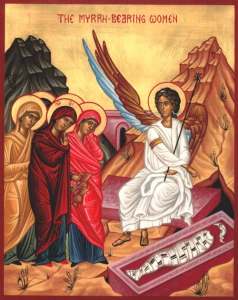 On the morning of the Resurrection, certain women disciples of Jesus went to his tomb to anoint his body with the traditional myrrh. They encountered into an astonishing and alarming site: The immense stone which sealed Jesus’ tomb had been rolled away. Inside the tomb they encounter a “young man” clothed in white sitting at the right side where Jesus had been laid. He addressed and informed them:
…Do not be alarmed: You seek Jesus of Nazareth who was crucified. He is risen! Behold the place where they laid him.
A troparion of the day declares this:
The angel came to the myrrh bearing women at the tomb said: Myrrh is proper for the dead; but Christ has shown himself a stranger to corruption! So proclaim: the Lord is risen, granting the world great mercy.
The Myrrh Bearing Women were expecting the expected, but they found the unexpected. They came to the tomb expecting to find a corpse, but encountered the Miracle of miracles: “Christ is risen from the dead!” Did they know of the raising of the son of the widow of Nain? They surely witnessed the raising of Lazarus from the dead and his emergence from his tomb.
The witnessing of these two miracles done by our Lord brought about shock and awe to those present at these miracles. Likewise, the experience of the Myrrh Bearing Women brought to them an equal response, and how could they wrap their minds around this news?
However, after 2,000 years we know the story. It’s old news: we’ve read the book and seen the movie. Therefore, we treat it as well known history. The element of awe is no longer there for us. So, I want to give you and me a cold slap in the face. We who are asleep need a major jolt of spiritual caffeine! Let’s review a theological and ontological fact given to us by St Paul:
We were buried, therefore, with him by baptism into death, so that as Christ was raised from the dead by the glory of the Father, that we too might walk in newness of life (Romans 6: 6).
We are also united to his resurrection. Therefore, we share in his new miraculous life. It is to be our understood reality by which we live. Hence, in his epistles he gives us further instruction:
If then you have been raised with Christ [the construction of the phrase assumes the positive], seek the things that are above, where Christ is seated at the right hand of God. Set your minds on things that are above, not on things that are on earth. For you have died, and your life is hidden with Christ in God. When Christ who is our life appears, then you also will appear with him in glory (Colossians 3: 1 – 4)
Given these facts, St Paul then explains to us the need for the corresponding lives we are to live,
Put to death, therefore, what is earthly in you: immorality, impurity, evil desire, and covetousness, which is idolatry. On account of these the wrath of God is coming. In these you once walked, when you lived in them. But now put them all away: anger, wrath, malice, slander, and foul talk from your mouth. Do not lie to one another, seeing that you have put off the old man with his practices and have put on the new man, who is being renewed in knowledge after the image of his creator…Put on then, as God’s chosen ones, holy and beloved, compassion, kindness, lowliness, meekness, and patience, if one of you has a complaint against another, forgiving each other; as the Lord has forgiven you, so you must forgive. And over all these put on love, which binds everything together in perfect harmony. And let the peace of Christ rule in your hearts, to which indeed you were called in the one body. And become thankful (Colossians 3: 5 – 10, 12 – 17).
Be reminded, then of this hymn of Pascha: “Thy Resurrection, O Christ our Savior, the angels in heaven sing — enable us on earth to glorify thee in purity of heart!” Purity of heart — our Lord states this: “Blessed are the pure in heart, because they will see God (St Matthew 5: 8). The holy king David gives us this:
Create in me a clean heart, O God, and put a new and right spirit within me…Restore to me the joy of your salvation, and uphold me with a willing spirit (Psalm 50/51: 10, 12).
 Consider the Eucharist. Here is another sacramental and ontological reality which is to have us pursue purity of heart:
Therefore, Jesus said to them, “Truly, truly, I say to you, unless you eat the flesh of the Son of Man and drink his blood you do not have life in yourselves. The one who is eating my flesh and is drinking my blood has eternal life, and I shall raise him in the Last Day. For my flesh is true food, and my blood is true drink. The one who is eating my flesh and drinking my blood abides in me and I in him (John 6: 53 — 56).
Jesus’ resurrected life is worked into our mortal being by faithfully consuming his Body and Blood given to us via Communion. He indwells us, and we are in him. Thus, we become his body, and must live out Christ’s life before the world.
“Enable us to glorify thee in purity of heart!” That’s nice, you may say, but how? I can speak only from my own experience and from the lessons which I have learned. Let me begin with this statement which comes from St Paul: The struggle is in the mind. We read this from the Prayer of the Hours: “…Set aright our minds; cleanse our thoughts.” Therefore, we must throw away habitual thoughts that continue to keep us in the trap of habitually impure actions that are contrary to our existence in Christ Jesus.

Jesus Christ Conquers
We know the people, circumstances, settings, etc., which trigger automatic responses. These automatic responses arise from the corruption, or impurity that still resides within us. Thus, we need to have a holy game plan which can be used to overcome such habits. I inform you of one of my triggers: shopping. In a store, especially a large and busy store, I can become impatient, irritated, and generally cranky. So, while I am in the parking lot, still in my car, I must inform myself of my game plan: I will choose to be patient, peaceful, and joyful. I must inform myself to pray for all I will encounter and ask God’s blessing to be upon all I pass by — my fellow shoppers (who may be impatient, irritated, etc.). These words from St Paul also form my game plan:
See that no one pays back evil for evil, but always pursue the good both for one another and for all. Rejoice always. Pray constantly. Give thanks in, with, and for all things for this is the will of God for you in Christ Jesus (1 Thessalonians 5: 15 – 18).
Choose to seek the good for all. Choose to rejoice, even if you may not feel inclined to do so given the circumstances. Choose to pray in all settings, and in every hour. Choose to give thanks even in a negative or challenging setting; and within the company of people who my be inpatient, irritable, and cranky. By doing so we extend Christ himself into the space and time we occupy. By choosing to implement such a game plan we bear Christ to all, and we form Christ within us — the one who is the source of our purity of heart. Thus, we imitate Christ and become Christ-like.
By our lives lived in concert with Christ, and as we pursue purity of heart, we can ask the Myrrh Bearing Women to pray for us. Living in his purity, let us surprise the Myrrh Bearing Women with our growing purity of heart!
The following is a corresponding sermon:
In Christ,
Fr Irenaeus
Union with Christ and the Parable of the Rich Fool
Posted: November 19, 2024 Filed under: The Eucharist and Living the Eucharist | Tags: all things are held in Christ by his Incarnation, baptism unites us to Christ's death and resurrection, Be rich towards God, be self-giving and other-receiving, Christians are participants in the divine nature, Galatians 2: 20 Christ lives in me, Recapitulation, Romans 6: 3 - 5 and baptism, set your mind on things above, St John 15: 3 -4, St John 6: 53 -56, the metaphor of the Branches and the Vine, the mystery of Christ in us - the hope of glory, the Parable of the Rich Fool, theosis as a model of salvation, through the Eucharist Christ abides in us and we in Christ, Union in Christ, we are seated in Christ in the heavens Col 3: 1 -4, we bear Christ to the world, we beat Christ to creation 2 Comments Throughout his epistles St Paul writes about his, and our, union with Christ. By this union Christ indwells us, and we indwell Christ. The epistle reading for the ninth Sunday of St Luke comes from his letter to the Galatians. We have this verse:
I was crucified together with Christ. I no longer live, but Christ lives in me. The life I now live in the flesh, I live by faith in the Son of God who loved me and gave himself up for me (Gal 2: 20).
With this verse, St Paul states he was co-crucified with Christ. How did this come about, and by what means? The answer comes from baptism — both his and ours:
Or are you ignorant that everyone who was baptized in Christ Jesus, was baptized into his death? Therefore, we were buried together with him through baptism [dia tou baptismatos – showing agency] unto death in order that just as Christ was raised from death through the glory of the Father, so that we might walk in newness of life. For if we were conformed to the likeness of his death, even more we shall be united with his resurrection (Romans 6: 3 – 5).
St Paul teaches we also have union with his resurrection. We have been joined, or united, to Christ’s resurrection.
In addition to baptism, the sacrament of the Eucharist also brings about this union with our Lord:
Therefore, Jesus said to them, “Truly, truly I say to you unless you eat the flesh of the Son of Man and drink his blood you have no life in you. The one who is eating my flesh and is drinking my blood has eternal life, and I shall raise him in the last day. For my flesh is true food, and my blood is true drink. The one who is eating my flesh and is drinking my blood abides in me and I in him (St John 6: 53 – 56).
We also maintain this union with Christ by conducting our lives according to his teachings. St John records these words of Jesus from the metaphor of the Vine and the Branches:
Already you are clean by the word which I have spoken to you. Abide in me, and I in you. Just as the branch is not able to bear fruit on its own unless it should abide in the vine, likewise neither can you, unless you abide in me (St John 15: 3 – 4).
Our salvation consists not only of the forgiveness of sins. Though this forgiveness is foundational, there is more to salvation. It is ultimately, and in its fullest form, a relational union by, in, with, and for Christ. In his letter to the Colossians, St Paul gives us a summary statement:
…the mystery which has been hidden from the ages and generations, but now has been manifested to his saints. To them God chose to declare how great among the Gentile are the riches of the glory of this mystery, which is Christ in you, the hope of glory (Colossians 1: 26 – 27).
This leads us to the salvific model of theosis. As this union is worked, or penetrates, into the entirety of our being, we are partakers of the divine nature, and we become godly, and godlike. Christ is formed within us because we carry within us God the Son.
Furthermore, St Paul instructs us that this union exists even beyond our present physical condition:
If, therefore you have been raised together with Christ [the Greek construction affirms the positive], seek the things above, where Christ is seated at the right hand of the Father. Set your mind on the things above, not on the things of earth. For we died, and our life has been hidden together in Christ in God. Whenever Christ is manifested, who is your life, then also you shall be manifested together with in in glory (Colossians 3: 1 – 4).
Even now, St Paul declares, we are seated together with Christ and will experience our resurrection by this ontological union! I offer a listing of these facts about our salvation:
+ Christ lives in us, and we live for him.
+ We were crucified together with Christ by our baptism
+ We were raised together with Christ by our baptism
+ If we are eating and drinking his Body and Blood we abide in Christ and he in us.
+ If we by faith conduct our lives according to the teaching of Christ we abide in him and he in us.
+ We are hidden together with Christ in the heavens.
+ Christ is in us — the hope of glory
This union in Christ represents just a part of a greater union which extends far beyond ourselves. St Paul informs us of what is called recapitulation:
[I am] declaring to you the mystery of his will, according to his good pleasure, which he set forth in him for the plan for the fullness of the ages, to gather together all thing in Christ — those things in the heavens and those things upon the earth (Ephesians 1: 9 – 10).
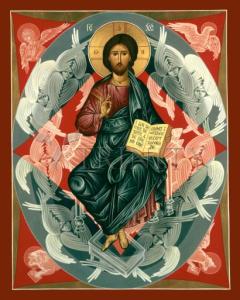 Hence, I expand upon recapitulation. Jesus becomes a creature by assembling his human body from the elements of carbon, nitrogen, sulfur, oxygen, etc., in the uterus of Mary. Thus, as a microcosm of creation, Christ has gathered together everything and everyone into himself. By this he has undone the shattering and scattering of all things into death, darkness, sin, and alienation when Eve disobeyed and Adam capitulated which led to the sin that occurred in the Garden. Adam and Eve were to be the stewards for the care of all creation. They were to serve it as priests, vice regents, and prophets of God for all of creation. They failed. Christ succeeded. He overcame death and granted life for all and all things by his resurrection. By his ascension into heaven all things are held together in him in his glorified body.
This union with Christ demands that we walk in newness of life, and in this newness of life bear Christ to all of humanity and all of creation. This will mean an ongoing struggle of our will to be conformed to his will and ways. But, we are empowered by the Holy Spirit (who also abides in us) who works with us to overcome our sins as we choose to cooperate with him.
Let’s now move to St Luke’s Gospel reading for the day. It gives us The Parable of the Rich Fool. This parable tells us what we are not to do in this life. There is a background for today’s reading which is from St Luke 12: 13 – 15. An outline is presented,
A man asks Jesus to judge between him and his brother for a proper division of the inheritance.
Jesus replies: “Man, who made me judge or divider over you? Take heed, and beware of all covetousness; for a man’s life does not consist in the abundance of his possessions.”
 Now we move to the Rich Fool: He had an abundance of crops from his harvest. It was so great that it could not be properly stored. He tears down the old, and builds new barns and granaries to hold the abundance. So far we have no foul. However, this changes when we discover this internal monologue: “Soul, you have ample good laid up for many years; take your ease eat, drink, and be merry!” (St Luke 12: 19). So, here we have the foul: He saw his harvest and wealth to be exclusively for his own enjoyment. God replies to his folly:
Fool! This night your soul is required of you. And the these you have prepared, whose will they be? So is he who lays up treasure for himself, and is not rich toward God (St Luke 12: 19 – 20).
So what can be said about The Rich Fool: He could have partied and feasted with the blind, the lame, the poor — those who could never repay him. He could have given from his surplus to feed those in need. He could have shared from the profits of sales with the poor of his synagogue. Like the Rich Man who ignored Lazarus, all he had to do was give of himself and of his wealth to bring aid and comfort to another.
With our salvation — our relational union in, with, and for Christ — we are to conduct ourselves according to his teachings.
Work out your own salvation with fear and trembling; for God is at work in you, both to will and to work according to his good pleasure” (Philippians 2: 12b – 13).
As noted above, we are to set our minds on things above — things which will last, and not on the things of this world system which will perish. We can make a summary with this instruction: Be self-giving and other receiving!
Here is a corresponding sermon given at St Nicholas Greek Orthodox Church in Tacoma, WA given on 11/17/24:
In Christ,
Fr Irenaeus
 Father Irenaeus Williams