Capo Gear Review: G7th ART Performance 3 vs Dunlop Pivot
Posted: January 27, 2026 Filed under: Music and Guitars | Tags: Review of G7th Performance ART capo vs Dunlop Pivot Capo Leave a commentI have done comparative capo reviews in previous postings. These reviews represent a type of a quest, or search, for the well designed and highly functional capos. The search continues, so now, I am comparing two “clamp style” capos: the Dunlop Pivot capo and the G7th ART Performance 3 capo.
There are good and bad capos, and I have discovered examples of both types. A good capo will offer no string buzz when applied to the fret board, and, more importantly, will maintain a good degree of tuning stability when applied to the guitar’s neck. The all important factor of tuning stability will tested, and then put through statistical analysis to offer an objective decision and determine which will determine the winner. Each manufacturer makes its claim regarding their capo’s advantages to the guitarist.
Let’s begin with the claim set forth by G7th ART Performance 3:
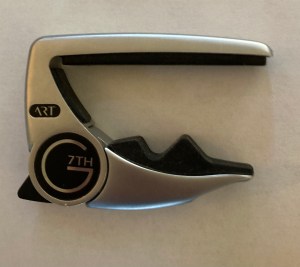
G7th ART Performance 3
The Performance 3 is the culmination of years of designing, tweaking, and improving — but most importantly, listening to guitarists and their views on what a capo SHOULD do. Now, coupling our Unique Tension Control system with the ground-breaking ART [Adaptive Radius Technology] string pad mechanism gives a near-perfect capo experience.
The ART system within the top bar of G7th Performance 3 capos adapts to the true curvature over your strings and fretboard, exerting completely even pressure across all the strings — setting a new standard of in-tune, buzz-free use. It gives you the maximum tuning stability with the minimum possible tension in EVERY position, on ANY guitar neck.
Now, we read Dunlop’s claim coming from the packaging for its Pivot capo:
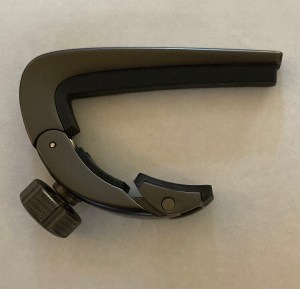
Dunlop Pivot
Precise Intonation: Patented self-centering neck pivot adapts to a variety of neck shapes for even tension and tuning stability.
Easy Adjustment: Low-resistance gear quickly dials in precise pressure.
Clarity & Sustain: Notes ring out longer and more clearly thanks to tone-enhancing mass and dense rubber padding.
Optimized Fret Pad: Accommodates fretboard radius to reduce string buzzing.
Materials and Methods: I put the two capos to the test on four different acoustic guitars. The same Snark electronic tuner is used for all testings. All four guitars were tuned to standard tuning. D’Addario Nickel Bronze acoustic light gauge strings (12 – 53) are on all guitars. (They are amazing strings!). Each capo was placed sequentially on frets 2, 5, and 7 on all guitars. All six strings were plucked in all positions to assess tuning stability. All guitars were retuned before repositioning each capo at the above noted positions. Any “distuning” caused by capo application was noted for each capo at every position on all six strings by the number of “minute” sharp increments (noted by “+”) from the in-tune “12 o’clock” position on the tuner. There was a total of 144 testings. For statistical analysis a paired two-tailed T-test was used, and both T and P values will be presented and explained in the results section found in the text below.
Results:
Rainsong N-JM11002 (Nashville Series) Carbon Fiber Acoustic Jumbo:
G7th ART: a total of +4 minutes sharp (at fret 2 = +2, 4 strings in tune; fret 5 = +1, 5 strings in tune; fret 7 = +1, 5 in tune)
Dunlop Pivot: a total of +5 minutes sharp (at fret 2 = +1, 5 strings in tune; fret 5 = +3, 3 strings in tune; fret 7 = +1, 5 strings in tune).
Rainsong BI-JM1000N2 Carbon Fiber Acoustic Jumbo:
G7th ART: a total of +7 minutes sharp (at fret 2 = +3, 3 strings in tune; fret 5 = +3, 3 strings in tune; fret 7 = +1, 5 strings in tune).
Dunlop Pivot: a total of +6 minutes sharp (at fret 2 = +3, 3 strings in tune; fret 5 = +1, 5 strings in tune; fret 7 = + 2, 4 strings in tune)
Breedlove Pro Series Spruce/Rosewood Acoustic Dreadnought:
G7th ART: a total of +1 minute sharp (at fret 2 = 0, all 6 strings in tune; fret 5 = +1, 5 strings in tune; fret 7 = 0, all strings in tune)
Dunlop Pivot: a total of +3 minutes sharp (at fret 2 = +1, 5 strings in tune; fret 5 = +1, 5 strings in tune; fret 7 = +1 minutes sharp, 5 strings in tune)
Composite Acoustic Legacy Carbon Fiber coustic Dreadnought:
G7th ART: a total of 4 minutes sharp (at fret 2 = 0, all strings in tune; fret 5 = +3, 3 strings in tune; fret 7 = +1, 5 strings in tune)
Dunlop Pivot: a total +1 minutes sharp (at fret 2 = 0, all strings in tune; fret 5 = +1, 5 strings in tune; fret 7 = 0, 6 strings in tune)
Total “Minutes” Sharp:
G7th ART Performance 3: +16 of 72 total string position testings
Dunlop Pivot: +15 of 72 total string position testings
T-Value = 0.234, and P-value = 0.820: Both values state that there is NO objective or significant difference in string tuning stability.
Discussion and Conclusion:
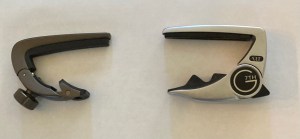
Equally Good Capos
It can noted that the two Rainsong guitars had more minutes sharp than both the Breedlove and Composite Acoustic guitars. T’his is likely due to the strings on Rainsong guitars are older than those on the other two guitars.
What about string buzzing? There was no string buzz noted with either capo for all 144 string testings.
Regarding the important issue of tuning stability, the above noted P value objectively demonstrates that the two reviewed capos offer equal tuning stability. Plus, the total number of mistunings recorded are very minimal given my experience reviewing and testing a variety of capos on a variety of guitars. Capos cause mistunings due to two reasons: 1) the capo’s design — how it grips the fretboard, and 2) the radius of the guitar’s fretboard along with the neck’s overall construction. I own both capos, and consistently use them on my guitars, and both prove to offer solid tuning stability.
Ease of application is to be considered. Here the advantage goes to G7th ART capo. It is easily applied and released by pressing up or down on a triangular knob on the capo’s base. The Dunlop Pivot must be applied and released by turning a wheel on the pivot bar located on its bottom. But, in my opinion, this is not a source of inconvenience for attachment or for release.
Finally, I must add that the Dunlop Pivot capo has a big price advantage, being sold for $31.49 on line while the base model of the G7th ART is selling for $69.99. This added $38.50 offers the overall nod to Dunlop’s Pivot capo (plus it works exceptionally well on 12-string guitars).
Keep on playing (with capos),
Fr Irenaeus
 Father Irenaeus Williams