
Living in the Underground
Posted: September 27, 2024 Filed under: The Eucharist and Living the Eucharist | Tags: acting by faith without thought of benefit, becoming "sons of the Most High", becoming compassionate, do to others as you would have others do to you, growing in compassion, lend without expecting repayment, living in a parallel society, love your enemies, St Luke 6: 31-36, St Matthew 5: 1-49, subverting the world system, the "economy" of the Kingdom of Heaven, the Beatitudes and living counter culturally Leave a commentThe underground. For me, the thought of the “underground” brings images of underground resistance fighters secretly operating to fight an oppressive tyrant. In any case, those who “live in the underground” conduct their lives around an alternative set of rules to achieve a desired goal.
Our Lord Jesus Christ has also constructed an alternative society — an underground movement. Here, those who are of the Church are to live lives that are in profound contrast to those who live according to the world system. Much of the sixth chapter of St Luke’s Gospel spells out, in part, how we who live in the alternative society of the Church are to conduct lives:
As you wish men to do to you, do so to them. If you love those who love you, what benefit of grace is that to you? For even sinners love those who love them. If you do good to those who do good to you, what benefit of grace is that to you? For even sinners do the same. And if you should lend to those whom you hope to receive back, what benefit of grace is that? Even sinners lend to sinners in order to receive back what is lent. Rather, love your enemies, do good and lend not expecting anything in return, and your reward shall be great, and you will be sons of the Most High, because he is good to the ungrateful and the evil. Become compassionate just as your Father is compassionate (St Luke 6: 31 – 36).
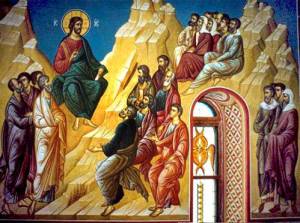
The Sermon on the Mount
Both St Luke (see St Luke 6: 20 – 49) and St Matthew (see St Matthew 5: 1 – 48) offer behaviors that are of the underground life of the Church — ways of thought and living that are stark alternatives to the “economies” (the Greek word means “how a house is managed”) of the world system. The teachings of our Lord in these scriptural passages invert and subvert the “economies” of the world system. By them, a behavioral counter culture of the Kingdom of Heaven is established. Undoing, defeating, subverting the world system is not accomplished by operating by the same methods. We do not fight fire with fire. St Paul offers a corresponding, definitive rule:
Do not repay evil for evil, but always pursue the good both for one another and for all. Rejoice always. Pray constantly. Give thanks for all things for this is the will of God for you in Christ Jesus (1 Thes 5: 15 – 18).
“Become compassionate just as your Father is compassionate.” This is not just to be a goal, but it is to be our reality! Several years age while hearing a man’s confession he stated he wished to be compassionate, “but I just don’t feel like being compassionate.” I responded by telling him that we don’t wait for a feeling to act for good. It may never come. Rather, I suggested that he “do compassion” and you will become compassionate. I added, “Look for common situations your life to do compassionate things.”
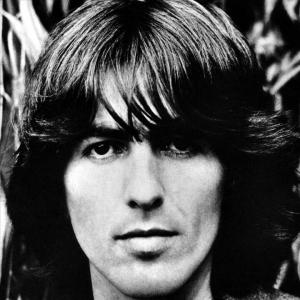
George Harrison
A better term for an underground society is a parallel society — it offers a more constructive foundation for action. In the parallel society which is the Church — as we faithfully follow Christ’s teachings — we will love those who hate us. We will do good and extend ourselves to others without thought of compensation. We, by doing, will become who we are to be in Christ. However, we have to start out with small steps that are realistic and obtainable. For example, if one only know three guitar chords one cannot expect to play the Beatles’ Here Comes the Sun. But, by practicing and expanding one’s “guitar chops” in “the woodshed”— one day one will be able to play George Harrison’s wonderful and beautiful song. Similarly, regarding works of faith, we start out small and work our way up as we, by faith, cooperate with the Holy Spirit and grow in his ways.
Now, I present a thematic shift — a shift to thoughts and how we think. This shift is important since our thoughts will determine how we act and form our lives. From the Prayer of the Hours we have this: “…Sanctify our souls, purify our bodies, set aright our minds, cleanse our thoughts.” Along with this, I offer words from Elder Thaddeus of Vitovnica:
Our life depends on the kind of thoughts we nurture. If our thoughts are peaceful, calm, meek, and kind, then that is what our life is like. If our attention is turned to the circumstances in which we live, we are drawn into a whirlpool of thoughts and can have neither peace nor tranquility.

Light and Life
Also, please allow me to present an exercise that will improve our thoughts and increase compassionate, merciful, and peaceful mindsets and actions. When driving in town take notice of pedestrians and pray that they be blessed, that God’s mercy come upon them, and they be drawn into the Light and Life of Christ. The same can be done in any situation or setting. I believe such simple spiritual exercises will lead us to think and act in ways to the benefit of others so that, in turn, we attain our Lord’s will for our lives: “Become compassionate just as your Father is compassionate…and become sons of the Most High.”
In Christ while living in The Underground,
Fr Irenaeus
Here is a link to “Here Comes the Sun”
Progressing in Peace
Posted: July 11, 2023 Filed under: Etcetera, The Eucharist and Living the Eucharist | Tags: 1 Thessalonians 5: 14 - 18, All Saints Day in the Orthodox Church, becoming sons of the Father, becoming whole and complete, Being a peacemaker, bless those who curse you, blessed are the peacemakers, love your enemies, progressing in peace, pursue the good for all, the Beatitudes, the Greek word teleios, turn the other cheek Leave a commentIn the Orthodox Church, the Sunday after Pentecost is All Saints Day. This is appropriate because, upon the sending of the Holy Spirit, the day of Pentecost marks the beginning of the sanctification of the Church. The Gospel reading for the day consists of St Matthew 10: 32 – 33, 37 – 38, and 19: 27 – 30. These verses give us some of the instructions of the way of holiness:
If you confess Christ before men, Christ will confess you before the Father. You cannot love parent of child more than Christ. One must take up your cross and follow Christ. Many who have been first shall be last, and those who have been last shall be first.
Let’s focus on confessing and denying. There are obvious ways of confessing or denying Christ. For example, one can publicly declare or deny ones faith in Christ. There are more subtle ways as well: what we do or not do before humanity and creation. This is like imaging God. All of humanity bears the image of God. If we act and speak in love, peace, or mercy we image God well before creation. If we act or speak sinfully before creation, then we image God poorly, and tell lies about the nature of God.
 Let’s continue this discussion of confessing and denying concerning our actions, and thus, the ways of the saints. The fifth chapter of St Matthew begins with it the Sermon on the Mount: “Upon seeing the crowd, he ascended the mountain. And after he sat down his disciples approached him. And he opened his mouth and taught them” (St Matthew 5: 1 – 2). In the Beatitudes Jesus tells us who is counted as blessed. It is the poor in spirit; those who are mourning; the meek; those who are thirsting for righteousness; the merciful; those who are pure in heart; the peacemakers; those who are persecuted for righteousness; those who are insulted, persecuted, and are spoken of evilly falsely for the sake of Christ. All these are blessed because they acted in ways contrary to the ways of the world system, but acted in accordance with the ways of Christ.
Our Lord further instructs us that we are to be the salt of the earth, i.e., we are to preserve it from corrupting influences. We are to be the light of the world “…you are to shine your light before men that they might see your good works, and glorify your Father who is in the heavens” (St Matthew 5: 13, 14, 16).
Christ then speaks to his disciples regarding enemies in St Matthew 5:38 – 48. To begin this discussion, we need to know that ultimately our true enemies are not of flesh and blood. St Paul informs us about our true enemies:
Finally, be strong in the Lord and in the strength of his might. Put on the whole armor of God, that you may be able to stand against the wiles of the devil. For we are not contending against flesh and blood, but against the principalities, against the powers, against the world rulers of this present darkness, against the spiritual hosts of wickedness in the heavenly places (Ephesians 6: 10 – 12).
However, we know that there are men and women who wish us ill. Their presence may truly be a source of challenge, and even danger in our lives. The Book of Psalms contains psalms that address such enemies. These are the imprecatory psalms. For example, we have Psalm 17 (LXX 16):
Keep me as the apple of the eye; hide me in the shadow of your wings, from the wicked who despoil me, my deadly enemies who surround me. They close their hearts to pity; with their mouths they speak arrogantly. They track me down; now they surround me; they set their eyes to cast me to the ground. They are like a lion eager to tear, as a young lion lurking in ambush. Arise, O Lord! Confront them, overthrow them! Deliver my life from the wicked by your sword, from men by your hand, O Lord, from men whose portion in life is of the world. May their belly be filled with what you have stored up for them; may their children have more than enough; may they leave something over to their babies (vv 8 – 14).
Note that the psalmist asks God to deal with his enemies, and does not seek to take matters into his own hands. Flesh and blood enemies may do evil. Evil is to be addressed and called out for what it is. But, how we deal with personal enemies determines how well faith and Christ will be formed in us.
In St Matthew 5: 38 – 48, Christ gives his directives to us. We are to turn the other cheek when stricken; go the extra mile when compelled to go one mile. We are to give to those who beg, and lend to those who ask without refusing. We are to love our enemies. We are to bless those who curse us. We are to do good to those who hate us, and pray for those who persecute us. All of his instructions are about overcoming strife, conflict, hatred, and isolation. By pursuing this path of peace we are transformed “…so that you may be sons of your Father who is in heaven” (St Matthew 5: 45). Note how this directly corresponds to Jesus’ words from the Beatitudes: “Blessed are the peacemakers, for they shall be called sons of God” (St Matthew 5: 9).
The ideal of peace and unity, or relational union, always has its source in the Holy Trinity. The Holy Trinity is our exemplar. There is always perfect, whole, complete relational union between the three Persons of the Trinity. There is always perfect love and preference for the other Person. There is no strife, and no conflict. There is only perfection, wholeness, and completeness.
The Greek word is teleios. It can be translated as perfect, but also “whole” and “complete.” Teleios is our call and our goal: “Therefore [if you do / attain this], you shall be perfect / whole / complete just as your Father in heaven is perfect / whole / complete” (St Matthew 5: 48). The saints attained this and they manifested such peace to the world by their lives. Their peacemaking was recognized by their peers.
 Progressing in peacemaking is like progressing in forgiveness (Progressing in Forgiveness). We must forgive to be forgiven. But forgiveness can be a difficult process — we must struggle to attain it. Making peace is a similar struggle, but struggle and progress we must! In the first century writing called the Didache (The Teaching) we read this: “…but you, love those who hate you, and you shall have no enemy” (Didache. 1: 3). This is a perspective — the perspective of the saints — and it is to be ours as well if we seek to become whole and complete (even perfect)!
St Paul offers sound advise as we struggle to become peacemakers:
And we exhort you, brethren, to warn the idle, encourage the fainthearted, help the weak, and be patient with all. See that no one pays back evil for evil, but always pursue the good both to one another and to all. Rejoice always. Pray constantly. Give thanks in all things, for this is the will of God for you in Christ Jesus (1 Thessalonians 5: 14 – 18).
The following is a corresponding sermon:
In Christ and in his peace,
Fr Irenaeus
 Father Irenaeus Williams