Leaving Behind and Following
Posted: October 14, 2025 Filed under: The Eucharist and Living the Eucharist | Tags: 2 Corinthians 5: 17, Being a new creation in Christ, Colossians 3: 1 - 17, fruit of the Spirit, Galatians 5: 16 - 24, Hebrews 12: 1 - 2, Jesus Christ Conquers, laying aside every weight and sin which clings so closely, Leaving behind all things, living the Beatitudes, St Luke 5: 1-11 Leave a commentThe text for this posting comes from St Luke 5: 1 – 11, and the subject matter of these verses is the calling of three Apostles: Simon Peter, James, and John. The concluding verse reads as follows,
And after putting their boats to the land, and leaving all things, they followed him (St Luke 5: 11).
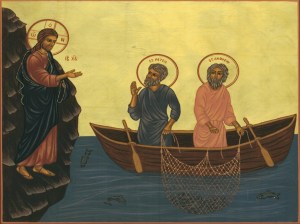 Simon Peter, James, and John set down their livelihoods. They left everything to follow Christ. Their calling as Apostles (as with all the Apostles) was unique. None of us has such a calling to apostleship. Very few of us will receive a call to the monastic life, though some may choose a life of simplicity apart from monasticism.
However, all Christians are called to follow Christ in holiness of life, in purity of heart, and in peace and repentance. Most of us here have families, jobs / careers, and other responsibilities that prohibit us from abandoning these ties and obligations entrusted to us. Yet, as part of our call to follow Christ, there are things to be left behind and abandoned. I turn to a few New Testament passages from St Paul’s epistles.
HEBREWS 12: 1 – 2:
Therefore, since we are surrounded by so great a cloud of witnesses, let us also lay aside every weight, and sin which clings so closely, and let us run with perseverance the race that is set before us, looking to Jesus the pioneer and perfecter of our faith, who for the joy that was set before him endured the cross, despising the shame, and is seated at the right hand of the throne of God.
GALATIANS 5: 16 – 24:
But I say, walk by the Spirit, and do not gratify the desires of the flesh. For the desires of the flesh are against the Spirit, and the desires of the Spirit are against the flesh; for these are opposed to each other, to prevent you from doing what you would. But if you are led by the Spirit you are not under the Law. Now the works of the flesh are plain: immorality, impurity, licentiousness, idolatry, sorcery, enmity, strife, jealousy, anger, selfishness, dissension, party spirit, envy, drunkenness, carousing, and the like. I warn you, as I warned you before, that those who do such things shall not inherit the Kingdom of God. But the fruit of the Spirit is love, joy, peace, patience, kindness, goodness, faithfulness, gentleness, self-control; against such there is no law. And those who belong to Christ Jesus have crucified the flesh with its passions and desires.
COLOSSIANS 3: 1 – 6; 12 – 17:
If then you have been raised with Christ, seek the things that are above, where Christ is seated at the right hand of God. Set your minds on things that are above, not on things that are on earth. For you have died, and your life is hidden with Christ in God. When Christ who is our life appears, then you also will appear with him in glory. Put to death what is earthly in you: immorality, impurity, passion, evil desire, and covetousness, which is idolatry. On account of these the wrath of God is coming…Put on then, as God’s chosen ones, holy and beloved, compassion, kindness, humility, meekness, and patience, forbearing one another, forgiving each other; as the Lord has forgiven you, so you also must forgive. And over all these put on love, which binds everything together in perfect harmony. And let the peace of Christ rule in your hearts, to which indeed you were called in the one body. And become thankful. Let the word of Christ dwell in you richly, as you teach and admonish one another in all wisdom, and as you sing psalms, hymns and spiritual songs with thankfulness in your hearts to God. And whatever you do, in word or deed, do everything in the name of the Lord Jesus, giving thanks to God the Father through him.
2 CORINTHIANS 5: 17:
So then if someone is in Christ, he is a new creation. The old things passed away, and behold all things have become new.
 Since we are a new creation in Christ we are, therefore, to conduct our lives as Christ wills, and by the Holy Spirit to conform our lives to this reality. Added to this we are citizens of the Kingdom of Heaven. Every citizen of a country, every ethnicity, whether Serbians, Greeks, English, Americans, Russians, Mexicans, etc., have unique languages, cuisines, and cultural customs and mannerisms by which they are known and recognized. Therefore, as citizens of the Kingdom of Heaven — we who are in Christ — must have cultural mannerisms which declare our heavenly citizenship. I turn to the Beatitudes to flesh out this point. The Beatitudes are not lofty, unattainable ideals. On the contrary, they are spiritual virtues that are to be worked into our lives. These are the cultural characteristics by which we live and are recognized — they declare our heavenly citizenship.
ST MATTHEW 5: 1 – 16:
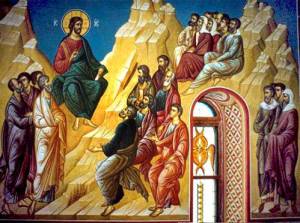
And upon seeing the crowd, he went up the mountain, and after he sat down his disciples approached him. He the opened his mouth and taught them, saying:
“Blessed are the poor in spirit, for theirs is the Kingdom of Heaven.
“Blessed are those who are mourning, for they shall be comforted.
“Blessed are the meek, for they shall inherit the earth.
“Blessed are those who are hungering and thirsting after righteousness, for they shall be satisfied.
“Blessed are the merciful, for they shall receive mercy.
“Blessed are the pure in heart, for they shall see God.
“Blessed are the peacemakers, for they shall be called the sons of God.
“Blessed are those who are persecuted for the sake of righteousness, for theirs is the Kingdom of Heaven.
“Blessed are you whenever they insult you, persecute you and speak all manner of evil against you falsely for my sake. Rejoice and be glad for great is your reward in heaven, for thus they persecuted the prophets who came before you.
“You are the salt of the earth; but if salt has lost its taste, how shall its saltiness be restored? It is no longer good for anything except to be thrown out and trodden under foot. You are the light of the world. A city set on a hill cannot be hidden. Nor do men light a lamp and set it under a bushel, but on a stand, and it gives light to all in the house. Let your light so shine before men, that they may see your good works and give glory to your Father who is in heaven.”
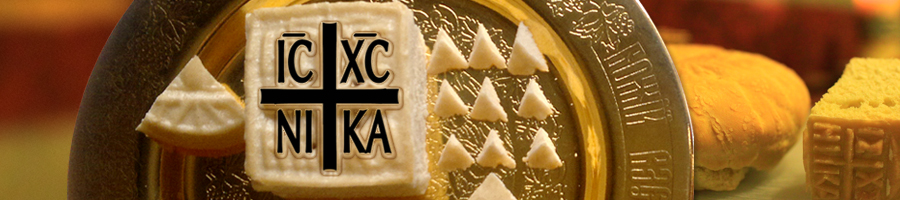
 As did Peter, James, and John, we too are to put our boats onto the land, leave what is contrary to the Christian life and follow our Lord. Such a life is a struggle, and we are to engage in this contest with the will to win — as can only be done by the work of the Holy Spirit in our lives. Come to the Sacraments. Especially come to the Eucharist with intention and with a purpose. There is a message is impressed into the surface of the Lamb, the piece of bread which will become his Body: in a cruciform arrangement one reads IC XC NIKA. This means Jesus (IC) Christ (XC) conquers (the Greek verb nika — conquers). Over what did, and does, Jesus conquer? He was, and is, victorious over sin, death, darkness, and alienation. Thus, pray that his victory over sin, death, darkness, and alienation comes into our lives, and that these are replaced with his holiness, life, light, and relationship. We pray that he gives to us his cleansing and victory. Pray also that his victories in our lives cause us to put our boats to the land, and lay aside every weight, and sin that clings so closely, and follow our Lord more fully.
The following is a corresponding sermon given at St Sava Serbian Orthodox Church on October 12, 2025:
In Christ,
Your Neighbor is Here, There, and Everywhere
Posted: November 11, 2024 Filed under: Etcetera, The Eucharist and Living the Eucharist | Tags: living the Beatitudes, loving your neighbor as yourself, Parable of the Good Samaritan, spiritual bandages and medicines Leave a commentThis posting examines the parable of the Good Samaritan which is found in St Luke 10: 25 -37. It begins with a dialogue between Jesus and an expert in the Mosaic Law.
The lawyer tests Jesus: “What must I do to inherit eternal life?”
Jesus in reply (also testing him): “What is written in the law? How do you read it?”
The lawyer gives his reply: “You shall love the Lord your God with all your heart, with all your soul, with all your strength, with all your mind, and your neighbor as yourself.
Jesus: “You have answered correctly. Do this and you shall live.”
The lawyer, wishing to justify himself, asks, “And who is my neighbor?”
 We now move to a brief summary of the parable. As we all know, those who occupy a similar religious office as the lawyer, are cast as the villains because they ignore and pass by the injured man in need of rescue. Then Jesus gives a twist to the plot; the hero is an unexpected and despised — in the mind of the lawyer — Samaritan who stops to help to the man.
The despised Samaritan exhibits compassion: He binds his wounds, and also medicates the wounds with oil and wine. He then takes him to an inn for further care, and extends the care of the injured man with his own money to compensate the innkeeper.
The epistle reading that accompanies the Gospel reading from St Luke comes from Galatians 1: 11 – 19. The subject is St Paul’s calling to be an Apostle. From Galatians 1: 15 – 16 we read this: “But he who set me apart from my mother’s womb, and had called me through his grace, revealed his Son to me that I might preach the Good News of him to the Gentiles.” He was set apart, and called to be an Apostle and given a defining ministry that continues for us to this day.
Though we are not called to be an Apostle as he, the 12, and the 70 were called, we have a calling! In his first epistle, St Peter writes,
But as he who called you is holy; be holy yourselves in all your conduct; since it is written, “You shall be holy, for I am holy (1 Peter 1: 15 – 16).
St Paul informs us of our ministry that results from our baptism — a ministry of works of faith. Regarding works that arise from faith in Christ, St Paul informs us of this in Philippians 2: 12b – 13:
Work out your own salvation with fear and trembling; for God is at work in you, both to will and to work for his good pleasure.
He writes this as well in his letter to the Ephesians:
For by grace you have been saved through faith; and this is not of your own doing, it is the gift of God — not because of works, lest any man should boast. For we are his workmanship, created in Christ Jesus for good works, which God prepared beforehand, that we should walk [peripataesomen] in them (Ephesians 2: 8 – 10).
When St Paul uses the word walk it is to be understood that it refers to how a Christian is to be conducting his / her life, and how we are to conform our thoughts and actions to match and imitate Christ. Essentially, as the lawyer correctly notes, “We are to love our neighbors as ourselves.”
I pose a question: Where do we find our neighbor? As Sir Paul might answer, they are here, there, and everywhere. The walking wounded are all around us — here, there, and everywhere.
What are our bandages, oils, and wines? Before I offer my attempt to answer this question, let me put forward this admonition from St Paul, “Now, I urge you brethren, to warn the idle…” (1 Thessalonians 5: 14). With this, let the focus be on spiritual idleness. There is a saying: “Comfort the afflicted; afflict the comfortable. Also, there are times we need to be lovingly disturbed in a way to move us more deeply into the ways of Christ. However, we are to cause no one and no thing distress by acting or speaking out of anger, irritation, or annoyance. Rather, you and I are to seek to relieve the distress of others, and all things, by living according to the Beatitudes:
The Beatitudes — they are not given by Christ to be spiritual ideals — they are to be embodied. They are to be worked into our lives by living them. As per one of my favorite axioms: We must do to become.
I return to my question posed above. What are our bandages and medicines? The are love, kindness, prayer, mercy, humility, giving assistance (among many other treatment options). Yes, even smiling can provide a soothing balm.
Do this, and we shall live!
In Christ,
Fr Irenaeus
 Father Irenaeus Williams