Leaving Behind and Following
Posted: October 14, 2025 Filed under: The Eucharist and Living the Eucharist | Tags: 2 Corinthians 5: 17, Being a new creation in Christ, Colossians 3: 1 - 17, fruit of the Spirit, Galatians 5: 16 - 24, Hebrews 12: 1 - 2, Jesus Christ Conquers, laying aside every weight and sin which clings so closely, Leaving behind all things, living the Beatitudes, St Luke 5: 1-11 Leave a commentThe text for this posting comes from St Luke 5: 1 – 11, and the subject matter of these verses is the calling of three Apostles: Simon Peter, James, and John. The concluding verse reads as follows,
And after putting their boats to the land, and leaving all things, they followed him (St Luke 5: 11).
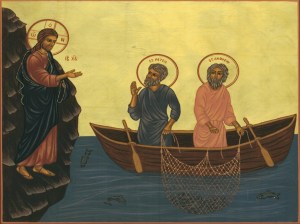 Simon Peter, James, and John set down their livelihoods. They left everything to follow Christ. Their calling as Apostles (as with all the Apostles) was unique. None of us has such a calling to apostleship. Very few of us will receive a call to the monastic life, though some may choose a life of simplicity apart from monasticism.
However, all Christians are called to follow Christ in holiness of life, in purity of heart, and in peace and repentance. Most of us here have families, jobs / careers, and other responsibilities that prohibit us from abandoning these ties and obligations entrusted to us. Yet, as part of our call to follow Christ, there are things to be left behind and abandoned. I turn to a few New Testament passages from St Paul’s epistles.
HEBREWS 12: 1 – 2:
Therefore, since we are surrounded by so great a cloud of witnesses, let us also lay aside every weight, and sin which clings so closely, and let us run with perseverance the race that is set before us, looking to Jesus the pioneer and perfecter of our faith, who for the joy that was set before him endured the cross, despising the shame, and is seated at the right hand of the throne of God.
GALATIANS 5: 16 – 24:
But I say, walk by the Spirit, and do not gratify the desires of the flesh. For the desires of the flesh are against the Spirit, and the desires of the Spirit are against the flesh; for these are opposed to each other, to prevent you from doing what you would. But if you are led by the Spirit you are not under the Law. Now the works of the flesh are plain: immorality, impurity, licentiousness, idolatry, sorcery, enmity, strife, jealousy, anger, selfishness, dissension, party spirit, envy, drunkenness, carousing, and the like. I warn you, as I warned you before, that those who do such things shall not inherit the Kingdom of God. But the fruit of the Spirit is love, joy, peace, patience, kindness, goodness, faithfulness, gentleness, self-control; against such there is no law. And those who belong to Christ Jesus have crucified the flesh with its passions and desires.
COLOSSIANS 3: 1 – 6; 12 – 17:
If then you have been raised with Christ, seek the things that are above, where Christ is seated at the right hand of God. Set your minds on things that are above, not on things that are on earth. For you have died, and your life is hidden with Christ in God. When Christ who is our life appears, then you also will appear with him in glory. Put to death what is earthly in you: immorality, impurity, passion, evil desire, and covetousness, which is idolatry. On account of these the wrath of God is coming…Put on then, as God’s chosen ones, holy and beloved, compassion, kindness, humility, meekness, and patience, forbearing one another, forgiving each other; as the Lord has forgiven you, so you also must forgive. And over all these put on love, which binds everything together in perfect harmony. And let the peace of Christ rule in your hearts, to which indeed you were called in the one body. And become thankful. Let the word of Christ dwell in you richly, as you teach and admonish one another in all wisdom, and as you sing psalms, hymns and spiritual songs with thankfulness in your hearts to God. And whatever you do, in word or deed, do everything in the name of the Lord Jesus, giving thanks to God the Father through him.
2 CORINTHIANS 5: 17:
So then if someone is in Christ, he is a new creation. The old things passed away, and behold all things have become new.
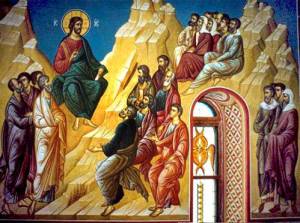 Since we are a new creation in Christ we are, therefore, to conduct our lives as Christ wills, and by the Holy Spirit to conform our lives to this reality. Added to this we are citizens of the Kingdom of Heaven. Every citizen of a country, every ethnicity, whether Serbians, Greeks, English, Americans, Russians, Mexicans, etc., have unique languages, cuisines, and cultural customs and mannerisms by which they are known and recognized. Therefore, as citizens of the Kingdom of Heaven — we who are in Christ — must have cultural mannerisms which declare our heavenly citizenship. I turn to the Beatitudes to flesh out this point. The Beatitudes are not lofty, unattainable ideals. On the contrary, they are spiritual virtues that are to be worked into our lives. These are the cultural characteristics by which we live and are recognized — they declare our heavenly citizenship.
ST MATTHEW 5: 1 – 16:
And upon seeing the crowd, he went up the mountain, and after he sat down his disciples approached him. He the opened his mouth and taught them, saying:
“Blessed are the poor in spirit, for theirs is the Kingdom of Heaven.
“Blessed are those who are mourning, for they shall be comforted.
“Blessed are the meek, for they shall inherit the earth.
“Blessed are those who are hungering and thirsting after righteousness, for they shall be satisfied.
“Blessed are the merciful, for they shall receive mercy.
“Blessed are the pure in heart, for they shall see God.
“Blessed are the peacemakers, for they shall be called the sons of God.
“Blessed are those who are persecuted for the sake of righteousness, for theirs is the Kingdom of Heaven.
“Blessed are you whenever they insult you, persecute you and speak all manner of evil against you falsely for my sake. Rejoice and be glad for great is your reward in heaven, for thus they persecuted the prophets who came before you.
“You are the salt of the earth; but if salt has lost its taste, how shall its saltiness be restored? It is no longer good for anything except to be thrown out and trodden under foot. You are the light of the world. A city set on a hill cannot be hidden. Nor do men light a lamp and set it under a bushel, but on a stand, and it gives light to all in the house. Let your light so shine before men, that they may see your good works and give glory to your Father who is in heaven.”
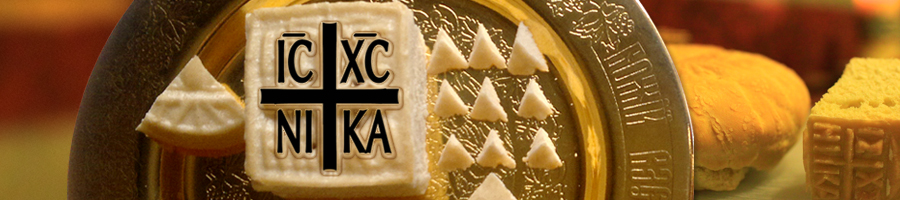
 As did Peter, James, and John, we too are to put our boats onto the land, leave what is contrary to the Christian life and follow our Lord. Such a life is a struggle, and we are to engage in this contest with the will to win — as can only be done by the work of the Holy Spirit in our lives. Come to the Sacraments. Especially come to the Eucharist with intention and with a purpose. There is a message is impressed into the surface of the Lamb, the piece of bread which will become his Body: in a cruciform arrangement one reads IC XC NIKA. This means Jesus (IC) Christ (XC) conquers (the Greek verb nika — conquers). Over what did, and does, Jesus conquer? He was, and is, victorious over sin, death, darkness, and alienation. Thus, pray that his victory over sin, death, darkness, and alienation comes into our lives, and that these are replaced with his holiness, life, light, and relationship. We pray that he gives to us his cleansing and victory. Pray also that his victories in our lives cause us to put our boats to the land, and lay aside every weight, and sin that clings so closely, and follow our Lord more fully.
The following is a corresponding sermon given at St Sava Serbian Orthodox Church on October 12, 2025:
In Christ,
Righteous Presentations
Posted: August 2, 2024 Filed under: The Eucharist and Living the Eucharist | Tags: alive to Christ and dead to sin, cleansing of sin by the Eucharist, commissioning of the Prophet Isaiah, freedom from sin in Christ, hungering and thirsting for righteousness, Isaiah 6: 8, Jesus Christ Conquers, present yourself to holiness, Romans 6: 1 - 7, Romans 6: 11 - 13, St Matthew 5: 6, we are freed from sin Leave a comment Our saving relationship in Christ demands that we present ourselves to God for service to him. The Greek verb paristaemi / paristano (present / offer) can be translated to mean “to place at one’s disposal.” With this understanding, I am reminded of the Isaiah. Upon his commission to God’s service, the prophet Isaiah presented himself to God. He placed himself in service to God: “Here am I. Lord. Send me” (Isaiah 6: 8). As Isaiah presented himself at God’s disposal after being cleansed by the coal of fire taken from the heavenly altar, so we, having been cleansed by baptism, faith, and the Eucharist, must present ourselves to God to be in his service.
However, in our former lives apart from faith in Christ and the newness of life that comes from him, we were unable to present ourselves to be in God’s service. St Paul comments on this in his epistle to the Roman faithful:
For as by one man’s [Adam’s] disobedience many were made sinners, so by one man’s [Christ’s] obedience many will be made righteous (Romans 5: 19).
St Paul continues,
What shall we say then? Are we to continue in sin that grace may abound? By no means! How can we who died to sin still live in it? Do you not know that all of us who have been baptized into Christ Jesus were baptized into his death? We were buried therefore with him by baptism into death, so that as Christ was raised from the dead by the glory of the Father, we too might walk in newness of life.
For if we have been united with him in a death like his, we shall certainly be united with him in a resurrection like his. We know that our former man was crucified with him so that the sinful body might be destroyed, and we might no longer be enslaved to sin. For he who has died is freed from sin (Romans 6: 1 – 7).
Thus, by our new life of freedom from sin, in Christ. We are no longer slaves to sin. We are now free to present ourselves for holy service to God. St Paul gives further instruction:
So you also must consider yourselves dead to sin and alive to God in Christ Jesus. Let not sin therefore reign in your mortal bodies, to make you obey their passions. Do not present [maede paristanete] your members to sin as as instruments of wickedness, but present [alla parastanete] yourselves to God as instruments of righteousness (Romans 6: 11 -13).
I am a sinner. I continue to struggle and fight against the sin and corruption that still indwells me, and it is only by cooperating with God’s grace that this can be done and sin overcome. But, I have known many of faith who have only an intellectual understanding of these words of St Paul. There seems to be a surrender — there is only an apparent minimal will to fight for the freedom given to us by Christ. There is no heart for battle to grow in purity. Perhaps the origin of this complacency comes from this bumper sticker mindset: “Christians aren’t perfect. We’re just forgiven!” This saying represents a truncated and reductionistic understanding of our salvation. We are forgiven, but that is not the sum total of our salvation. Our Lord speaks of the benefits of such struggle: “Blessed are those who hunger and thirst for righteousness, for they shall be satisfied” (St Matthew 5: 6).
Jesus Christ Conquers
Though, from time to time, we succumb to sin due to our weaknesses, We have been and continue to be cleansed by Christ as we battle sin. I return to the prophet Isaiah and the cleansing which came to him. The coal of fire which cleansed his lips is seen by the Church to be an Old Testament type for the Eucharist’s sanctifying power which comes to the faithful Christian in communion. A priest will say this after consuming the Body and Blood of Christ, “Behold this coal of fire has touched my lips and takes away my transgressions and cleanses me of my sin.” The same is true for every Christian who comes forward for the Sacrament. Though we may have fallen, we are set on our feet and made clean to continue to present ourselves to be in Christ’s service. Also, regarding the Eucharist, there is a message impressed upon the Lamb (the portion of the bread which becomes the Body of Christ by the operation of the Holy Spirit upon the simple bread): “Jesus Christ conquers.” His victory over sin and death is taken into our lives to nourish and empower us as we, by the Holy Spirit, present ourselves to God for our sanctification.
May these words of St Paul be of benefit: “For just as you once presented your members as slaves to uncleanness and to greater and greater lawlessness. Thus now present your members as slaves to righteousness which leads to sanctification” (Romans 6: 19).
In Christ,
Fr Irenaeus
What Are We Thinking?
Posted: April 21, 2024 Filed under: Etcetera, The Eucharist and Living the Eucharist | Tags: Cleanse our thoughts, Fifth Sunday of Lent, Jesus Christ Conquers, Our thoughts determine our lives, Sanctify our thoughts, Set aright our minds, St Thaddeus of Vitovnica, Take every thought captive to obey Christ, the battle is in the mind, the Beatitudes 4 CommentsThe Gospel reading for the Fifth Sunday of Lent begins with Christ proclaiming to his disciples all that would soon happen to him:
Behold, we are going up to Jerusalem and the Son of Man will be handed over to the Chief Priests and Scribes, and they shall condemn him to death, and hand him over to the Gentiles, and they will ridicule him, beat him, spit on him, and will kill him. And on the third day he shall rise again (St Mark 10: 33 – 34).
The reading then comes to James’ and John’s request made to our Lord. They ask that one of them would to sit at his right, and one at his left when Christ comes into the glory of his Kingdom. Our Lord responds to their request,
…You do not know what you ask. Are you able to drink from the cup from which I drink? And the baptism in which I am baptized are you able to be baptized? (St Mark 10: 38)
James and John were attempting to order themselves with Christ according to the world system’s forms of power and authority. This, understandably, was a cause of offense to the other ten Apostles. Our Lord gives them all this instruction:
…You know that those who are supposed to rule over the Gentiles lord it over them, and their great men exercise authority over them. But it shall not be so among you; but whoever would be great among you must be your servant, and whoever would be first among you must be slave of all. For the Son of Man also came not to be served but to serve, and to give his life as a ransom for the many (St Mark 10: 42 – 25).
The Beatitudes also spell out a very different ethos to that of the world system. In the Sermon on the Mount we are informed that a poverty of spirit, mourning, meekness, righteousness, mercy, purity, and peace making are valued, and those exhibiting the qualities will be blessed by Jesus in his Kingdom s(see St Matthew 5: 1 – 11).
Based upon the request of James and John, I come to this point: the battle is in the mind. St Paul writes this: “We destroy arguments and every proud obstacle to the knowledge of God, and take every thought captive to obey Christ” (2 Corinthians 10: 5). We have this proper request from the “Prayer of the Hours: “…Set aright our minds; cleanse our thoughts…” Again, the battle, therefore, is in the mind!
Let me paraphrase Christ’s statement to James and John in the form of questions that can be directed to us: “What are you thinking?” “What am I thinking?” “What are you thinking?” “What are we thinking?”
 The Fifth Sunday of Lent focuses on the life St Mary of Egypt. A battle raged in her mind, her soul, and every part of her being. She was a slave to sin — especially sexual sin. She could be thought of as a sex-addict. Thus, in her mind, dopaminergic and serotonergic neurochemicals came into play which made her sin an addiction to her specific proclivities. She was directed to cross over the Jordan to work out her salvation with fear and trembling (Philippians 2: 12). In the Palestinian wilderness, she waged war against her passions, thought patterns, and habits by the power of the Weapon of the Cross. She, by the working of the Holy Spirit, defeated her sinful thoughts and manner of life, and holiness was worked into every part of her being. We call her a holy warrior, and our venerable mother among the saints.
 I am presently reading a book: Our Thoughts Determine Our Lives (The Life and Teachings of Elder Thaddeus of Vitovnica). Here are some quotes given by the saint who reposed in in Christ in 2003 in Serbia.
Our thoughts determine our whole life. If our thoughts are destructive, we will have no peace. If they are quiet, meek and simple, our life will be the same, and we will have peace within us. It will radiate from us and influence all beings around us — rational beings, animals, and even plants. Such is our ‘thought apparatus,’ which emits thoughts with which we influence all other beings (p 49).
If we have good thoughts and desires, these thoughts will give us peace and joy even in this life, and even more so in eternity (p 56).
Our life depends on the kind of thoughts we nurture. If our thoughts are peaceful, calm, meek and kind, then that is what our life is like. If our attention is turned to the circumstances in which we live, we are drawn into a whirlpool of thoughts and can have neither peace nor tranquility (p 63).
We cannot achieve salvation unless we change our thoughts and make them different…This is achieved by the work of Divine power in us. Our minds thus become deified, free of passions, and holy. Only a mind which has God within it and a constant remembrance of the Lord can be deified. By knowing that He is in us and we are in Him, we can move around like fish in the water. He is everywhere, and we, like fish, swim in Him (p 60).
St Thaddeus would, I think, confirm that the battle is in the mind.
Whether we are of faith or not, we are the captains of our consciousness. We are in control of our thoughts. But we who are in Christ, and have Christ in us, truly have even greater power over our thoughts. In Christ we lack nothing, and have no excuses. “Take every thought captive to obey Christ.” And we pray, “Set aright our minds; cleanse our thoughts!”
 Our minds are constantly active, and can wander seemingly at will. When a remote memory pops into my head, I ask, “Where did that come from?” To many people who are troubled by damaging thoughts I give an illustration I call “The Pond.” Picture a pond that has numerous over-hanging trees on its shore. In the autumn all the leaves fall and sink to the bottom of the pond. There they decompose. The decomposition process will from time to time release a bubble of gas and remain for a while on the water’s surface. Here’s the parallel: “Bubbles” (our thoughts) arise into our consciousness. If these “bubbles” are foul we are to pop them. Such thoughts do not, and should not, remain active in our minds. We have the power to replace them with blessings, prayers, and all that is holy and of God. We cannot let such toxic bubbles exist! This is a battle to engage — even if it occurs 100 times per day! We can successfully enter into this combat because we have the Three Persons of the Trinity indwelling us! Thus we are spiritually empowered and armed! We find this in Psalm 38: 21 – 22:
Do not forsake me, O Lord! O my God, be not far from me! Make haste to help me, O Lord, my salvation!
We are in this battle, this arena of spiritual combat. Where are our arenas? Where are our battle fields? For me, it is commonly in a retail setting — especially CostCO. (“One does not simply walk into CostCo!”) I can be impatient with the large number of customers that move at a snail’s pace, and with those who collect around the kiosks of food samples. To have victory in this field of battle, I must determine in advance how I will think and conduct myself! Before entering, I must determine to act with patience, and pray for all customers I encounter. Oh, and to smile!
Thus, all of when we enter our arenas, and our battlefields (we know where they are, and what they hold for us), we must determine in advance both thoughts and conduct. We must have a battle plan.
We are not alone in our struggles and battles. Our struggles are not unique to any of us. The saints had the same struggles, and by the power of the Holy Trinity working in them, by the prayers of the Mother of God, and the saints, they won their sanctification. And so can we! Let us call out the Christ, “Do not forsake me, O Lord! O my God, be not far from me! Make haste to help me, O Lord, my salvation!”
Here is a corresponding sermon:
In Christ who gives us victory,
Fr Irenaeus
 Father Irenaeus Williams