Icons, Veneration, Presence, and Contact
Posted: March 10, 2025 Filed under: Etcetera, The Eucharist and Living the Eucharist | Tags: iconodules, icons offer contact to the spiritual realm, Icons offer presence, reverence of icons, Sunday or Orthodoxy, the Iconoclastic controversy, Triumph of the Church over iconoclasm, veneration of icons is not idolatry Leave a comment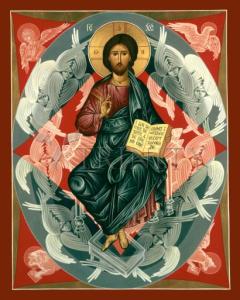
Christ Enthroned
The Sunday of Orthodoxy is the first Sunday of Lent. This is an annual commemoration of the triumph of the Orthodoxy Church over the heresy of iconoclasm. Iconoclasm involved the destruction of the icons of the Church. Those who destroyed icons were called iconoclasts, or “icon breakers.” Those who preserved and defended the Church’s use of icons were the iconodules, meaning “venerators of icons.” This controversy lasted over 120 years, and it wasn’t pretty.
For non-Orthodox Christians, and even some Roman Catholics this is no big deal: Icons are not found in, for example, Protestant churches. Protestant history involved, and still is involved in some form of iconoclasm. Here, they are foreign, and are objects of suspicion. Hence, Orthodox Christians are accused, falsely, of idolatry.
For several years now, there has been thousands of conversions to the Orthodox Church. Those who begin to explore the Church have many questions. Among them are questions about icons. Protestant objections to icons and their purpose in the Orthodox Church must be explained. Let me be clear: Orthodox Christians do NOT worship icons. We do not worship wood and paint. We worship only the Triune God: Father, Son, and Holy Spirit. St John of Damascus explains this point for us:
Concerning the charge of idolatry: Icons are not idols but symbols [in ancient understanding, the symbol contains within itself that which is symbolized], therefore when an Orthodox venerates an icon, he is not guilty of idolatry. He is not worshipping that pictured, but merely venerating it. Such veneration is not directed toward wood, paint or stone [mosaics], but towards the person depicted. Therefore, relative honor is shown to material objects, but worship is due God.
Icons…protect the full and proper doctrine of the Incarnation. While God cannot be represented in his eternal nature [his essence]…He can be depicted simply because he took on human flesh. Of him who took a material body, material images can be made. In so taking a material body, God proved that matter can be redeemed. He deified matter, making it spirit-bearing, and so if flesh can be a medium for the Spirit, so can wood and paint, although in a different fashion.
I do not worship matter, but the Creator of matter, who for my sake became material and deigned to dwell in matter who through matter effected my salvation.
Venerate and veneration are not commonly used words. A definition is put forth. When someone is venerated, respect and honor are shown to the person. The act of veneration of an icon is done by making the Sign of the Cross before, bowing toward it, and then kissing the icon (generally the right hand of the one depicted in the icon).
 Recently, a young Protestant man visited St Nicholas Orthodox Church in Tacoma, Washington. He was troubled by these actions and asked me to explain them to him. I used the illustration of a young child and a photograph of her grandfather. Such a young child may kiss the photo of her grandfather. She is expressing her love for the man; she is not worshipping him. Even at a young age she knows that the photograph is not her grandfather, but, simply, his image presented to her by the photograph. Again, she is expressing her love for him. In like manner, an Orthodox Christian’s veneration of an icon shows one’s love for the person presented to him, or her, by the icon.
I used purposefully the word presented. The one depicted by the icon, whether Christ, his Mother, or a saint, is presented to the one venerating the image. Its presentation offers presence. When Christ is depicted by an icon there is a sacramental presence of him which is offered to the one who venerates his icon. It involves a touch-point: the love and honor expressed by the act of veneration is passed along to Christ. There is a spiritual communication from the material of the icon to Christ himself, or to anyone presented by an icon.
Let me develop this idea with another illustration. I am writing this posting using, of course, the word processing program of my computer. To access this program, I touched the “icon” which presents the program to me. I have accessed the electronic workings of the program. So, as with the computer icon, so it is analogous with the icon of Christ: I have a point of contact with him, and my honor and love are passed on to him in this sacramental manner of contact.
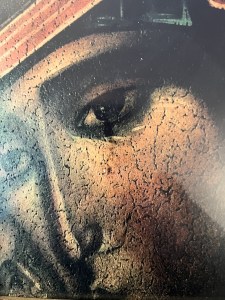
Note the two tears under the eye.
This sacramental, or spiritual, communication is not just a one-way road. Christ and his saints, especially Mary his Mother, communicate to the faithful via their icons. These communications are understood as miracles. For example, at St Anne Orthodox Church in Corvallis, Oregon (where I have served the Diving Liturgy many times), an icon of Mary brought forth a physical, liquid tear from her left eye. This event was captured by a photograph which is placed next to the actual miraculous icon.
Let me add this. Quantum physicists tell us that an electron, or some part of an atom (which is material), can occupy two places at once, and have some degree of communication across this separation in space and time. Furthermore, that which is spiritual and that which is material are not separated from each other in some dualistic existence as taught by some theologians and philosophers from past centuries. Rather, the spiritual and the material are in constant communication, contact, and in continual relationship with each other. Thus, we can understand the Sacraments and sacramental objects such is icons.
In conclusion, reality is not confined to the explanations offered by philosophers, false prophets, naturalists, and materialist. And I can’t resist…I quote Cat Stevens, “Oh baby, baby, it’s a wild world!”
In Christ who became matter for our salvation,
Fr Irenaeus
The Seventh Ecumenical Council and Being an Icon
Posted: October 14, 2024 Filed under: Etcetera, The Eucharist and Living the Eucharist | Tags: Being an icon, humans are living icons, humans bear the image of God, iconoclast, iconodules, Icons declare the Incarnation, Orthodox Christians venerate icons, Orthodox Icons are not idols, St John of Damascus, the Seventh Ecumenical Council, venerating icons Leave a commentThe seventh ecumenical council was convened in 787 by Emperor Contantine VI and Empress Irene. It was attended by 308 bishops and presided by Tarasios of Constantanople. Addressed was the iconoclastic controversy. There were two parties: the iconoclasts, or “icon breakers”, and the iconodules, or the “venerators of icons.”

Christ the Good Shepherd
Many issues were at play, among them the Christian attitude towards matter, and the nature of redemption and salvation. Its history was varied and complex, but was influenced by Muslims and Jews who were profoundly opposed to any expression of “spiritual reality” by “physical, material expressions.” Also there were always “puritans” in the Church who saw all material and physical expressions of the faith as a potential for the occurrence of idolatry.
Here are three quotes from St John of Damascus who informs us of the Orthodox teaching concerning icons:
Concerning the charge of idolatry: Icons are not idols but symbols, therefore when an Orthodox venerates an icon, he is not guilty of idolatry. He is not worshipping that pictured, but merely venerating it. Such veneration is not directed toward wood, or paint or stone, but towards the person depicted. Therefore, relative honor is shown to material objects, but worship is due to God.
We do not make obeisance to the nature of wood, but we revere and do obeisance to Him who was crucified on the Cross…When the two beams of the Cross are joined together I adore the figure because of Christ who was crucified on the Cross, but if the beams are separated, I throw them away and burn them.
Icons are necessary and essential because they protect the full and proper doctrine of the Incarnation. While God cannot be represented in his eternal nature [his essence]…He can be depicted simply because He took on human flesh. Of Him who took a material body, material images can be made. In so taking a material body, God proved that matter can be redeemed. He deified matter, making it spirit-bearing, and so if flesh can be a medium for the Spirit, so can wood and paint, although in a different fashion.
However, the iconoclastic heretics forgot ONE main truth which they seem to have ignored. At the core of the argument for the making and veneration / honoring of icons is this: there has always been a material manifestation of the invisible God. Regarding all humanity we read this from Genesis 1:26, 27:
Then God said, ‘Let us make man in our image [eikon] and likeness…so God created man in his own image, in the image of God he created him; male and female he created them.
Next we have these passages from the New Testament regarding Christ:
In many and various ways God spoke of old to our fathers by the prophets; but in these last days he has spoken to us by a Son, whom he appointed the heir of all things, through whom he created the ages. He reflects the glory of God and bears the very stamp of his nature… (Hebrews 1: 1 – 3)
He is the image of the invisible God…(Colossians 1: 15a)
And the Word became flesh and tabernacled among us, full of grace and truth; we beheld his glory, glory as the only-begotten Son of the Father (John 1: 14).
That which was from the beginning, which we have heard, which we have seen with our eyes, which we have looked upon and touched with our hands, concerning the word of life — the life was made manifest and we saw it, and testify to it, and proclaim to you the eternal life which was with the Father and was made manifest to us (1 John 1: 1 – 2).
St John of Damascus summarizes for us:
I do not worship matter, but the Creator of matter, who for my sake became material and deigned to dwell in matter, who through matter effected my salvation.
Now I bring forward a shift to ethics, or moral theology. Here are words from Exodus regarding both God and images:
I am the LORD your God, who brought you out of the land of Egypt, out of the house of bondage. You shall have no other Gods but me. You shall not make for yourself a graven image, or any likeness of anything that is in the heavens above, or that is in the earth beneath, or that is in the water under the earth; you shall not bow down to serve them…You shall not take the name of the LORD your God in vain; for the LORD will not hold him guiltless who takes his name in vain.
These first three commandments uphold for Israel the integrity of God for them. “You shall love the LORD your God with all your heart, and with all your soul, and with all your mind” (St Matthew 22: 37). The other seven commandments are to uphold the integrity of the image bearers of God and their relationship with one another, and with God their LORD: “You shall love your neighbor as yourself” (St Matthew 22: 39).
Why couldn’t the Jews from an image of God? Because the Icon of God, Jesus, had not yet been revealed to them, “And the Word became flesh and tabernacled among us.” I again quote from St John of Damascus:
I do not worship matter, but the Creator of matter, who for my sake became material and deigned to dwell in matter, who through matter effected my salvation.
 The first iconoclast did not appear in the eastern empire in the 7th or 8th century, but in the Garden of Eden! The serpent was the first iconoclast. Truly, the Serpent was the first iconoclast: he deceived and marred those who were created in the image of God. Though the image of God was not lost, the integrity was lost. Humanity lost communion with God, and with the creation they were to serve as God’s vice-regents and priests. Rather than serving and cultivating creation in love, its exploitation began. Rather than upholding the dignity of humanity, humans began to degrade other humans.
The complaint of the Psalmist truly was the complaint of all humanity:
The enemy has pursued me. He has crushed my life to the ground, and has made me sit in darkness like those long dead” (LXX Psalm142, MT Psalm 143).

Jesus Christ Conquers
We were not left alone to never ending lament and sorrow. God intervened and rescued us from such darkness, bondage, and alienation. We were delivered from sin and its death. We were liberated by the one God-man “commando raid” of the Incarnate God, Jesus Christ, who is the image and likeness of God (“…If you have seen me, you have seen the Father…” John 14: 9). Christ came as our Victor. He liberated us. He re-created us. He restored the image of God in us. He exalted us even beyond our original status.
The image of God has been restored, and is being restored in us as we exist in relational union in Christ, and cooperate with the Holy Spirit who sanctifies us. We are 3-D icons. We are living, moving, breathing icons and priests. As such icons and priests we declare to all of creation, by our actions, what God is like.
Hence, we are given an ethic in the category of an ethic of being. By this ethic we are to understand this: we are to bear God to all creation by holy actions and prayers and words of blessing, and bear creation to God by our prayers and offerings. We are to work with God to uphold, and restore the image of God in one another as we love and serve one another. St Paul instructs us:
Do not repay evil for evil, but pursue the good both for one another and for all. Rejoice always. Pray constantly. Give thanks in, with, and for all things, for this is the will of God for you in Christ Jesus (1Thessalonians 5: 15 – 18).
Thus, we are either truthful icons demonstrating God’s love to humanity and creation, or we are false icons that tell lies about what God is like. We are either iconodules or we are iconoclasts.
Here is the corresponding sermon:
In Christ who is the Icon of the invisible God,
Fr Irenaeus
 Father Irenaeus Williams