Leaving Behind and Following
Posted: October 14, 2025 Filed under: The Eucharist and Living the Eucharist | Tags: 2 Corinthians 5: 17, Being a new creation in Christ, Colossians 3: 1 - 17, fruit of the Spirit, Galatians 5: 16 - 24, Hebrews 12: 1 - 2, Jesus Christ Conquers, laying aside every weight and sin which clings so closely, Leaving behind all things, living the Beatitudes, St Luke 5: 1-11 Leave a commentThe text for this posting comes from St Luke 5: 1 – 11, and the subject matter of these verses is the calling of three Apostles: Simon Peter, James, and John. The concluding verse reads as follows,
And after putting their boats to the land, and leaving all things, they followed him (St Luke 5: 11).
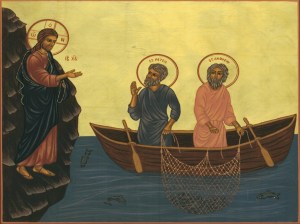 Simon Peter, James, and John set down their livelihoods. They left everything to follow Christ. Their calling as Apostles (as with all the Apostles) was unique. None of us has such a calling to apostleship. Very few of us will receive a call to the monastic life, though some may choose a life of simplicity apart from monasticism.
However, all Christians are called to follow Christ in holiness of life, in purity of heart, and in peace and repentance. Most of us here have families, jobs / careers, and other responsibilities that prohibit us from abandoning these ties and obligations entrusted to us. Yet, as part of our call to follow Christ, there are things to be left behind and abandoned. I turn to a few New Testament passages from St Paul’s epistles.
HEBREWS 12: 1 – 2:
Therefore, since we are surrounded by so great a cloud of witnesses, let us also lay aside every weight, and sin which clings so closely, and let us run with perseverance the race that is set before us, looking to Jesus the pioneer and perfecter of our faith, who for the joy that was set before him endured the cross, despising the shame, and is seated at the right hand of the throne of God.
GALATIANS 5: 16 – 24:
But I say, walk by the Spirit, and do not gratify the desires of the flesh. For the desires of the flesh are against the Spirit, and the desires of the Spirit are against the flesh; for these are opposed to each other, to prevent you from doing what you would. But if you are led by the Spirit you are not under the Law. Now the works of the flesh are plain: immorality, impurity, licentiousness, idolatry, sorcery, enmity, strife, jealousy, anger, selfishness, dissension, party spirit, envy, drunkenness, carousing, and the like. I warn you, as I warned you before, that those who do such things shall not inherit the Kingdom of God. But the fruit of the Spirit is love, joy, peace, patience, kindness, goodness, faithfulness, gentleness, self-control; against such there is no law. And those who belong to Christ Jesus have crucified the flesh with its passions and desires.
COLOSSIANS 3: 1 – 6; 12 – 17:
If then you have been raised with Christ, seek the things that are above, where Christ is seated at the right hand of God. Set your minds on things that are above, not on things that are on earth. For you have died, and your life is hidden with Christ in God. When Christ who is our life appears, then you also will appear with him in glory. Put to death what is earthly in you: immorality, impurity, passion, evil desire, and covetousness, which is idolatry. On account of these the wrath of God is coming…Put on then, as God’s chosen ones, holy and beloved, compassion, kindness, humility, meekness, and patience, forbearing one another, forgiving each other; as the Lord has forgiven you, so you also must forgive. And over all these put on love, which binds everything together in perfect harmony. And let the peace of Christ rule in your hearts, to which indeed you were called in the one body. And become thankful. Let the word of Christ dwell in you richly, as you teach and admonish one another in all wisdom, and as you sing psalms, hymns and spiritual songs with thankfulness in your hearts to God. And whatever you do, in word or deed, do everything in the name of the Lord Jesus, giving thanks to God the Father through him.
2 CORINTHIANS 5: 17:
So then if someone is in Christ, he is a new creation. The old things passed away, and behold all things have become new.
 Since we are a new creation in Christ we are, therefore, to conduct our lives as Christ wills, and by the Holy Spirit to conform our lives to this reality. Added to this we are citizens of the Kingdom of Heaven. Every citizen of a country, every ethnicity, whether Serbians, Greeks, English, Americans, Russians, Mexicans, etc., have unique languages, cuisines, and cultural customs and mannerisms by which they are known and recognized. Therefore, as citizens of the Kingdom of Heaven — we who are in Christ — must have cultural mannerisms which declare our heavenly citizenship. I turn to the Beatitudes to flesh out this point. The Beatitudes are not lofty, unattainable ideals. On the contrary, they are spiritual virtues that are to be worked into our lives. These are the cultural characteristics by which we live and are recognized — they declare our heavenly citizenship.
ST MATTHEW 5: 1 – 16:
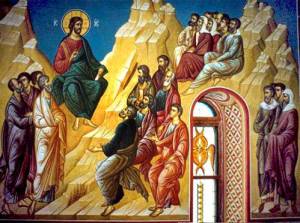
And upon seeing the crowd, he went up the mountain, and after he sat down his disciples approached him. He the opened his mouth and taught them, saying:
“Blessed are the poor in spirit, for theirs is the Kingdom of Heaven.
“Blessed are those who are mourning, for they shall be comforted.
“Blessed are the meek, for they shall inherit the earth.
“Blessed are those who are hungering and thirsting after righteousness, for they shall be satisfied.
“Blessed are the merciful, for they shall receive mercy.
“Blessed are the pure in heart, for they shall see God.
“Blessed are the peacemakers, for they shall be called the sons of God.
“Blessed are those who are persecuted for the sake of righteousness, for theirs is the Kingdom of Heaven.
“Blessed are you whenever they insult you, persecute you and speak all manner of evil against you falsely for my sake. Rejoice and be glad for great is your reward in heaven, for thus they persecuted the prophets who came before you.
“You are the salt of the earth; but if salt has lost its taste, how shall its saltiness be restored? It is no longer good for anything except to be thrown out and trodden under foot. You are the light of the world. A city set on a hill cannot be hidden. Nor do men light a lamp and set it under a bushel, but on a stand, and it gives light to all in the house. Let your light so shine before men, that they may see your good works and give glory to your Father who is in heaven.”
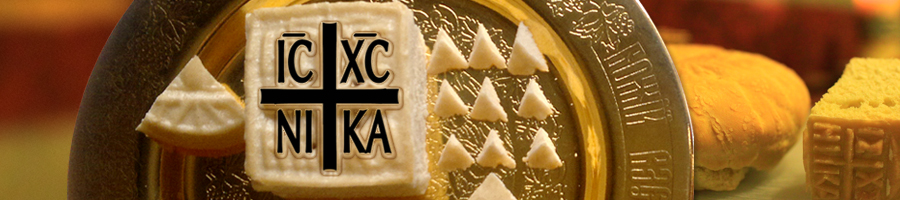
 As did Peter, James, and John, we too are to put our boats onto the land, leave what is contrary to the Christian life and follow our Lord. Such a life is a struggle, and we are to engage in this contest with the will to win — as can only be done by the work of the Holy Spirit in our lives. Come to the Sacraments. Especially come to the Eucharist with intention and with a purpose. There is a message is impressed into the surface of the Lamb, the piece of bread which will become his Body: in a cruciform arrangement one reads IC XC NIKA. This means Jesus (IC) Christ (XC) conquers (the Greek verb nika — conquers). Over what did, and does, Jesus conquer? He was, and is, victorious over sin, death, darkness, and alienation. Thus, pray that his victory over sin, death, darkness, and alienation comes into our lives, and that these are replaced with his holiness, life, light, and relationship. We pray that he gives to us his cleansing and victory. Pray also that his victories in our lives cause us to put our boats to the land, and lay aside every weight, and sin that clings so closely, and follow our Lord more fully.
The following is a corresponding sermon given at St Sava Serbian Orthodox Church on October 12, 2025:
In Christ,
Confessors, Martyrs, and Apostates
Posted: July 1, 2024 Filed under: Etcetera, The Eucharist and Living the Eucharist | Tags: Confessing Christ, Denying Christ, Hebrews 11: 35 -38, Hebrews 12: 1 - 2, Maccabees 1: 62 - 63, Matthew 10: 32 - 33, Panagia Pantassana wonder-working icon, persecution is coming, persecution is here, saints and their icons, St Nicholas Greek Orthodox Church in Tacoma Washington, the time of the Maccabees, We are surrounded by so great a cloud of witnesses, wonder-working icon of St Anna Leave a commentWe find these words in Hebrews 12: 1 “Therefore, since we are surrounded by so great a cloud of witnesses…” When you step into an Orthodox Church anywhere in the world you will step into the company of the “cloud of witnesses.” Look all around…there are saints to be seen and to be encountered by their icons. Also there may be present those saints who are unseen by us. For example, near the conclusion of the clergy’s entrance prayers in preparation for each Divine Liturgy (which occur just before our entrance into the sanctuary), we bow to each other and ask for forgiveness from each other. We bow to the faithful present, and even no one else is there, bow to those who may be present that cannot be seen.
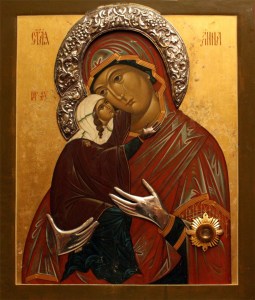
St Anna holding Mary
The saints who surround us are not passive spectators. They are active, and act for us, as they exist in Christ and act for him as servants, as they did while in this physical life. I offer two examples I have recently experienced. In October 2022 a wonder-working icon of St Anna (the mother of Mary, and grandmother of Jesus) was presented to the faithful at St Nicholas Greek Orthodox Church in Tacoma, Washington. After the completion of the akathist prayers, all venerated her icon. During this month, I was burdened by the reassignment of my dear friend, Fr Seraphim Majmudar, to an Orthodox Church in California. Upon my veneration of her icon, our Lord worked through her, and gave me release from the burden and grief regarding this upcoming event. Then most recently, during Pentecost last week (June 23, 2024) at the same St Nicholas Orthodox Church, the oil from the wonder-working icon of Mary called Panagia Pantassana (from Mt Athos’ Vatopedi Monastery) was applied to my very painful left knee (a meniscus tear?) by the parish’s new rector, Fr Anthony Cornett. Within several hours the pain had greatly diminished, and remains so to this day.
Of the saints who are surrounding us by their icons, some were martyrs, some were confessors, and some had their holy lives ending in peace. Regarding martyrs and confessors, we read this from Hebrews 11: 35 – 38:
…Some were tortured, refusing to accept release, that they might rise again to a better life. Others suffered mocking and scourging, and even chains and imprisonment. They were stoned, they were sawn in two, they were killed with the sword; they went about in skins of sheep and goats, destitute, afflicted, ill-treated — of whom the world was not worthy — wandering over deserts and mountains, and in dens and caves of the earth.
We should also learn of martyrs from the period of the Maccabees. During the evil reign of the evil Greek king Antiochus Epiphanes (a general of Alexander the Great), the Temple and Jerusalem were cruelly desecrated. Gentile cults were established. Many Jews capitulated and apostatized. Thousands of others remained faithful and became martyrs or confessors, and others became national heroes. Of martyrs of this era we find this in 1 Maccabees 1: 62 – 63:
But many in Israel stood firm and were resolved in their hearts not to eat unclean food. They chose rather to die rather than to be defiled by food or to profane the holy covenant; and they did die.
Moving to the twentieth century we have the brutal persecutions of the Soviet Union, and other communist countries, when and where thousands upon thousands became martyrs and confessors for their faith.
However, persecution is not found only in the past and elsewhere. We are not to think that we are, or will be, protected from persecution just because we live “in the West.” Look around you, “the West” is on life support. I can give examples from England. A Catholic woman was very recently arrested because she prayed (quietly and peacefully) the Rosary in public. Also, a man was arrested for reading the Bible (quietly and peacefully) on a park bench. At home in America, persecution is upon us, and gradually increasing month by month.
I now present St Matthew 10: 32 – 33:
Therefore, whoever shall confess me before men, I also shall confess him before my Father who is in the Heavens. But, whoever might deny me before men, I also shall deny him before my Father who is in the heavens.
In the the major litanies of the Divine Liturgy we find this prayer: “For our deliverance from all affliction, wrath, danger and necessity, let us pray to the Lord.” We also pray; “Help us, save us, have mercy on us, and keep / protect us by your grace.” We don’t want a climate of persecution, trouble, or adversity because we may fail. We may deny Christ in these situations. Further, we cannot fantasize that we will bravely become confessors in our day of trial. Though we pray that overt trials, persecutions, etc., not come our way, yet small trials, testings, and troubles come our way daily.
We cannot think that we will confess Christ during a time of great testing if we cannot confess Christ in a far lesser setting of testing! These lesser, mundane trials may come in the setting of family, work, traffic, school, or in the marketplace. When such small trials come our way, how do we respond? Do we confess Christ with joy, peace, prayer, blessing, and thanksgiving? If so, this is the response of faith and of the Holy Spirit working in our lives. If this is our choice and response, we CONFESS Christ! Or, do we respond with anger, cursing, and frustration? If so, this is the result of the corruption that still resides in us. If this is our choice and response, we DENY Christ!
We always have the power to confess Christ. Christ is in us, and we are in Christ — this is a relational union of God’s presence in us — and this is our salvation. We must determine in advance how we will respond. Our practice of smaller confessions will prepare us for true times of troubles.
Here is the text from Hebrews 12: 1 – 2:
Therefore, since we are surrounded by so great a cloud of witnesses, let us lay aside every weight, and sin which clings so closely, and let us run with perseverance the race that is set before us, looking to Jesus the pioneer and perfecter of our faith, who for the joy that was set before him endured the cross, despising the shame, and is seated at the right hand of the throne of God.
Thus, his Life and Light are to prevail in our lives. Hence, we are to confess Christ with kindness, patience, blessing, peace, and thanksgiving before all who witness these confessions of Christ. We are to confess Christ that we too may be saints!
The following is the corresponding sermon:
In Christ whom we confess,
Fr Irenaeus
 Father Irenaeus Williams