Gear Review: The Glider Capo
Posted: August 4, 2024 Filed under: Music and Guitars | Tags: Dunlop Pivot Capo is excellent for 12 string guitars, Guitar gear review of the Glider Capo, Review of the Glider Capo 1 Comment
My capo collection (to date)
With this review my search for the perfect capo continues. With this ongoing quest (quest sounds more noble), I have accumulated quite a number of capos. There are “crazy cat ladies,” and now with my collection, I guess this makes me a “crazy capo guy” who now posts his fourth capo review.
The capo is an incredibly valuable tool for any guitarist. As any player knows, there are two major concerns about applying a capo to the neck of a guitar: the first is string buzz, and the second is tuning stability. In this posting I am evaluating the Glider Capo (by Greg Bennett), and my findings and opinion will be found below.
Information about the Glider capo can be found on the internet at glidercapo.com. Upon visiting the website we are given this claim:
Glider capo is the world’s most innovative guitar capo. It is recognized for its unique ability to roll up and down the fret board for seamless key changes.
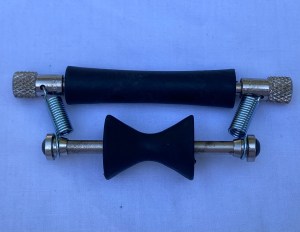
The Glider Capo
Let me first comment regarding the rolling, or gliding, of the capo up and down the neck. There is one video where a guitarist uses the thumb of his fretting hand to move the capo along the fret board. Others show a player using either the fretting hand or the picking hand to alter its position. I found that I need to use my picking hand to smoothly move the capo into proper position. This technique allowed me to keep the capo straight and parallel with the fret. (I could not accomplish this by using my thumb or fretting hand.) When glided into position, the Glider Capo wants to naturally rest about 1/4 inch (0.635cm) above the fret — a perfect position.

Glider Capo in position
The Glider Capo was tested for both string buzz and tuning stability on three guitars: a Rainsong Nashville Series jumbo (a carbon fiber six string), a Breedlove Pro Series dreadnought (solid, traditional woods, six string), and a Rainsong Concert Series 12 string jumbo (carbon fiber). D’Addario nickel-bronze light gauge strings (12 – 53) are on both six string guitars. For all testing, After application, the capo was first placed at position two, then glided to positions five, and seven on all three guitars. Right out of the gate let me state that I find that the Glider Capo CANNOT be used on a 12 string guitar! The problem here is with the capo’s inability to properly compress itself onto the higher gauge octave strings. There is significant buzzing, and these high octave strings go flat — significantly so for the fourth and fifth strings’ pairings. (I give my recommendation for a good capo for a 12 string near the close of this posting.)
String buzz is discussed first. The Glider Capo on the six string Rainsong Nashville jumbo gave no fret buzz at any of the three capoed positions. However, the Glider Capo caused on / off string buzzing on the sixth string at the Breedlove’s frets five and seven.
Tuning stability is next addressed. A Snark electronic tuner was used for all testings. Both the Rainsong Nashville Series jumbo and the Breedlove dreadnought were put in tune before the application of the capo. Placement began at fret two and tuning stability first tested here. The Glider Capo was then rolled to the fifth and then seventh positions where tuning stability was also tested. Using the Snark tuner, “distuning” was noted for both guitars at each position on all six strings by the number of “minute” increments flat or sharp from the “12 o’clock (in tune) position. Here are the results:
Breedlove Pro Series dreadnought:
Fret two: +1 minute sharp on string two (+1 total)
Fret five: +1 minute sharp on strings two and six (+2 total)
Fret seven: +1 minute sharp on strings two and six (+2 total)
Rainsong Nashville Series jumbo:
Fret two: +1 minute sharp on string one (+1 total)
Fret five: +1 minute sharp on strings one, two, and five (+ 3 total)
Fret seven: +1 minute sharp on strings one, two, and six (+3 total)
The total number of “minutes” sharp is quite minimal and proves insignificant when compered to the distunings produced by other capos with various grasping mechanisms that I previously tested and reviewed using very near identical methods. Given the rolling mechanism of the Glider Capo I was surprised with the results. I must conclude that the Glider Capo offers great tuning stability! In fact, it likely offers the best tuning stability of any capo I own. But, again, it cannot be used on a 12 string guitar for the reasons noted above. (I place here, my recommendation for a really good capo for a 12 string guitar. It is Dunlop’s Pivot Capo. The advantage it possesses is that this capo uses a dial-in resistance gear that can be adjusted for pressure at any position on the neck.)
An honest review seems to require note of a downside. Therefore, I must note one drawback, but this is purely my own subjective comment. The application of the Glider Capo to the neck is a bit clumsy given the needed technique by which it is applied. However, given its fantastic tuning stability, I can get over it.
As a “crazy capo guy,” I confidently recommend the Glider Capo for any player’s six string guitars — acoustic or electric. One can be purchased from Amazon for $34.99 USD. More information can be found at glidercapo.com as well as from tonalmusicinc@gmail.com. Tonal Music is located in Franklin, Tennessee.
Keep on playing,
Fr Irenaeus
 Father Irenaeus Williams