St Ambrose of Milan and the Thankful Leper
Posted: December 9, 2025 Filed under: The Eucharist and Living the Eucharist | Tags: "Let us go forth in peace", 1 Thessalonians 5: 16 - 18, become Eucharists, Become thankful Col 3: 15, give thanks for all things, Hypostatic Union, living eucharistically, Real Presence, St Ambrose of Milan, St John 6: 50 -51, St Luke 17: 13 - 19, The Eucharist is a re-presentation of the Incarnation, the Eucharist is the Body and Blood of Christ, The Healing of Ten Lepers, the one thankful leper, transubstantiation and Monophysitism Leave a commentEvery year on December 7 the Orthodox Church commemorates St Ambrose of Milan. He was bishop of Milan in the fourth century and is, of course, a saint of the Church. One of his works, The Mysteries, was extremely important for my conversion to the Orthodox Church, and subsequent ordination to the deaconate and then the priesthood.
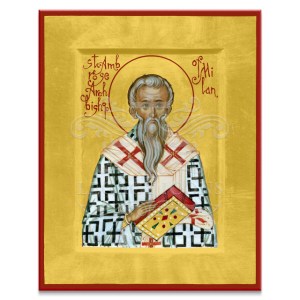
St Ambrose of Milan
This work taught me, when I was a Protestant, that Holy Communion — the Eucharist — gives to the communicant the true, all-holy, and precious Body and Blood of the incarnate God, our Lord and Savior Jesus Christ. This epiphany occurred in 1992 when I was a student at a Protestant seminary. Upon this revelation I was undone — my “apple cart was tipped over.” I experienced a “paradigm shift.” I went “through the looking glass.” I had to ask some fundamental questions, among them being, “What is salvation? Are we saved by more than faith alone?” “What is reality?” My dualistic understanding of matter and spirit was shattered — they are not separated by a great chasm, they intermingle with one another.
Specifically, I was confronted by these sentences found in The Mysteries:
Perhaps you may say: “I see something else; how do you tell me that I receive the Body of Christ?” (9: 50).
It has been proven that the sacraments of the Church are more ancient; now realize that they are more powerful. In very fact it is a marvelous thing that God rained manna on the fathers, and they were fed by daily nourishment form heaven. Therefore, it is said: “Man has eaten the bread of angels.” But yet all those who ate that bread died in the desert, but this food which you receive, this living bread which came down from heaven, furnishes the substance of eternal life, and whoever eats this bread “will not die forever;” for it is the body of Christ (9: 49).
St Ambrose quotes from the sixth chapter of St John’s Gospel, and more specifically the Bread of Life discourse that took place in the synagogue of Capernaum. I had to read from St John’s sixth chapter myself over and over for the message of these verses to sink into my mind (I still refer to them quite frequently).
Your fathers ate the Manna in the wilderness and died. This is the Bread which is coming down from heaven [katabainon], in order that if someone might eat of it might not die. I am the Living Bread which came down [katabas] from heaven. If someone might eat of this Bread he shall live forever, and the Bread which I will give is my Flesh in behalf of the world (St John 6: 49 -51).
St John uses two different participle forms of the Greek verb katabainein, “to come down,” or “to descend.”
-
- Katabainon — substantival present passive form. The present tense, or aspect, of a Greek verb implies an ongoing activity — no ending of the action is demanded. This means there is a Bread which is continually coming down from heaven.
- Katabas — a substantival aorist active form. The aorist declares an action is completed. With this participle, our Lord refers to the Bread which is his Body which came down from heaven only once. Katabas, thus, refers to his physical Body of the Incarnation that stood before those assembled in the synagogue.

The Living Bread
Again, St John 6: 50 informs us that there is a Bread which is continually coming down from heaven. Our Lord then defines and clarifies what and who this Bread is in 6:51. He most clearly states that this Bread which is continually descending from heaven is none other than his physical body of the Incarnation — the body that came down — once and for all which will be broken and given for the life of the world. They are one and the same!
Perhaps one who denies this truth might think, “Well, by the time of St Ambrose the Church became confused about this matter and many others as well.” Wrong! 250 years earlier St Ignatius of Antioch — himself a disciple of St John — gave to the church of Smyrna of these words regarding the Eucharist:
They [false teachers] abstain from the Eucharist and prayer, because they do not confess the Eucharist to be the Flesh [sarka – a feminine noun] of our Savior Jesus Christ. The Flesh [taen, feminine article – sarka is its antecedent] which suffered for our sins, the Flesh [taen, feminine article– again sarka is the antecedent] which, by the goodness of the Father, was raised (Ignatius to the Smyrnaeans VII: 1).
The Apostolic Tradition of the Church, from St John the Apostle, through St Ignatius (early second century), through St Ambrose of Milan (fourth century), to this very day has always taught that by the Eucharist the Church is given our Lord’s Body and Blood. To deny this is to deny the faith of the One, Holy, Catholic, and Apostolic Church! To deny this truth is to imply that St John who observed, heard, and touched our Lord — the Incarnate Logos (see 1 John 1: 1- 5) is a liar. And you accuse all the Fathers of the Church to be liars as well.
Hence, from all of this, especially from St John’s words, we are to understand that the Eucharist is a re-presentation of the Incarnation. All that is of Christ — all that he is, and all that he did and accomplished for our salvation — are re-presented anew to us. A re-presentation of the Incarnation means that the hypostatic union also applies to the Eucharist. Regarding Jesus of Nazareth the hypostatic union means that he is fully God and fully man. These two natures are in an indivisible union in the one Person of Jesus, yet the two natures are not to be confused. Then, regarding the Eucharist, it is fully Jesus’ Body and Blood and fully bread and wine — two “natures” exist in an indivisible union, yet they are not to be confused. (As an aside, The Roman Catholic understanding of transubstantiation is a bit reminiscent of the error of Monophysitism — that there is only one nature of Jesus. Thus, transubstantiation states there is only one nature of the Eucharist: there is only Body and Blood, the bread and wine are simply incidentals. With the teaching of transubstantiation the Eucharist is a bit misunderstood.)
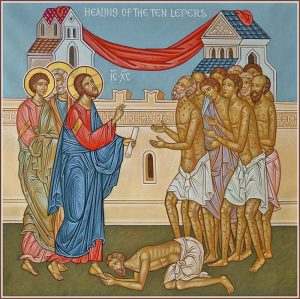 In addition to the commemoration of St Ambrose of Milan, the day’s Gospel reading presents to the Church the account of the healing of ten lepers. All were healed, but only one returns to worship and give thanks to Jesus for his healing:
Then one of them, when he saw that he was healed, turned back and was glorifying God with a loud voice; and he fell on his face at Jesus’ feet, giving thanks to him. Now, he was a Samaritan. Now, in answering, Jesus said, “Were not ten cleansed? Where are the nine? Was no one found returning to give glory to God but this foreigner?” And he said to him, “Rise and go on your way; your faith has saved you!” (St Luke 17: 15 – 19).
Only one healed leper gave thanks to God. Therefore, only one lived eucharistically.
Living eucharistically: what do I mean by this phrase? The Greek word eucharistia means thanksgiving. St Paul gives this command to the Colossian church: “And become thankful [kai eucharistoi ginesthe] (Colossians 3:15). You can also say it this way, “Become Eucharists!”
When the Divine Liturgy comes to its conclusion a priest descends the solea and declares this: “Let us go forth in peace!” These words are not simply a command to direct us as we reenter the world. These words give a commissioning, and a new liturgy begins with the empowering of the Eucharist that moves us to our departures. St Paul writes,
Rejoice always. Pray constantly. Give thanks [eucharisteite] in, with, and for all things: for this is the will of God for you in Christ Jesus (1 Thes 5 – 16 – 18).
By giving thanks for not only the good and pleasant things of life, but also for the difficult and unpleasant things (and people) we live eucharistically. Thus, if we live eucharistically we incarnate all we encounter — we bear Christ into all things and for all things. Thus there can be transformations, and we are certainly formed more completely into the image of God, and Christ is more fully formed in us. We are living Eucharists in the world, and we act as the thankful leper who glorified God!
In Christ,
Fr Irenaeus
Discerning the Will of God
Posted: December 16, 2023 Filed under: The Eucharist and Living the Eucharist | Tags: 1 Thessaloonians 5: 16 - 18, determining the will of God, give thanks for all things, Jeremiah 29 ; 11- 13, living the Eucharist, pray constantly, present actions form the future, Psalm 25: 8 - 10, rejoice always, Romans 12: 2 and the will of God Leave a comment I am a convert to the Orthodox Church. My faith in Christ began in an evangelical context while a pharmacy student at Washington State University. I am thankful for this. Their particular evangelical flavor was not a shallow, fluffy variety, but one which took the Christian faith seriously and practiced it with a joyful fervor. My companions were all college age like me at the time, and like me faced many life decisions — many of minor importance, but some of great significance. This all involved for us discerning the will of God for our young lives. This discernment of the will of God was often perplexing for many. The desire to follow Christ faithfully and to be in God’s will — perfectly — was drawn from the Scriptures. Two passages came into play:
For I know the plans I have for you, says the Lord, plans for for welfare and not for evil, to give you a future and a hope. Then you will call upon me and come and pray to me, and I will hear you. You will seek me and find me; when you seek me with all your heart (Jeremiah 29: 11 – 13).
Do not be conformed to this world but be transformed by the renewal of your (humon) mind, that you (humas) may discern (dokimazein) what is the will of God, what is good and acceptable and perfect (Romans 12: 2).
Concerning these two passages from Scripture it is important to note a few things. Regarding the verses from Jeremiah, the context was the return of Jews to Jerusalem and Judaea from the Babylonian captivity: this was for the entire Jewish people, not for one person. Then, regarding St Paul’s words from Romans, the “your” and “you” is not singular, but in the second person plural (humon, humas). In other words, these words are directed to the entire church in Rome as one united body of faith. And the word dokimazein can be translated not only as “discern,” but also “test,” “prove,” or “demonstrate.”
 With the focus on discernment, discovering the will of God was, then, perplexing when misunderstood in the singular, or in the personal. I recall many conversations that included the complaint: “I’ve been praying, but I still don’t know what God wants me to do.” Looking back, such a process of discernment now seems like figuring out a puzzle, or guessing under which shell the nut is hid. That such a specific will in all matters of one’s personal life is unlikely. Adhering to this approach to discover God’s will in everything now seems delusional, and could lead to confounding indecision. (Furthermore, continued indecision can lead to anxiety and depression.)
Now I move forward in time 40 years. My youngest son, a devout Orthodox Christian, recently had a conversation with me about figuring out his future. He is a journeyman residential electrician, but wants to better his income and have a more satisfying career. Regarding his career, he is uncertain whether he should pursue commercial work, go to lineman’s school, or seek a a college degree in project management. He also wants desires marriage and family, and wants to find a faithful wife. (Does anyone know a faithful young woman in her twenties?) Thus, he could fall into the same dilemma as did my peers when I was young. Well, he didn’t ask for specific advice, but as any good father would do, I offered advice. My advice came from the words of St Paul found in 1 Thessalonians 5: 16 – 18:
Rejoice always. Pray constantly. Give thanks for all things: for this is the will of God for you in Christ Jesus.
Quite general or generic, yet his words are profound and offer the greatest guidance that can be given. In all situations and in all circumstances — good, bad, or indifferent — these words apply, and when practiced, will put one in God’s will. Anyone can rejoice, pray, and give thanks when things are going well. But, things don’t always go our way. When faced with challenging, distressing, and upsetting circumstances, or people, one can still rejoice, pray, and give thanks for them. This is the way of holiness and growth in Christ, and it is the way of the Saints. With these determined decisions and actions the Holy Spirit is free to work in our lives and transform us and better form the image of God within us. More importantly, with these three faithful attitudes and actions we begin to form our future and cooperate with God’s will.
 Our present, in part, forms our future. Let me give an example from grapevines. I have several vines on my property. Grapevines are aggressive growers. They send out tendrils to attach to fixed structures. This is done for their growth. With joy, prayer, and thankfulness in all situations the consequent actions serve as our own tendrils reaching out to the presently unknown future. Tendrils sent out with such intent will entwine, likely, with correspondent consequences established to achieve God’s intended outcomes our personal lives — always being our salvation. Allow me to slightly rephrase this thought. With such a holy perspective, circumstances, encounters, and the random events that happen can be transformed, sending forth healthy, whole, and holy tendrils ahead of us — tendrils that God, in his omnipotence, can pull toward himself and toward the good. Again, such a holy, eucharistic perspective and consequent actions trans form us. Thus, we are capable of more and more holy, joyful, prayerful, eucharistic actions in all the circumstances we encounter in this huge, expansive, and often difficult reality called the present.
This is truly how we establish God’s will in our lives. However, this does require patience — also a virtue which will allow us to perceive God’s will. Living the Christian life in this faithful manner will allow us to see truth and meaning when we read words like these from the Scriptures:
Good and upright is the Lord; therefore he instructs sinners in the way. He leads the humble in what is right, and teaches the humble his way. All the paths of the Lord are mercy and faithfulness, for those who keep his covenant and his testimonies (Psalm 25/24: 8 – 10).
We live in disturbing and distressing times. We seem to be pressed on all sides. These times will test us. Fear and worry do us no good. A determination to rejoice, being ever prayerful, and living eucharistically (by giving thanks in, with, and for all things) will guide us and direct our ways. When we don’t know what to do, or what decisions to make continue patiently with joy, prayer and thanksgiving. Also engage with the words of David in Psalm 5: 8,
Lead me, O Lord, in your righteousness because of my enemies; make you way straight before me.
In Christ the Good Shepherd who leads us,
Fr Irenaeus
 Father Irenaeus Williams