Walking Upright
Posted: December 2, 2025 Filed under: Etcetera, The Eucharist and Living the Eucharist | Tags: 1 Corinthians 4: 14 - 16, begotten of God, St Andrew the First Called, St John 1: 35 - 51, St Luke 13: 10 - 17, St Paul calls himself "Father", St Paul fathered the church of Corinth, the cursed serpent's realm, The healing of the bent over woman, The thematic focus of St John's Prologue 1: 11 - 13 1 CommentThe Gospel text for the 25th Sunday after Pentecost comes from St Luke 13: 10 – 17. From the text we read about the healing of a woman who was bent over double by a spirit for 18 long years. She was suffering due to the work of the enemy:
And he [Jesus] was teaching in one of the Synagogues on the Sabbath. And behold there was a woman who was having a spirit of weakness for 18 years, and she was bent over double and was unable to completely straighten up (St Luke 13: 10 – 11).
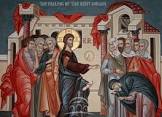 Her posture was bent down at an approximate angle of 90 degrees. Thus, her gaze was essentially always downward unless she inclined her head upward to see (and perhaps that was done with difficulty). She looked to the ground to the stones and dirt. Thus, her gaze was directed to decay: the earth and soil are made from the breakdown, or decay of stone and organic substances. She looked down upon the byproducts of death. Therefore, spiritually speaking, her gaze was set to the realm of the serpent:
The Lord God said to the serpent, “Because you have done this, [the deceiving of Eve] cursed are you above all cattle, and above all wild animals; upon your belly you shall go, and dust you shall eat all the days of your life (Genesis 3: 14).
Although the woman’s condition was a physical ailment the spiritual parallel is evident: Apart from Christ and a life of faith and repentance we are all bent over double with our eyes fixed upon the Serpent’s realm of decay and death. But Jesus intervened,
Upon seeing her, Jesus called and said to her, “Woman, you are released from your weakness.” And he placed his hands on her and immediately she straightened up and glorified God (St Luke 13: 12 – 13).
With this healing her gaze was in a forward direction. She now clearly saw our Lord and praised God for her healing. She could now look upon God’s creation around her, and look up to the heavens. She now moved and lived without pain.
So, we come to our spiritual condition — apart from Christ we are bent over double and gaze down upon death and decay; upon sin, darkness, and alienation. By being in Christ by faith and Sacrament we stank upright and can look upon him with the eyes of faith. But, when we look away from his ways and stray from him we have begun to be doubled over and gaze upon death and decay once more. But, we are given the Sacrament of Confession’s spiritual chiropractic treatment to set us straight again.
 Every year, on November 30, we also commemorate the Apostle Andrew — the First Called of the Apostles (St John 1: 35 – 51 is the Gospel text for his feast day). He too, as he walked with our Lord, was spiritually straightened up. In Christ, with Christ, and for Christ he gazed upon him and learned from him. He, together with the other apostles, gave us the Apostolic Tradition which has guided the Orthodox Church for 2,000 years.
By the Apostolic Tradition we are taught by the Scriptures and those who interpret them by this holy Tradition. This Apostolic Tradition gives us other gifts. We worship The Triune God in the Divine Liturgy and all the services of the Church. We enter into the Sacramental life of the Faith, especially by receiving the Body and Blood of our Lord in and by the Eucharist. We are given examples of godly, holy living by the lives of the saints. In the epistle set for the day, St Paul has written this for us:
I do not write this to make you ashamed, but to admonish you as my beloved children. For though you have countless guides in Christ, you do not have many fathers. For in Christ Jesus through the Gospel I begot [egenneesa] you. Therefore, I exhort you — become imitators of me (1 Corinthians 4: 14 – 16).
St Paul’s use of the verb translated begot / fathered can take us back to the Prologue of St John’s Gospel. The Prologue is found in the Gospel’s first chapter and consists of verses 1 – 18. These verses are constructed in a very specific way to lead us to the center and focus of the Prologue’s message:
Unto his own things [ta idia – the things of creation] he came, and his own [oi idioi – his fellow Jews] did not receive him. But as many as received him, he gave to them authority to become children of God, to those who believe in his name. They, not from blood, nor the from the will of the flesh or the will of a man, were begotten [egenneetheesan] from God (St John 1: 11 – 13).
These verses inform us that we are the children of God. We are the children of a spiritual family of faith. And as any family has defining appearances and characteristics, so are we to have defining spiritual characteristics that, for example, are found in the Beatitudes (see St Matthew 5: 1 – 12).
By being in Christ we stand up straight. We look forward to clearly see and follow along the path of Christ. Also, in addition to the Scriptures, we can take the guidance of the Apostles and the saints as we move confidently in the ways of the Apostolic Tradition which, in part, was set out by St Andrew the First Called.
Here is the corresponding sermon given at St Jacob of Alaska Orthodox Church in Bend, Oregon on 11/30/25:
In Christ,
Fr Irenaeus
 Father Irenaeus Williams