Sanctification Under Our Rooves
Posted: July 11, 2025 Filed under: Etcetera, The Eucharist and Living the Eucharist | Tags: 1 Thessalonians 5: 15 - 24, becoming god-like, becoming whole and complete, divination, experiencing God, The centurion's confession of faith in Mt 8: 5 - 13, The Centurion's faith, Theosis Leave a commentSANCTIFICATION UNDER OUR ROOVES
In the sixth chapter of his letter to the Church in Rome, St Paul notes the contrasts between their lives before coming to faith in Christ and their lives after faith and baptism in Christ. The contrast shows their previous lives as Roman pagans bound them as slaves to sin, but their union with Christ binds them as slaves to righteousness (Romans 8: 18). St Paul continues,
When you were slaves of sin, you were free in regard to righteousness. But, then, what return did you get from the things of which you are now ashamed? The end of those things is death. But, now that you have been set free from sin and have become slaves of God, the return you get is sanctification and its end, eternal life (Romans 8: 20 – 22).
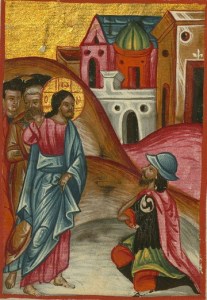 Sanctification, or the attainment of holiness, is the primary theme of this posting. But, I present a slight detour: the Fourth Sunday of St Matthew’s Gospel readings informs us of the faithful Centurion who approaches Jesus asking that he heal his servant who is paralyzed and is suffering terribly (St Matthew 8: 5 – 6). Jesus agrees to heal the servant. The Centurion then says these words to our Lord:
Upon answering, the Centurion said, Lord, I am not worthy that you should enter under my roof, but only say the word and my servant shall be healed (St Matthew 8: 8).
Jesus marvels at his answer and says, “Truly I say to you, not even in Israel have I found such faith (St Matthew 8: 10).

St Photini
“I am not worthy!” No one is worthy. No one is ever worthy of the salvation and grace given to us by Christ. In the Gospels we find example after example of the unworthy whom Christ called, healed, showed mercy, and to whom he extended his salvation and holiness. We can recall the woman with an ongoing menorrhagia who unworthily was healed by touching the hem Jesus’ garment. We read of the unworthy and sinful tax collectors who were called by Jesus to follow him (Matthew the Apostle and Zacchaeus who became a bishop). We know the sinful and unworthy Samaritan woman who entered into our Lord’s renewing, life-giving water — she would become an evangelist and martyr whom we know as St Photinia. We are to remember St Peter who said, “Depart from me, for I am a sinful man, O Lord!” St Luke 5: 8b).
There are numerous others, and we are to count ourselves among them, for we too are unworthy sinners who can echo the Centurion’s words: “I am not worthy that you should enter under my roof!” Isn’t it the case that we hesitate to have people come to our homes because of accumulated clutter, dirty dishes in the sink, or the miraculous breeding of “dust bunnies” in the unswept corners? In spite of the fact that the maid never shows up to tidy up for us, our Lord already knows the condition both of our homes and our souls. More importantly, he is not afraid of the situation of our “interior domestic environment.” He is ready to go to work to clean us up and make us a fitting habitation for his presence in our lives — no matter how many cleanings it takes.
No one is ever worthy, but we must ready ourselves for the work that he will do in our lives — the works of sanctification of purification. “Blessed are the pure in heart, for they shall see God” (St Matthew 5: 8). The Beatitudes — the listing of spiritual attributes — are not to be seen as lofty, unattainable ideals. Rather, they are all to be worked into us as evidence of the sanctifying work God is to be doing in our lives — if we allow this work to be done.
I continue with the subject of sanctification, especially those who came from a Protestant tradition where we first encountered Christ. While a student at a Protestant seminary, I took a course on the writings and theology/soteriology of Martin Luther. In one of his works he wrote this to describe our spiritual state as he understood it: “We are piles of dung covered over with pure snow.” For him, that was the Christian’s condition, apparently to be understood to be static, unchanging. Orthodoxy sees the picture differently: We are piles of dung covered by pure snow which is to penetrate the dung and transform it to a top soil which is to bring forth the Fruits of the Spirit (see Galatians 5: 22 – 24).
Luther was quite nuanced, but the majority of Protestants understand salvation to be in essence a juridical pronouncement of innocence: When Jesus took upon himself the penalty of our sins, it was to declare our legal innocence before God the Father. This is for the Protestant what is called justification. The problem is that this can become an abstraction where sanctification is optional. Most Protestants properly deny this, but the constructed bifurcation of salvation between justification and sanctification is not easily resolved. Salvation can become static and reduced to a bumper sticker: “Christians aren’t perfect, they are simply forgiven.” Our Lord tells us the opposite: “You, therefore, must be perfect (or whole / complete) as your heavenly Father is perfect (whole / complete)” (St Matthew 5: 48). This is why St Paul gives us this from his letter to the Philippians: “…work out your own salvation with fear and trembling; for God is at work in you, both to will and to work for his good pleasure” (Philippians 2: 12b – 13). This does not mean we earn our salvation by works of the Law, but we are to cooperate with God’s working in our lives so that the pure snow of salvation transforms us into valuable top soil which, in turn, produces the Fruits of the Spirit.
This brings us to the salvific model of theosis. Theosis — this process of salvation — means that we human sinners become god-like. We do NOT become God, just god-like. Divinization is a process of purification. It is an ongoing spiritual work of the Holy Spirit to restore us to be pure and true image bearers of God.
As a process there are steps to be taken as we “work out our own salvation with fear and trembling.” In his book Theosis: the True Purpose of Human Life, Archimandrite George Kapsanis informs us of the required conditions and steps for engaging this process. The first is humility (which is an ongoing process itself):
Thus, the beginning of the path towards theosis is humility, i.e., the acknowledgement that the purpose of our life is outside ourselves, and that it is with our Father, our Maker and Creator. Humility is likewise needed to see that we are sick, that we are full of weaknesses and prey to passions (p. 43).
The next he outlines is the need for asceticism:
The Holy Fathers also tell us that theosis proceeds in stages, from the lowest to the highest. Once we have acquired humility [a process itself] we embark, with repentance and much patience, on the daily struggle in Christ, putting into practice His holy commandments in order to cleanse ourselves from the passions (p. 44).
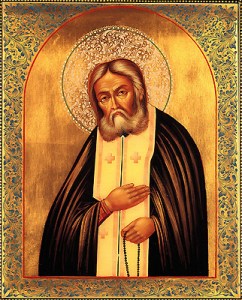
St. Seraphim of Sarov
The Archimandrite tells us that there are three parts of the soul to be cleansed of the passions: 1) the intellect which is cleansed by a watchfulness and guarding of the mind where we are “keeping the good thoughts and rejecting the bad” (p. 47). We are to understand that we are the captains of our consciousness, and we are to take every thought captive that would bring damage to our souls. 2) The passionate part of the soul is cleansed by love. 3) “Finally, the desiring part is cleansed by self-control” (p. 44). Self denial is to take place. We are to deny ourselves excessive food and drink, and other sensual activities which could bring harm to us.
The third requirement involves participation in the life of the Church, the Holy Sacraments of Confession and the Eucharist. Both Sacraments cleanse us, but the Eucharist additionally gives us Jesus’ victory over sin, darkness, alienation, and death when we consume his Body and Blood. Then, also, the prayers of the Church — primarily the Jesus Prayer which we can employ in any setting: “Lord, Jesus Christ, Son of God, have mercy on me a sinner.”
None of here today at Holy Resurrection Orthodox Church are monastics [where the sermon was given]. We do not have such a calling, though some present may be called to that in the future if it is God’s will. But, we can enter into this process of theosis in our “secular lives” at home, school, work, or the market place. Acknowledging this fact Archimandrite George offers this to the non-monastic Christian:
This [theosis], however, is the purpose and the great aim of our lives. How far we get is not the most important thing. What is important is the struggle itself, which God blesses abundantly, both in the present age and in the age to come (p.57).
In conclusion St Paul offers this regarding sanctifying activities, and God’s pledge to bring about our sanctification and purification:
See that no one repays evil for evil, but always pursue the good both for one another and for all. Rejoice always. Pray constantly. Give Thanks in, with, and for all things for this is the will of God for you in Christ Jesus. Do not restrain the Spirit; do not despise prophecy. Test all things; hold fast the good, avoid every appearance of evil. Now, may the God of peace himself sanctify you completely, and keep your spirit, soul, and body sound and blameless in the presence of our Lord Jesus Christ. the one who is calling you is faithful, and he will do this (1 Thessalonians 5: 15 – 24).
The following is the corresponding sermon given 7/6/25:
In Christ who calls us to sanctification,
Fr Irenaeus
Progressing in Peace
Posted: July 11, 2023 Filed under: Etcetera, The Eucharist and Living the Eucharist | Tags: 1 Thessalonians 5: 14 - 18, All Saints Day in the Orthodox Church, becoming sons of the Father, becoming whole and complete, Being a peacemaker, bless those who curse you, blessed are the peacemakers, love your enemies, progressing in peace, pursue the good for all, the Beatitudes, the Greek word teleios, turn the other cheek Leave a commentIn the Orthodox Church, the Sunday after Pentecost is All Saints Day. This is appropriate because, upon the sending of the Holy Spirit, the day of Pentecost marks the beginning of the sanctification of the Church. The Gospel reading for the day consists of St Matthew 10: 32 – 33, 37 – 38, and 19: 27 – 30. These verses give us some of the instructions of the way of holiness:
If you confess Christ before men, Christ will confess you before the Father. You cannot love parent of child more than Christ. One must take up your cross and follow Christ. Many who have been first shall be last, and those who have been last shall be first.
Let’s focus on confessing and denying. There are obvious ways of confessing or denying Christ. For example, one can publicly declare or deny ones faith in Christ. There are more subtle ways as well: what we do or not do before humanity and creation. This is like imaging God. All of humanity bears the image of God. If we act and speak in love, peace, or mercy we image God well before creation. If we act or speak sinfully before creation, then we image God poorly, and tell lies about the nature of God.
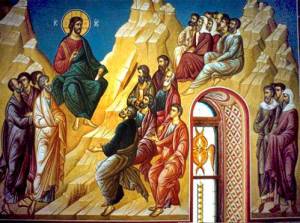 Let’s continue this discussion of confessing and denying concerning our actions, and thus, the ways of the saints. The fifth chapter of St Matthew begins with it the Sermon on the Mount: “Upon seeing the crowd, he ascended the mountain. And after he sat down his disciples approached him. And he opened his mouth and taught them” (St Matthew 5: 1 – 2). In the Beatitudes Jesus tells us who is counted as blessed. It is the poor in spirit; those who are mourning; the meek; those who are thirsting for righteousness; the merciful; those who are pure in heart; the peacemakers; those who are persecuted for righteousness; those who are insulted, persecuted, and are spoken of evilly falsely for the sake of Christ. All these are blessed because they acted in ways contrary to the ways of the world system, but acted in accordance with the ways of Christ.
Our Lord further instructs us that we are to be the salt of the earth, i.e., we are to preserve it from corrupting influences. We are to be the light of the world “…you are to shine your light before men that they might see your good works, and glorify your Father who is in the heavens” (St Matthew 5: 13, 14, 16).
Christ then speaks to his disciples regarding enemies in St Matthew 5:38 – 48. To begin this discussion, we need to know that ultimately our true enemies are not of flesh and blood. St Paul informs us about our true enemies:
Finally, be strong in the Lord and in the strength of his might. Put on the whole armor of God, that you may be able to stand against the wiles of the devil. For we are not contending against flesh and blood, but against the principalities, against the powers, against the world rulers of this present darkness, against the spiritual hosts of wickedness in the heavenly places (Ephesians 6: 10 – 12).
However, we know that there are men and women who wish us ill. Their presence may truly be a source of challenge, and even danger in our lives. The Book of Psalms contains psalms that address such enemies. These are the imprecatory psalms. For example, we have Psalm 17 (LXX 16):
Keep me as the apple of the eye; hide me in the shadow of your wings, from the wicked who despoil me, my deadly enemies who surround me. They close their hearts to pity; with their mouths they speak arrogantly. They track me down; now they surround me; they set their eyes to cast me to the ground. They are like a lion eager to tear, as a young lion lurking in ambush. Arise, O Lord! Confront them, overthrow them! Deliver my life from the wicked by your sword, from men by your hand, O Lord, from men whose portion in life is of the world. May their belly be filled with what you have stored up for them; may their children have more than enough; may they leave something over to their babies (vv 8 – 14).
Note that the psalmist asks God to deal with his enemies, and does not seek to take matters into his own hands. Flesh and blood enemies may do evil. Evil is to be addressed and called out for what it is. But, how we deal with personal enemies determines how well faith and Christ will be formed in us.
In St Matthew 5: 38 – 48, Christ gives his directives to us. We are to turn the other cheek when stricken; go the extra mile when compelled to go one mile. We are to give to those who beg, and lend to those who ask without refusing. We are to love our enemies. We are to bless those who curse us. We are to do good to those who hate us, and pray for those who persecute us. All of his instructions are about overcoming strife, conflict, hatred, and isolation. By pursuing this path of peace we are transformed “…so that you may be sons of your Father who is in heaven” (St Matthew 5: 45). Note how this directly corresponds to Jesus’ words from the Beatitudes: “Blessed are the peacemakers, for they shall be called sons of God” (St Matthew 5: 9).
The ideal of peace and unity, or relational union, always has its source in the Holy Trinity. The Holy Trinity is our exemplar. There is always perfect, whole, complete relational union between the three Persons of the Trinity. There is always perfect love and preference for the other Person. There is no strife, and no conflict. There is only perfection, wholeness, and completeness.
The Greek word is teleios. It can be translated as perfect, but also “whole” and “complete.” Teleios is our call and our goal: “Therefore [if you do / attain this], you shall be perfect / whole / complete just as your Father in heaven is perfect / whole / complete” (St Matthew 5: 48). The saints attained this and they manifested such peace to the world by their lives. Their peacemaking was recognized by their peers.
 Progressing in peacemaking is like progressing in forgiveness (Progressing in Forgiveness). We must forgive to be forgiven. But forgiveness can be a difficult process — we must struggle to attain it. Making peace is a similar struggle, but struggle and progress we must! In the first century writing called the Didache (The Teaching) we read this: “…but you, love those who hate you, and you shall have no enemy” (Didache. 1: 3). This is a perspective — the perspective of the saints — and it is to be ours as well if we seek to become whole and complete (even perfect)!
St Paul offers sound advise as we struggle to become peacemakers:
And we exhort you, brethren, to warn the idle, encourage the fainthearted, help the weak, and be patient with all. See that no one pays back evil for evil, but always pursue the good both to one another and to all. Rejoice always. Pray constantly. Give thanks in all things, for this is the will of God for you in Christ Jesus (1 Thessalonians 5: 14 – 18).
The following is a corresponding sermon:
In Christ and in his peace,
Fr Irenaeus
 Father Irenaeus Williams