Abiding to Eternal Life
Posted: May 28, 2023 Filed under: The Eucharist and Living the Eucharist | Tags: abiding in Christ, anamnesis, Ascension, epiclesis, relational union with Christ, the Greek verb mention, union with God Leave a commentRelationship: It is the basis of reality and existence. The Holy Trinity, the Father, the Son, and the Holy Spirit, is the source of all relationships. The Son is eternally begotten of the Father. The Holy Spirit eternally processes from the Father. From the Divine Liturgy we confess, “…Father, Son, and Holy Spirit: the Trinity one in essence and undivided.” The three Persons of the Trinity exist in an eternal relational union. From this Trinitarian relational union all of creation is brought forth and in which we are to dwell. All is meant for relationship.
 In St John 14: 10 – 21, Jesus informs the Apostles of his relational union with the Father. “I am in the Father and the Father is in me…and the Father is abiding in me” (St John 14: 10). He continues to discuss an extension of divine relationship to include humanity regarding the upcoming sending of the Holy Spirit on the day of Pentecost: “And he shall give to you another Comforter that he might abide with you forever” (St John 14: 16). Elsewhere, in St John’s Gospel, Jesus teaches of his abiding in those who believe in him. “If you should keep my commandments you abide in my love” (St John 15: 10). We also have these words of our Lord regarding the Eucharist. “The one who is eating my flesh and is drinking my blood abides in me, and I abide in him” (St John 6: 56).
Menein (the infinitive form of the verb) is the Greek verb used in St John’s Gospel. It is to be translated as “abide”, “dwell”, but can also be translated as “remain”, “last”, or “endure” For the believer, this abiding, or dwelling speaks of a relational union which is to result in the entrance to eternal life.
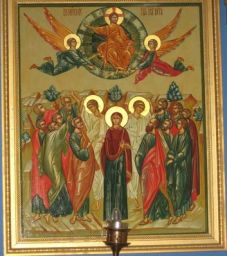
By means of the Incarnation all of creation is gathered together into union in Christ (see Ephesians 1: 10). Hence, every thing has, to some degree, benefit from the acts and ministry of God incarnate. By the Cross the Lamb of God takes away the sin of humanity (yet all of creation, in some manner, is a beneficiary of the Cross). By the Resurrection all of redeemed humanity is glorified and is given eternal life (and again all of creation is a beneficiary). By the Ascension into heaven, all that is redeemed, glorified, and given eternal life is carried into the realm of the Kingdom of Heaven (and all of creation, in some manner, is a beneficiary). Regarding the Ascension we have the words of one of the feast’s hymns:
When you had fulfilled the dispensation for our sake, and united earth to heaven you did ascend in glory, O Christ our God…not being parted from those who love you, but remaining with them…
Just mentioned were the Cross, the Resurrection, and the Ascension. This brings us to the part of the Divine Liturgy call the Anamnesis. Sts Paul and Luke use this word in their accounts of the Last Supper — or the Institution of the Eucharist. The word is generally translated as “memory” or “remembering”. But the word actually has as its meaning a “calling into presence.” It can have the meaning also of “invocation”. In the Divine Liturgy the Anamnesis reads as follows,
Remembering this saving commandment and all those things which have come to pass for us: the Cross, the Tomb, the Resurrection on the third day, the Ascension into Heaven, the Sitting at the Right Hand, and the Second and Glorious Coming.
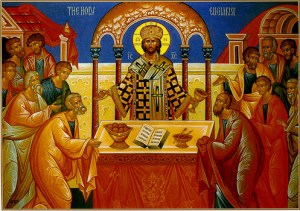 All the saving actions by Christ come into our presence. They are to abide with us and in us as we abide in them. Mysteriously they are around us always. Though unseen and unperceived they ever ring and sing throughout the universe. They condense upon our offering of bread and wine: “Thine own of thine own, we offer unto Thee on behalf fo all and for all.” They are offered to God the Father. Then in the Epiclesis (here we have another invocation) the Holy Spirit is called upon to be with us, and to bring Jesus Christ present to us in the Eucharist. With this invocation, Christ re-presents himself to us in the bread and wine which become his Body and Blood.
He (and they) are to abide, dwell, in us and with us as Christ is formed in us by faithfully abiding in him. He (and they) indwell us as we indwell in the Father, and the Son, and the Holy Spirit. All are to endure in relational union as they bear us to eternal life in the Kingdom of Heaven and the decent of the New Jerusalem (Rev 21: 2 – 3). We read from some of the concluding words of The Apocalypse (Revelation): “He who testifies to these things says, ‘Truly I am coming soon.’ Amen. Come, Lord Jesus” (Rev 22: 20).
The following is a corresponding sermon:
In Christ,
Fr Irenaeus
 Father Irenaeus Williams