All four Gospels contain the account of the Feeding of the 5,000.This miracle is to point the reader to the Eucharist, because it is a type of the Eucharist.A type, though almost exclusively found in the Old Testament (OT), is a person or event that holds within itself the reality which is fulfilled in the New Testament.The fulfillment is usuallyfound in the person of Jesus Christ.For example, Melchizedek, the priest and king of Jerusalem who offered bread and wine to Abraham, is a type for Jesus Christ — Jesus is the antitype, or fulfillment of the type found in the OT (Genesis 14: 18, see also Psalm 110 / 109; 4).
With the Feeding of the 5,000, as found in St Matthew 14: 14 -22, the five loaves of bread offered by the Apostle point to Christ who is the Bread of Life (St John 6: 35).Additionally, the two fish offered by the Apostles also point to Christ.The Greek word for fish is icthus which serves as the acronym:“Jesus Christ Son of God Savior.”
St John, in the sixth chapter of his gospel, alters the actions of Christ and the Apostles in this miracle to parallel the account of the Last Supper described in the synoptic Gospels, as, for example, in St Mark’s gospel (St Mark 14: 22 – 25).As an added note near the conclusion of this passage from St Matthew’s account of the miracle, the Apostles were to gather together the remaining fragments of bread into twelve baskets.St John tags this to the collection of the fragments into the twelve baskets:“…in order that they might not perish” (St John 6: 12).The preserved fragments of bread left over from the miracle were given to the care of the 12 Apostles, and then into the care of every canonical bishop of the Church.
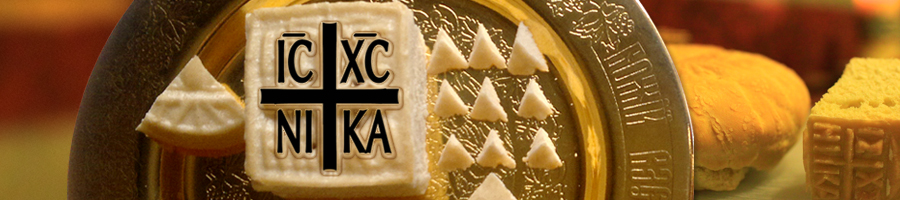
The Eucharist is the central point of the worship of the Church in the Divine Liturgy.Here, Christ is re-presented to his redeemed people.Communion is for our salvation, and it augments our relational union with our Lord:
The Living Bread
The Jews then disputed among themselves, saying, “How can this man give us his flesh to eat?”So Jesus said to them, “Truly, truly, I say to you, unless you eat the flesh of the Son of Man and drink his blood, you have no life in you; he who eats my flesh and drinks my blood has eternal life, and I will raise him up at the last day.For my flesh is food indeed, and my blood is drink indeed.He who eats my flesh and drinks my blood abides in me, and I in him (St John 6: 52 – 56).
At a priest’s ordination, the newly ordained priest stands at the bishops right hand at the Altar.Into his cupped hands he receives the consecrated bread which is now the Body of Christ.He is instructed to discern and care for the Body of Christ.This one Body of Christ is not only present in the Sacrament, but all who are assembled of the faithful present that day in the Divine Liturgy.This Body of Christ, which is the Church, is one Body with many members (see 1 Corinthians 12: 12 – 14).This one Body is gathered together in unity.This one Body is gathered together in love for one another.This one Body is gathered together in peace.The need for unity, love, and peace is made clear in the part of the Divine Liturgy called The Peace:
Priest:Peace be unto all.
Choir / people:And to your spirit.
Deacon (or Priest):Let us love one another, that with one mind we may confess:
Choir:Father, Son, and Holy Spirit:The Trinity, one in essence and undivided!
The unity and love found in the Holy Trinity is the source of the love and unity to be found in the assembled Body of Christ.If there is no unity, no love, and no peace found in those assembled — then we tell lies about the Trinity.
Regarding disunity, one can turn to 1 Corinthians 1: 10 – 18.Here, St Paul addresses the divisions found in Corinth which were based upon who was baptized by whom (1 Corinthians 1: 12).Given this problem St Paul asks the rhetorical question:“Is Christ divided?”
The bread and wine of the Eucharist also point to a unity that comes from an agricultural diversity.Regarding the bread, many grains of wheat were harvested from many stalks of wheat, ground to flour, and formed into one bread.Many grapes were harvested, crushed, and transformed into the wine found in one cup.Likewise, many people from varied backgrounds, ages, careers, ethnicities, etc., are gathered together to make the one Body of the Church.These varied backgrounds, etc., come together in Christ where “there is neither Jew nor Greek, there is neither slave nor free, there is neither male nor female; for you are all one in Christ” (Galatians 3: 28).Jesus declares to us the need of unity:“…Whoever is not with me is against me!Whoever does not gather with me scatters” (St Matthew 12: 30).
But, outside of the four walls of the Church, we have the world where there is division.Groups of people are intentionally pitted against each other to the point of hatred and to the point of conflicts and wars.
In any gathering together of the Body of Christ there will be found a diversity of opinions on all matters — even political opinions.Thus, there can be profound differences.Somewhere in his letter to the Philippians, St Paul exhorts them to “put up with one another.”There is to be a tolerance of opinions and personalities — even when it is difficult.(Some opinions, if in conflict with the Gospel and the apostolic teaching of the Church, need to be lovingly and firmly corrected.)
America finds itself in a presidential election year.With every election, I think the saying is true that we choose between the “lesser of two (or more) evils.”Regarding politics and the upcoming elections in November, 2024, we must remember two facts.Ultimately, we do not have a president, but a King!Ultimately, we are not citizens of asecular country, but of a Kingdom that is not of this world!
Again, the world system and its assorted powers — especially in these days — seek to divide us in order to conquer, to subjugate, and to control us.The powers that be, both seen and unseen, seem to hate unity, love, and peace.It is especially the unseen powers that hate the Church.They seek to bring about division, hatred, and strife among us of his one Body.We need to stand firm with and for one another, and to “put up with one another” even when (and especially when) opinions differ.Finally let’s keep this in mind:“Let us love one another, that with one mind we may confess:Father, Son, and Holy Spirit!The Trinity one in essence and undivided.”
 Father Irenaeus Williams
The Eucharist and the Necessity of Unity in Days of Division
Posted: August 20, 2024 | Author: Fr. Irenaeus | Filed under: The Eucharist and Living the Eucharist | Tags: A commentary on Mt 14: 14 - 22 the Feeding of the 5000, apostolic succession, Apostolic succession and the Eucharist, St John 6: 52 - 56, the Church is the Body of Christ, the Eucharist and unity of the faithful, the Feeding of the 5000 as a New Testament type of the Eucharist., The Feeding of the 5000 in St Matthew, typology | Leave a commentWith the Feeding of the 5,000, as found in St Matthew 14: 14 -22, the five loaves of bread offered by the Apostle point to Christ who is the Bread of Life (St John 6: 35). Additionally, the two fish offered by the Apostles also point to Christ. The Greek word for fish is icthus which serves as the acronym: “Jesus Christ Son of God Savior.”
St John, in the sixth chapter of his gospel, alters the actions of Christ and the Apostles in this miracle to parallel the account of the Last Supper described in the synoptic Gospels, as, for example, in St Mark’s gospel (St Mark 14: 22 – 25). As an added note near the conclusion of this passage from St Matthew’s account of the miracle, the Apostles were to gather together the remaining fragments of bread into twelve baskets. St John tags this to the collection of the fragments into the twelve baskets: “…in order that they might not perish” (St John 6: 12). The preserved fragments of bread left over from the miracle were given to the care of the 12 Apostles, and then into the care of every canonical bishop of the Church.
The Eucharist is the central point of the worship of the Church in the Divine Liturgy. Here, Christ is re-presented to his redeemed people. Communion is for our salvation, and it augments our relational union with our Lord:
At a priest’s ordination, the newly ordained priest stands at the bishops right hand at the Altar. Into his cupped hands he receives the consecrated bread which is now the Body of Christ. He is instructed to discern and care for the Body of Christ. This one Body of Christ is not only present in the Sacrament, but all who are assembled of the faithful present that day in the Divine Liturgy. This Body of Christ, which is the Church, is one Body with many members (see 1 Corinthians 12: 12 – 14). This one Body is gathered together in unity. This one Body is gathered together in love for one another. This one Body is gathered together in peace. The need for unity, love, and peace is made clear in the part of the Divine Liturgy called The Peace:
The unity and love found in the Holy Trinity is the source of the love and unity to be found in the assembled Body of Christ. If there is no unity, no love, and no peace found in those assembled — then we tell lies about the Trinity.
Regarding disunity, one can turn to 1 Corinthians 1: 10 – 18. Here, St Paul addresses the divisions found in Corinth which were based upon who was baptized by whom (1 Corinthians 1: 12). Given this problem St Paul asks the rhetorical question: “Is Christ divided?”
But, outside of the four walls of the Church, we have the world where there is division. Groups of people are intentionally pitted against each other to the point of hatred and to the point of conflicts and wars.
In any gathering together of the Body of Christ there will be found a diversity of opinions on all matters — even political opinions. Thus, there can be profound differences. Somewhere in his letter to the Philippians, St Paul exhorts them to “put up with one another.” There is to be a tolerance of opinions and personalities — even when it is difficult. (Some opinions, if in conflict with the Gospel and the apostolic teaching of the Church, need to be lovingly and firmly corrected.)
America finds itself in a presidential election year.With every election, I think the saying is true that we choose between the “lesser of two (or more) evils.” Regarding politics and the upcoming elections in November, 2024, we must remember two facts. Ultimately, we do not have a president, but a King! Ultimately, we are not citizens of a secular country, but of a Kingdom that is not of this world!
Again, the world system and its assorted powers — especially in these days — seek to divide us in order to conquer, to subjugate, and to control us. The powers that be, both seen and unseen, seem to hate unity, love, and peace. It is especially the unseen powers that hate the Church. They seek to bring about division, hatred, and strife among us of his one Body. We need to stand firm with and for one another, and to “put up with one another” even when (and especially when) opinions differ. Finally let’s keep this in mind: “Let us love one another, that with one mind we may confess: Father, Son, and Holy Spirit! The Trinity one in essence and undivided.”
The following is a corresponding sermon:
In Christ,
Fr Irenaeus