The Greatest Two Commandments and the Son of David
Posted: September 20, 2020 Filed under: Etcetera | Tags: ego eimi and its scriptural meaning, Exodus 3:14 and God's self-revelation to Moses, honor all who bear the image of God, Jesus self proclamations of his deity, Love your neighbor as yourself, The greatest commandment Mt 22: 34 - 40, Who is the Son of David Mt 22: 41 -46 Leave a comment This day’s second gospel reading records two questions. The first was posed to Jesus by the Pharisees; the second was posed by Jesus to the Pharisees. Let’s examine the second question first. Jesus’ question to the Pharisees is this: “What do you think about the Christ? Whose son is he?”
The Pharisees give their answer: he is the son of David.
Jesus replies, “Then, why does David in the spirit call him Lord, saying, ‘the Lord said to my Lord, sit at my right hand until I might place your enemies beneath your feet’. Therefore, if David calls him Lord, how is he his son?”
Our Lord’s reply asks for some clarification. David would NOT call any biological son or descendant LORD! As the King of Israel, in fact, he would not address any man as Lord. The Pharisees would not answer because they understood the significance of their answer: The Messiah is more than human, indeed he is God. Our Lord is not being too subtle here, he makes a bold declaration about himself.
There are other places in the gospels where Jesus declares himself to be God. We find this in example St. John’s gospel account of Jesus walking on the water of the Sea of Galilee. We find this in St. John 6: 19 – 20:
Therefore, after they had come twenty-five to thirty stadia, they observed Jesus walking upon the sea and coming near the boat, and they were afraid. But, Jesus says to them, “I am (ego eimi): do not fear.”
 The Greek phrase ego eimi is to call the reader to another event in Exodus: God’s self-revelation to Moses in the Burning Bush. The Septuagint text of the Old Testament when translated reads, “And God said to Moses, ‘I am the One who Is’ (ego eimi ho on), and he said, ‘Thus you shall say to the sons of Israel, The One who Is has sent me [Moses] to you’” (Ex 3: 14). Additionally, Jesus also declares his deity to the Jews in St. John 8: 58, “…Truly, truly I say to you, before Abraham existed, I am (ego eimi).
Though the Pharisees were unwilling to answer Jesus’ question, we can conclude that Jesus is God. He is the Son of God, the Son of Man, and Creator. He is our Savior. With this information there are implications to be considered.
Let’s now turn to the first question. Jesus is asked by one of the lawyers in testing:
“Teacher, what is the greatest commandment in the Law?” Jesus answered him,
You shall love the Lord you God with all your heart, and with all your soul, and with all your mind. And a second one is like it, “You shall love your neighbor as yourself.” On these two commandments depend all the law and the prophets (Mt 22: 39).
Personal love for God is not an intellectual exercise, or abstraction. It is manifested not only by acts of devotion and the praise of God through worship. Our love for God is perfected by our love for others — by what we do and say to one another. The converse of this is equally true: if we hate our neighbor, then we declare hatred of God.
Our present condition is more than challenging. We live in divided, polarizing times. Here is this most obvious example of our present day. We attack one another based upon opposing political opinions. We have witnessed vicious attacks, not just in the secular media, but also in settings that are somewhat more personal. In this latter context he outlet is usually, almost exclusively, observed in the supposed anonymity and false safety of the latrine of social media. Conservatives are ravaged by liberals, and visa versa. In a word, all of this is pathetic. On Facebook and other sites everyone must have the last word and show oneself to be more intelligent and have greater insight than the one who is taken on as adversary.
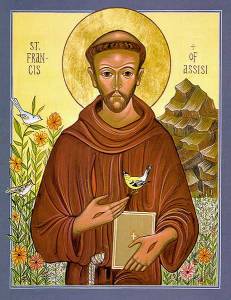
However, in our context of our common faith and life in Christ, we should embrace the words of St. Francis: “Lord, make me an instrument of your peace…grant that I should seek not so much to be consoled, as to console; to be understood as to understand; to be loved as to love…”
There is no truth or salvation found in politics. Every Christian is to understand that we are all citizens of a Kingdom. The primary sign of such citizenship is love — love for one another, love for all our neighbors, and love for the entirety of creation.
F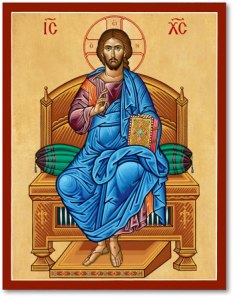 inally, there is this to be considered. In the Orthodox Church, icons are everywhere, and everywhere venerated. We pass honor to the one portrayed by the icon whether it is Christ or a saint. An Orthodox Christian would never dishonor or defile an icon. Let me add this: humans are also icons! We all, all, bear the image of God! Hence, we are to honor one another and our neighbors. We are to love our image bearing neighbors as ourselves. If you dishonor an icon, you dishonor, the Maker of the icon! So, since Christ our Lord is God, let’s love our brothers, sisters, and all our neighbors as ourselves. By this we demonstrate true love for our Triune God, Father, Son, and Holy Spirit!
The following is a sermon that corresponds with this posting:
In Christ,
Fr. Irenaeus
Guitar Review: Godin Multiac Steel (Natural)
Posted: July 2, 2020 Filed under: Music and Guitars | Tags: Godin Multiac Steel: a true acoustic-electric hybrid guitar, Godin's Multiac Steel is an acoustic guitarist's electric guitar, Guitar review of the Godin Multiac Steel (Natural), Review of Godin Multiac Steel (Natural) 2 Comments
Godin Multiac Steel
There are only two kinds of guitar players in the world…Well actually there are many types of guitar players in the world, but allow me to break it down to what applies to me. There are only two types of guitar players in the world, those who can move between acoustics and electrics with ease, and those who cannot. While my two sons occupy the first position, I, sadly, occupy the latter. I’m an acoustic player. While I appreciate the wonderful tones that come from an electric guitar when played through effect pedals and amplifiers, I am far, far, more comfortable with an acoustic guitar. Part of that comfort comes from the fact that acoustic guitars were the first guitars I owned, and upon which I learned the instrument. Another aspect is that with an acoustic guitar no set up (and take down) of amp, cables, or pedals is part of the music making experience. You pick one up and play. One more admission: I have a relatively “heavy hand” and I find an acoustic far more accepting and forgiving of my touch. So, my three electrics generally languish in their cases and my amps collect dust.
 In my explorations, I have tried various acoustic-electric hybrids such as the Taylor T5 and Godin’s Ultra-6 to name a few. Their necks and touch are far too electric in feel, and thus, never purchased. Then early in 2019 I learned about Godin’s new Multiac Steel hybrid. I tried one out at a local store comparing it with a Taylor T5. Hands down the Multiac Steel was the winner. Though heavier, it felt and played far more like an acoustic than an electric. Yet, there were many features that make it also an electric guitar.
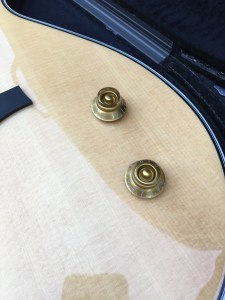
Volume (top) Tone (bottom)
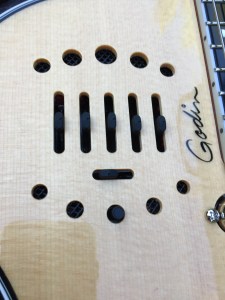
It is an attractive instrument having the appearance of a Les Paul. It is solidly built guitar. It makes a statement of quality. This Multiac has a solid spruce top, mahogany neck with a synthetic fretboard of Richlite (used on some Martin guitars as well), and a chambered wooden body. It has a 25.5 inch scale length and a nut width of 1.72 inches which together add to the acoustic feel I prefer. There are both acoustic LR Baggs pickups and a Seymour Duncan lipstick pickup (this single coil is located just below the fret board). There are two sets of controls and two outputs jacks that allow you to dial in a mix of both acoustic and electric qualities, acoustic only tone, or electric only tone. The control knobs on the body are the true captains of the tone. When you plug into the acoustic output you can blend the acoustic and single coil pickups: the volume knob adds in the single coil to taste while the tone knob dials in the single coils tone (neck to bridge tones). When the single coil output is accessed alone no acoustic blend can occur — it becomes purely electric in character. However — since it is a hybrid — you can plug into both outputs and play through both an acoustic and an electric amp.
 The guitar without any amplification when played has the sound of a hollow body electric when such a guitar is not amplified. But, of course it needs to be amplified to demonstrate its true qualities. The Godin was first played through a Marshall AS50D acoustic amp through the acoustic output jack. Through this amp the Multiac sounded like any amplified acoustic guitar until you blend in the lipstick single coil with the volume control knob. Here, the tone is quite unique.
Next, I went for the pure electric aspect of the Godin. I plugged into a Blackstar HT Club 40 amplifier. The tone produced was truly that of a electric guitar whether played clean or on overdrive. A variety of tones were selected from the amp, and this guitar handled all of it quite steadily.
I truly have the best of both worlds — I now have an electric guitar that has the comfortable feel of an acoustic guitar.
Keep on playing,
Fr. Irenaeus
Sunday of the Blind Man — Seeing with New Eyes
Posted: May 24, 2020 Filed under: Etcetera, The Eucharist and Living the Eucharist | Tags: Healing of the man born blind, John 9: 1 - 38 and the man born blind, looking upon nothing base, receiving spiritual eyes, the sacramental healing of the man born blind Leave a comment Today is the sixth Sunday of Pascha, and we read from St. John 9: 1- 38, and learn of Jesus’ healing of a man born blind. This restoration of sight is the sixth sign that is reported in St. John’s Gospel. This miraculous sign occurs “that the works of God might be manifested in him.”
His healing takes place in a sacramental manner: Jesus “anoints (chrismates)” him from clay made by the mixing of Jesus’ saliva (the saliva of God) with clay on the ground (we have the union of divine and material). Jesus then instructs him to have his eyes “baptized” by washing off the anointed clay from his eyes in the Pool of Siloam. “He went and washed and came back seeing” (9: 7). With his new vision he encounters Christ:
Jesus heard that they cast him out [of the Synagogue], and when he finds him he said, “Do you believe in the Son of Man?” And he answered and said, “And who is he, Lord, that I might believe in him?” And Jesus said to him, “You have seen him, and the one speaking with you is he.” And he said, “I believe, Lord!” and he worshipped him (9: 35 – 38).
Richard Adams and Animal Welfare
Posted: May 17, 2020 Filed under: Animal Welfare, Speculative Fiction | Tags: Animal welfare in Richard Adams Plague Dogs, Christian animal welfare, Christian animal welfare as advocated by Richard Adams, discussion of animal welfare in Plague Dogs, Richard Adams a Christian animal welfare activist, Richard Adams and animal welfare 2 Comments
Richard Adams
English author Richard Adams is best known for his worldwide best seller, Watership Down first published in 1972, and was subsequently made into an animated movie 1978, and animated television series in England, then recently butchered by Netflix-BBC two years ago. Adams was involved in a number of movements directed toward animal welfare, and was, for a time, director of England’s RSPCA. In Watership Down, Adams’ rabbit characters remark about humanity’s indifference, and even hostility to animals and the environment in general. Perhaps the most striking lament by Adams comes from Chapter 21, “For El-ahrairah to Cry.” Here, Holly (the Bard of the band of rabbits) states:
It [evil] comes from men…All other elil [enemies] do what they have to do and Frith [the rabbits’ god] moves them as he moves us. They live on the earth and they need food. Men will never rest till they’ve spoiled the earth and destroyed animals
Thomas Sunday (AKA Antipascha Sunday)
Posted: April 26, 2020 Filed under: Etcetera | Tags: "The saints prove the faith", blessed are those who do not see yet believe, faith's actions form faith, how to become Christlike, imitation of Christ forms Christ in the believer, Phil 2: 12 - 13, St. John 20: 25 - 29, St. Thomas comes to faith, Thomas Sunday (or Antipascha Sunday), to live God is to prove God, to prove God is to live God, We must do to become Leave a comment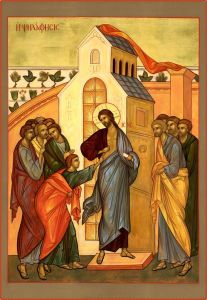 The Sunday after Pascha (Easter) is known as Antipascha Sunday, or also as Thomas Sunday. The day’s gospel reading gives the account of the coming of St. Thomas to faith in Jesus. Thomas doubted the word of the Apostles who saw Jesus when he commission them and he demanded proof.
“Unless I should see the impression of the nails, and put my finger into the impression of the nails, and place my hand into his side, I shall never believe. “And after eight days the disciples were again inside and Thomas was with them. And while the doors were locked, Jesus came and stood in their midst and said, “Peace to you.” Then he was saying to Thomas, “Bring you finger here and see my hands and bring your hand and place it into my side, and stop being faithless but faithful.” Thomas answered and said to him, “My Lord and my God.’”Jesus was saying to him, “Because you have seen me you believed? Blessed are those who do not see and believe!” (John 20: 25 – 29).
Thomas had to see and touch. It was this irrefutable encounter that brought Thomas to faith and his own declaration of his faith in Christ, “My Lord and my God!”
In just over 30 days Jesus would be taken back into the heavens, and his glorified physical body would very, very rarely be seen again by human eyes. Thus, all who have placed their faith in Christ over the centuries have done so without seeing physical proof of Christ’s resurrected body.
Yet we believe. But, in all honesty, sometimes we must acknowledge that faith can be fragile — especially in this age of skepticism. In this generation faith is mocked, and it is called delusional. When terrible things happen in the world the faithless ridicule and ask, “Where is this God?” Yet when great good happens, God is never acknowledged as an Actor in the good.
Miracles still happen, and lives are changed by God’s grace (his energies) at work in our lives, yet…the faithful doubt at times. And the faithful can even come to a point of crisis where faith can be abandoned and they join the ranks of the secularists which abound these days. On occasion — via confession or a conversation — such doubts and questions are brought to my attention by someone (and all the clergy of this parish). What is my answer? I give an axiom: “To prove God is to live God; to live God is to prove God.” In other words, actively engage your faith in your surroundings — among those around you, in the quiet of your home, and among all of God’s creatures and creation.
I can give ordinary examples from my life regarding this psychology. if I feel tired and drained after a day of work, I find that if I exercise that fatigue is overcome and I feel strengthened and renewed. If I am feeling depressed, the depression is overcome by an act of self-giving for the good of another, however small — my good mood is then restored.
 Now I offer faith’s parallel. With what ever amount of faith we possess, ACT in a manner contrary to doubt and the corruption that still abides in us. ACT in a manner contrary to the doubt of fallen human nature. CHOOSE to ACT in a manner that imitates Christ and his saints. I put forward another axiom: “We must do to become.” Think of the musician or athlete — that which is practiced is formed within the musician and athlete. The parallel of faith is this: if we practice Christ, Christ is formed and made alive in us. He is “PROVEN”! And we move from faithlessness’ death to faith’s life.
We also have this saying: “The saints prove the faith.” For my own benefit the ultimate “saint-proof” is manifested by those saints who are INCORRUPT. This is the miracle where nature’s decay following death is overcome by the divinizing energies of God which worked in them by their acts of faith. We read this from St. Paul: “Work out your own faith with fear and trembling, for God is the one energon (working) in you, and to will and to energein (to work) in behalf of his good pleasure” (Phil 2: 12, 13). It is in this verse that we learn of the “energies” of God (his grace) that God works into us for our salvation. Hence, it is by faith’s chosen actions that the reality of God is encountered and touched.
Thus, without seeing do, and by doing become, and by becoming prove Christ to yourself and to the faithless world that surrounds us.
Christ is risen!
Fr. Irenaeus
The following is a corresponding sermon:
Christ Is Risen!
Posted: April 19, 2020 Filed under: Etcetera | Tags: Christ is risen!, Pascha in isolation 2 Comments This is a Pascha (Easter) unlike any other. No Orthodox Christian living in the western world has a memory of a Holy Week, Holy Saturday, or Pascha such as we have experienced this year. We are in isolation, and unable to gather together to worship our Lord. The services of Holy Week and Pascha were faithfully and truly celebrated by the mandated few. Yet, this year there was no communal experience of the victorious declaration of his resurrection with the illumination of the darkened nave as the lighting of candles dispersed the night’s gloom. There was no communal joyous Paschal Matins. There was no communal hearing of the Paschal Gospel (St. John 1: 1 – 18), no communal exchange of the peace, no common movement toward Communion of his Body and Blood, no singing of the Paschal Troparion together as the assembled faithful — his Body.
I must confess to occasional pouting and sulking like a preteen this past week through yesterday. But, our risen Lord is constant even in inconstant times (even when I pout). He is truly “risen from the dead trampling down death by death…” He is constant and faithful even in this isolation caused by an unseen viral enemy. He is working in our lives in spite of absences and disruptions which are put upon us for the common good of all. He is working his Light and Life into us even in these strange days.
So, let our faith and joy “go viral!” Keep this hymn in our hearts and hold it as our prayer during this Pascha day and its season:
Thy resurrection, O Christ our Savior, the angles in heaven sing! Enable us on earth to glorify thee in purity of heart.
Christ is risen!
Fr. Irenaues
Brief Commentaries on St. John Chapter Six, Part Four: The Poetic Parallelism of St. John 6: 50 – 51
Posted: March 29, 2020 Filed under: The Eucharist and Living the Eucharist | Tags: a New Testament parallelism exists in John 6:50 - 51, Jesus declares his Body to be given via the Eucharist, Jesus' teaching of the Eucharist in John 6: 50 - 58, Synthetic parallelism in John 6: 50 - 51, The Bread of John 6:50 -51, The continually eaten Bread of John 6: 50 - 51, the eucharistic teaching of John 6:50 - 51, The real presence of Jesus' Body and Blood in the Eucharist Leave a comment Ancient authors wrote differently than modern authors of poetry, prose and narrative. The ancient authors wrote using fixed forms that aided in imparting meaning and emphasis. These forms were also employed to aid in memorization of their works. These fixed forms abound in the Christian Scriptures — both Old and New Testaments. One such literary form is parallelism. Parallelism is found throughout the poetry of the Old Testament, and then especially in the Psalms. These poetic structures can also be found in the New Testament, and one such example can be found in St. John 6: 50 – 51. Before examining this text, let’s first consider the three basic types of parallelism found in the Scriptures: synonymous, antithetical, and synthetic/stair-step (although scholars can define other types in addition to these three). I quote from Psalms — Reading and Studying the Book of Praises by W. H. Bellinger, Jr. (Hendrickson Publishers, 1990), 13.
Synonymous parallelism. The second line enhances the thought of the first by way of closely related statement:
What is man that thou art mindful of him,
and the son of man that thou dost care for him? (Ps 8:4)…
Antithetical parallelism. The second line may complete a thought by presenting a contrast to the first line:
For the wicked shall be cut off;
but those who wait for the Lord shall possess the land. (Ps 37:9)…
[Synthetic] Stair-step parallelism. The second line may continue the thought of the first and take it a step further:
For the Lord is a great God,
and a great King above all gods. (Ps 95:3)
The Kingdom of God Is In Your Midst! A Brief Commentary on St. Luke 17: 21
Posted: February 22, 2020 Filed under: Etcetera, The Eucharist and Living the Eucharist | Tags: Christ is in our midst!, commentary on Luke 17:21, Eucharist is the central event of worship, exegesis of Luke 17:21 based on semantic domains, Exegetical commentary on St. Luke 17:21, Luke 17:21 the Kingdom of God is in your midst, The Church is the manifestation of the Kingdom of God in space and time, the Divine Liturgy manifests the Kingdom of God in space and time, where Christ is there is the Kingdom of God 4 Comments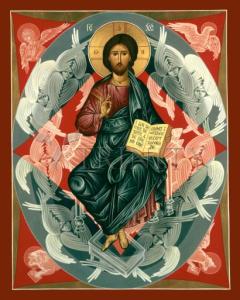
Christ Enthroned
Well over a decade ago I encountered a man who was rejecting the Church (though he was not a parishioner of Holy Resurrection Orthodox Church which I serve as an assisting priest). He quoted a verse from St. Luke’s gospel to justify his departure from the Church. The verse that was shoved in my face comes from St. Luke 17:21, “…The Kingdom of God is within you.” Knowing Greek I tried to offer a correction to his misapplied verse. It did not work. Justifying himself he left the life of the Church and will not return. His conviction was that since the Kingdom of God was within him he needed no one to instruct him, and had no need to follow the ways of Christ within the context of the sacramental life and teachings of the Church. He wanted spiritual autonomy simply because he wanted to continue in an adulterous affair.
This verse from St. Luke’s gospel has been and is misused by many to justify many things — none of them come to any good. With this posting I offer a much better translation and interpretation of St. Luke 17:21. Let’s begin with the context. Jesus has gathered around him both Pharisees and his disciples: he is in the midst of this gathering. Given this setting we read this,
Being asked by the Pharisees when the Kingdom of God was coming, He answered them, “The Kingdom of God is not coming with signs to be observed; nor will they say, ‘Look, here it is!’ or ‘There!’ Behold the Kingdom of God is in your midst (he basileia tou theou entos humon estin).
Gear Review: G7 Performance 3 (ART) Guitar Capo
Posted: February 8, 2020 Filed under: Music and Guitars | Tags: Comparison of G7 Performance 3ART capo to 3 other G7 capos, G7 Nashville capo, G7 Performance 3 ART capo, G7 Performance capo, Is the G7 Performance 3 ART capo a superior capo?, Review of G7 Performance 3 ART capo, review of three G7 guitar capos Leave a commentQuests. Some are factual, some mythical. I have one of my own: the quest for the perfect capo. Some say it doesn’t exist. I have a collection of a variety of capos. Some work well on some of my guitars, but not on others. With any capo there can be the problem of skewing the guitar’s strings upon application of the capo. Then there’s problem of the guitar staying in tune after application. And, of course, there is the issue of a buzzing of strings when the capo is applied. Thus, we guitarists have the never ending quest for the perfect capo.
There have been developments is capo design. One involves application of specific pads which correspond to the guitar’s fretboard radius. This likely solves the problem, but is impractical (I would never take the time to change the pads). Recently I read of the marketing of a new G7 capo in Acoustic Guitar magazine. The new capo is called the G7th Performance 3 Guitar Capo (clamping mechanism). It involves G7’s technology called “Adaptive Radius Technology” (ART). Per G7:
Revolutionary new active string pad infinitely adapts to match any guitar perfectly. The ART mechanism delivers unrivaled tuning stability by applying even pressure across the strings. Suitable for ALL ACOUSTIC and ELECTRIC 6 string guitars.
The Rich Ruler (A Man Who Could Not Give)
Posted: January 23, 2020 Filed under: The Eucharist and Living the Eucharist Leave a commentWe read of a wealthy ruler’s encounter with Christ in St. Luke’s gospel. He begins a conversation with him by his question, “What shall I do that I might inherit eternal like?” By their dialogue we learn that he kept all the rules. However, Jesus moves deeper: “Yet, there is one thing you still lack. Sell everything you have, and give to the poor, then you will have treasure in heaven, then come, follow me” (18:22)
This wealthy man had to give. But, he had to give from the core of his being. His whole identity was in his wealth. He was defined by his wealth. His wealth sheltered him, clothed him well, fed him well. By it he was able to move through life with status, privilege, ease, and comfort. But the cost was too dear.
We are asked to give — usually not to the same extent — but we are to give. We can write a check, contribute on-line, or drop some cash in a box. Quite easy, and we don’t break a sweat. But, as was the wealthy ruler, we are sometimes asked to give from a deeper place, a costlier place. What might this mean? Let’s look to Jesus for the answer. He gave himself, he emptied himself — all done that he could receive us to himself in relational union with him, the Father, and the Holy Spirit.
What prevents us from giving in this manner? Self preservation. I refer to Jesus’ words found earlier in St. Luke’s gospel: “For whoever would save his life will lose it; and whoever loses his life for my sake, he will save it” (St. Luke 9: 24). It seems then, that ultimately we must give from that place we keep locked up tight and secure for our self preservation. It is from this vault that we need to reach into when called upon from time to time.
Again remember our Lord: he was self-giving, and other-receiving. This transaction of self is eucharistic. In the Eucharist, Christ gives himself anew to us via the bread which becomes his Body and the wine which becomes his Blood. In the Eucharist we have Christ welcoming us to himself as we move to his Banquet Table. We, by consuming his Body and Blood, have Christ entering into our being, and we are joined more fully to Christ. Thus, when we give of ourselves to and for others, and we receive others to ourselves, we extend to Eucharist to all and all things. Ultimately by this type of giving we receive Christ more fully into our lives.
I am reminded of the words of St. Francis: “It is in giving that we receive…” The wealthy man, had he given, would have received far more in return than that which he had to give up. He would have received Christ in return. Let us give eucharistically that we may gain Christ more fully.
In Christ,
Fr. Irenaeus
The Thankful Leper
Posted: January 21, 2020 Filed under: The Eucharist and Living the Eucharist Leave a comment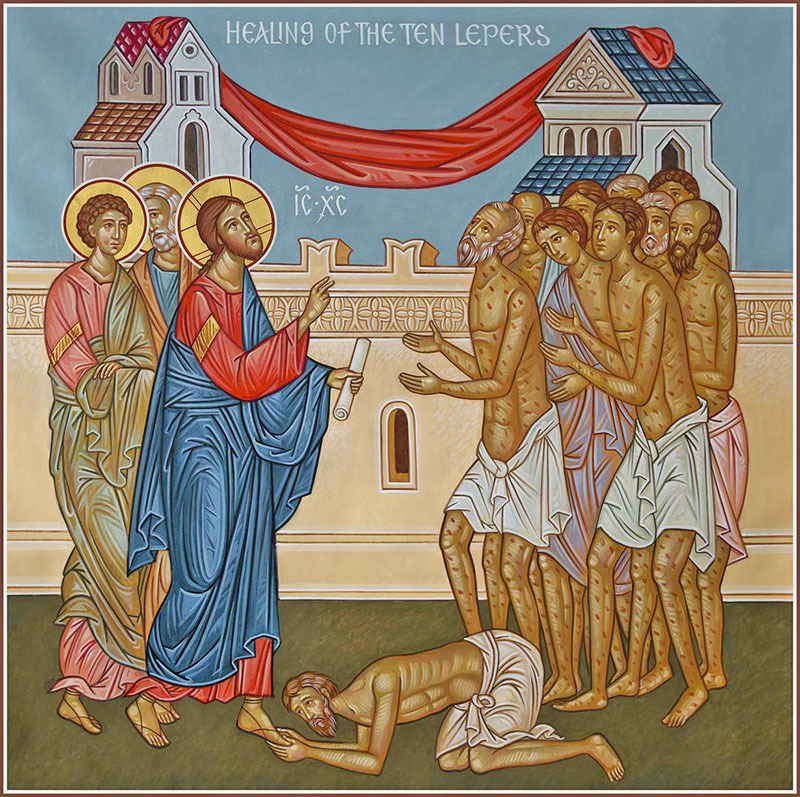 St. Luke’s gospel gives us the account of Jesus’ healing of ten lepers (17: 11 – 19). They stood at a distance as he passed by — they were unclean, excised from society by their disease from all relationships and cultural participation. They were exiles in their own land. Yet, by faith, they boldly call out for God’s mercy to come upon them. And Jesus responds to their plea: “Go and show yourselves to the priests.” St. Luke comments, “And as they went they were cleansed.” Their bodies were restored, and their stigma was washed away. They were restored to family, community, and communal worship.
All obeyed. They did precisely as they were told. Let me be clear, obedience to God’s command and will is always good! But, we should be honest with ourselves: sometimes it is minimal and superficial. It can be as a child’s response, “If I have to!”
As the text moves on we read,
Then one of them, when he saw that he was healed, turned back, praising God with a loud voice; and he fell on his face at Jesus’ feet, giving him thanks. Now, he was a Samaritan (17: 15 – 16).
The tenth, now healed, leper awakens to his salvation, and he responds to his healing with praise, worship, and thanks. This foreign leper responded to Jesus eucharisticallly. Jesus observes the contrast and remarks,
…Were not ten cleansed? Where are the nine? Was no one found to return and give praise to God except this foreigner? And he said to him, Rise and go your way; your faith has made you well (17:17 – 19).
Let’s consider obedience and duty in the context, first, of the worship of God in the Divine Liturgy of the Orthodox Church. We have responded to the call to worship when we assemble within the walls of the church. This is good — neither did we sleep in on a Sunday morning, nor stay home to relax, or watch the game. This is good. But as stated above, sometimes our obedient assembly can be minimal and superficial. We need to be mindful that by our presence in the Divine Liturgy we’ve assembled to worship and praise the Triune God, and to give thanks to our God. We read this dialogue between priest and the faithful from the beginning of the Anaphora of the Divine Liturgy:
Priest: Let us lift up our hearts.
People: We lift them up to the Lord.
Priest: Let us give thanks to the Lord.
People: It is proper and right.
The priest then continues,
It is proper and right to hymn You, to bless You, to give thanks to You, and to worship You in every place of Your dominion; for You are God ineffable, beyond comprehension, invisible, beyond understanding, existing forever and always the same; You and Your only begotten Son and Your Holy Spirit. You brought us into being out of nothing, and when we fell You raised us up again. You did not cease doing everything until You led us Your kingdom which is to come. For all these things we thank You and Your only begotten Son and Your Holy Spirit; for all things that we know and do not know, for blessings seen and unseen that you have bestowed upon us. We also thank You for this liturgy which You are pleased to accept from our hands…
From this we learn that we are to give thanks to God not only during our assembly for worship, but also “…in every place of your dominion.” Now, in this second context, we are to give thanks to God everywhere, at all times, and in all circumstances in which we find ourselves. St. Paul instructs us from his first letter to the faithful in first century Thessalonica: “Rejoice always, pray constantly, and give thanks in all things; for this is the will of God for you in Christ Jesus” (1Thes 5: 16 – 18). By this attitude and these actions we extend our worship of God from the context of the Divine Liturgy to the context of our every day lives. We are to rejoice, pray, and give thanks to God in every situation: the pleasant and the uncomfortable; the exciting and the mundane; the happy and the sad; in ease and in frustration.
By living doing so we live eucharistically. By doing so we are transformed more fully into the image of God — Christ is form fully formed in us. By doing so we manifest Christ into the circumstance and transform it. By doing so we live as the thankful tenth leper.
In Christ,
Fr. Irenaeus
A Stunned Finch and the Calling of St. Peter
Posted: September 23, 2019 Filed under: Etcetera | Tags: "from now on you will be a fisher of men, bishop and priest serve as Alter Christus, Christ as Great Physician, healing of a stunned gold finch, The calling of St. Peter, the Church is founded by Christ Leave a comment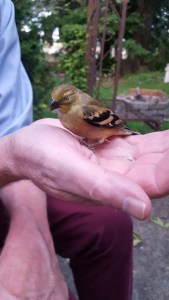 In the fifth chapter of St. Luke’s gospel, we learn about the calling of St. Peter (along with Sts. James and John) in Luke 5: 1 – 11. Upon witnessing the miraculous catch of fish, Peter falls at Jesus knees and states, “Depart from me, O Lord, for I am a sinful man!” Jesus replies, “Do not be afraid; from now on you’ll be catching men.” Then Peter, James, and John leave everything and begin to follow Christ.
Thus, St. Peter and all the Apostles were to gather together a scattered, lost humanity into the “boat” (nave) which is the Church. This is a picture of Recapitulation: all and all things are gathered into union with Christ (Eph 1: 9 – 10). Christ founded a Church built upon St. Peter and his confession: “You are the Christ, the Son of the living God” (Mt: 16: 15 – 20). It is in the Church that we hear the Scriptures, move through the liturgies of the Church, worship God, and participate in the sacramental life of the Church. Here we are cleansed and nourished by the Eucharist. By all this, by faith, Christ is formed in us.
Now comes a change of imagery. I will shift from the catching of schools of fish to the gathering together of charms of finches, murders of crows, and the gathering together of chickadees, nuthatches, pine siskins, and humming birds to name a few. Several years ago I began feeding birds. First I began feeding crows peanuts, then humming birds, and finally finches, and other birds that will gather at feeders. There are a number of bird feeders and bird baths around the back patio of our house. The birds are nourished, and many nesting groups are prospering in this environment (this is especially important today with the loss of habitat for many avian species). We now hear a fantastic array of voices, and observe their amusing behaviors.
 But, unfortunately, there have been a small number of casualties when a bird slams into a window. A few days ago in mid-September, a gold finch was rescued. The finch slammed into the window, and I witnessed it dropping to the concrete. I immediately went outside to assess the situation. The finch was still alive, but clearly stunned by the impact. I picked up this member of my “flock” and cupped it in my hands to keep it warm. Prayers were said, “Lord have mercy, Christ have mercy, Lord have mercy on your creature.” Its sides were gently stroked to stimulate it. Prayer and warming continued for some time. Then, I took the finch into the house. The alien surroundings aroused the bird to full consciousness. I took it back outside, and within a few moments the finch flew away from my hands to the branches of a walnut tree to rejoin its charm.
This finch happened to be rescued by a priest, and this experience soon began to be seen as an image of pastoral care. For, we too can become injured and stunned by our collisions with the events of life in this world. Upon such injuries we have two options: remain isolated, or enter into the care of the Church for spiritual revival. In the Church the injured come into the care of bishops and priests who stand as Christ for the flock — a bishop or a priest is alter Christus (“another Christ”). By such faithful and loving ministry, it is ultimately Christ who administers the needed healing within the Church which he founded.
Hence, when so injured and stunned do not isolate yourself. Come to the Church and be ministered to by its life and Sacraments. Thus, you will receive the healing care of Christ the Great Physician. You will be restored and return to flight!
The following link offers a corresponding homily:
In Christ,
Fr. Irenaeus
The Nativity of the Theotokos (the Mother of God)
Posted: September 9, 2019 Filed under: Etcetera | Tags: Elizabeth honor her in the Holy Spirit, Mary as type of the Burning Bush, Mary's cousin, The birth of the Mother of God - Mary, The Mother of Jesus has a birthday!, The Nativity of the Theotokos Leave a comment The birth of Mary is celebrated every year on September 8. A hymn from the Liturgy of the day reads,
By your nativity, O Most Pure Virgin, Joachim and Anna [Mary’s parents] are freed from barrenness; Adam and Eve from the corruption of death. And we, your people, freed from the guilt of sin, celebrate and sing to you: the barren woman gives birth to the Theotokos, the nourisher of our Life!
Given the words of that hymn, the world, and many of our Christian brethren must think us fools and mad! But, we Orthodox Christians commemorate the birth of Mary, the Mother of our God, without apology and with confidence. We honor her, we do not worship her. We acknowledge her as the New Eve: her obedience in the presence of the Archangel Gabriel releases the knot of Eve’s disobedience. By Mary’s obedience, God the Son (who is the New Adam) can rescue, release, and save all of humanity. By Mary’s “YES”, God becomes fully human — a creature — and by his Incarnation gathers all of humanity and all of creation in himself in a relational union (Eph 1: 10)!
Confess or Deny
Posted: July 27, 2019 Filed under: Etcetera, The Eucharist and Living the Eucharist | Tags: All Saints Day in the Orthodox Church, Confessing Christ, confessing Christ before men, Definition of a Confessor, Denying Christ, Homologein Greek meaning, Mt 10: 32 - 33 Leave a commentWith this posting, I am either a few weeks late or several months early. Its text comes from a portion of St. Matthew’s gospel appointed for All Saints Day (the first Sunday after Pentecost in the Orthodox Church), and I focused on Mt 10: 32 – 33 which reads,
Therefore, whoever shall confess me before men, I also shall confess him before my Father who is in the heavens. But, whoever might deny me before men, I also shall deny him before my Father who is in the heavens.

Homologein is the Greek word for “to confess.” It can also be translated as admit, declare, promise, and even give thanks / praise. Beyond this lexical fact, however, there is a class of saints known as Confessors. These are men and women who did not deny Christ under the conditions of persecution, trial, torture, or any form of adversity. St. Maximus the Confessor is one who comes to mind. But, whether confessor, martyr, or one who died peacefully, all the saints confessed Christ by their holy lives.
In the Great Litany we find this prayer: “For our deliverance from all affliction, wrath, danger and necessity, let us pray to the Lord.” We don’t want a climate of persecution, trouble, or adversity because we may fail. We may deny Christ in these situations. Though we pray that overt trials, persecutions, etc., not come our way, yet small trials, testings, and troubles come our way daily. These trials may come in the setting of family, work, in traffic, in school, or in the marketplace. When such small trials come our way, how do we respond? Do we confess Christ with joy, peace, prayer, blessing, and thanksgiving? If so, this is the response of faith and of the Holy Spirit working in our lives. Or, do we respond with anger, cursing, and frustration? If so, this is the result of the corruption that still resides in us. With such responses we deny Christ.
We always have the power to confess Christ. Christ is in us, and we are in Christ — this is a relational union of God’s presence in us — and this is our salvation. Thus, his Life and Light are to prevail in our lives. Hence, we are to confess Christ with kindness, patience, blessing, peace, and thanksgiving before all who witness these confessions of Christ before mankind and all creation. We are to confess that we too may be saints!
St. Paul writes these words in his first letter to the Thessalonian church:
See that no one repays evil for evil, but always pursue the good both for one another and for all. Rejoice always. Pray constantly. Give thanks in all things. For this is the will of God for you in Christ Jesus (1 Thes 5: 15 – 18).
To confess Christ is always our goal, and by this Christ is more completely formed within us. Many litanies conclude with these words: “Help us, save us, have mercy on us, and keep us O God, by your grace.” Let this be our prayer in all settings, and let us confess Christ daily.
Below is the corresponding homily.
In Christ,
Fr. Irenaeus
The Light of the World
Posted: July 14, 2019 Filed under: The Eucharist and Living the Eucharist | Tags: Chalcedon - the Fourth Ecumenical Council, Definition of Chalcedon, Hypostatic Union, Jesus is fully God and fully human, John 6:56, Leo the Great, Mt 5: 14 - 15, the Eucharist strengthens our union in Christ, the light of the world, you are the light of the world Leave a commentAnnually in the Orthodox Church there are commemorations of the Seven Ecumenical Councils. There were seven of them. This Sunday, July 14, 2019, I served as a substitute priest at St. Sophia Greek Orthodox Church in Bellingham, Washington for Fr. Michael Tervo. The Greek Orthodox Church focused on the Fourth Council — the Council of Chalcedon — and its Definition of Chalcedon, as penned by Pope Leo the Great. The key statement of this Council involved the hypostatic union — that Jesus Christ is fully God and fully human. These two natures (divine and human) exist in the one Person of Jesus Christ in an indissoluble union. These two natures, while in union, are, at the same time, never in confusion. This definition is in response to the false teaching of Nestorius. This heretical bishop essentially made Jesus into two separate persons: one divine and one human. There could be no union of the two natures in his mind. Nestorius tried to give the Church a Christ with a multiple personality disorder. His view was rightly rejected and judged as heresy. Jesus is NOT an “either-or,” he is a “both-this-and-that.”
The gospel reading put forward by the Greek Archdiocese comes from Mt 5:14 – 19. Verse 14 grabbed my attention which quotes Jesus: “You are the light of the world…” Elsewhere, in St. John’s gospel, Jesus declares, “I am the light of the world” (Jn 8: 12). Both statements from the Scriptures are true. It is not an either-or proposition, it is “both-this-and-that.”
The Synaxis of the Twelve Apostles
Posted: June 30, 2019 Filed under: Etcetera, The Eucharist and Living the Eucharist | Tags: Apostolic succession and the Eucharist, Commemoration of the Twelve Apostles, commissioning of the twelve apostles, Jesus authority and ministry is extended to the Apostles, Jesus gives authority to the Apostles to forgive sins, John 20: 21 - 22 and the Apostles authority to forgive sins, Mt 10: 1- 8 and the commissioning of the 12 Apostles, The Apostles' ministry continues in the 21st century Church, the Feeding of the 5000 as a New Testament type of the Eucharist., The Synaxis of the Twelve Apostles Leave a comment On June 29 of every year the Church celebrates the Feast of Sts. Peter and Paul. The following day is the Synaxis (gathering together) of the twelve Apostles, when all twelve are commemorated. The day’s gospel reading is taken from St. Matthew 10: 1 – 8, and we are informed that Jesus gave them authority over unclean spirits (to cast them out), and to heal every disease and illness. We learn of their names: “Simon (who is called Peter), his brother Andrew; James the son of Zebedee, and his brother John; Philip and Bartholomew; Thomas, and Matthew the tax collector; James, son of Alphaeus and Thaddeus; Simon the Cananaean, and Judas Ischariot, who betrayed him” (10: 2 – 4). Jesus then sent and commissioned them to go to the perishing sheep of the House of Israel. They were to proclaim that “the Kingdom of Heaven has drawn near.” They were to heal diseases, raise the dead, cleanse lepers, cast out demons. As they received freely, so they were to give (10: 6 – 8).
Guitar Review: Taylor Grand Pacific 317e
Posted: May 9, 2019 Filed under: Music and Guitars | Tags: New Taylor tone of Grand Pacific Dreadnought, review of Taylor Grand Pacify 317e, Taylor Grand Pacific 317e guitar review, Taylor's Grand Pacific dreadnought - fantastic guitar 6 Comments Taylor Guitars is one of America’s premier guitar makers. Their guitars stand shoulder to shoulder with Martin, Gibson, Larrivee, and other great North American guitar manufacturers. They are known for their quality of build and playability. I have owned three Taylor guitars, but have sold all three. I bought them all for their playability. I sold them all due to tone. To me they all were “strident”, and this tone quality always put me off from them. They were set aside, all to be sold to a guitarist who loved that well known “modern Taylor tone.”
I follow the guitar industry. I strive to keep abreast of what is new, and who is doing what. What are the innovations? What are the new models? Of course, Taylor came out with its “V-Class” bracing in 2018. Bracing — you might as well try to discuss particle physics with me (and I’d probably appreciate particle physics more than bracing). “Big deal!” I thought of this innovation. Then, this year (2019) came the new Taylor news — a new type of dreadnought guitar with V-class bracing that offered a completely new Taylor tone. Okay, I might be interested, but I doubted it.
 In mid-April I made another trip to Tacoma’s Ted Brown Music. In the store’s properly humidified acoustic guitar room there is a wall of Taylor guitars. In a corner hung a Taylor Grand Pacific 317e. Okay, I’ll bite. I sought to compare it to a Yamaha A5R dreadnought, and my own Faith Legacy Mars dreadnought which I happened to have with me. I compared the Grand Pacific to a Grand Auditorium 414ce, then a Grand Orchestra model. Was there a difference in tone with the Grand Pacific? An emphatic “Yes,” was stated. I have become a fan of Yamaha’s A5 series guitars. They are very playable with great clear tone and fantastic electronics. The Grand Pacific was equally playable, and its electronics, when played through a Fishman Loud Box Mini Charge (by the way, a fantastic acoustic amp!), was equal to the Yamaha system. The 317e was then compared to my beloved Faith Legacy Mars drop shoulder dreadnought. The 317e’s blended tone with strummed and arpeggiated chords held up to the Faith dreadnought, and the quality of tone was equally pleasing. Contrasting the Faith Legacy Mars to the Grand Pacific, the Faith has a more muscular tone, while the Grand Pacific had an airier, but very pleasing tone.
My go-to songs of the Beatles, Kinks, and others were a pleasure to play. The playability is typically Taylor, and of equal ease to the Yamaha A5 and the Faith guitars’ own playability.
 Like the Faith and Yamaha A5 dreads, the appearance of the 317e is simple, tasteful, and classy. The tested Grand Pacific model has a gorgeous bear claw spruce top which puts forth a lovely gloss finish. The sapele back and sides are of a satin finish, as is the mahogany neck. It has an ebony fretboard and bridge. The nut width is 1.75 inches. The lower bout is 16 inches in width. The rounded dreadnought body is not new, but follows Breedlove’s (and now Bedell’s) rounded dreadnought design — this shape is nothing innovative as Taylor may claim. By the way, the case is eye candy. I feel I should buy a case to protect this case!
I was pleased and impressed with this 317e. It is truly a new Taylor sound with all the Taylor quality one is to expect. The Grand Pacific was purchased a week later. This Taylor dreadnought is a “keeper.” Finally, there is a Taylor guitar that rings true to me, and will do so for a new group — yet a more traditionally minded group — of guitarists. Well done Andy Powers and Taylor!
Keep on playing!
Fr. Irenaeus
Sunday of the Cross
Posted: April 1, 2019 Filed under: The Eucharist and Living the Eucharist Leave a comment The third Sunday of Lent is known as the Sunday of the Cross. Its gospel reading comes from Mark 8:34 – 9:1. Mark 8:34 reads, “And after receiving the crowd together with his disciples he said to them, ‘If someone wills to follow after me, let him deny himself, take up his cross and follow me.’”
We do not do this alone, our Lord always leads us in the way. A few verses earlier he states, “…it is necessary for the Son of Man to suffer much, and be rejected by the elders, chief priests and scribes and to be killed and after three days to rise again (8:31).” Following Jesus’ words, Peter rebukes him, then Jesus rebukes Peter: “Get behind me Satan…” Peter had the way of world in mind: SELF PRESERVATION.
The Sparrow and the Swallow in the Temple
Posted: March 20, 2019 Filed under: Etcetera | Tags: Afterlife for animals?, all animal life is in Christ, All life shares in Christ's life, all things are in union with Christ, can animals worship God?, Christ as Microcosm, Christ as Microcosm holds all life within himself, Christian animal welfare, the "worship" of the sparrow and the swallow in the Temple, The sparrow and the swallow in the Temple (Psalm 84: 1 - 4) Leave a commentPsalm 84:1 – 3 (LXX 83: 1 – 4) reads,
How lovely is your dwelling place, O Lord of hosts! My soul longs, yes, faints for the courts of the Lord; my heart and flesh sing for joy to the living God. Even the sparrow finds a home, and the swallow a nest for herself, where she may lay her young at your altars.”
 Regarding the sparrow and the swallow, the Psalmist’s observation may be taken as a side observation, taken at a glance and to be dismissed by those with the more serious mind of faith. This would prove to be an error. This “off hand” verse comes from the eye of informed, mature, and loving faith.


The Feeding of the 5,000 – A Typology and Unity
Posted: August 3, 2020 | Author: Fr. Irenaeus | Filed under: The Eucharist and Living the Eucharist | Tags: 000, 000 and the Last Supper, 000 as a New Testament type of the Eucharist, A commentary on Mt 14: 14 - 22 the Feeding of the 5, Differences and Unity in the Body of Christ his Church, Parallels between the Feeding of the 5, Support one another in spite of differences, The Church as the Body of Christ, the Feeding of the 5, unity in Christ, Unity of the faithful demanded by both Baptism and the Eucharist | Leave a commentThe hour grows late, and the disciples ask Jesus to dismiss the crowd that they might buy food in the surrounding villages. But, Jesus has something different in mind. He offers a surprising and perplexing suggestion to them: “You give them something to eat!” Only five loaves of bread and two fish were in in the disciples’ possession. This limited supply did not hinder our Lord’s next action: in that grassy area he commanded the crown to sit down. Jesus not only healed their illness, but intended to feed them to their satisfaction. He served them not only the simple staples of bread and fish, but gave of himself (in typological fashion) to those reclining to be filled and sustained. The five loaves of bread point to him because Jesus the Bread of Life. Additionally, the two fish also refer to him: the Greek word ichthus (fish) was understood by the early Church to serve as this acronym, Jesus Christ God’s Son Savior.
The Eucharist offers its own similarities: the actions of bishops and priests are the same with the Bread which has become his Body for our holy consumption. We have this from the Divine Liturgy in the part of the Anaphora knowns the Fractioning: “Broken and distributed is the Lamb of God: broken yet not divided; ever eaten yet never consumed, but sanctifying those who partake thereof.”
There are other parallels. As that crowd assembled from differing places to be before Christ, so do we assemble before Christ from differing places. We assemble together to come before Christ as the Body of Christ. Here, in and as the Church, the assembled ONE Body of Christ will receive by faith the ONE Body and Blood of Christ. We assemble together before Christ: young, old; male, female; tall, short; working, retired; of varied races, ethnicities, and life experiences. We share the Peace of Christ together as ONE Body to receive his ONE Body and Blood.
Let’s examine St. Paul’s epistle which was read and heard today (1 Corinthians 1: 10 – 18). In this reading we learn that in ancient Corinth there were divisions stemming from the question, who was baptized by whom? The faithful in that city were missing the big picture: no matter who baptized them, they were all baptized into Christ. St. Paul calls them out on their divisions as he would call us out on today’s cultural, societal, economic, and WORSE — political divisions. Such divisions, especially political divisions, have no place here, and will ultimately be of no importance when we stand before Christ enthroned!
Recently at Holy Resurrection Orthodox Church two of our deacons’ sermons have addressed divisions, opinions, and the need to uphold and support one another in our common life together in Christ. We are all in Christ, and make up his one Body, the Church. So, whether assembled together for the Eucharist, or scattered back to homes and work places, we are to uphold one another in spite of differences. This is our calling, that we, the ONE Body of Christ can, in love, peace, and strength, always come together to receive in love and peace the ONE Body and Blood of Christ who is our Lord, God, and Savior.
The following is a link to the corresponding sermon:
In Christ,
Fr. Irenaeus