
What Are We Thinking?
Posted: April 21, 2024 Filed under: Etcetera, The Eucharist and Living the Eucharist | Tags: Cleanse our thoughts, Fifth Sunday of Lent, Jesus Christ Conquers, Our thoughts determine our lives, Sanctify our thoughts, Set aright our minds, St Thaddeus of Vitovnica, Take every thought captive to obey Christ, the battle is in the mind, the Beatitudes 4 CommentsThe Gospel reading for the Fifth Sunday of Lent begins with Christ proclaiming to his disciples all that would soon happen to him:
Behold, we are going up to Jerusalem and the Son of Man will be handed over to the Chief Priests and Scribes, and they shall condemn him to death, and hand him over to the Gentiles, and they will ridicule him, beat him, spit on him, and will kill him. And on the third day he shall rise again (St Mark 10: 33 – 34).
The reading then comes to James’ and John’s request made to our Lord. They ask that one of them would to sit at his right, and one at his left when Christ comes into the glory of his Kingdom. Our Lord responds to their request,
…You do not know what you ask. Are you able to drink from the cup from which I drink? And the baptism in which I am baptized are you able to be baptized? (St Mark 10: 38)
James and John were attempting to order themselves with Christ according to the world system’s forms of power and authority. This, understandably, was a cause of offense to the other ten Apostles. Our Lord gives them all this instruction:
…You know that those who are supposed to rule over the Gentiles lord it over them, and their great men exercise authority over them. But it shall not be so among you; but whoever would be great among you must be your servant, and whoever would be first among you must be slave of all. For the Son of Man also came not to be served but to serve, and to give his life as a ransom for the many (St Mark 10: 42 – 25).
The Beatitudes also spell out a very different ethos to that of the world system. In the Sermon on the Mount we are informed that a poverty of spirit, mourning, meekness, righteousness, mercy, purity, and peace making are valued, and those exhibiting the qualities will be blessed by Jesus in his Kingdom s(see St Matthew 5: 1 – 11).
Based upon the request of James and John, I come to this point: the battle is in the mind. St Paul writes this: “We destroy arguments and every proud obstacle to the knowledge of God, and take every thought captive to obey Christ” (2 Corinthians 10: 5). We have this proper request from the “Prayer of the Hours: “…Set aright our minds; cleanse our thoughts…” Again, the battle, therefore, is in the mind!
Let me paraphrase Christ’s statement to James and John in the form of questions that can be directed to us: “What are you thinking?” “What am I thinking?” “What are you thinking?” “What are we thinking?”
 The Fifth Sunday of Lent focuses on the life St Mary of Egypt. A battle raged in her mind, her soul, and every part of her being. She was a slave to sin — especially sexual sin. She could be thought of as a sex-addict. Thus, in her mind, dopaminergic and serotonergic neurochemicals came into play which made her sin an addiction to her specific proclivities. She was directed to cross over the Jordan to work out her salvation with fear and trembling (Philippians 2: 12). In the Palestinian wilderness, she waged war against her passions, thought patterns, and habits by the power of the Weapon of the Cross. She, by the working of the Holy Spirit, defeated her sinful thoughts and manner of life, and holiness was worked into every part of her being. We call her a holy warrior, and our venerable mother among the saints.
 I am presently reading a book: Our Thoughts Determine Our Lives (The Life and Teachings of Elder Thaddeus of Vitovnica). Here are some quotes given by the saint who reposed in in Christ in 2003 in Serbia.
Our thoughts determine our whole life. If our thoughts are destructive, we will have no peace. If they are quiet, meek and simple, our life will be the same, and we will have peace within us. It will radiate from us and influence all beings around us — rational beings, animals, and even plants. Such is our ‘thought apparatus,’ which emits thoughts with which we influence all other beings (p 49).
If we have good thoughts and desires, these thoughts will give us peace and joy even in this life, and even more so in eternity (p 56).
Our life depends on the kind of thoughts we nurture. If our thoughts are peaceful, calm, meek and kind, then that is what our life is like. If our attention is turned to the circumstances in which we live, we are drawn into a whirlpool of thoughts and can have neither peace nor tranquility (p 63).
We cannot achieve salvation unless we change our thoughts and make them different…This is achieved by the work of Divine power in us. Our minds thus become deified, free of passions, and holy. Only a mind which has God within it and a constant remembrance of the Lord can be deified. By knowing that He is in us and we are in Him, we can move around like fish in the water. He is everywhere, and we, like fish, swim in Him (p 60).
St Thaddeus would, I think, confirm that the battle is in the mind.
Whether we are of faith or not, we are the captains of our consciousness. We are in control of our thoughts. But we who are in Christ, and have Christ in us, truly have even greater power over our thoughts. In Christ we lack nothing, and have no excuses. “Take every thought captive to obey Christ.” And we pray, “Set aright our minds; cleanse our thoughts!”
 Our minds are constantly active, and can wander seemingly at will. When a remote memory pops into my head, I ask, “Where did that come from?” To many people who are troubled by damaging thoughts I give an illustration I call “The Pond.” Picture a pond that has numerous over-hanging trees on its shore. In the autumn all the leaves fall and sink to the bottom of the pond. There they decompose. The decomposition process will from time to time release a bubble of gas and remain for a while on the water’s surface. Here’s the parallel: “Bubbles” (our thoughts) arise into our consciousness. If these “bubbles” are foul we are to pop them. Such thoughts do not, and should not, remain active in our minds. We have the power to replace them with blessings, prayers, and all that is holy and of God. We cannot let such toxic bubbles exist! This is a battle to engage — even if it occurs 100 times per day! We can successfully enter into this combat because we have the Three Persons of the Trinity indwelling us! Thus we are spiritually empowered and armed! We find this in Psalm 38: 21 – 22:
Do not forsake me, O Lord! O my God, be not far from me! Make haste to help me, O Lord, my salvation!
 We are in this battle, this arena of spiritual combat. Where are our arenas? Where are our battle fields? For me, it is commonly in a retail setting — especially CostCO. (“One does not simply walk into CostCo!”) I can be impatient with the large number of customers that move at a snail’s pace, and with those who collect around the kiosks of food samples. To have victory in this field of battle, I must determine in advance how I will think and conduct myself! Before entering, I must determine to act with patience, and pray for all customers I encounter. Oh, and to smile!
Thus, all of when we enter our arenas, and our battlefields (we know where they are, and what they hold for us), we must determine in advance both thoughts and conduct. We must have a battle plan.
We are not alone in our struggles and battles. Our struggles are not unique to any of us. The saints had the same struggles, and by the power of the Holy Trinity working in them, by the prayers of the Mother of God, and the saints, they won their sanctification. And so can we! Let us call out the Christ, “Do not forsake me, O Lord! O my God, be not far from me! Make haste to help me, O Lord, my salvation!”
Here is a corresponding sermon:
In Christ who gives us victory,
Fr Irenaeus
Take Up Your Cross!
Posted: April 8, 2024 Filed under: The Eucharist and Living the Eucharist | Tags: "By this sign conquer!", "Get behind me Satan" (St Mark 8: 33), Cause of death by crucifixion, Consent or denial, dying to one's self, History of Crucifixion, St Mark 8:35 - 35, St Peter's Confession St Mark 8: 29b, Sunday of the Cross, Take up your cross, the Emperor St Constantine 1 CommentThis posting is made to correspond with the Sunday of the Cross which is the third Sunday of Great Lent in the Orthodox Church. On this Sunday Lent is half over, and its theme is to turn the mind to Holy Week’s events.
A brief history and explanation of crucifixion is given. It originated in Babylon / Assyria as a means of execution. The next to employ crucifixion was Alexander the Great, and it was practiced in the eastern regions of his empire. Then the Phoenicians picked it up. Later, crucifixion was passed on to and used by the Romans who perfected it. In the Roman Empire this method of execution was used for more than 500 years until outlawed by St Constantine in the fourth century.
 Crucifixion was brutal, cruel and humiliating. It was feared and loathed. It was the form of execution for slaves, disgraced soldiers, and foreigners. The criminal’s time until death could range from a few hours (as in the case of our Lord) up to four days. Roman soldiers had to be present at the place of execution until the death of the victim was confirmed. To hasten death, the victims lower legs would be fractured, or the chest wall pierced by a spear (as in the case of our Lord). Hence, the claim by secularists and skeptics that on the Cross Christ merely “swooned” and revived in the tomb is ludicrous. How did the condemned die? First, blood loss and dehydration led to hypovolemic shock. Death followed from asphyxia, acute congestive heart failure, and cardiac arrest (the cessation of electrical activity in the heart).
Though once an object of horror, now the image of the Cross is sacred and holy to us, and is the symbol of the Christian. If you have this in mind you will see cruciform images all around you provided by the geometry of nature.
A few verses before the day’s Gospel reading we find these verses which come after St Peter’s famous and inspired confession, “You are the Christ” (as found in St Mark 8: 29):
And he began to teach them that it is necessary for the Son of Man to suffer much, and to be rejected by the elders, the chief priests, and the scribes and to be killed, and after three days to rise again. And he was speaking this openly. Then Peter took him aside and rebuked him. But, upon turning around and seeing his disciples, he rebuked Peter, saying, “Get behind me, Satan! For you do not have in mind the matters of God, but the matters of men” (St Mark 8: 31 – 33).
The day’s Gospel reading then begins,
And calling together the crowd along with his disciples, he said to them, “If anyone would follow after me, he is to deny himself, and to take up his cross and follow me. For whoever wishes to save his life, he shall lose it. But, whoever loses his life for my sake and of the Gospel, he shall save it” (St Mark 8: 34 – 35).
Briefly, I turn back to St Constantine. When a young man, he had a solid claim to be emperor. But, he had to defeat other contenders. His chief rival was Maxentius. His rival’s superior forces came against Constantine, and a decisive battle would soon take place. However, prior to the battle, Constantine had a vision of the Cross that came with the message, “By this sign, conquer!” The Cross was affixed to his soldiers’ shields, and Constantine defeated Maxentius’ forces at the Milvian Bridge.
“By this sign, conquer!” By the Cross Jesus conquered death — he destroyed death by his own death. The instrument of shameful execution became his weapon of victory!
Take note! By this same sign we conquer! It is important to note that we have union with Christ’s crucifixion. St Paul writes this in his letter to the Galatians:
For I, through the Law, died to the Law, in order that I might live to God. I was crucified together [sunestauromai] with Christ: I no longer live, but Christ lives in me. The life I now live in the flesh, I live by faith through the Son of God who loved me, and gave himself for me (Gal 2: 19 – 20).
“I was crucified together (sunestauromai) with Christ…” These words impart this reality of an ontological union with our crucified Lord, God, and Savior. When Christ died by crucifixion on the cross St. Paul was also there on the Cross in that moment. He, too, was suspended on that wood. And so are we who live today who have the same relational union with Jesus.
Thus, with this reality, it is imperative that we take up our crosses and follow Christ. For us, as it was for our Lord and the Cross, our own crosses are both instruments of death and weapons of victory. We must die to ourselves to gain his victory over sin and corruption that are still active in our lives. To do so, we must take up the little crosses placed in front of us each and every day. Those little crosses are the mundane things, the annoying, and irritating things and people we encounter every day.

Light and Life
Given this, we are to CONSENT to death! See such consent as the means to gain life — the LIFE of CHRIST! The little crosses are not to be avoided or ignored. What happens if we deny the death offered by these little crosses? By denying, we only allow darkness and corruption to remain active in our lives. We lose our lives and do not gain Christ!
Let me give an example of an every day cross. A little Cross can be the impatient driver that cuts in front of us on the freeway to make his or her exit. We now have the choice to consent to death or deny this cross. To deny this little cross would mean that one reacts in anger: a gesture is made, the horn is blown, and “French words” are spoken to the driver. This is just the action our Adversary wants from us. But, to consent and to take up this little cross means we bless the other driver and pray for him. Further, to live eucharistically, we can embrace this little cross a bit more by giving thanks for his action. This is because, by his “offense,” he now comes into our consciousness. By praying for blessing and protection to come to him, a portion of that remaining corruption in us is excised from us, and put to death. Added to this, the situation and the driver are carried to Christ. Redemption and transformation take place. That little cross became a weapon of victory.
Jesus Christ conquers
Again, by the determined actions of consent and thanksgiving for the little crosses that are presented to us, we die to ourselves. By such dying the life of Christ is poured into us. By taking up our small crosses, the victorious Gifts of his Body and Blood that were offered on the Cross are presented anew to humanity, all physical creatures, and to the entirety of the universe for their sanctification.
The following is a sermon that corresponds to the posting:
In Christ who destroyed death by death,
Fr Irenaeus
Guitar Review: the Enya X3 Pro Acoustic Plus 2.0
Posted: March 13, 2024 Filed under: Music and Guitars | Tags: cantilevered guitar neck, Enya Music USA, Enya X3 Pro vs Rainsong Black Ice and Nashville Series guitars, Guitar Review: Enya X3 Pro Acoustic Plus 2.0 11 Comments
Enya X3 Pro
Reviewed is the new Enya X3 Pro Acoustic Plus 2.0 4/4 carbon fiber guitar. This guitar is made by the Chinese company Enya Music, and is sold directly from Enya Music USA located in Houston, Texas. This guitar model was originally introduced in 2019, but upgraded for this present iteration.
Some physical specs are discussed in this paragraph. The X2 Pro is constructed entirely of carbon fiber. The body style would be akin to Taylor’s Grand Auditorium body. It has a nut width of 1 11/16 inches. The nut and saddle are of the Tusc material. Bridge pins are plastic (I have replaced them with ebony pins). The total length of the guitar is 41 inches (versus the travel sized model’s total length of 36 inches). The width at the lower bout is 15.75 inches. The body depth is 3 3/4 inches at the upper bout, and 4 inches at the lower bout. At its price point, it is surprising to me that the guitar has a cantilevered neck which extends over the upper body without touching its surface (which is the definition of “cantilever / cantilevered”). McPherson guitars also uses this structure on their guitars. According to McPherson, the cantilever design is to increase sustained vibration of the guitar’s top — the sustain of the X3 Pro will be discussed later in this posting. Also, contrary to its price, the frets are smooth as one would expect on a more upscale guitar. The Enya web site states that the neck is to have a zero fret, which my guitar does NOT have (oops!).

Effects control dial
When you pick up the X3 Pro you immediately notice its weight: 6.2 lbs. It is rather heavy for an acoustic guitar (for example, my Rainsong Black Ice jumbo weighs in a slim 4.6 lbs which includes its LR Baggs Stage Pro Element electronics). The Enya’s added weight comes from the electronics — the SP1 Acoustic Plus 2.0 System — which brings with it onboard effects. Each of four effects (reverb, delay, chorusing, and wah) are accessed by a control dial on the base side of the lower bout. You press on the control knob sequentially, and each effect is visually noted by the color coming from the circumference of the knob. The intensity of each effect is also controlled by turning the knob. This feature works nicely and will add some fun for the player.
Does the cantilevered neck add sustain? I now compare the sustain delivered by a total of three six string guitars: The Enya X3 Pro, a Rainsong Black Ice Jumbo, and a Rainsong Nashville Series Jumbo. The sustain of each guitar is measured from the initial play of an Asus2 chord until I no longer hear the sound (its decay). Additionally, all three guitars have identical strings (D’Addario Nickel Bronze 12 – 53), and the Asus2 will be played with an identical pick (Dunlop Flow 0.73mm). Further, care was taken to apply equal force to the chord.
Here are the results:
Enya X3 Pro:16.78 seconds
Black Ice Jumbo:16.43 seconds
Nashville Jumbo:13.9 seconds.
The Enya was the winner by a scant 0.35 seconds. The shorter duration of sustain from the Nashville jumbo could be explained by its pick guard. Does the cantilevered neck improve sustain? Minimally.

Rainsong Black Ice Jumbo
The very subjective quality of tone is next discussed. As I did my preliminary research of the Enya X3 Pro, I turned to two YouTube reviews. I was more than a bit annoyed by both reviewers apparent ignorance of the existence of carbon fiber guitars. Rainsong guitars have been produced since the 1980s (unfortunately, Rainsong has closed up shop), and Ovation’s Adamas line has been around for about the same amount of time. I was equally annoyed by their skepticism of the tonal quality of a carbon fiber guitar when compared to the traditional wooden acoustic guitar. I am an advocate of carbon fiber acoustics. Their tone is every bit as good as that of any wooden acoustic, and, in fact, I prefer the tonal quality of my Rainsongs to all of my wooden acoustics. With first impressions, to my ears, the Enya’s tone is inferior to that offered by the Rainsongs I have mentioned. Again, the sustain is solid. The volume produced by the guitar is substantial (generally a positive quality), but it seems to drown out any of any possible tonal subtleties (if they exist at all)— which all the Rainsongs possess in abundance. Additionally, when compared to my two Rainsongs, the tone is nearly identical to the “woody” and “boxy” tones of some traditionally made guitars. Granted, some players like such a sonic quality, but it doesn’t “make my bunny jump.” Perhaps the tonal qualities, as I find them, come about by the price point of the Enya ($499.99), thus putting it in the “bottom-shelf” or “entry level” category of acoustic guitar.
Now, several months after this original posting, I offer an addendum: after taking the Enya on a couple of road trips, and without the (unfair) comparisons to the Rainsongs, I have come to appreciate this guitar. It is an adequate instrument and has proven itself to be satisfying to play.
I purchased the Enya X3 Pro for only one reason: Travel. I was not interested in the smaller travel versions of the Enya carbon fiber guitars — smaller guitar, smaller tone. I can take it with me and not be overly concerned if it is lost, destroyed, or stolen during a flight, or any form of travel. I can live with its subjectively lesser sonic qualities while on a vacation.
As noted above, Enya guitars are only sold directly by Enya Music USA. But, note, on their Reverb store offers can be made that are readily accepted and bring the price down by as much as 15% (which I received). This is a generous and nice touch by the manufacturer to gain market share.
Keep on playing,
Fr Irenaeus
Sunday of the Publican and the Pharisee 2.0
Posted: February 24, 2024 Filed under: Etcetera, The Eucharist and Living the Eucharist | Tags: Exalt yourself and be humbled, humble yourself and be exalted St Luke 18: 14, Preparing for Great Lent, St Luke 18: 9 - 14, Sunday of the Publican and the Pharisee, The Parable of the Publican and the Pharisee Leave a comment With the parable of the Publican and the Pharisee we in the Orthodox Church know that Great Lent is one week closer. This parable is found in St Luke 18: 9 -14. Our Lord directed this parable to those whom had a false self confidence that they were righteous and despised others (St Luke 18: 9). The day’s Gospel reading continues, “two men went up to the Temple to pray, one a Pharisee and the other a tax collector” (St Luke 18: 10). The verses that follow demonstrate the differences in the two men. We read this about the Pharisee:
The Pharisee stood by himself and prayed these things: “God, I thank you that I am not like other men — greedy, unjust, adulterers, or even like this tax collector. I fast twice a week and give tithes from all that I get” (St Luke 18: 11 – 12).
The Pharisee, of course, had contempt for all who were not like himself — or rather — perceived himself to be. It is Christ’s intention for the hearer o the parable to be shocked by the Pharisee’s stance. First, he stood apart from all others in the Temple. Second, he did not pray to God, he only praised himself. His arrogance left no room for God’s presence. Though Christ states that people should listen to the Pharisees, they were not to do as they did.
Though the Pharisee’s behavior and attitude are terrible and to be rejected, it is far too easy to not see the Pharisee that raises his ugly head in each of us from time to time. It is easy for the healthy to look down on the ill, and the affluent to look down on the poor. It is far too easy for the educated and the sophisticated to look down on the “unwashed masses” and those seen as simple; the urban to snub their noses at the rural. Such examples can go on and on, and we can find examples that apply to our own false confidence and pride. An excerpt from the Prayer of St Ephraim the Syrian is to speak to all of us, and in all of the Church’s seasons: “Yes, my God and King, grant me to see my own transgressions and not to judge my brother…”
In stark contrast we have the tax collector:
And the tax collector stood from afar and would not lift his eyes to heaven. He beat his chest saying, “God be merciful (ilasthaeti) to me a sinner” (St Luke 18: 13).
Note the tax collector’s word. It is not the more common eleao with its imperative form of eleaeson, or “have mercy”. He uses the word ilaskomai in the imperative form ilasthaeti — he is asking not only or mercy, but also, “bring about my forgiveness,” or “take away my sin.” This request was answered for all of humanity when Christ gave himself up on the Cross to take away our sins. The words of John the Baptist ring true: “Behold the Lamb of God who takes away the sin of the world” (St John 1: 29).
Christ our Righteous Judge gives his verdict regarding these two men:
I say to you that this man [tax collector] went down to his home having been justified rather than the other. For everyone who exalts himself will be humbled, but the one who humbles himself will be exalted (St Luke 18: 14).
The kontakion for the day is to give us further guidance:
Let us flee from the pride of the Pharisee! Let us learn humility from the Publican’s tears! Let us cry to our Savior: “Have mercy on us, O Only Merciful One!”
In Christ,
Fr Irenaeus
The Meeting in the Temple, St Simeon, and Candlemas
Posted: February 3, 2024 Filed under: Etcetera, The Eucharist and Living the Eucharist | Tags: Candlemas, Light and Life of Christ, St Anna the Prophetess, St Simeon, take the Light of Christ into your life, The Feast of the Meeting in the Temple, the light of the world, you are the light of the world Leave a comment
Icon of the Meeting in the Temple
Every February 2 we have the Feast of the Meeting in the Temple. We meet two holy, elderly prophets: St Simeon and St Anna. Yet, apart from the Holy Family, St Simeon’s role in the presentation of Jesus in the Temple as part of the Law is key. This elderly saint and prophet gave the Church a valuable hymn as it is recorded in St Luke’s Gospel:
Now in peace dismiss your servant, because my eyes have seen your salvation which you prepared before the face of all people: A Light for revelation to the Gentiles, and the glory of your people Israel (St Luke 2: 29 -32).
St Simeon said these words as he held his long awaited Savior in his arms as Sts Mary and Joseph took in the moment and his prophecy.
Light is clearly the primary theme of this second major feast of the Church year. Just over 30 years later we have Jesus’ own words about himself:
I am the Light of the world: the who follows me shall never walk in the darkness, but shall have the Light of Life (St John 8: 12).
Light and Life
Once, and not too long ago, there was a world lit only by fire — by candle, torch, or fire in the hearth. Darkness likely may have seemed darker, and those who walked and prowled in it even more dangerous. So. light had to have been more precious in those days. The fire for a home had to be maintained and safeguarded. The Light of Christ is by far the most precious Light of all lights, and it is to be maintained and safeguarded with in us with even greater vigor and vigilance.
The Light of Christ has always been sung and praised by the Church. “O Gladsome Light” is one of the oldest hymns of the Church, possibly going back to our earliest days. It is sung as part of every vespers service:
O Gladsome Light of the holy glory of the immortal Father: heavenly, holy, blessed Jesus Christ. Now that we have come to the setting of the sun, and behold the light of evening we praise God: Father, Son, and Holy Spirit. For meet it is at all times to worship you in voices of praise, O Son of God and giver of life. Therefore, all the world does glorify you!
Given this hymn, it is easy to understand why in every Orthodox service candle light is seen throughout the nave and in the sanctuary. These candles made from beeswax (the bees, too, offer their gifts) signify many things. But they always witness to the Light of Christ.
 This feast day is also called Candlemas — candles are blessed this day for their use throughout the year. After the candles are blessed, the faithful in attendance each receive and light a candle. Its flame is kept for the duration of the Divine Liturgy (or at least as long as it lasts). All physical lighting illuminates a room or a house. The Light of Christ is the brilliant Light that dispels the darkness in our souls where sin and lies may find shelter and persist in bringing about spiritual ruin and disease. If permitted to shine, the Light of Christ illumines and brings healing to those formerly dark places. Additionally, Jesus says this as recorded in the Gospel of St Matthew:
You are the light of the world…Thus let your light shine before men, so that they might see your good works, and might glorify your Father who is in the heavens (St Matthew 5: 14, 16).
During the Divine Liturgy of this feast day, the faithful hold their candles. The flame signifies the fire of the Holy Spirit. The flame’s light signifies the life giving Light of Christ. Let us take this Flame and Light into our lives. Let us continually do this to dispel the dark corners remaining in us where sin, corruption, and lies hide. Let his Light shine that these horrors may be excised from our lives. Also, in and by all that we do in Christ Jesus our Lord, God, and Savior, let us bring his Light to this darkened and depraved world.
St Simeon and St Anna, pray for us!
In Christ who is the Light of the world,
Fr Irenaeus
St Ephraim the Syrian and His Prayer of Repentance
Posted: January 29, 2024 Filed under: Etcetera, The Eucharist and Living the Eucharist | Tags: Imaging God to all and all creation, Self-judgment not judgment of others, St Ephraim the Syrian, The Prayer of St Ephraim the Syrian, The Prayer of St Ephraim the Syrian is used in Lent 3 CommentsSt Ephraim the Syrian, a teacher of repentance, was born at the beginning of the fourth century in the city of Nisibis in Mesopotamia into the family of poor farmers. His parents raised their son in piety, but from his childhood he was known for a quick temper and reckless actions. He often had fights and was thoughtless in regard for others. Upon imprisonment and then acquittal for the false accusation of stealing a sheep, he chose the path of faith and repentance.
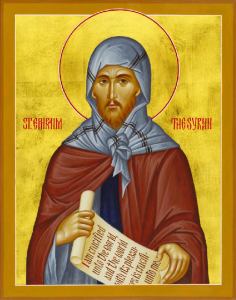
St Ephraim the Syrian
This young man of faith he joined monastic hermits in the surrounding mountains and began a life of asceticism. Here, he was a disciple of St James of Nisibis. After this city was taken by the Persian army in 363, he fled to Edessa and joined a monastery there. Here he combined monastic practice with intense study of the Scriptures. The Holy Spirit gave him a gift of teaching, and was an influential preacher to all people. At some point in his life, he was ordained a deacon by St Basil the Great. He wrote hymns and prayers. The most commonly used is his prayer of repentance said throughout Lent. It will be examined in the body of this posting which begins with the first few verses of the Gospel reading for Sunday, January 28, 2024 (the 34th Sunday after Pentecost):
Then one of them, a lawyer, asked Him a question, testing him, and saying,
Teacher, which is the great commandment in the law? Jesus said to him, “You shall love the Lord your God with all your heart, with all your soul, and with all your mind. this is the first and great commandment. And the second is like it: You shall love your neighbor as yourself. On these two commandments hang all the Law and the Prophets (St Matthew 22: 35 – 40).
By these gospel verses all Christians are to live. All the saints lived by these verses and embodied them, and St Ephraim is in their number.
Light and Life
By sacrament and faith, Christ indwells every Christian, and every Christian is in Christ — a relational union exists. As St Ephraim lived out Christ, Christ’s Light and Life permeated him and interpenetrated him. As he lived out the Gospel, humbled himself, “rejoiced always, prayed constantly, and gave thanks in, with, and for all things” his being interpenetrated Christ, and he had Christ formed in him. As we love God and our neighbor, as we act out our faith, rejoicing always, praying constantly, and giving thanks in, with, and for all things (living eucharistically), we, too, have Christ’s touch coming into us, and we touch Christ who abides in us and we in him. Like all the saint, Christ is to be formed in us.
The Pre-Lenten Sundays are not far away. Lent then follows, and St Ephraim’s writings play an important part in this season. Among his writings is his famous “Prayer of Repentance”. This prayer is a guide for our lives not only during Lent, but for every day of our lives. It is presented here:
O Lord and Master of my life, give me not the spirit of sloth, despair, lust of power and idle talk. But give rather the spirit of chastity, humility, patience and love to your servant. Yes, O Lord and King, grant me to see my own transgressions and not to judge my brother, for blessed are you unto ages of ages. Amen.
I offer a brief commentary:
“Give me not the spirit of sloth, despair, lust of power, and idle talk…”
We are to work with God to empty ourselves of our passions. We are to cut out the corruption that is in our lives, and all those things that snare and entangle us are to be cast off. “Put to death therefore what is earthly in you…” (Col 3: 5). All of our sinful habits and behaviors are to be removed and no longer appear. St Paul is again quoted, “Discard the old man together with his practices” (Col 3: 9).
“But rather give to me the spirit of chastity, humility, patience and love to your servant…”
“Put on the new [man], who is being renewed in knowledge after the image of his Creator” (Col 3: 10). We are to work with God that Christian virtues may replace the corruption of our flesh that still remains in us.
“Yes, O Lord and King, grant me to see my own transgression and not to judge my brother, for your are blessed unto ages of ages. Amen.”
Our Lord gives these words to us: “And he said to them, ‘Take heed what you hear; the measure you give will be the measure you get…” (St Mark 4: 24). If others fall short of our demanding standards, then be sure that we will be assessed by God with the same unit of measure. And when we point the finger of accusation and judgment on another… we are to look at our hands — we have three fingers pointing back at us. St Paul gives this advise: “Do nothing according to selfishness nor according to conceit, but in humility considering / preferring others better than yourselves” (Phil 2: 3). Additionally, Jesus gives us this from St Matthew 5: 7: “Blessed are the merciful — because they shall receive mercy.” How often is it that we want justice to come upon another while wanting mercy for ourselves? We must remember this, “Forgive that you may be forgiven. And somewhere St Paul offers this: “Put up with one another!” By this portion of St Ephraim’s prayer we can begin to love our neighbors (and one another) as ourselves.
Jesus Christ Conquers
we act in love towards each other and our neighbors, then we prove our love for God. In the Divine Liturgy we have “The Passing of the Peace”, and there is this exchange: “Christ is in our midst” says one person, and the other replies, “He is and ever shall be”. With this exchange there is a phrase sung by the choir. We are to think about them and what these words say to us: “Let us love one anther, that with one mind we may confess: Father, Son, and Holy Spirit; the Trinity one in essence, and undivided.” What does this say to us? Our unity with one another in love; our forgiveness of one another in love; our preference for one another in love reflects and declares to the entirety of creation the mutual love and unity of the Trinity! By this we “image” God correctly to the world. If we do not act in peace and in love we do not “image” God — we tell lies about God to creation.
St Ephraim also wrote prayers intended to be said prior to, and in preparation for receiving the Body and Blood of Christ in the Eucharist and participation in the entirety of the Divine Liturgy. Here is an excerpt:
Sanctify me by your Mysteries, illumine my mind with knowledge of you, make your hope to shine out in my heart, hold me worthy to supplicate for it, O God my Father and Lord of my life. Illumine your lamp within me, place in me what belongs to you so that I may forget what belongs to myself…Rig together my impulses for the ship of repentance, so that in it I may exult as I travel over the world’s sea until I reach the haven of your hope. When I am tempted, may my mind take courage from the recollection of you. Illumine before me the path that is dark through the brilliance due to awareness of you.
St Ephraim, pray for us!
The following is the corresponding sermon:
In Christ,
Fr Irenaeus
St Maximus the Confessor, Christology and the Salvific Model of Theosis
Posted: January 25, 2024 Filed under: Etcetera, The Eucharist and Living the Eucharist | Tags: All creation has union in Christ, being a confessor, deification, divination, hypostatic union expressed in the Eucharist, Hypostatic Union in Christ, interpenetration of the human and divine in Jesus Christ, St Maximus the Confessor, Theosis 3 Comments
St Maximus the Confessor
St Maximus the Confessor was born in Constantinople around the year 580. He was raised in a devout Christian home. He received an excellent education, then entered into government service and was a counselor to the emperor Heraclius (ruled 611 – 641). Constantinople and the imperial court were very sympathetic to the Monothelite christological heresy (meaning Christ had only one will — divine will — thus diminishing his human nature among other theological errors). He left the court and became a monk. He began to write extensively and persuasively regarding correct christological understanding of Christ’s hypostatic union as defined by the fourth Ecumenical Council (the Council of Chalcedon). His defense of orthodox Christology, though very influential, brought about his imprisonment and torture (his tongue was cut out and his right hand cut off). His proper understanding of christology also led him to explain further the salvific model of theosis which will be explored in the text below.
Let’s begin by examining one aspect of the doctrine of orthodox christology. This is the hypostatic union. In simple terms it is this: Christ has two natures: the divine (being God the Son), and human (being Jesus of Nazareth who took human flesh from the ever-virgin Mary). Thus, we proclaim that Jesus is fully God and fully man. These natures are united in the one person of Christ. The two natures are indivisible, yet never to be confused. Within this hypostatic union, as St Maximus and others have taught, the divine nature communicates, permiates, and interpenetrates (perikhoresis is a word St Maximus uses) the human nature while the human nature communicates, permeates, and interpenetrates the divine nature of Christ. There is a mutual interpenetration between the two natures. Because of this unifying interpenetration, on the Cross God tasted and experienced human death. This can be said of all of Christ’s incarnate experiences: God experienced hunger and thirst. God experienced joy and sorrow. God experienced a headache. On the flip side of this, human nature and human will and action were deified as the divine nature was interpenetrated by his human nature. Added to this, human nature was glorified by Christ’s resurrection from the dead.
 This hypostatic union also exists and is expressed in a similar, yet differing manner by the Eucharist. St John 6: 50 – 51 teaches that by the Eucharist the Incarnation is re-presented to us (see my posting “Brief Commentaries on St John Chapter Six, Part Four: The Poetic Parallelism of St John 6: 50 – 51). Hence, there is an expression of the hypostatic union. We have the material elements of bread and wine. By the work of the Holy Spirit (as he is invoked by the epiklesis) Christ joins his Body and Blood to the bread and wine. There is an indivisible union without confusion in this Sacrament.
By sacrament and faith, the Christian is in Christ, and Christ in us. Our salvation is relational union in Christ! Therefore, there is a similar interpenetration (perikhoresis) within man. St Maximus states that “…divine and human energy [are] in cooperation, and not as a mixed form of both.” The divine interpenetrates our humanity. Our human nature interpenetrates the divine in our lives. It is important to clearly state that a creature cannot encounter the essence of God, just as a creature cannot encounter the surface of the sun and survive. But, creatures experience the rays of the sun which exert their life giving effect to every creature on this planet. In like manner, the Fathers teach that it is God’s energies that we experience and works their saving effect in us.
This brings us to the concept of theosis — or “divinization” / “deification”. “God became man that man can become god,” teaches St Anthanasius. This divinization occurs only as is proper for our species: humans do NOT become God!. Simply put, it is the perfect, whole, complete restoration of the image of God within us. We become who and what we were intended by our Creator to be.
However, though this process does occur and is a process, it is not “magical” — we must cooperate with our Lord. St Paul gives us this:
Have this mindset in you which was also in Christ Jesus, though existing in the form of God, did not consider equality with God to be cause for exploitation. But he emptied himself, taking the form of a slave, coming in the likeness of man. And being found in the likeness of man, he humbled himself and became obedient to death — even the death of the cross (Phil 2: 5 – 8).
As the Son emptied himself to become man, we are to empty ourselves of our passions so that the divine energies — the Light and Life of Christ — can fill us and permeate us. Speaking to this need for self-emptying was have St John the Baptist’s words: “He must increase, but I must decrease: (St John 3: 30). We have Christ’s words from the Beatitudes: “Blessed are the pure in heart because they shall see God” (St Matthew 5: 8). We then have this excerpt from the “Prayer of the Hours”: “Sanctify our souls. Purify our bodies. Set aright our minds. Cleanse our thoughts.”
Yet, there is another — and equally mysterious — interpenetration that occurs between Christ our Creator and his creation. I refer to some verses that St Paul wrote in two of his Prison Epistles. First, we have these two verses:
Declaring to you the mystery of his will, according to his good pleasure, which set forth in him for the purpose of the fulness of time, to gather together in him [Christ] all things, those things in heaven and those things on earth (Ephesians 1: 9 – 10).
Further regarding the union of the entirety of creation in Christ we turn to his letter to the Colossians:
Because by him all things were created, those things in heaven and those on earth, all things seen and unseen, whether thrones or dominions or rulers or authorities: all things were created through him and for him. And he is before all things, and in him all things consist in their proper orders (sunestaeken)…because in him all the fulness (pan ta plaeroma) was pleased to dwell (Colossian 1: 16, 17, 19).
Hence, by his Incarnation, an interpenetration also exists between Christ and the entirety of creation because all things also have a relational union in Christ as does humanity. All things in some way, as is appropriate for their species and their ordering in Christ, experience this interpenetration as is proper for their kind. And they will, in some wild, unimaginable way will also experience some degree of glorification upon his return at the end of these days.
This is our salvation, and St Maximus has taught the Church this fact clearly.
I need to come back to another fact of St Maximus’ life, and it applies to us in the twenty-first century. If we live out and clearly teach the Orthodox faith, we can expect troubles and persecution. Persecution of Christians is now fully operational in this country. Oppression is being made manifest and is growing at an alarming rate. Because of his steadfast faith in Christ, and his unwavering commitment to declare the truth of the faith, St Maximus is known as a Confessor. He was imprisoned. His tongue cut out and right hand cut off that he could no longer speak or write of the truth of the Orthodox faith. Yet, he never denied the Lord. May the same grace of God be with us in our days!
Here is the troparion for St Maximus the Confessor,
O Champion of Orthodoxy, teacher of purity and of true worship, the enlightener of the universe and the adornment of hierarchs; all wise Father Maximus, your teachings have gleamed with light upon all things. Intercede before Christ God to save our souls!
Here is the link to the corresponding sermon:
In Christ who transforms and strengthens us,
Fr Irenaeus
Proper Vision to Discern the Times
Posted: January 15, 2024 Filed under: Etcetera, The Eucharist and Living the Eucharist | Tags: Ephesians 6: 10 - 12; The blind man of Jericho, Powers authorities rulers, Spiritual Blindness, spiritual powers at work in the world, Spiritual Sight, The full armor of God, the world system 2 CommentsLight and Life
While on his way to Jericho, there was a blind man begging beside the road. He asked what the crowd what the commotion might mean. He was informed that Jesus the Nazarene was passing by. The blind man cries out to Jesus for help. Even though he was rebuked by the crowd, he calls out all the louder to Jesus who, then, stops and asks,
“What do you want me to do for you?” “That I might see again,” he replied. And Jesus said to him, “See again. Your faith has saved you.” And he began to see again, and he followed him, glorifying God. And all those who beheld this gave praise to God (St Luke 18: 35 – 43).
To restore the sight of the blind was exclusively a sign of his Messiahship. This blind man had his physical eyesight restored. Now seeing, he followed in the company of Jesus on the way to Jerusalem.
John Newman, in his famous hymn “Amazing Grace,” states this, “…was blind, but now I see.” The former slave trader had spiritual sight given him to see his sins, and to see his Savior, and to walk in His ways. Without physical sight it is difficult to move through this world. In the ancient world the blind were reduced, generally, to abject poverty.
There is a worse type of blindness — spiritual blindness. Without spiritual sight one cannot move through this world, and exists in abject spiritual poverty. Without spiritual sight — given only by Christ — we cannot navigate through these darkened, depraved, and evil days brought upon us by this world system.
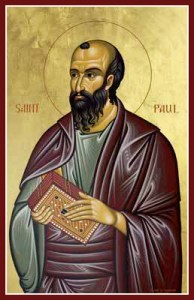
St Paul
This world system stands opposed to the Kingdom of God. It is an anti-Kingdom with its names of world rulers, powerful elite in government, commerce and every industry, in education, in entertainment, and in the military. Many of them, many times, and in many ways, seek to persecute the Church, and the entirety of humanity. However, St Paul informs us of our true enemies — those who are the puppet masters who manipulate those in earthly, temporal power.
Finally, my brethren, become strong in the Lord, and in the power of his strength. Put on the armor of God, so that you are able to stand against the trickery of the Devil. Because our struggle is not against flesh and blood, but against the powers, against the authorities, against the world rulers of the darkness of this age, against the spiritual agents of evil in the heavenly places (Ephesians 6: 10 – 12).
St Paul gives further information regarding these agents:
And you being dead in your transgressions and sins, in which you once walked according to age of this world, according to the powers of the authorities of the air, of the spirit now working in the sons of disobedience (Ephesians 2: 1 – 2).
Though at the time of their creation they may have been good, or neutral beings (Colossians 1: 16), they no longer appear to operate in such a manner. They are at work in the ways and affairs of the sons (and daughters) of disobedience — those who are not in Christ and do not walk in his ways. Who are these bodiless powers, authorities, and rulers? They are species, or orders, of spiritual, or possibly angelic beings. Though they have different names, their activities cannot be separated according to their assigned order. To give more information regarding these creatures, I quote from the Theological Dictionary of the New Testament:
We may gather from Eph 6: 12 that different spheres of influence are allotted to them, probably by their overlord [Satan]…Their abode is now in the lowest of the differing heavenly spheres from which darkness comes upon the world…Strictly, however, the reference is not to dominion over other spirits, but to power over the cosmos and earthly realm…Though now under the foot of Christ and are deprived of any great power…This does not mean, of course, that their power is destroyed. Man is still engaged in continuing conflict with them. They are not merely behind those who threaten Christians for their faith; they are also behind all moral temptations (vol. II, 483). They are to be distinguished from demons…they are cosmic powers (vol III, 573).
They influence and manipulate the rich rulers of this age — of this very day. The names of these men and women are many. Though they wish to subjugate humanity to a new feudal society, they are only names of human faces — mere puppets of their spiritual masters.
In the past four years we have observed their intentions and activities in very clear and demonstrable ways. Whether unnecessary COVID lock downs which brought only trouble to uncountable numbers; political collectivist schemes calling for “equity” (any collectivism will demand totalitarianism for its enactment and continued enforcement); the orchestrated mania of gender confusion with its consequent pharmacological poisonings and surgical mutilations (which lead to sterility and is nothing more than a biological alchemy); a digital national / international ID, or a Central Bank Digital Currency (which will lead to a digital prison); the goal is always for the destruction of humanity. All such plans of these cosmic powers and their human accomplices are hideously anti-human.
But we are not helpless. Far from it because Christ has subjugated them (Ephesians 1: 20 – 23). In fact we have power over them by Christ. St Paul tells us of our defensive tools in Ephesians 6: 13 – 17 as listed here:
Put on the whole armor of God (that you may be able to withstand in the evil day).
The belt of truth is to be fastened around your waist. (Truth is always victorious over lies.)
Breastplate of righteousness.
Feet shod with the gospel of peace.
Shield of faith to quench all the flaming darts of the enemy.
Helmet of salvation.
Sword of the Spirit (the word of God).
Jesus Christ Conquers
Of course, these provide only defensive protection. For faith to truly grow so that we may “…become strong in the Lord, and in the power of his strength,” we must go on the offensive. Faith is not just an abstract noun. Like love, faith must be a verb: there must be action. Faith can increase in us because we are partakers of the divine nature. And we are primarily strengthened by the Eucharist. I offer axioms to encourage offensive action:
To do, you must become; to become, you must do.
Do Christ to become Christ-like.
To live God is to prove God; to prove God is to live God.
What about this? Do one thing every week that takes you out of your comfort zone — something that bears Christ to those around you in your everyday life. As we “do Christ” here are guiding words from St Paul:
Now I urge you, brethren to warn the idle, to encourage the faint-hearted, and be patient with all. Do not repay evil for evil, but pursue the good, both for one another and for all. Rejoice always. Pray constantly. Give thanks in, with, and for all things, for this is the will of God for you in Christ Jesus (1 Thessalonians 5: 14 – 18).
With all that you do in faith — all that forms the strength of the Lord in you — do to the glory of God, and for the release of humanity and creation from the dark powers that hold the world in captivity.
The following is a corresponding sermon:
In Christ who has liberated us,
Fr Irenaeus
Discerning the Will of God
Posted: December 16, 2023 Filed under: The Eucharist and Living the Eucharist | Tags: 1 Thessaloonians 5: 16 - 18, determining the will of God, give thanks for all things, Jeremiah 29 ; 11- 13, living the Eucharist, pray constantly, present actions form the future, Psalm 25: 8 - 10, rejoice always, Romans 12: 2 and the will of God Leave a comment I am a convert to the Orthodox Church. My faith in Christ began in an evangelical context while a pharmacy student at Washington State University. I am thankful for this. Their particular evangelical flavor was not a shallow, fluffy variety, but one which took the Christian faith seriously and practiced it with a joyful fervor. My companions were all college age like me at the time, and like me faced many life decisions — many of minor importance, but some of great significance. This all involved for us discerning the will of God for our young lives. This discernment of the will of God was often perplexing for many. The desire to follow Christ faithfully and to be in God’s will — perfectly — was drawn from the Scriptures. Two passages came into play:
For I know the plans I have for you, says the Lord, plans for for welfare and not for evil, to give you a future and a hope. Then you will call upon me and come and pray to me, and I will hear you. You will seek me and find me; when you seek me with all your heart (Jeremiah 29: 11 – 13).
Do not be conformed to this world but be transformed by the renewal of your (humon) mind, that you (humas) may discern (dokimazein) what is the will of God, what is good and acceptable and perfect (Romans 12: 2).
Concerning these two passages from Scripture it is important to note a few things. Regarding the verses from Jeremiah, the context was the return of Jews to Jerusalem and Judaea from the Babylonian captivity: this was for the entire Jewish people, not for one person. Then, regarding St Paul’s words from Romans, the “your” and “you” is not singular, but in the second person plural (humon, humas). In other words, these words are directed to the entire church in Rome as one united body of faith. And the word dokimazein can be translated not only as “discern,” but also “test,” “prove,” or “demonstrate.”
 With the focus on discernment, discovering the will of God was, then, perplexing when misunderstood in the singular, or in the personal. I recall many conversations that included the complaint: “I’ve been praying, but I still don’t know what God wants me to do.” Looking back, such a process of discernment now seems like figuring out a puzzle, or guessing under which shell the nut is hid. That such a specific will in all matters of one’s personal life is unlikely. Adhering to this approach to discover God’s will in everything now seems delusional, and could lead to confounding indecision. (Furthermore, continued indecision can lead to anxiety and depression.)
Now I move forward in time 40 years. My youngest son, a devout Orthodox Christian, recently had a conversation with me about figuring out his future. He is a journeyman residential electrician, but wants to better his income and have a more satisfying career. Regarding his career, he is uncertain whether he should pursue commercial work, go to lineman’s school, or seek a a college degree in project management. He also wants desires marriage and family, and wants to find a faithful wife. (Does anyone know a faithful young woman in her twenties?) Thus, he could fall into the same dilemma as did my peers when I was young. Well, he didn’t ask for specific advice, but as any good father would do, I offered advice. My advice came from the words of St Paul found in 1 Thessalonians 5: 16 – 18:
Rejoice always. Pray constantly. Give thanks for all things: for this is the will of God for you in Christ Jesus.
Quite general or generic, yet his words are profound and offer the greatest guidance that can be given. In all situations and in all circumstances — good, bad, or indifferent — these words apply, and when practiced, will put one in God’s will. Anyone can rejoice, pray, and give thanks when things are going well. But, things don’t always go our way. When faced with challenging, distressing, and upsetting circumstances, or people, one can still rejoice, pray, and give thanks for them. This is the way of holiness and growth in Christ, and it is the way of the Saints. With these determined decisions and actions the Holy Spirit is free to work in our lives and transform us and better form the image of God within us. More importantly, with these three faithful attitudes and actions we begin to form our future and cooperate with God’s will.
 Our present, in part, forms our future. Let me give an example from grapevines. I have several vines on my property. Grapevines are aggressive growers. They send out tendrils to attach to fixed structures. This is done for their growth. With joy, prayer, and thankfulness in all situations the consequent actions serve as our own tendrils reaching out to the presently unknown future. Tendrils sent out with such intent will entwine, likely, with correspondent consequences established to achieve God’s intended outcomes our personal lives — always being our salvation. Allow me to slightly rephrase this thought. With such a holy perspective, circumstances, encounters, and the random events that happen can be transformed, sending forth healthy, whole, and holy tendrils ahead of us — tendrils that God, in his omnipotence, can pull toward himself and toward the good. Again, such a holy, eucharistic perspective and consequent actions trans form us. Thus, we are capable of more and more holy, joyful, prayerful, eucharistic actions in all the circumstances we encounter in this huge, expansive, and often difficult reality called the present.
This is truly how we establish God’s will in our lives. However, this does require patience — also a virtue which will allow us to perceive God’s will. Living the Christian life in this faithful manner will allow us to see truth and meaning when we read words like these from the Scriptures:
Good and upright is the Lord; therefore he instructs sinners in the way. He leads the humble in what is right, and teaches the humble his way. All the paths of the Lord are mercy and faithfulness, for those who keep his covenant and his testimonies (Psalm 25/24: 8 – 10).
We live in disturbing and distressing times. We seem to be pressed on all sides. These times will test us. Fear and worry do us no good. A determination to rejoice, being ever prayerful, and living eucharistically (by giving thanks in, with, and for all things) will guide us and direct our ways. When we don’t know what to do, or what decisions to make continue patiently with joy, prayer and thanksgiving. Also engage with the words of David in Psalm 5: 8,
Lead me, O Lord, in your righteousness because of my enemies; make you way straight before me.
In Christ the Good Shepherd who leads us,
Fr Irenaeus
The Conception of the Theotokos and Freedom in Christ
Posted: December 12, 2023 Filed under: Etcetera, The Eucharist and Living the Eucharist | Tags: determine to do the will of God, enter by the narrow door, fruit of the Spirit, spiritual children of Abraham and Sarah, St Anna's conception of Mary, St Anna's conception of the Theotokos (Mother of God), the battle is in the mind, The Conception of Mary, We are born of the free woman, we are free in Christ Leave a commentEvery year on December 9 the Orthodox Church commemorates the conception by St Anna of the Theotokos (Mother of God), that is Mary. The Gospel reading’s concluding verse for this commemoration is found in St Luke 8:21: “…these are my mother and my brothers: those who hear the word of God are are doing it.” Concerning this day, and pointing to the Incarnation of God the Son in human flesh, St Paul writes these words: “When the fullness of time came, God sent his Son, born of a woman born under the Law in order that those under the Law might be set free” (Gal 4: 4 – 5).
We have this brief history regarding St Anna:
St Anna holding Mary
Saint Anna, the mother of the Virgin Mary, was the youngest daughter of the priest Nathan from Bethlehem, descended from the tribe of Levi. She married Saint Joachim, who was a native of Galilee. For a long time Saint Anna was childless, but after twenty years, through the fervent prayer of both spouses, an angel of the Lord announced to them that they would be the parents of a daughter, Who would bring blessings to the whole human race.The Conception of the Virgin Mary by Saint Anna took place at Jerusalem. The many icons depicting the Conception by Saint Anna show the Most Holy Theotokos trampling the serpent underfoot.

And we have this from the day’s troparion:
Today the bonds of barrenness are broken: God has heard the prayers of Joachim and Anna. He has promised them beyond all their hopes to bear the Maiden of God, by whom the Uncircumscribed One was born as a mortal Man; He commanded an angel to cry to her [Mary]: “Rejoice, you who are full of grace, the Lord is with you.”
Again we read from Gal 4: 4 – 5:
When the fullness of time came, God sent his Son, born of a woman born under the Law [of Moses] in order that those under the Law might be set free.
This epistle reading for the day’s commemoration comes from St Paul:
For it is written that Abraham had two sons, one by a slave and one by a free woman. But the son of the slave was born according to the flesh, the son of the free woman through promise…So, brethren, we are not children of the slave but of the free woman (Gal 4: 22 -23, 31).
The descendants of Abraham were born of the free woman — Sarah. Christians are the spiritual, faith descendants of Abraham, and so, are also born of the free woman. We are also spiritually born of God (see St John 1: 12 – 13). Being so born, we are now in Christ to be free and no longer bound to sin! In Christ we are freed from sin, not just the penalty of sin!
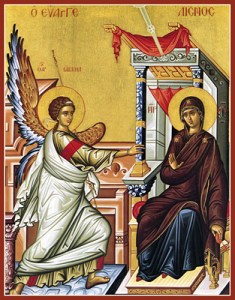
Icon of the Annunciation
We note this holy day for a specific reason: We will come to the Feast of the Annunciation when the Archangel Gabriel comes to Mary and declares to her God’s salvific purpose for her. In responding to the Archangel’s words she replies, “May it be done unto me according to your word.” From Mary’s words come the Incarnation of God the Son in human flesh: “Behold the Lamb of God who takes away the sin of the world” (St John 1: 29). He sets us free from the death of sin. He destroys death by death. He gives to us his Light and Life of his Resurrection. From Mary’s words will also bring he coming of the sanctifying Holy Spirit on the day of Pentecost who, by baptism, joins us to Christ. Thus, we share in Christ’s life, and the life of God in the Holy, Catholic, and Apostolic Orthodox Church.
WE ARE FREE IN CHRIST. “For freedom Christ has set us free; stand fast therefore, and do not submit again to a yoke of slavery” (Gal 5: 1)
We are additionally free to bear the fruit of the Holy Spirit: love, joy, peace, patience, kindness, goodness, faithfulness, gentleness, self-control (Gal 5: 22 – 23). This fruit is the polar opposite to what we were once held in bondage, that is, the fruit of the flesh: immorality, idolatry, sorcery, enmity, strife, jealousy, anger, selfishness, dissension, party spirit, envy, drunkenness, carousing, and the like (Gal 5: 19 – 21). Of this foul, poisonous fruit St Paul warns us: “…as I warned you before, that those who do such things shall not inherit the Kingdom of God” (Gal 5: 19 – 21). St Paul then instructs us, “And those who belong to Christ Jesus have crucified the flesh with its passions and desires” (Gal 5: 24).
I return to our Lord’s words, ““…these are my mother and my brothers: those who hear the word of God are are doing it.” There was another Gospel reading for December 9. We also read from St Luke:
Strive to enter by the narrow door; for many I tell you, you will seek to enter and will not be able. When once the householder has risen up and shut the door, you will begin to stand outside and to knock at the door, saying, ‘Lord open to us.’ He will answer you, ‘I do not know where you come from.’ Then you will begin to say, ‘We ate and drank in your presence, and you taught in our streets.’ But he will say, ‘I tell you, I do not know where you come from; depart from me, all you workers of iniquity! (St Luke 13: 24 – 27).
What about those who were locked out. It all seems a bit unfair at first glance. Consider this — They ate and drank, listened to him, but did not do what they heard from Christ.We must determine what we will do and not do that we might walk on the narrow path and enter through the narrow door. I quote from a portion of the Prayer of the hours: “…Sanctify our souls, purify our bodies, set aright our minds, cleanse our thoughts…”
The battle is in the mind. We have the Holy Spirit; Christ is in us; we have the Father. We are thus empowered — we lack nothing. We have the Eucharist to solidify our union in Christ, and to cleanse us of our sins, and to receive his victory over sin, darkness, alienation from God and all of creation. We have the sacrament of Confession additionally for the forgiveness of sins, and to put us back on the narrow path when we lose our way.
We have all we need “to hear the word of God AND DO IT!
In Christ who frees us,
Fr Irenaeus
That Our Names Are Written in the Heavens
Posted: November 25, 2023 Filed under: Etcetera, The Eucharist and Living the Eucharist | Tags: 1 Clement 29: 1, Become as little children, Book of Life, names written in the heavens, Rev 3: 4 - 6 and the church of Sardis, St Clement mentioned in Phil 4: 3 by St Paul, St Clement of Rome, St Clement the 4th bishop of Rome, St Luke 10: 19 - 20, St Luke 10: 21, the Hieromartyr Clement Bishop of Rome, The Kingdom of Heaven is revealed to little children, victors of the faith Leave a comment
The Seventy
In the tenth chapter of St Luke’s Gospel we read about Jesus’ appointment of 70 other men after the calling of the twelve Apostles. These 70 others also served in an apostolic manner. Their names appear throughout the New Testament, and they are commemorated annually on their feast days. In this chapter, Jesus sends them on a mission to every town which he would soon enter (St Luke 10: 1 – 12). We read this:
The seventy returned with joy saying, “Lord, even the demons are subject to us in your name!” And he said to them, “I saw Satan fall like lightning from heaven. Behold I have given you authority to tread upon serpents and scorpions, and every power of the enemy, and nothing shall hurt you. Nevertheless, in this do not rejoice that the spirits are subject to you. But, rejoice that your names are written in the heavens (St Luke 10: 19 – 20).
It appears that we are to learn that we are not to rejoice in spiritual authority or any other gift, or gifts, given to us by God. Rather, we are to rejoice in the gift of the grace and salvation of relationship with God — that we are enrolled in the census of the Kingdom of Heaven as its citizens.
After being given this information and instruction, our Lord himself rejoices,
In that hour Jesus rejoiced in the Holy Spirit and said, “I thank you, Father, Lord of heaven and earth, that you have hidden these things from the wise and knowledgable and revealed them to children; yes, Father, for such was your gracious will (St Luke 10: 21).
“…And revealed them to children (nepiois)…” The matters of the Kingdom of Heaven and the relationship with God were and are given to nepiois — infants or children who exist in innocence. Regarding the necessity of being childlike we read this from St Mark’s Gospel:
And they were bringing children to him, that he might touch them; and the disciples rebuked them. But when Jesus saw it he was indignant, and said to them, “Let the children come to me, do not hinder them; for to such belongs the Kingdom of God. Truly, I say to you, whoever does not receive the Kingdom of God like a child shall not enter it (St Mark 10: 13 – 15).
In this innocence and faithfulness we are to conduct ourselves by faith. For our names to continue to exist in the heavens we must persevere in the faith. We are to “…with fear and trembling work out your salvation. For God is the one who works in you; to will and to work in behalf of his good pleasure” (Phil 2: 12b – 13). Then we find this in the third chapter of Revelation of John in the message to the church in Sardis (whose works had, to the most part, become dead and displeasing to the Lord):
But you have a few names in Sardis who have not soiled their garments and they shall walk with me in white, because they are worthy. Thus, the one who overcomes shall be clothed in white garments and his name shall never be wiped away from the Book of Life. And I shall confess his name before my Father and before his angels. The one who has an ear is to listen to what the Spirit says to the churches (Rev 3: 4 – 6).
One who persevered and conquered is St Clement of Rome. He was the fourth bishop of Rome, and St Paul mentions him in his letter to the Philippians:
And I also ask you, who are a loyal coworker, help these women [Euodia and Syntyche] for they have labored together with me in the gospel together with Clement and the rest of my coworkers, of whom their names [are] in the Book of Life (Phil 4: 3).

St Clement Bishop of Rome
St Clement’s feast day occurs every November 25. Clement was raised in luxury and received a fine education. He became dissatisfied with his life offered by Rome and left the city. He travelled extensively, and while in Alexandria Clement met St Barnabas (one of the Seventy) and received the truth of the Gospel. He then travelled to Palestine and was baptized by St Peter himself. His work as bishop of Rome was very fruitful, but displeasing to the emperor Trajan. He was exiled to the Crimea. His work and miracles continued among his fellow prisoners. His continued faithfulness led to his martyrdom. He was throw into the sea with an anchor tied to his neck. St Clement conquered — he was victorious — and his name abides in the Book of Life. He is numbered among the Apostolic Fathers, that is, those who immediately followed in the footsteps of the Apostles. Two letters written by him to the Corinthians exist. St Clement offers this instruction to the Corinthians of the late first century and to us:
Let us approach him in holiness of soul, raising pure and undefiled hands to him, loving our gracious and merciful Father, who has made us the portion of his choice for himself (1 Clement XXIX. 1).
Let’s recall the words of St John in the Apocalypse: “Thus, the one who overcomes shall be clothed in white garments and his name shall never be wiped away from the Book of Life.”
The following is a corresponding sermon:
In Christ who empowers us to overcome,
Fr Irenaeus
Guitar Review: Rainsong Black Ice Jumbo (BI-JM1000N2)
Posted: November 21, 2023 Filed under: The Eucharist and Living the Eucharist | Tags: BI-JM1000N2 Rainsong Black Ice Jumbo review, Guitar review of Rainsong Black Ice Jumbo, Rainsong guitars, Rainsong Nashville jumbo bodied guitar Leave a commentBlack Ice Jumbo
This review of Rainsong’s Black Ice series jumbo guitar is my fifth review of a Rainsong guitar. I now own three Rainsong guitars — all jumbo bodied models. The purchase of the Black Ice jumbo took place in May, 2023, and was my retirement gift to myself after working 38 years as a clinic pharmacist (good bye corporate, allopathic medicine!).
Rainsong has four series of guitars. Two series have a spruce sound board fused to the carbon fiber top (essentially two sound boards fused together). The two series with this spruce fusion are the Nashville and Vintage series. The two series with all carbon fiber construction are the Concert and Black Ice varieties. Concerning the Black Ice series, Rainsong offers this comment:
When players picture a Rainsong, they’re often thinking about the Black Ice series. Not only are they breathtaking to view, but every soundboard is individually conceived with its own unique appearance and signature tone.
When I tell my guitar playing friends I have become a fan, advocate, and devotee of Rainsong guitars (and carbon fiber guitars in general) I encounter raised eyebrows and the comment of “really?” Yes, really. The vast majority are curious and ask more questions. Some — a minority who are guitar luddites — just shake their heads in disbelief. These “Doubting Thomases” need to know that any and all carbon fiber guitars stand within the “tradition” of the acoustic guitar. Any tradition must be living to be valid — otherwise tradition becomes a dead “traditionalism.” That is, there must be a “creative faithfulness” to the established, ongoing tradition. Hence, each new generation must both live within the established tradition, and express the tradition with a new, excited, and winsome voice. To hear and to play any carbon fiber changes minds (a recent tryout of a used Composite Acoustic proved to be very pleasing), and proves they stand solidly within the acoustic guitar family.

Nashville jumbo
Additionally, carbon fiber constructions offers advantages over the wooden acoustic guitar. First, these guitars are structurally solid and extremely stable. You have no worries about changes in humidity, seasonal temperature shifts, or stress of string tension on any part of the guitar. They are not indestructible, but the material advantages of carbon fiber are superior to wood in every aspect. The second advantage of carbon fiber is that there is no worry about diminishing supplies of tone woods, and no stress upon tone wood species and ecosystems.
Tone. What about tone? Rainsong guitars sound like an acoustic guitar should sound. There is nothing “artificial” or “industrial” about a carbon fiber guitar’s tone. Added to this, these guitars are not clones: they all have different characteristics and tonal qualities. I will give a subjective comparison of the Black Ice jumbo and my Nashville jumbo (N-JM1100N2). Both are light weight and both yield great volume, sustain, and tonal nuances. However, the Black Ice jumbo has a more “muscular” voice than the Nashville, and offers slightly more volume more readily than the Nashville model. For amplification, it comes with an L. R. Baggs Stage Pro Element which consists of volume, notch, phase, bass, mid, and treble controls. The Black Ice jumbo’s Stage Pro Element also has an on board tuner. As with its Nashville sister it is very playable (as are all Rainsongs).
 Rainsong guitars are very well made, and will easily last a player’s lifetime and the lifetime of his / her children and grandchildren. But purchasing one has become an issue for someone who wants to try one out in a the brick-and-mortar shop. Earlier in 2023, Rainsong changed its method of sales. Soon, a Rainsong guitar must exclusively be purchased from the company directly. Distributing shops still carry remaining inventory, and usually at a discounted price, but this will end in the near future. I have contacted Rainsong’s Woodinville, Washington office, and production is ongoing. Further, you can order any model in stock, or order your custom made model with a 30-day trial period (rainsong.com).
I would encourage you to consider these fantastic acoustic guitars. Such a musical expedition will be worth your time and money.
Keep on playing,
Fr Irenaeus
All Will Be Revealed
Posted: November 3, 2023 Filed under: Etcetera, The Eucharist and Living the Eucharist | Tags: be doers of the word, determine to do what is right and true, nothing is hidden that shall not be made manifest, Set aright our minds, St James 1: 22 - 25, St Luke 8: 16 - 18, St Matthew 5: 14 - 16, the battle is in the mind, you are the light of the world 2 CommentsA somewhat alarming passage is found in St Luke’s Gospel:
No one after lighting a lamp covers it with a vessel, or puts it under a bed, but puts it on a stand, that those who enter may see the light. For nothing is hidden that shall not be made manifest, nor anything secret that shall not be known and come to light. Take heed then, how you hear; for to him who has will more be given, and from him who has not, even what he thinks that he has will be taken away (St Luke 8: 16 – 18).
Elsewhere, in St Matthew’s Gospel we read again of light:
You are the light of the world. A city set on a hill cannot be hidden. Nor do men light a lamp and put it under a bushel, but on a stand, and it give light to all in the house. Let your light shine before men, that they may see your good works and give glory to your Father in heaven (St Matthew 5: 14 – 16).
These verses from St Matthews Gospel informs us that we are the light of the world, as is Christ the Light of the world. As he is in us and we in him — so are both true. We are to manifest his light by our good works so that God will be glorified by those who observe them. So we are to live as Christians.
But the alarm given to us is found in St Luke’s words. For nothing is hidden that shall not be made manifest, nor anything secret that shall not be known and come to light. All will be revealed for all is known by God. Our Lord also tells us that what is said in secret will be shouted from the rooftops.
The text also holds this:
Take heed then, how you hear; for to him who has will more be given, and from him who has not, even what he thinks that he has will be taken away.
How we hear what we hear refers to how we hear the teachings of our Lord Jesus Christ. Do we hear, but do not put into practice? Do we know, but not stubbornly not act accordingly? St James gives these words to us:
But be doers of the word, and not hearers only, deceiving yourselves. For if any one is a hearer of the word and not a doer, he is like a man who observes his natural face in a mirror; for he observes himself and goes away and at once forgets what he looks like. But he who looks into the perfect law of liberty, and perseveres, being no hearer that forgets but a doer that acts, he shall be blessed in his doing (St James 1: 22 – 25).
St James instructs us to do the will of Christ — to act positively upon God’s words, and put into practice those works that show Christ’s light — and our light — to the world. But what about those temptations to ignore, disobey, and then enter into sin?
I will give my illustration of “The Bubble.” This illustration is about the control of our thoughts, especially thoughts that would bring us into error and sin if acted upon. Thoughts are extremely import because thoughts determine outcomes. Thus, they determine reality. Let’s say there is a pond with over hanging trees. Every autumn the leaves fall from the numerous branches and settle to the pond’s bottom. There the leaves decay. This process will often release a bubble of gas which rises to the surface. Such a bubble is a thought that could lead to temptation, or some random memory which, if acted upon would lead us into sin. At this point of awareness there is no error, no sin. But, when the “bubble” rises to our consciousness we have two options: we can allow the “bubble” with its stench to reside on the surface of our consciousness and interact with it. When acted upon, the thought draws us into sin. Or, we can pop the “bubble” and be victorious and advance in our faith.
We will all stand before Christ in judgment in the Last Day. What we have done — good and ill — will be revealed. In our time in this life we must act by faith in holy ways that correspond to the will of Christ. Acting faithfully in this manner will bring us welcome into his Kingdom. This battle between our Lord’s will and our own carnal will takes place in the mind. We read this exerpt from the Prayer of the Hours: “…Set aright our minds; cleanse our thoughts.” This petition sums things up quite well — yes the battle is in the mind.
Jesus Christ conquers
Let me inform you of a particular challenge for me. I can be quite impatient in a check out line in any retail setting, especially with someone who is young. If this impatience is expressed to the employee I have sinned. Therefore, I must determine in advance how I will interact with this person. Will I bless this person who bears the image of God, or will I be an ass? I must choose to be a blessing for her or him, and I generally utter these words from Psalm 38 (37): 22: “Make haste to help me, O Lord, my salvation”. If the “bubble” of impatience arises to the surface of my consciousness I must pop it and be victorious according to our Lord’s will. I, too, must rejoice in this encounter. I must pray for this person, and give thanks for this person and this interaction (see 1Thes 5: 16 – 18).
So, determine in advance what you will do, or not do, in any given situation and with any inappropriate, tempting thought. Determine not to say, speak, or do evil. Be determined to bless with word and action, and what is illumined will bring glory to God and not shame to our souls.
In Christ,
Fr Irenaeus
A Dream’s Warning
Posted: October 2, 2023 Filed under: Etcetera Leave a commentMore than forty years ago I had a vivid dream of spiritual significance. Its details have remained in my memory ever since that night. Although I only on occasion recall it, I lay it out in this posting. I do so in the hope that it will speak to the reader as it has for me, and now seems very appropriate given the dark and depraved times in which we live.
The year in which the dream occurred was 1982. At the time I was a student in Washington State University’s College of Pharmacy, and had come to faith in Christ about nine months earlier.
 The dream is described. I was in an old house that was in disrepair. While looking at its dusty floors and dingy walls an angel approached me. He had a mission for me. The communication between us was terse, but kind. He handed me a three-chambered, antique revolver. I was instructed to fire the first round into the wall as proof of its capability as a weapon. The round blew a sizable hole in the wall. The angel then gave me added instructions. With the second round I was to destroy the locking mechanism of a door. I was then to enter the room and kill the evil man that dwelt in the room. I climbed the stairs to the room and shot open the door. I had no idea of the room’s dimensions. The only light came from a small, dirty window. It illumined only the first few feet of the room in which I stood. From the darkness emerged a man of 50 to 60 years of age. He was pale, and rotund, and moved slowly while stooped over slightly at the waist. His head was large and his hair was white and thin. I believe he knew why I was there. I pointed the revolver at him, but he began to speak to me. In disobedience I did not fire the third round, but engaged in conversation with him. I lowered the revolver. He sat me down at a nearby table and we began to play a “board game” of some type. I failed my mission. I was now ensnared and would soon perish. The dream, thankfully, ended prior to my demise.
Its significance of the dream is clear. Obviously the dream was about — and still is about — the consequences of disobedience and compromise with evil. Throughout my life I have entered into very minor thematic parallels with this dream, there have been successes and failures — resistance and collaboration have often walked hand-in-hand in my past. But, ultimately, the importance of the dream is a challenge which I will face in the future — some day I will be confronted by a great evil. I know that I will not have to kill, yet I am to overcome the confrontation and challenge of my life in some manner.
There are many dark rooms inhabited by many dark, evil men and women. They all pose the same threat and danger to us. The dark rooms and their dark inhabitants have always been with us. The rooms have been inhabited by tyrants across the ages. The dark inhabitants today are not just political figures, but can be from corporations and other institutions. Whatever the source, however embodied, they are threats to our freedoms and souls. However embodied, they are growing in number and in strength.
In my opinion, the greatest threat to freedom, integrity, and faith comes from the impending implementation of both a Central Bank Digit Currency (CBDC) and a national, if not global, digital ID. For nearly twenty years we have been entangled in the digital web by our “relationship” with our cell phones. The convenience and ease of use of debit cards have paved the way and readied us for a CBDC.
What is to be done? What will I do, and what will you do in the face of such a demanding power? God has the power to “deliver from the snare of the fowler”, and to be our “shield and buckler” (e.g., Psalm 91 / 90: 3, 4). Yet, at the same time, we must ready ourselves in ways that are fit and proper for each person and family. A “one-size-fits-all” plan does not exist. Ultimately, it is all too possible that many will be Confessors for the faith.
It is not my desire to be doom and gloom. We are not to be fearful, but we are to be aware. Readiness can be done in many ways. Friends and those who are aware of these threats and form small “parallel societies” (see my postings: The Parallel Society II: The Proposals of Vaclav Benda and The Parallel Society) for mutual support and assistance. But, ultimately, the greatest preparation is spiritual: we must walk faithfully with our Lord Jesus Christ to his glory!
In Christ,
Fr Irenaeus
The Parable of the Talents
Posted: September 30, 2023 Filed under: Etcetera, The Eucharist and Living the Eucharist | Tags: equity will lead to totalitarianism, ethic of being, faith demands action, Good and faithful servant!, St Matthew 25: 14 - 30, the danger of equity, The Parable of the Talents, to become you must do Leave a comment The Parable of the Talents is found in twenty-fifth chapter of St Matthew’s Gospel (25: 14 – 30). (It is also found in St Luke’s Gospel as well (19: 11 – 27).) We read of three servants with the same common master, but there are two different outcomes. The parable begins with the master summoning the three servants:
For there was a certain man who called his servants and entrusted to them his possessions. And to one he gave five talents, to one two, and to one one — to each according to his ability (St Matthew 25: 15)
After some time the master returns and calls for an accounting. However, we discover there were two very different outcomes. The servant given five talents invests the money and doubles the amount. So does the servant given the two talents. To these servants their master gives them his words of praise:
Well done good and faithful servant. With a little you were faithful, and you will be entrusted with much more. Enter into the joy of your lord!” (St Matthew 25: 21, 23).
The third servant proved to be fearful and guarded: Knowing his master could be shrewd and demanding he buried his talent and earns nothing. He receives a very different message from their common master,
…Evil and lazy servant! You knew I harvested where I did not sow and gathered up what I did not winnow. You should have taken my silver to the banks and when I returned I might have earned the interest. Therefore, take from him the talent and give it to the one having ten talents! For the having much shall be given more and shall have in an abundance, and to the one who has nothing — it shall be taken from him! Cast him into the outer darkness where there will be weeping and gnashing of teeth! (St Matthew 25: 26 – 30).
(There is a clear parallel with this parable to the outcomes of the Last Judgement: We have two sets of people, and both groups call Jesus “Lord”. Yet, there are two equally contrasting outcomes. Those faithful to Christ by caring for the poor, the ill, and the prisoner will be welcomed into the Kingdom of God, while those who did not act faithfully will receive this sentence: “Depart from me…! (St Matthew 25: 41)).
George Orwell
In these days we will likely find the treatment of the third and fearful servant to be very unfair. The master knew he had lesser abilities than the other two servants. His damning sentence seems exceptionally unfair since he did not lose any of the money entrusted to him. We find this outrageously unjust because we expect leniency in this day and age. We may find the master unbearable because we are beginning to expect equity to be the new norm for all — identical outcomes for all in spite of accomplishment or ability. It must be noted that equity is quite a new and abnormal expectation, and one that is dangerous. It is dangerous because equity ultimately is a clear form of collectivism. And as George Orwell states, a collectivism will demand the tyranny of totalitarianism.
However, in contrast to this parable our Lord has stated that “a bruised reed will not be broken, and a flickering candle will not be extinguished”. Yet faithfulness is demanded from the faithful no matter the portion of faith / grace given to us. St Paul writes to us: “ing then gifts differing according to the grace given us, let us use them” (Romans 12: 6).
As love is not a feeling, but demands action, so faith is not simply an acceptance of certain intellectual propositions. It, too, demands action (see Philippians 2: 12 -13)! St Paul gives us this instruction: “Now we exhort you, brethren, to warn the idle, encourage the faint-hearted, to help the weak, and to be patient will all” (1 Thessalonians 5: 14). Regarding the “idle,” St Paul refers not only to those who are physically idle, but also to those who are spiritually idle!
How do we then put our faith into action? By doing. I give to you an axiom: we must do in order that we might become. Allow me to suggest as a guide the concept of an ethic of being. If you want to develop the faithful virtue of truthfulness, tell the truth. If you want to become compassionate and merciful, then act accordingly. If you want to develop the faithful virtue of gratitude, then give thanks at all all times, in every setting, and for all things. St Paul gives to us these verses:
Do not repay evil for evil, but pursue the good both for one another and for all. Rejoice always. Pray constantly. Give thanks in, with, and for all things, for this is the will of God for you in Christ Jesus (1 Thessalonians 5: 15 – 18).
In a few more verses from this same epistle St Paul writes,
Now, may the God of peace himself sanctify you wholly, and keep your spirit, soul, and body sound and blameless in the presence of our Lord Jesus Christ. The one who calls you is faithful and he will do this (1 Thessalonians 5: 23)
We all have differing amounts of faith. We have been been given differing gifts of the Holy Spirit. As St Paul commands us: “Let us use them!” (Romans 12: 6) that we may hear these blessed words from our Lord, “Well done my good and faithful servant! Enter into the joy of your Lord!”
The following is a corresponding sermon:
In Christ,
Fr Irenaeus
A Re-evaluation of Status
Posted: August 28, 2023 Filed under: Etcetera | Tags: 1 Cor 1: 26 - 29, concern about wealth and power, Dante's Inferno, Mt 5: 1 - 12 the Beatitudes, Niccolo Machiavelli, seeing with spiritual eyes, The Beatitudes as qualities of citizens of the Kingdom of Heaven Leave a comment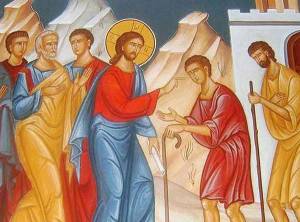
Healing of the Two Blind Men
For Saturday, August 27,2023 the Gospel reading was from St Matthew 20: 29 -34 which gives the account of the healing of two blind men. The passage can be summarized in this manner. As Jesus left Jericho with a crowd following him, two blind men who sat by the road called out “Lord, Son of David, have mercy on us.” Jesus touched their eyes and they could see. The formerly blind men now had physical sight. And with sight they followed Christ on his way to Jerusalem.
Although physical sight is valuable, spiritual sight is even more valuable. This is better understood from St John’s account of Jesus healing the man bourn blind (St John 9: 1 – 41). Our Lord offers this statement: “…For judgment I came into this world, in order that those who do not see might see, and those who see might become blind” (St John 9: 39). Putting it another way, we are to understand that those with only natural sight might see with new spiritual eyes, but those who cling stubbornly to natural, physical sight might become blind — no spiritual sight can be given to them. We find this in a kontakion for the Sunday of the Man Born Blind (the 6th Sunday of Pascha):
I come to you, O Christ, blind from birth in my spiritual eyes, and call to you in repentance: You are the most radiant Light of those in darkness!
With spiritual sight given by God we can now truly PERCEIVE!
We now move to the epistle reading for the Saturday which comes from St Paul’s first epistle to the Corinthians:
For consider [blepete] your calling, brethren, that not many of you were wise according to the flesh, not many were powerful, not many were of noble birth. But God selected the foolish things of the world, in order that the wise of this world might be put to shame. And God selected the weak of the world in order that he might shame the strong. And the low-born and the despised were selected by God, also the things which are not in order to abolish the things which are. All this so that no one might boast before God in the flesh (1 Cor 1: 26 – 29).
“Blepete.“ This Greek verb is in the imperative form — it is a command to the Corinthian Church. The word can be most commonly translated as “see” or “look at”. It can also be translated “consider” or “regard.” According to St Paul, we are to consider, or observe, that we are of the “lesser things” of the world. We are a people not regarded as important by those who see with “cosmopolitan eyes” – eyes that see only through the lens of the world system. IF we think of ourselves as belonging in the company of the sophisticates, the powerful, the important of the world, we DO NOT perceive ourselves properly. IF we want to belong among the sophisticated of the world, then we exist as “friends of the world” and thus “at enmity with God” (St James 4:4).
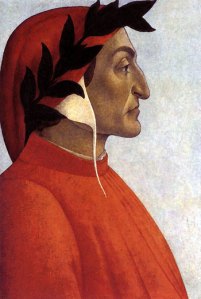
Dante Alighieri
Regarding the perils of worldly status, I give two historical illustrations from the late Medieval era and then of the Renaissance era of Italy. The first comes from Dante Alighieri who wrote The Inferno. He had become a man of faith when he penned the classic. But, he was formerly involved in the politics of Florence. He apparently turned away from the power circles of Florence and noted the dangers of such power: he puts the political “movers and shakers” of Florence — the power elite of his day — in the inferno upon their death. Niccolo Machiavelli provides the second example. Mr Machiavelli had stated that he wanted no part of Heaven because there would be no powerful, sophisticated people there. There would be no intrigue and no exiting conversation. He concluded that he would be bored in Heaven and would, seemingly, prefer Hell.
Then, I provide this autobiographical account. I was once a young man. I had begun my career as a clinical pharmacist. I was a single man in those days. Though a Christian at the time, yet I wanted to live among and be associated with the professional classes. I wanted no part of the working man’s world. If you wanted to sell me something, “snob appeal” worked nearly every time. I have matured and have changed my mind. I have no desire for the Inferno!
I do not imply that all who are wealthy and occupy political office are damned. And I do fully appreciate that we of the Western World are wealthy in light of others and of other eras. However, not many of us were wise, powerful, or of wealthy, elite birth. This tells us we are to see ourselves with eyes that let us value things very differently! Further, with this proper self-evaluation and awareness, we are to live according to the Beatitudes:
Sermon on the Mount
Upon seeing the crowds, he ascended the mountain. After he sat down his disciples approached him. He opened his mouth and taught them, saying: Blessed are the poor in spirit, for theirs is the Kingdom of Heaven. Blessed are those who mourn, because they shall be comforted. Blessed are the meek [humble], because they shall inherit the earth [land]. Blessed are those who hunger and thirst after righteousness, because they shall be satisfied. Blessed are the merciful, because they shall obtain mercy. Blessed are the pure in heart, because they shall see God. Blessed are the peacemakers, because they shall be called the sons of God. Blessed are those who are persecuted for righteousness’ sake, because theirs is the Kingdom of Heaven. Blessed are you whenever men revile and persecute you falsely for my sake, because your reward is great in Heaven, for so they persecuted the prophets who came before you (St Matthew 5: 1 – 12).
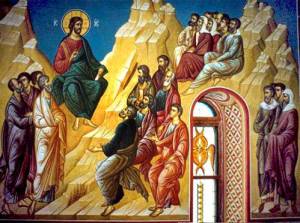
The Beatitudes overturn the conventional wisdom of both the ancient and modern worlds. The Beatitudes are to be the personal qualities and characteristics of those who work to be the citizens of the Kingdom of Heaven!
Every August 26 the Orthodox Church commemorates the martyrs Adrian and his wife Natalia. A hymn honoring Adrian reads,
You regarded faith as an imperishable treasure, O most blessed one, abandoning the ungodliness of your fathers and walking in the footsteps of the Master. You were enriched with divine gifts, O glorious Adrian. Pray to Christ God for the salvation of our souls.
We are living in darkened, depraved days. Our faith is openly despised and persecution is truly beginning. We cannot be friends of the world system. By our faith in God, We are to exert greater effort, and even double ours efforts, to cultivate the characteristics of the Beatitudes. By doing so and becoming such we become friends of God and, again, citizens of the Kingdom of Heaven. We then walk with Christ together with the saints.
The following is a corresponding sermon:
In Christ,
Fr Irenaeus
A Cricket Keeping Common Time
Posted: August 5, 2023 Filed under: Animal Welfare, The Eucharist and Living the Eucharist | Tags: a cricket keeping time, Abbey Road, appreciation of animals, blessing God's creatures, cricket's "voice", living in solidarity with all of God's creatures, musicality of birds, The Beatles' "Sun King" Leave a commentDecades ago, as a younger man, I had an indifference to many creatures, and some I loathed. As I have grown older, and hopefully have increased in faith, I have developed a greater and increasing appreciation for all of God’s creatures. Now, as I walk through my property, I bless the animals that I see on any given path.
 Birds, dogs, and cats all have voices and vocalizations — they vary greatly. I have become somewhat attune to two of my dogs’ vocabularies. I can discern a few meanings by now: “the food bowl is empty,” “water is needed”, and “I need to go out” stand out among other messages. The variety of bird songs and voices also have wonderful variations. Finches, pine siskens, and junkoes are the more vocal of the all the species I encounter. During summer evenings one of the species (or maybe all three) have “chat times” that are quite remarkable. They assemble in a tree and sound like a choir! (My anthropomorphic interpretation is that they are discussing their days and sharing news before their night’s sleep.) There is a musical quality to God’s singers and musicians. Even a psalmist has commented on this:
Even the sparrow finds a home, and the swallow a nest for herself where she may lay her young at your altars, O Lord of hosts, my King and my God. Blessed are those who dwell in your house, ever singing your praise! (Psalm 84 / 83: 3 – 4).

Abbey Road Cover
During late July, 2023 while visiting my mother in southeastern Washington, I slept on her couch with a window open to let in the cool evening air. After a few moments, I heard the sound of a cricket, or similar insect. God’s tiny percussionist was keeping perfect common (4/4) time at a rate of 100 beats per minute. A metronome could not do better, and the tone of the beat held was certainly superior to the mechanical quality of such a devise.I recorded its “beat” twice, the first for about 3.5 minutes duration, and the second for just over five minutes. My intention is to use it as a natural metronome, and even use it as a background for a future composition. Though any work of my own would never be of the quality of the cricket included on the Beatles’ “Sun King” found on Abbey Road, I will do my best to honor this cricket’s musicianship.
With this appreciation of the cricket’s perfect keeping of common time, I hope that I and all of the faithful in Christ can see the potential (and need) for harmonic interactive relationships with all of God’s creatures and creation. This hope isn’t based upon some sappy sentiment. Somewhere, Saint Paisios noted that as holiness increases in one’s life a love for all of God’s creatures increases — to the point of birds and animals will be drawn to a saintly presence (I think of St Blaise, St Seraphim of Sarov, and St Francis). I also have this hope because as we move through the perilous times in which we now find ourselves we will be able to show love, extend peace, give thanks, and live in solidarity with all and all things. By living in this manner we will be sanctifying the world to the glory of God.
In Christ, and someday in perfect common time,
Fr Irenaeus
Perceiving, Valuing, and Ordering Christ in Our Lives
Posted: August 4, 2023 Filed under: The Eucharist and Living the Eucharist | Tags: becoming confessors, Dying to self and gaining Christ, perceiving Christ, Receiving the Holy Spirit, spiritual sight gives spiritual understanding, Taking up one's cross Leave a commentThe Gospel reading for Saturday, July 22, 2023 came from St Matthew 10: 37 – 11:1. This posting concentrates on verses 37 – 39 which read,
The one who loves father and mother more than me, is not worthy. And the one who loves son or daughter more than me is not worthy. And who does not take up his cross and follow after me is not worthy. The one who finds his life will lose it, and the one who loses his life for my sake shall find it (St Matthew 10: 37 – 39).
 We are to love Christ more than family members. This is not a hyperbolic statement! The nearest and dearest relationships in our lives are to be subordinated to Christ. We are to take up our own crosses. The cross is an instrument of death, of execution. The Christian is to sacrifice self (one’s life) which is entangled in this world system that we might gain spiritual life — life in the eternity of the Kingdom of God. In other words, we are to make assessments and order matters from lesser to greater cost, and from lesser to greater value. Our lives in our economic system teach us that the quality of our investments determine the amount of “interest” paid.
The next day’s Gospel (the Seventh Sunday of Matthew) comes from St Matthew 9:27 – 35. In it we read of two blind men who as Christ to give them sight. Jesus asked them, “Do you believe I am able to do this?” They answer in the affirmative, and they received sight. They saw God Incarnate, their Lord and Savior. Then Jesus gives them one command, “See that no one knows of this!” (St Matthew 9: 30). They did not obey Jesus’ “gag order”, but told everyone in the region of their healing by Christ.
 So, are we like the two blind men? Are we as disobedient? Are we unwilling to deny self in the most obvious thing that is right in front of us? Or will we do a proper accounting and accept Christ and subordinate our will to his will? We may put up the objection, “But it’s so insignificant!” However, the reality is that it right in front of us, and to gain Christ in this matter we are to die to self. We are to take up this little cross and, thus, gain Christ. These little, mundane, and seemingly insignificant things, when released to Christ always lead to incremental spiritual gains. Our incremental deaths to self will, in time, accumulate to greater gains in our lives in Christ. If we cannot die to self, i.e., obey, in the little things required of us, how could we die to the greater things that could be demanded of us in the future?
We need this discipline because we live in perilous times. Events in politics and economics may very soon confront us with such choices. What “parent” or “child” (the valued things of this world) will we be called upon to release to Christ? What might be the crosses we may be called upon to take up, thus losing self, but gaining Christ? We need to be prepared to be confessors in this age.
Upon receiving our sight and seeing Christ do we truly perceive him for who he is and properly heed his call? Or, we we act like the two blind men who, upon receiving sight, looked at Christ, but did not perceive him as their God, Lord, and savior and then disobeyed.
St Paul writes this in his epistle to the Romans: “Therefore, I make known to you that no one speaking by the Spirit of God calls Jesus accursed, and no one can say Jesus is Lord except by the Holy Spirit” (Romans 12: 3). By the sacrament of Chrismation the Holy Spirit is received: “The seal of the gift of the Holy Spirit!” In every Divine Liturgy there is the portion called the epiclesis:
Again we offer unto Thee this reasonable and bloodless worship, and ask Thee, and pray Thee, and supplicate Thee: Send down Thy Holy Spirit upon us and upon these Gifts [bread and wine] here offered.
With these words the bishop / priest invokes the Holy Spirit to come upon the bread and wine to make them the Body and Blood of Christ, and that the faithful assembled that day may receive anew the Holy Spirit. These two petitions are made that by the Holy Spirit — upon consuming Christ’s Body and Blood — Christ may be more completely formed within us. And, thus, we may be empowered to perceive Christ with comprehending spiritual eyes, and die to ourselves that we have eternal life in Christ.
In Christ,
Fr Irenaeus
You Are the Light of the World
Posted: July 17, 2023 Filed under: Etcetera, The Eucharist and Living the Eucharist | Tags: "Let us depart in peace!", Jesus is the Light of the World, Light and Life, shining Christ's light by works of faith, the faithful bear Christ's light to the world, you are the light of the world Leave a commentLight and Life
On July 16, 2023 I had the pleasure of serving at St Sophia Greek Orthodox Church in Bellingham, Washington. That day’s Gospel reading came from St Matthew 5: 14 – 19. In the first two verses of this passage Jesus tells us this:
You are the light of the world. A city sitting upon a hill is not able to be hidden. Nor does one light a lamp and place it under a basket, but upon a lamp stand, and it gives light to all in the house. Thus, let your light shine before men, so that they may observe your good works, and glorify your Father in the heavens St Matthew 5: 14 – 15).
But there is also one who is a greater Light, and is the source of all light:
Therefore Jesus spoke again saying, “I am the Light of the world. The one who follows me shall never walk in the darkness, but shall have the Light of Life (St John 8: 12).
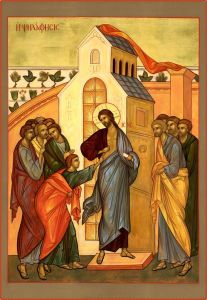
St Thomas touches Christ’s wounds
Jesus’ Apostles and disciples walked most directly and intimately in his Light. Apart from the Divine Light radiating from Jesus on the day of the Transfiguration (which only Peter, James, and John observed), the Apostles and disciples witnessed Christ’s Light by his works. They saw Jesus raise the dead, heal the sick, and give sight to the blind. Moreover, they witnessed his resurrection from the dead. We have St Thomas’ words upon seeing his resurrected body and touching his wounds from crucifixion: “My Lord and my God!” (St John 20: 29). From these experiences St John begins his first letter:
That which was from the beginning, which our eyes have seen, which we beheld, and our hands have touched concerning the Word of Life. And the Life was manifested and we saw it and we testify and declare to you the Eternal Life, who was with the Father, and was manifested to us (1 John 1: 1).
He and the other Apostles have declared who Jesus is. He is God Incarnate. He is the Light of the world. He is Light and Life. By continuing in the apostolic faith and Sacrament the faithful abide in him. For example we have this: “The one who is eating my flesh and is drinking my blood abides in me, and I in him” (St John 6: 56). We bear within us the Light of the world, and it is him we shine forth to the world.
How, then, do we shine forth his Light to the world? By faith’s good works!
Where are we to shine this light? Everywhere! When do we shine this light? At all times! To whom do we shine this light? To everyone. Shining his light does not require grandiose public displays. Shining the light of Christ is best done in our everyday lives before those we know — especially in our homes.
The city on the hill is, of course, the Church. Cities in the ancient world had no public street lights. The light of the city came almost exclusively from domestic sources — lamps burning both inside and outside of homes. The shining light came from personal sources, but when seen together made the city visible to the traveler in the distance.
Every Divine Liturgy begins its ending with this exhortation: “Let us depart in peace!” We depart back to our homes and to our little corners of the world to shine forth his light to the glory of our Father in the heavens.
In Christ,
Fr Irenaeus
 Father Irenaeus Williams
The Kinks’ “Dedicated Follower of Fashion,” Satire, and the Prayer of St Ephraim the Syrian
Posted: March 21, 2024 | Author: Fr. Irenaeus | Filed under: Etcetera, Music and Guitars | Tags: Commentary on the Kinks' "Dedicated Follower of Fashion", humility and satire, The Kinks' "Dedicated Follower of Fashion, The Prayer of St Ephraim the Syrian, true satire | Leave a commentThe Kinks circa 1967 (Ray is standing.)
I have an admission: I love the music of the British Invasion of the 1960s. When the Beatles, Rolling Stones, et al., hit the shores of America I was a little boy in grade school. At that time my only interests were baseball and the space program that involved Mercury, Gemini, and Apollo missions. I didn’t discover the Beatles’ music until after their breakup in 1970 when I heard George Harrison’s “What Is Life”. I then immersed myself in the Beatles’ music and followed their post-Beatles careers faithfully. I soon discovered the Rolling Stones, and the Kinks among other bands. I love the sound of the era, and I have learned to play dozens of songs from that decade on guitar.
Among those songs is the Kinks’ “Dedicated Follower of Fashion.” It was composed by Ray Davies (front man and rhythm guitarist), and was released as a single throughout the world in 1966. It has the flavor of the “Music Hall” era. We, today, would think of it as a “novelty song.”
A little history of this time in London and other urban areas is in order. Some of the youth of the day had one peculiar social division: Mods versus Rockers. As I recall, the Mods followed fashion, and other cultural trends. The Rockers were of a rougher cut, and cared little about fashion, etc. If you could extrapolate these two groups musically into the 1970s, Mods, I would imagine, would lean towards “Glam Rock,” while the Rockers would be fans of the “Punk Rock” scene.
Somewhere in Piccadilly
Clearly, the Kinks’ song is a rather scathing critique of the ephemeral and superficial “dandies” and the “swingers” of London, and those who endlessly shopped Carnaby Street and other trendy locations, perhaps even Piccadilly Circus.
The song is clever and humorous. The song is a satirical jab at other peoples’ foibles.
However, if such (and all) satirical material is only aimed at the “other” without some humility, the humor becomes ridicule and offers only a caricature of those targeted. If one uses satire, one has to accept it when used on “our people”, or us. For satire to be of true value, one has to laugh with those targeted, not just at them. We all have to be able to laugh at ours, and ourselves.
About a decade ago I wrote a less satirical (and worthless too, no doubt!) song I called “Lewis and Clark.” Here is the first verse:
I stumbled upon the file containing its lyrics and chords a short while ago. It prompted me to think of “Dedicated Follower of Fashion.” My thoughts then turned towards me. Though I had a simple four mile commute to work, I, too, at times, spent far too long stuck in freeway traffic in the Puget Sound area of Washington State. Though I never have colored my hair, I, too, have vanity. What was my motivation for those lyrics? Was I willing to see myself as the subject of the jab? I have decided not to resuscitate the song until my motives are properly sorted — perhaps, better, ditch it altogether.
As noted in the title of this posting, this brings me to the Prayer of St Ephraim the Syrian used so frequently by Orthodox Christians, and especially during the season of Great Lent:
In this highly divisive and divided society, where we pick sides and find enemies all around us, St Ephraim’s Prayer should inform our consciences. We need to acknowledge our own weaknesses, foibles, and be charitable about our neighbors’ positions on politics — and even fashion!
Here is a link to “Dedicated Follower of Fashion” (please excuse the brief ad): https://youtu.be/oxYGOSSj9A0?si=ULEvkx-nPd9ysNPy
In Christ with all of my own foibles,
Fr Irenaeus