The Victorious and Life-giving Cross
Posted: March 24, 2025 Filed under: The Eucharist and Living the Eucharist Leave a commentI present a hymn sung every Matins (Orthros), and is said by a priest or deacon every Divine Liturgy. It reads,
Having beheld the Resurrection of Christ, let us worship the holy Lord Jesus, the only sinless one. We venerate your Cross, O Christ, and we praise and glorify your holy Resurrection; for you are our God, and we know no other than you; we call on your name. Come all you faithful, let us venerate Christ’s holy Resurrection! For through the Cross joy has come into all the world. Let us ever bless the Lord, praising his Holy Resurrection, for by enduring the Cross for us, he has destroyed death by death.
 In the slavic liturgical tradition for the Third Sunday of Lent, the Sunday of the Cross, a blessing Cross is beautifully decorated with flowers placed all around it. Many Orthodox Churches have a splinter of the True Cross, upon which Jesus was crucified, contained within a small reliquary which is placed upon the cross that will be venerated. These venerations occur at the conclusion of Matins and the Divine Liturgy of this Sunday.
Though originally the cross was a horrifying instrument of execution, now, for the faithful Christian, it is the object of Christ’s victory over death. The cross is adored by Christians; it is the symbol of our faith. We wear the cross. It is displayed in our homes. The eyes of faith even see its shape and form in objects of nature. But, we are not to see it void of its power becoming only an empty token or ornament.
This is a portion of the Gospel reading for the day:
And after turning to the crowd, together with his disciples, he said to them, “Whoever wishes to follow me is to deny himself, and is to take up his cross and follow me. For whoever wishes to save his life, shall lose it; whoever loses his life for my sake and of the Gospel, this one shall shall save it (St Mark 8: 34 – 35).
Again, quoting the hymn noted above, we have, “For by enduring the Cross, he has destroyed death by death.” For us, the Cross of Christ, though the symbol of our faith, it is to remain an instrument of death. By this, I mean that the crosses we take up are to destroy those necrotic sins which inhabit our lives. These sins are also like cancers. In any person, even though otherwise health there are little “colonies” of cancers. These colonies are called “cancer in situ,” meaning “ cancer in place”, or in its setting within our bodies. Technically, they are non-threatening (our immune systems destroy them) unless given the opportunity to “awaken” and become an eruptive, active, and life-threatening cancerous tumor.
In a similar fashion, there are sins that abide in us in situ. And like a physical cancerous tumor, they are to cut out and destroyed. In this case the Cross is the scalpel and is life saving for our souls.
Where do we find the crosses we are to bear? How often do we come upon them? We find them every day and here, there, and everywhere. Every day we are to take up our cross by faith to put to death the in situ sins that abide in us. For example, if we are tempted to become angry we have this choice: we can deny the cross and give into anger, or we can come by faith to the cross and keep our peace. Here, we can pray, “Make haste to help me, O Lord, my salvation” (Psalm 39/38: 22). We can also say the Jesus Prayer. And, even counting to ten (possibly very slowly) can also be used by our Lord. Also, during this season of Lent, we could be tempted to break our fast, or give into gluttony. Or we can take up our cross and ignore the urge to eat and continue life-giving abstinence. Here, we can say the same prayers, and we can also tell ourselves that “I can wait for 15 more minutes before I eat. After this brief time out, then a longer interval can be proposed. Also, we can busy ourselves with a physical activity, and the urge to eat will pass.
Both of these examples involve an exercise of the will. We always have this choice: Do we deny ourselves and move to the cross, or do we let the cancer of sin grow a little bit more?

Jesus Christ Conquers
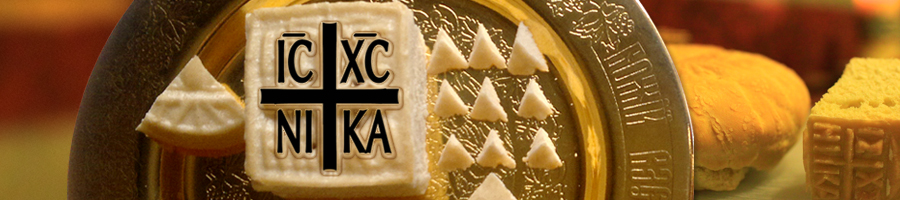
Just before the conclusion of the Divine Liturgy of this Sunday of the Cross the assemble faithful venerate the cross placed before them. This is not to be done mindlessly and robotically. With our venerations, we need to pray that the life-giving power of the Cross be ours. We are to take it into ourselves. And the crosses we wear, when in need, we should press them to our chests and pray for its victory to be ours. Additionally, There is another way in which we take up the Cross, which should be known by every Orthodox Christian. Impressed onto the surface of the bread that will become the Body of Christ, called the Lamb, is an image of the Cross. Above the arms of the cross are the Greek letters IC (an abbreviation for Jesus) on its right, and XC (an abbreviation for Christ) on its left. Below each arm is half of the Greek word nika, meaning “[he] conquers”. The two letters NI appear on its right, and KA on its left. When put together, we have the message, “Jesus Christ conquers!”
Thus, each time we consume the Body and Blood of Christ his Victory enters into every part of our being! By so doing we are given the spiritual power to conquer the cancer, or death of sin residing in situ within us. And more, by consuming Christ’s Body and Blood with spiritual and faithful purpose, we are given the power to embody Christ before the world and the entirety of creation which resides in sin, death, darkness, and alienation from God.
In conclusion, allow me to add this message from history. Prior to his decisive battle with his rival Maxentius, Constantine (not yet St Constantine) saw a vision of the Cross in the sky above him. The voice of the Lord came to him saying, “By this sign, Conquer!” Crosses were, in some manner, placed upon the shields of his soldiers. St Constantine was victorious. Therefore, let us afix ourselves to our crosses, and by them be victorious!
In Christ who is ever victorious,
Fr Irenaeus
Icons, Veneration, Presence, and Contact
Posted: March 10, 2025 Filed under: Etcetera, The Eucharist and Living the Eucharist | Tags: iconodules, icons offer contact to the spiritual realm, Icons offer presence, reverence of icons, Sunday or Orthodoxy, the Iconoclastic controversy, Triumph of the Church over iconoclasm, veneration of icons is not idolatry Leave a comment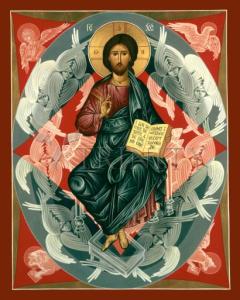
Christ Enthroned
The Sunday of Orthodoxy is the first Sunday of Lent. This is an annual commemoration of the triumph of the Orthodoxy Church over the heresy of iconoclasm. Iconoclasm involved the destruction of the icons of the Church. Those who destroyed icons were called iconoclasts, or “icon breakers.” Those who preserved and defended the Church’s use of icons were the iconodules, meaning “venerators of icons.” This controversy lasted over 120 years, and it wasn’t pretty.
For non-Orthodox Christians, and even some Roman Catholics this is no big deal: Icons are not found in, for example, Protestant churches. Protestant history involved, and still is involved in some form of iconoclasm. Here, they are foreign, and are objects of suspicion. Hence, Orthodox Christians are accused, falsely, of idolatry.
For several years now, there has been thousands of conversions to the Orthodox Church. Those who begin to explore the Church have many questions. Among them are questions about icons. Protestant objections to icons and their purpose in the Orthodox Church must be explained. Let me be clear: Orthodox Christians do NOT worship icons. We do not worship wood and paint. We worship only the Triune God: Father, Son, and Holy Spirit. St John of Damascus explains this point for us:
Concerning the charge of idolatry: Icons are not idols but symbols [in ancient understanding, the symbol contains within itself that which is symbolized], therefore when an Orthodox venerates an icon, he is not guilty of idolatry. He is not worshipping that pictured, but merely venerating it. Such veneration is not directed toward wood, paint or stone [mosaics], but towards the person depicted. Therefore, relative honor is shown to material objects, but worship is due God.
Icons…protect the full and proper doctrine of the Incarnation. While God cannot be represented in his eternal nature [his essence]…He can be depicted simply because he took on human flesh. Of him who took a material body, material images can be made. In so taking a material body, God proved that matter can be redeemed. He deified matter, making it spirit-bearing, and so if flesh can be a medium for the Spirit, so can wood and paint, although in a different fashion.
I do not worship matter, but the Creator of matter, who for my sake became material and deigned to dwell in matter who through matter effected my salvation.
Venerate and veneration are not commonly used words. A definition is put forth. When someone is venerated, respect and honor are shown to the person. The act of veneration of an icon is done by making the Sign of the Cross before, bowing toward it, and then kissing the icon (generally the right hand of the one depicted in the icon).
 Recently, a young Protestant man visited St Nicholas Orthodox Church in Tacoma, Washington. He was troubled by these actions and asked me to explain them to him. I used the illustration of a young child and a photograph of her grandfather. Such a young child may kiss the photo of her grandfather. She is expressing her love for the man; she is not worshipping him. Even at a young age she knows that the photograph is not her grandfather, but, simply, his image presented to her by the photograph. Again, she is expressing her love for him. In like manner, an Orthodox Christian’s veneration of an icon shows one’s love for the person presented to him, or her, by the icon.
I used purposefully the word presented. The one depicted by the icon, whether Christ, his Mother, or a saint, is presented to the one venerating the image. Its presentation offers presence. When Christ is depicted by an icon there is a sacramental presence of him which is offered to the one who venerates his icon. It involves a touch-point: the love and honor expressed by the act of veneration is passed along to Christ. There is a spiritual communication from the material of the icon to Christ himself, or to anyone presented by an icon.
Let me develop this idea with another illustration. I am writing this posting using, of course, the word processing program of my computer. To access this program, I touched the “icon” which presents the program to me. I have accessed the electronic workings of the program. So, as with the computer icon, so it is analogous with the icon of Christ: I have a point of contact with him, and my honor and love are passed on to him in this sacramental manner of contact.
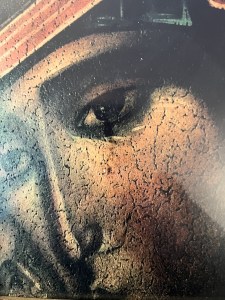
Note the two tears under the eye.
This sacramental, or spiritual, communication is not just a one-way road. Christ and his saints, especially Mary his Mother, communicate to the faithful via their icons. These communications are understood as miracles. For example, at St Anne Orthodox Church in Corvallis, Oregon (where I have served the Diving Liturgy many times), an icon of Mary brought forth a physical, liquid tear from her left eye. This event was captured by a photograph which is placed next to the actual miraculous icon.
Let me add this. Quantum physicists tell us that an electron, or some part of an atom (which is material), can occupy two places at once, and have some degree of communication across this separation in space and time. Furthermore, that which is spiritual and that which is material are not separated from each other in some dualistic existence as taught by some theologians and philosophers from past centuries. Rather, the spiritual and the material are in constant communication, contact, and in continual relationship with each other. Thus, we can understand the Sacraments and sacramental objects such is icons.
In conclusion, reality is not confined to the explanations offered by philosophers, false prophets, naturalists, and materialist. And I can’t resist…I quote Cat Stevens, “Oh baby, baby, it’s a wild world!”
In Christ who became matter for our salvation,
Fr Irenaeus
Gear Review Royale: Shubb Capo Royale vs Shubb Fine Tune Royale F1g
Posted: March 4, 2025 Filed under: Music and Guitars | Tags: Capo review: Shubb Capo Royale vs Shubb Fine Tune Royale Fig, Review of Shubb Fine Tune Royale Capo vs Shubb Capo Royale; Capo review of Shubb Fine Tune Royale F1g; adjustable screw capo vs yoke capo Leave a comment
R: Shubb Capo Royale, L: Shubb Fine Tune Royale F1g
I have done comparative capo reviews in previous postings. These reviews represent a type of a quest — all for the purpose of finding the “perfect capo.” The search continues, so now, I am comparing two previous winners: The Shubb Capo Royale (an adjustable screw capo) and Shubb Fine Tune Royale F1g (a yoke capo). There are good and bad capos, and I have discovered examples of both types. A good capo will offer no string buzz when applied to the fret board, and, more importantly, will maintain a good degree of tuning stability when applied. The all important factor of tuning stability will tested, and then put through statistical analysis to offer an objective decision and determine which will determine the winner.
Regarding the Shubb Capo Royale: It is, again, an adjustable screw capo which offers a clasping mechanism for neck attachment. The screw is tightened after application to apply direct downward pressure on the strings. Shubb offers its claim:
The Shubb Capo is designed to reduce tuning problems. Its custom material presses the strings just like your fingertip. Its unique design closes onto the neck just like your hand. Its pressure is totally adjustable. The result: no retuning is necessary.
Regarding the Shubb Fine Tune Royale F1g, It is a yoke style capo which also has a screw to supply pressure on the strings. The yoke style applies a direct, square downward pressure on the strings. Shubb offers this claim for its yoke capo:
…We are confident that it is the most accurate capo in the world…Its innovative adjusting knob makes it the most ergonomic screw-operated capo. The knob maintains a fixed relationship with the frame, for improved ease of use, and for the lowest profile when stored behind the nut. The knob’s six surfaces are numbered, providing a visual reference to more easily and accurately reproduce : ideal pressure. Greater contact area between screw, frame, and knob ensures that the fit will never become loose and sloppy. Specially developed rubber padding adds resilience to the capo’s closing action for finer control, and being absolutely inert, it will not mark an instrument. Improved jeweler’s style latch prevents accidental opening. Carefully machined to the closest thread tolerance.
Materials and Methods: I put the two capos to the test on four different acoustic guitars. The same Snark “Super Tight” electronic tuner is used for all testings. All four guitars were tuned to standard tuning. D’Addario nickel bronze acoustic light gauge strings (12 – 53) are on all guitars. Each capo was placed sequentially on frets 2, 5, and 7 on all guitars. All six strings were plucked in all positions to assess tuning stability. All guitars were retuned before repositioning each capo at the above noted positions. Any “distuning” caused by capo application was noted for each capo at every position on all six strings by the number of “minute” sharp increments (noted by “+”) from the in-tune “12 o’clock” position on the tuner. There was a total of 144 testings. For statistical analysis a two-tailed T-test was used, and both T and P values will be presented and explained in the results section found in the text below.
Results:
Rainsong N-JM11002 (Nashville Series) Carbon Fiber Acoustic Jumbo:
Shubb Capo Royale: a total of +7 minutes sharp (at fret 2 = +2, 4 strings in tune; fret 5 = +1, 5 in tune; fret 7 = +4, 3 in tune)
Shubb Fine Tune Royale F1g: a total of +2 minutes sharp (at fret 2 = 0, all strings in tune; fret 5 = +1, 5 in tune; fret 7 = +1, 5 in tune).
Rainsong BI-JM1000N2 Carbon Fiber Acoustic Jumbo:
Shubb Capo Royale: a total of +6 minutes sharp (at fret 2 = 0, all strings in tune; fret 5 = +3, 4 in tune; fret 7 = +3, 4 in tune).
Shubb Fine Tune Royale F1g: a total of +5 minutes sharp (at fret 2 = +1, 5 strings in tune; fret 5 = +3, 3 in tune; fret 7 = + 2, 4 in tune)
Breedlove Pro Series Spruce/Rosewood Acoustic Dreadnought:
Shubb Capo Royale: a total of +14 minutes sharp (at fret 2 = +2, 4 strings in tune; fret 5 = +5, 1 in tune; fret 7 = +7, none in tune)
Shubb Fine Tune Royale F1g: a total of +6 minutes sharp (at fret 2 = +2, 4 strings in tune; fret 5 = +1, 5 in tune; fret 7 = +3 minutes sharp, 3 in tune)
Composite Acoustic Legacy Carbon Fiber Acoustic Dreadnought:
Shubb Capo Royale: a total of +4 minutes sharp (at fret 2 = +1, 5 strings in tune; fret 5 = +1, 5 in tune; fret 7 = +2, 4 in tune)
Shubb Fine Tune Royale F1g: a total +3 minutes sharp (at fret 2 = 0, all strings in tune; fret 5 = +2, 4 in tune; fret 7 = +1, 5 in tune)
Total “Minutes” Sharp:
Shubb Capo Royale: +31 of 72 total string position testings
Shubb Fine Tune Royale F1g: +16 of 72 string position testings
T-Value = 2.24, and P-value = 0.027: Both values state that there is an objective and significant difference in string tuning stability. (A P-value < 0.05 shows significance, and the P-value of 0.027 means that there is a 97.3% chance that the result is not due to chance). The advantage goes to the Shubb yoke style capo.
Discussion and Conclusion:
One brief mention of string buzzing is noted. The Capo Royale caused one non-correctable buzz at the seventh fret of the sixth string on the Composite Acoustic Legacy dreadnought.

The winner: Shubb Fine Tune Royale F1g
The Shubb Fine Tune Royale F1g proved to be the superior capo for tuning stability. It appears that Shubb’s claim that “…We are confident that it is the most accurate capo in the world…” holds up to the test. Also, it must be stated that the greatest degree of tuning instability was observed on the Breedlove Pro Series dreadnought made from solid woods. Little difference in tuning stability was seen among the three carbon fiber guitars. It is likely that this is due to the structural stability that comes from carbon fiber construction — especially regarding the neck, though no bowing, etc., can be visually seen with the naked eye down the Breedlove’s neck. This difference in tuning stability found with all wooden guitars has been noted in previous reviews. With all testings, the carbon fiber guitars have consistently provided a superior tuning stability when compared to solid wood acoustics.
Ease of application goes to the adjustable screw capo — the Shubb Capo Royale.
I own Shubb’s Fine Tune F1g yoke style capo, and will be consistently using in on my guitars. I must add that its price tag may dissuade many players from purchasing one: it sells for $80 to $85 dollars. For me, it is worth it since I use capos more than half of the time when I play, whether I use standard capos, or a partial capo (also a Shubb).
Keep on playing,
Fr Irenaeus
This Is My Body…This Is My Blood
Posted: February 26, 2025 Filed under: The Eucharist and Living the Eucharist | Tags: anamnesis, Christ continually gives his Body and pours out his Blood via the Eucharist, Christ re-presents himself in the Eucharist, entrance into the Kingdom of God, Eucharistic presence of Christ, St John 6: 50 -51, St Luke 22: 19 - 20, St Luke's account of the Last Supper, the present Greek participle, The Words of Institution Leave a commentThe words and actions of Jesus in the Last Supper are examined in this posting. St Luke’s account will be the Gospel examined since it contains the greatest amount of detail and information. Of primary interest is Jesus’ use of two Greek verbal participles which are highlighted by italics and underlined:
And after taking bread and giving thanks, he broke it and gave it to them saying, “This is my body which is being given (didomenon) in behalf of you: do this in my remembrance (anamnesin). And likewise the cup after the dinner, saying, “This is the cup of the new covenant in my blood, which is being poured out (ekchunomenon) in behalf of you (St Luke 22: 19 – 20).

The Last Supper
St Luke uses two present, passive participles in the above passage: didomenon (is being given), and ekchunomenon (is being poured out). Participles are “semi-verbs” — they occupy a middle ground between verbs and nouns/adjectives/adverbs. Regarding the verbal significance of the above participles, Greek verbs (and subsequently, participles) tell far more than when an action occurred, that is, in the past, or in present, or will occur in the future. Greek verbs also inform us of the quality of action. This quality of action is called aspect. In these verses we have present passive forms. Regarding the present aspect, we are to know that the quality of the action implies an ongoing action:
The present tense is basically linear or durative, ongoing in its kind of action. The durative notion may be expressed graphically by an unbroken line ( _____ ), since the action is simply continuous (James A. Hewett, New Testament Greek — A Beginning and Intermediate Grammar, Henderiskson, 1986).
The above two participles impart a number of meanings to the two verses. At first glance, the ongoing quality is necessary to correspond to the continual, repetitive tradition of offering the Eucharist (Communion) to Christians over the centuries since Christ’s institution of this Sacrament — his Body is continually being given, and his Blood continues to be poured out to the faithful.
However, the continual giving of his Body and pouring out of his Blood represent far more than a simple memorial. Jesus’ words signify a re-presentation of himself to the Church with every Eucharist. How do we know this? To answer this question, let’s turn to St John’s Gospel, and specifically the sixth chapter:
This is the bread which is coming down (katabainon) from heaven, in order that if someone might eat of it might also not perish. I am the living bread which came down (katabas) from heaven: if ever someone might eat of this bread he shall live forever, and the bread which I shall give is my flesh in behalf of the life of the world (St John 6: 50 – 51).
 The above present active participle, katabainon, points to ongoing, continual “coming down, or descending”. Thus, there is a Bread which is continually coming down from heaven. Our Lord then defines and clarifies what and who this Bread is in 6:51. He most clearly states that this continually nourishing Bread is none other that his physical body of the Incarnation — the body that came down — katabas (aorist participle — a completed action) — and which will be broken and given for the life of the world. They are one and the same! Hence, the Eucharist is a re-presentation of the entirety of the Incarnation to the Christian faithful!
Let’s move back to the participles found in St Luke. Again, they state that he is giving himself, and is pouring out himself for our salvation in an ongoing, continual manner. More specifically, Jesus’ words and actions in the Upper Room put into action his self-giving sacrifice on the Cross. They put into action his burial. They put into action his resurrection and ascension. They put into action his second coming in his glory.
To be examined next is St Luke’s use of the Greek word, anamnesis. It can be translated as “remembrance.” But it means far more than a memory from, let’s say, a past vacation. It means a “calling into presence.” It is an invocation calling upon God’s presence to be with us as we worship. This invocation begins with the first words of the Divine Liturgy: “Blessed is the Kingdom of the Father, and of the Son, and of the Holy Spirit, now and ever and unto ages of ages.” We thus, invoke and enter into the Kingdom of God. The three Persons of the Holy Trinity are with us as are the saints who are alive in Christ. Also gathered around us are all the events of our salvation as is summarized with these words of the Divine Liturgy that come just before the bread and wine, our Gifts, are offered to God:
Remembering this saving commandment and all those things which have come to pass for us: the Cross, the Tomb, the Resurrection on the third day, the Ascension into heaven, the Sitting at the right hand, and the second and glorious Coming.
Therefore, all of Christ — his Person and every action of his, past, present, and future — is re-presented to the Church. He and they envelope all who are present in worship. St Luke, by his use of anamnesis, informs us that the Gifts of bread and wine are far more than an empty token. I conclude with these words of Christ as presented to us in the Divine Liturgy:
Take! Eat! This is my Body which is broken for you for the remission of sins. And likewise, after supper, he took the cup saying: Drink of it, all of you! This is my Blood of the New Covenant which is being poured out for you and for many, for the remission of sins!
In Christ,
Fr Irenaeus
That We Might See
Posted: January 19, 2025 Filed under: Etcetera | Tags: Colossians 3: 12 - 16, Healing of the blind man of Jericho, Prayer Before the Gospel Reading, Proper spiritual clothing, Spiritual Sight, St Luke 18: 35 -43, St Marcarius the Great of Egypt Leave a commentIn every Divine Liturgy, before the Gospel reading, The Prayer of the Holy Gospel is read:
Illumine our hearts, O Master who loves mankind, the pure light of your divine knowledge, and open the eyes of our mind that we may comprehend the proclamations of your Gospels. Implant in us also reverence for your blessed commandments so that, having trampled down all carnal desires, we may lead a spiritual life, both thinking and doing all those things that are pleasing to you. For you, Christ our God, are the illumination of our souls and bodies, and to you we offer up glory, together with your Father, who is without beginning, and your all-holy, good and life-creating Spirit, and and forever and to the ages of ages.
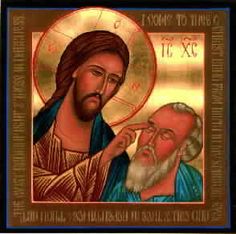 The Gospel reading for January 19, 2025 relays the account of the healing of the Blind Man of Jericho. The text comes from St Luke 18: 35 – 43. Jesus is on his way to Jerusalem, and he passes through Jericho. There is a blind man sitting along the way, and he is begging. He hears the crowd coming to him, and asks what is happening. The crowd informs him that Jesus is passing by with his disciples. A portion of the narrative reads,
Those going before him rebuked him so that he might be silent. But he cried out all the more, “Jesus, Son of David, have mercy on me!” Jesus stood and ordered him to be brought to him. And as he was drawing near, he asked him, saying, “What do you want me to do for you?” And he said, “Lord, that I might see!” And Jesus said to him, “See. Your faith has saved you.” And immediately he had sight, and he followed him glorifying God. And all the people seeing [this] gave praise to God (St Luke 18: 39 – 43).
As the text reads, with his regained sight he followed Jesus and gave glory to God. Hopefully, he was also now following with an illumined heart and with the eyes of his mind opened to walk along the path that leads to salvation. With such spiritual sight, and being led and empowered by the Holy Spirit, one will not wander from the path required by Christ:
Enter by the narrow gate; for the gate is wide and the way is easy that leads to destruction, and those who enter by it are many. For the gate is narrow and the way is hard that leads to life, and those who find it are few (St Matthew 7: 13 -14).
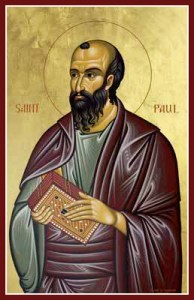 With such new, spiritual sight, we also need new and proper clothing for this journey with Christ. But first, we must discard improper clothing, clothing unfit for walking along the narrow path: “…and seeing that you have taken off the old man with his practices…put on the new man who is being renewed in knowledge after the image of his Creator”…(Colossians 3: 9 – 10). Thus, we see the need for a new wardrobe. From the day’s epistle reading St Paul tells us what we are to be wearing as we follow Christ:
Put on then, as God’s chosen ones, holy and beloved, compassion, kindness, lowliness, meekness, and patience. Forbear one another and if one has a complaint against another, forgiving each other; as the Lord has forgiven you, so you must also must forgive. And over all these put on love, which binds everything together in perfect harmony. And let the peace of Christ rule in your hearts, to which indeed you were called in the one body. And, become thankful. Let the word of Christ dwell in you richly, as you teach and admonish one another in all wisdom, and as you sing psalms and hymns and spiritual songs with thankfulness in your hearts to God (Colossians 3: 12 – 16).
Let me list the articles of clothing we are to wear: compassion, kindness, lowliness, meekness, patience, forbearance, forgiveness, love (as an overcoat), the peacefulness of Christ, and thankfulness.
There is a saying, “The clothes make the man.” How are these new clothes to be put on, or better, worked into our lives to make us the man, or woman, of God? The suit is put on by doing, or practicing, them. I offer a favorite axiom: “To become, you must do.”
Therefore, with renewed sight and new holy garments, we must have a new volition — a will that the Holy Spirit can use to accomplish our sanctification. St Macarius the Great of Egypt informs us:
For those truly believing in Christ, it is necessary to change and transform the soul from its present degraded nature into another, divine nature, and to be fashioned anew by the power of the Holy Spirit…He grants to everyone’s free will the grace of the Holy Spirit, which operates in an individual and directs the life of all who yearn to be saved.
I repeat the axiom: “To become, you must do.” We put on these garments of light and life by choosing to “do” them. As we choose and “do” these garments, these virtues will be worked into our souls — into our very being — by the Holy Spirit. These holy clothes will be seen and recognized by those who observe them when displayed by our lives of faith.
In closing, I present this prayer which is found near the conclusion of the First Hour:
O Christ, the True Light that enlightens and sanctifies every man that comes into the world, let the light of your countenance be signed upon us, that in it we might behold the Unapproachable Light. Guide our footsteps in the keeping of Your commandments, by the prayers of your most pure Mother and of all your saints. Amen.
The following is the corresponding sermon:
In Christ,
Fr Irenaeus
Gear Review of Two Yoke Capos: Shubb Fine Tune Royale F1g VS D’Addario Cradle Capo
Posted: January 1, 2025 Filed under: Etcetera, Music and Guitars, The Eucharist and Living the Eucharist | Tags: D'Addario Cradle Capo reviewed, Review of Shubb Fine Tune F1 yoke capo vs D'Addario Cradle Capo, Shubb Fine Tune F1 capo reviewed, varieties of guitar capos, Yoke-style guitar capos reviewed Leave a commentAs I have reviewed a number of capos over the years I have learned a good deal about them. The primary lesson learned is that not all capos are alike. There are capos of inferior and superior design. I have found that a good capo is determined by its design — specifically how a given capo applies pressure on the strings to the fretboard.
There are functionally four styles of capos:
-
- Strap and Toggle Capos. A strap or toggle using an elastic strap is wrapped around the guitar’s neck to apply the downward pressure on the strings.
- Trigger / Spring Capos. This class of capo is likely the most commonly used capo. A spring mechanism applies the needed downward pressure. With the trigger and spring capos there is the additional lateral pressure which brings the strings out of tune.
- Adjustable Screw Capos. This style offers a “clasping” mechanism for attachment to the neck. After application, a screw is tightened to apply direct square pressure onto the strings.
- Yoke Capos. These are very similar to the adjustable screw capos. They have an arm which is released for application to the neck. This style, too, is tightened by the screw to supply pressure on the strings. The yoke style offers direct, square pressure on all strings.

Top: Shubb Fine Tune Royale F1g, Bottom: D’Addario Cradle Capo
As the title states, I will compare two yoke-style capos: the Shubb Fine Tune Capo Royale F1g, and D’Addario’s Cradle Capo. I add the manufacturers’ claims and descriptions for both capos.
Shubb Fine Tune Royale F1g:
…We are confident that it is the most accurate capo in the world…it can remain on the guitar (behind the nut) when not in use.
Its innovative adjusting knob makes it the most ergonomic screw-operated capo. The knob maintains a fixed relationship with the frame, for improved ease of use, and for the lowest profile when stored behind the nut. The knob’s six surfaces are numbered, providing a visual reference to more easily and accurately reproduce your ideal pressure. Greater contact area between screw, frame, and knob ensures that the fit will never become loose and sloppy. Specially developed rubber padding adds resilience to the capo’s closing action for finer control, and being absolutely inert, it will not mark an instrument. Improved jeweler’s style latch prevents accidental opening. Carefully machined to the closest thread tolerance.
D’Addario Cradle Capo:
Even tension. Always ready…With its stainless steel, self-centering design, the Cradle Capo ensures even tension across the fretboard. Its adjustable micrometer lets you dial in the perfect pressure, while allowing the freedom for quick transitions and the ability to stay on the guitar, even when not in use.
Hypothesis: Given identical design and mechanism I posit that both capos will offer near identical tuning stability as well (as no string buzzing). A two-tail T-test will be used to “objectively” test my hypothesis. Both T and P values will be presented for assessment. The meaning of both values will be explained.
Material and Methods: I put the capos to the test on three different guitars. The same Snark “Super Tight” electronic tuner is used for all testings. All three guitars were tuned to standard tuning. Each capo was placed sequentially on frets 2, 5, and 7 on all three guitars. All six stings were plucked to assess tuning stability. Each guitar was retuned before repositioning each capo at the above mentioned frets. Any “distuning” caused by the capos was noted for each capo at each position (on all six strings) by the number of “minute” increments (flat and/or sharp noted by, for example, -1 for flat, or +2 for sharp) from the “12 o’clock” (the “in tune” position) on the tuner. There were a total of 108 testings. Also, both Rainsong guitars possess the N2 style neck.
Results: Here are the results in terms of total “distuning minutes” at all three fret positions (again 2, 5, and 7).
Rainsong N-JM1100N2 (Nashville Series) acoustic jumbo:
Shubb: +8 (at fret 2 = +1, 5 strings in tune; fret 5 = +3, 3 in tune; fret 7 = +4, 2 in tune)
D’Addario: +8 (at fret 2 = +1, 5 strings in tune; fret 5 = +4, 2 in tune; fret 7 = +3, 3 in tune)
Rainsong BI-JM1000N2 (Black Ice Series) acoustic jumbo:
Shubb: +11 (at fret 2 = +2, 4 strings in tune; fret 5 = +4, 2 in tune; fret 7 = +5, 1 in tune)
D’Addario: +12 (at fret 2 = +4, 2 strings in tune; fret 5 = +4, 2 in tune; fret 7 = +4, 2 in tune)
Paul Reed Smith (PRS) SE Starla solid body electric:
Shubb: +6 (at fret 2 = +2, 4 strings in tune; fret 5 = +2, 4 in tune; fret 7 = +2, 4 in tune)
D’Addario: +16 (at fret 2 = +3, 3 strings in tune; fret 5 = +6, none in tune; fret 7 = +7 none in tune)
Total “minutes” sharp:
Shubb: +25 of 54 total string position testings
D’Addario: +36 of 54 total string position testings
T = – 1.94: This states that a moderate difference exists in tuning stability between the two yoke-style capos. My hypothesis that there would be no tuning difference is to be rejected.
P value = 0.054: For a proven statistical difference, the P value has to be </= 0.05. The value of 0.054, though it approaches statistical significance, only indicates that the difference in tuning stability shows a “trending” to a superior tuning stability. Thus, it also informs me that I am to reject my hypothesis.
Discussion and Conclusion:
First, neither yoke capo caused any string buzzing at any position tested. Given the difference in the number of “sharp minutes” between the two yoke capos, I am to conclude that the Shubb Fine Tune Royale F1g capo shows a trend to be moderately superior to the D’Addario Cradle Capo in terms of tuning stability.
The winner: Shubb Fine Tune Royale F1g
What, then, might explain this trend? The “rubber / plastic” material that comes in contact with the strings is identical in width (7 mm). Their lengths differ by 1.0 mm, (Shubb 48 mm, D’Addario 49mm). Subjectively, the density of the rubber material feels the same. Could weight cause the difference affecting results? The Shubb capo weighs 38 grams while the D’Addario capo weighs 23 grams. I am uncertain about the significance of this difference. The only other variable that could explain this difference could be the tightening mechanism which presses upward from the back of the neck: the Shubb mechanism feels more sturdy, and likely offers a more secure pressure.
Given the two yoke-style capos, I will choose to use the Shubb Fine Tune Royale capo on my guitars. Both capos are more expensive than any of the other varieties of capos noted above: Shubb = $80 – 85 (Shubb direct purchase); D’Addario = $69.99 (Reverb), but as it is said, “You get what you pay for,” if you find it necessary to add either capo to your gear bag.
Keep on playing!
Fr Irenaeus
Every Good and Perfect Gift
Posted: December 24, 2024 Filed under: Etcetera, The Eucharist and Living the Eucharist Leave a comment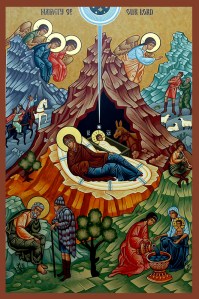 Near the conclusion of every Divine Liturgy is “The Prayer Before the Ambo.” A portion of it reads, “For every good gift and every perfect gift is from above, coming down from you, the Father of Lights.” This, of course, has as its source St James 1: 17.
Gifts and gift giving are part of the Christmas tradition, but any gift given by a human being to another pales in comparison to the Gift that is truly good and perfect which came down from the Father of Lights, that is his gift of Jesus:
For God so loved the world that he gave his only-begotten Son, that whoever believes in him should not perish but have eternal life (St John 3: 16).
The Father’s Gift, his Son, is God of God, Light of Light, true God of true God, begotten not made, of one essence with the Father.
Gifts are to give delight, joy, and gratitude. That is certainly the case when one thinks of a gift given from a parent, spouse, or friend. Yet, isn’t it also the case, though, that such gifts are generally and eventually forgotten. They are no longer valued, and ultimately discarded.
“For every good gift and every perfect gift is from above, coming down from you, the Father of Lights.” However, some gifts that may come from the Father of Lights may not be received by us initially with delight, joy, and gratitude.
Can a good and perfect gift from the Father of Lights be difficult to receive with delight, joy, and gratitude? The answer is, yes. But, the wisdom of faith must alter our perspective and perception. With the eyes of faith and wisdom a difficult and troubling gift can be received into one’s heart. I recall two such gifts. One was very challenging, the other was less difficult to receive, but both gifts permanently changed my life for the better.
During the Fall of October, 1997 I received a challenging and harsh gift. I was working as a clinical pharmacist at a hospital located in south King County in Washington State. For much of my life I had a problem with anger. Occasionally, such anger flashed for a moment and then receded. But in one case, anger exploded. I was, rightly, called on the carpet. I was suspended without pay for five days, then had to have repeated counseling sessions for an indefinite time. My first reaction was to reject this gift. I applied for another position at another area hospital. I justified myself not realizing that anger, once and for all, had to dramatically diminish in my life. St James informs us:
Know this, my beloved brethren. Let every man be quick to hear, slow to speak, slow to anger, for the anger of man does not work the righteousness of God (St James 1: 19 – 20).
But, while I was suspended and grumbling, I received a message: “Submit, then you will have victory.” And, so I did. And, of course, I entered into victory — the monster was reduced to a tiny mouse (well, in my case, at least a modestly sized rat). The counseling sessions came to an early end. Relationships were mended, and I moved through the rest of my time at this hospital with joy and humor.
The second gift also occurred while working at the same hospital in May, 2002. I had just completed my seminary education. During this time I sensed an inconsistency in my life. I had discovered the Eucharist and embraced it whole heartedly. But, I was missing something: What I had in my head had not yet moved truly into my heart. I did not yet receive all things into my being with thanksgiving.
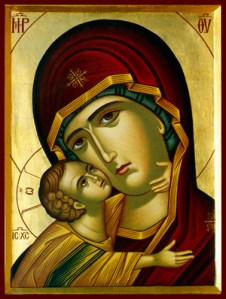 The day was beautiful in the morning sun. As I was walking from my car to the hospital, I asked God to help connect my head to my heart. For some reason I had to work in the central pharmacy with all of its given challenges. It was an exceptionally stressful day. The phones were ringing off their hooks. I felt the tension and stress all others felt. The phone by my desk rang and and I engaged the surrounding irritation. But, another message came my way: “Say thank you!” I said thank you for the annoying phone call which was a gift in disguise. At the other end of the phone was the most annoying nurse in the hospital. I listened to her express her trouble. I went to the medical floor she worked on and solved her problem. Not only was the problem solved, but my attitude about her changed — she suddenly became “delightful”, or as close as she could be to this state of being. My head and heart were united by this gift’s insight to the Eucharist (which means thanksgiving) — I am to give thanks for all things, circumstances, and people.
With this spiritual insight, all events, situations, and people — however difficult — can be received as gifts from the Father of Lights. Even, pain, illness, etc., can be received as gifts, and the power of prayer and thanksgiving transforms them to empowering gifts. We have this instruction from St Paul to his spiritual son, Timothy:
For everything created by God is good, and nothing is to be rejected if it is received with thanksgiving, for it is consecrated through the word of God and prayer (1 Timothy 4: 4 – 5).
All things, thus, can be seen as gifts from the Father of Lights. For all matters and circumstances that come our way, I present words for St Paul by which I try to live every day. I use them to guide me that I might walk in the ways of our Lord:
Rejoice always. Pray constantly. Give thanks in, with, and for all things; for this is the will of God for you in Christ Jesus (1 Thessalonians 5: 16 – 18).
 And so it is Christmas! We have prepared ourselves once more to receive the Divine Infant — the Good and Perfect Gift from the Father of Lights into our hearts. We do this so that Jesus can be formed within. Thus, all things can be seen as gifts for the Father of Lights. All such gifts when received from the Father of Lights with gratitude will further form Christ in us, so that we might bear Christ into all settings of life. If we do this, then every day will offer a touch of Christmas!
Christ is born! Glorify him!
Here is an abbreviated homily that corresponds to this posting:
In Christ, and in every good and perfect gift from the Father of Lights,
Fr Irenaeus
Union with Christ and the Parable of the Rich Fool
Posted: November 19, 2024 Filed under: The Eucharist and Living the Eucharist | Tags: all things are held in Christ by his Incarnation, baptism unites us to Christ's death and resurrection, Be rich towards God, be self-giving and other-receiving, Christians are participants in the divine nature, Galatians 2: 20 Christ lives in me, Recapitulation, Romans 6: 3 - 5 and baptism, set your mind on things above, St John 15: 3 -4, St John 6: 53 -56, the metaphor of the Branches and the Vine, the mystery of Christ in us - the hope of glory, the Parable of the Rich Fool, theosis as a model of salvation, through the Eucharist Christ abides in us and we in Christ, Union in Christ, we are seated in Christ in the heavens Col 3: 1 -4, we bear Christ to the world, we beat Christ to creation 2 Comments Throughout his epistles St Paul writes about his, and our, union with Christ. By this union Christ indwells us, and we indwell Christ. The epistle reading for the ninth Sunday of St Luke comes from his letter to the Galatians. We have this verse:
I was crucified together with Christ. I no longer live, but Christ lives in me. The life I now live in the flesh, I live by faith in the Son of God who loved me and gave himself up for me (Gal 2: 20).
With this verse, St Paul states he was co-crucified with Christ. How did this come about, and by what means? The answer comes from baptism — both his and ours:
Or are you ignorant that everyone who was baptized in Christ Jesus, was baptized into his death? Therefore, we were buried together with him through baptism [dia tou baptismatos – showing agency] unto death in order that just as Christ was raised from death through the glory of the Father, so that we might walk in newness of life. For if we were conformed to the likeness of his death, even more we shall be united with his resurrection (Romans 6: 3 – 5).
St Paul teaches we also have union with his resurrection. We have been joined, or united, to Christ’s resurrection.
In addition to baptism, the sacrament of the Eucharist also brings about this union with our Lord:
Therefore, Jesus said to them, “Truly, truly I say to you unless you eat the flesh of the Son of Man and drink his blood you have no life in you. The one who is eating my flesh and is drinking my blood has eternal life, and I shall raise him in the last day. For my flesh is true food, and my blood is true drink. The one who is eating my flesh and is drinking my blood abides in me and I in him (St John 6: 53 – 56).
We also maintain this union with Christ by conducting our lives according to his teachings. St John records these words of Jesus from the metaphor of the Vine and the Branches:
Already you are clean by the word which I have spoken to you. Abide in me, and I in you. Just as the branch is not able to bear fruit on its own unless it should abide in the vine, likewise neither can you, unless you abide in me (St John 15: 3 – 4).
Our salvation consists not only of the forgiveness of sins. Though this forgiveness is foundational, there is more to salvation. It is ultimately, and in its fullest form, a relational union by, in, with, and for Christ. In his letter to the Colossians, St Paul gives us a summary statement:
…the mystery which has been hidden from the ages and generations, but now has been manifested to his saints. To them God chose to declare how great among the Gentile are the riches of the glory of this mystery, which is Christ in you, the hope of glory (Colossians 1: 26 – 27).
This leads us to the salvific model of theosis. As this union is worked, or penetrates, into the entirety of our being, we are partakers of the divine nature, and we become godly, and godlike. Christ is formed within us because we carry within us God the Son.
Furthermore, St Paul instructs us that this union exists even beyond our present physical condition:
If, therefore you have been raised together with Christ [the Greek construction affirms the positive], seek the things above, where Christ is seated at the right hand of the Father. Set your mind on the things above, not on the things of earth. For we died, and our life has been hidden together in Christ in God. Whenever Christ is manifested, who is your life, then also you shall be manifested together with in in glory (Colossians 3: 1 – 4).
Even now, St Paul declares, we are seated together with Christ and will experience our resurrection by this ontological union! I offer a listing of these facts about our salvation:
+ Christ lives in us, and we live for him.
+ We were crucified together with Christ by our baptism
+ We were raised together with Christ by our baptism
+ If we are eating and drinking his Body and Blood we abide in Christ and he in us.
+ If we by faith conduct our lives according to the teaching of Christ we abide in him and he in us.
+ We are hidden together with Christ in the heavens.
+ Christ is in us — the hope of glory
This union in Christ represents just a part of a greater union which extends far beyond ourselves. St Paul informs us of what is called recapitulation:
[I am] declaring to you the mystery of his will, according to his good pleasure, which he set forth in him for the plan for the fullness of the ages, to gather together all thing in Christ — those things in the heavens and those things upon the earth (Ephesians 1: 9 – 10).
Hence, I expand upon recapitulation. Jesus becomes a creature by assembling his human body from the elements of carbon, nitrogen, sulfur, oxygen, etc., in the uterus of Mary. Thus, as a microcosm of creation, Christ has gathered together everything and everyone into himself. By this he has undone the shattering and scattering of all things into death, darkness, sin, and alienation when Eve disobeyed and Adam capitulated which led to the sin that occurred in the Garden. Adam and Eve were to be the stewards for the care of all creation. They were to serve it as priests, vice regents, and prophets of God for all of creation. They failed. Christ succeeded. He overcame death and granted life for all and all things by his resurrection. By his ascension into heaven all things are held together in him in his glorified body.
This union with Christ demands that we walk in newness of life, and in this newness of life bear Christ to all of humanity and all of creation. This will mean an ongoing struggle of our will to be conformed to his will and ways. But, we are empowered by the Holy Spirit (who also abides in us) who works with us to overcome our sins as we choose to cooperate with him.
Let’s now move to St Luke’s Gospel reading for the day. It gives us The Parable of the Rich Fool. This parable tells us what we are not to do in this life. There is a background for today’s reading which is from St Luke 12: 13 – 15. An outline is presented,
A man asks Jesus to judge between him and his brother for a proper division of the inheritance.
Jesus replies: “Man, who made me judge or divider over you? Take heed, and beware of all covetousness; for a man’s life does not consist in the abundance of his possessions.”
 Now we move to the Rich Fool: He had an abundance of crops from his harvest. It was so great that it could not be properly stored. He tears down the old, and builds new barns and granaries to hold the abundance. So far we have no foul. However, this changes when we discover this internal monologue: “Soul, you have ample good laid up for many years; take your ease eat, drink, and be merry!” (St Luke 12: 19). So, here we have the foul: He saw his harvest and wealth to be exclusively for his own enjoyment. God replies to his folly:
Fool! This night your soul is required of you. And the these you have prepared, whose will they be? So is he who lays up treasure for himself, and is not rich toward God (St Luke 12: 19 – 20).
So what can be said about The Rich Fool: He could have partied and feasted with the blind, the lame, the poor — those who could never repay him. He could have given from his surplus to feed those in need. He could have shared from the profits of sales with the poor of his synagogue. Like the Rich Man who ignored Lazarus, all he had to do was give of himself and of his wealth to bring aid and comfort to another.
With our salvation — our relational union in, with, and for Christ — we are to conduct ourselves according to his teachings.
Work out your own salvation with fear and trembling; for God is at work in you, both to will and to work according to his good pleasure” (Philippians 2: 12b – 13).
As noted above, we are to set our minds on things above — things which will last, and not on the things of this world system which will perish. We can make a summary with this instruction: Be self-giving and other receiving!
Here is a corresponding sermon given at St Nicholas Greek Orthodox Church in Tacoma, WA given on 11/17/24:
In Christ,
Fr Irenaeus
Your Neighbor is Here, There, and Everywhere
Posted: November 11, 2024 Filed under: Etcetera, The Eucharist and Living the Eucharist | Tags: living the Beatitudes, loving your neighbor as yourself, Parable of the Good Samaritan, spiritual bandages and medicines Leave a commentThis posting examines the parable of the Good Samaritan which is found in St Luke 10: 25 -37. It begins with a dialogue between Jesus and an expert in the Mosaic Law.
The lawyer tests Jesus: “What must I do to inherit eternal life?”
Jesus in reply (also testing him): “What is written in the law? How do you read it?”
The lawyer gives his reply: “You shall love the Lord your God with all your heart, with all your soul, with all your strength, with all your mind, and your neighbor as yourself.
Jesus: “You have answered correctly. Do this and you shall live.”
The lawyer, wishing to justify himself, asks, “And who is my neighbor?”
 We now move to a brief summary of the parable. As we all know, those who occupy a similar religious office as the lawyer, are cast as the villains because they ignore and pass by the injured man in need of rescue. Then Jesus gives a twist to the plot; the hero is an unexpected and despised — in the mind of the lawyer — Samaritan who stops to help to the man.
The despised Samaritan exhibits compassion: He binds his wounds, and also medicates the wounds with oil and wine. He then takes him to an inn for further care, and extends the care of the injured man with his own money to compensate the innkeeper.
The epistle reading that accompanies the Gospel reading from St Luke comes from Galatians 1: 11 – 19. The subject is St Paul’s calling to be an Apostle. From Galatians 1: 15 – 16 we read this: “But he who set me apart from my mother’s womb, and had called me through his grace, revealed his Son to me that I might preach the Good News of him to the Gentiles.” He was set apart, and called to be an Apostle and given a defining ministry that continues for us to this day.
Though we are not called to be an Apostle as he, the 12, and the 70 were called, we have a calling! In his first epistle, St Peter writes,
But as he who called you is holy; be holy yourselves in all your conduct; since it is written, “You shall be holy, for I am holy (1 Peter 1: 15 – 16).
St Paul informs us of our ministry that results from our baptism — a ministry of works of faith. Regarding works that arise from faith in Christ, St Paul informs us of this in Philippians 2: 12b – 13:
Work out your own salvation with fear and trembling; for God is at work in you, both to will and to work for his good pleasure.
He writes this as well in his letter to the Ephesians:
For by grace you have been saved through faith; and this is not of your own doing, it is the gift of God — not because of works, lest any man should boast. For we are his workmanship, created in Christ Jesus for good works, which God prepared beforehand, that we should walk [peripataesomen] in them (Ephesians 2: 8 – 10).
When St Paul uses the word walk it is to be understood that it refers to how a Christian is to be conducting his / her life, and how we are to conform our thoughts and actions to match and imitate Christ. Essentially, as the lawyer correctly notes, “We are to love our neighbors as ourselves.”
I pose a question: Where do we find our neighbor? As Sir Paul might answer, they are here, there, and everywhere. The walking wounded are all around us — here, there, and everywhere.
What are our bandages, oils, and wines? Before I offer my attempt to answer this question, let me put forward this admonition from St Paul, “Now, I urge you brethren, to warn the idle…” (1 Thessalonians 5: 14). With this, let the focus be on spiritual idleness. There is a saying: “Comfort the afflicted; afflict the comfortable. Also, there are times we need to be lovingly disturbed in a way to move us more deeply into the ways of Christ. However, we are to cause no one and no thing distress by acting or speaking out of anger, irritation, or annoyance. Rather, you and I are to seek to relieve the distress of others, and all things, by living according to the Beatitudes:
Blessed are the poor in spirit, because the Kingdom of Heaven is theirs. Blessed are those who are mourning, because they will be comforted. Blessed are the meek, Because they will inherit the earth. Blessed are those who are hungering and thirsting for righteousness, because they will be satisfied. Blessed are the merciful, Because they will receive mercy. Blessed are the pure in heart, because they will see God. Blessed are the peacemakers, because they will be called the sons of God. Blessed are those who are persecuted for the sake of righteousness, because theirs is the Kingdom of Heaven. Blessed are you when men insult you, persecute you and speak evil of you falsely for my sake. Rejoice and be glad because your reward is great in heaven, for so they persecuted the prophets who came before you (St Matthew 5: 3 – 12).
The Beatitudes — they are not given by Christ to be spiritual ideals — they are to be embodied. They are to be worked into our lives by living them. As per one of my favorite axioms: We must do to become.
I return to my question posed above. What are our bandages and medicines? The are love, kindness, prayer, mercy, humility, giving assistance (among many other treatment options). Yes, even smiling can provide a soothing balm.
Do this, and we shall live!
In Christ,
Fr Irenaeus
The Seventh Ecumenical Council and Being an Icon
Posted: October 14, 2024 Filed under: Etcetera, The Eucharist and Living the Eucharist | Tags: Being an icon, humans are living icons, humans bear the image of God, iconoclast, iconodules, Icons declare the Incarnation, Orthodox Christians venerate icons, Orthodox Icons are not idols, St John of Damascus, the Seventh Ecumenical Council, venerating icons Leave a commentThe seventh ecumenical council was convened in 787 by Emperor Contantine VI and Empress Irene. It was attended by 308 bishops and presided by Tarasios of Constantanople. Addressed was the iconoclastic controversy. There were two parties: the iconoclasts, or “icon breakers”, and the iconodules, or the “venerators of icons.”

Christ the Good Shepherd
Many issues were at play, among them the Christian attitude towards matter, and the nature of redemption and salvation. Its history was varied and complex, but was influenced by Muslims and Jews who were profoundly opposed to any expression of “spiritual reality” by “physical, material expressions.” Also there were always “puritans” in the Church who saw all material and physical expressions of the faith as a potential for the occurrence of idolatry.
Here are three quotes from St John of Damascus who informs us of the Orthodox teaching concerning icons:
Concerning the charge of idolatry: Icons are not idols but symbols, therefore when an Orthodox venerates an icon, he is not guilty of idolatry. He is not worshipping that pictured, but merely venerating it. Such veneration is not directed toward wood, or paint or stone, but towards the person depicted. Therefore, relative honor is shown to material objects, but worship is due to God.
We do not make obeisance to the nature of wood, but we revere and do obeisance to Him who was crucified on the Cross…When the two beams of the Cross are joined together I adore the figure because of Christ who was crucified on the Cross, but if the beams are separated, I throw them away and burn them.
Icons are necessary and essential because they protect the full and proper doctrine of the Incarnation. While God cannot be represented in his eternal nature [his essence]…He can be depicted simply because He took on human flesh. Of Him who took a material body, material images can be made. In so taking a material body, God proved that matter can be redeemed. He deified matter, making it spirit-bearing, and so if flesh can be a medium for the Spirit, so can wood and paint, although in a different fashion.
However, the iconoclastic heretics forgot ONE main truth which they seem to have ignored. At the core of the argument for the making and veneration / honoring of icons is this: there has always been a material manifestation of the invisible God. Regarding all humanity we read this from Genesis 1:26, 27:
Then God said, ‘Let us make man in our image [eikon] and likeness…so God created man in his own image, in the image of God he created him; male and female he created them.
Next we have these passages from the New Testament regarding Christ:
In many and various ways God spoke of old to our fathers by the prophets; but in these last days he has spoken to us by a Son, whom he appointed the heir of all things, through whom he created the ages. He reflects the glory of God and bears the very stamp of his nature… (Hebrews 1: 1 – 3)
He is the image of the invisible God…(Colossians 1: 15a)
And the Word became flesh and tabernacled among us, full of grace and truth; we beheld his glory, glory as the only-begotten Son of the Father (John 1: 14).
That which was from the beginning, which we have heard, which we have seen with our eyes, which we have looked upon and touched with our hands, concerning the word of life — the life was made manifest and we saw it, and testify to it, and proclaim to you the eternal life which was with the Father and was made manifest to us (1 John 1: 1 – 2).
St John of Damascus summarizes for us:
I do not worship matter, but the Creator of matter, who for my sake became material and deigned to dwell in matter, who through matter effected my salvation.
Now I bring forward a shift to ethics, or moral theology. Here are words from Exodus regarding both God and images:
I am the LORD your God, who brought you out of the land of Egypt, out of the house of bondage. You shall have no other Gods but me. You shall not make for yourself a graven image, or any likeness of anything that is in the heavens above, or that is in the earth beneath, or that is in the water under the earth; you shall not bow down to serve them…You shall not take the name of the LORD your God in vain; for the LORD will not hold him guiltless who takes his name in vain.
These first three commandments uphold for Israel the integrity of God for them. “You shall love the LORD your God with all your heart, and with all your soul, and with all your mind” (St Matthew 22: 37). The other seven commandments are to uphold the integrity of the image bearers of God and their relationship with one another, and with God their LORD: “You shall love your neighbor as yourself” (St Matthew 22: 39).
Why couldn’t the Jews from an image of God? Because the Icon of God, Jesus, had not yet been revealed to them, “And the Word became flesh and tabernacled among us.” I again quote from St John of Damascus:
I do not worship matter, but the Creator of matter, who for my sake became material and deigned to dwell in matter, who through matter effected my salvation.
 The first iconoclast did not appear in the eastern empire in the 7th or 8th century, but in the Garden of Eden! The serpent was the first iconoclast. Truly, the Serpent was the first iconoclast: he deceived and marred those who were created in the image of God. Though the image of God was not lost, the integrity was lost. Humanity lost communion with God, and with the creation they were to serve as God’s vice-regents and priests. Rather than serving and cultivating creation in love, its exploitation began. Rather than upholding the dignity of humanity, humans began to degrade other humans.
The complaint of the Psalmist truly was the complaint of all humanity:
The enemy has pursued me. He has crushed my life to the ground, and has made me sit in darkness like those long dead” (LXX Psalm142, MT Psalm 143).
Jesus Christ Conquers
We were not left alone to never ending lament and sorrow. God intervened and rescued us from such darkness, bondage, and alienation. We were delivered from sin and its death. We were liberated by the one God-man “commando raid” of the Incarnate God, Jesus Christ, who is the image and likeness of God (“…If you have seen me, you have seen the Father…” John 14: 9). Christ came as our Victor. He liberated us. He re-created us. He restored the image of God in us. He exalted us even beyond our original status.
The image of God has been restored, and is being restored in us as we exist in relational union in Christ, and cooperate with the Holy Spirit who sanctifies us. We are 3-D icons. We are living, moving, breathing icons and priests. As such icons and priests we declare to all of creation, by our actions, what God is like.
Hence, we are given an ethic in the category of an ethic of being. By this ethic we are to understand this: we are to bear God to all creation by holy actions and prayers and words of blessing, and bear creation to God by our prayers and offerings. We are to work with God to uphold, and restore the image of God in one another as we love and serve one another. St Paul instructs us:
Do not repay evil for evil, but pursue the good both for one another and for all. Rejoice always. Pray constantly. Give thanks in, with, and for all things, for this is the will of God for you in Christ Jesus (1Thessalonians 5: 15 – 18).
Thus, we are either truthful icons demonstrating God’s love to humanity and creation, or we are false icons that tell lies about what God is like. We are either iconodules or we are iconoclasts.
Here is the corresponding sermon:
In Christ who is the Icon of the invisible God,
Fr Irenaeus
Living in the Underground
Posted: September 27, 2024 Filed under: The Eucharist and Living the Eucharist | Tags: acting by faith without thought of benefit, becoming "sons of the Most High", becoming compassionate, do to others as you would have others do to you, growing in compassion, lend without expecting repayment, living in a parallel society, love your enemies, St Luke 6: 31-36, St Matthew 5: 1-49, subverting the world system, the "economy" of the Kingdom of Heaven, the Beatitudes and living counter culturally Leave a commentThe underground. For me, the thought of the “underground” brings images of underground resistance fighters secretly operating to fight an oppressive tyrant. In any case, those who “live in the underground” conduct their lives around an alternative set of rules to achieve a desired goal.
Our Lord Jesus Christ has also constructed an alternative society — an underground movement. Here, those who are of the Church are to live lives that are in profound contrast to those who live according to the world system. Much of the sixth chapter of St Luke’s Gospel spells out, in part, how we who live in the alternative society of the Church are to conduct lives:
As you wish men to do to you, do so to them. If you love those who love you, what benefit of grace is that to you? For even sinners love those who love them. If you do good to those who do good to you, what benefit of grace is that to you? For even sinners do the same. And if you should lend to those whom you hope to receive back, what benefit of grace is that? Even sinners lend to sinners in order to receive back what is lent. Rather, love your enemies, do good and lend not expecting anything in return, and your reward shall be great, and you will be sons of the Most High, because he is good to the ungrateful and the evil. Become compassionate just as your Father is compassionate (St Luke 6: 31 – 36).
The Sermon on the Mount
Both St Luke (see St Luke 6: 20 – 49) and St Matthew (see St Matthew 5: 1 – 48) offer behaviors that are of the underground life of the Church — ways of thought and living that are stark alternatives to the “economies” (the Greek word means “how a house is managed”) of the world system. The teachings of our Lord in these scriptural passages invert and subvert the “economies” of the world system. By them, a behavioral counter culture of the Kingdom of Heaven is established. Undoing, defeating, subverting the world system is not accomplished by operating by the same methods. We do not fight fire with fire. St Paul offers a corresponding, definitive rule:
Do not repay evil for evil, but always pursue the good both for one another and for all. Rejoice always. Pray constantly. Give thanks for all things for this is the will of God for you in Christ Jesus (1 Thes 5: 15 – 18).
“Become compassionate just as your Father is compassionate.” This is not just to be a goal, but it is to be our reality! Several years age while hearing a man’s confession he stated he wished to be compassionate, “but I just don’t feel like being compassionate.” I responded by telling him that we don’t wait for a feeling to act for good. It may never come. Rather, I suggested that he “do compassion” and you will become compassionate. I added, “Look for common situations your life to do compassionate things.”
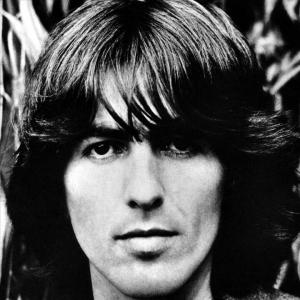
George Harrison
A better term for an underground society is a parallel society — it offers a more constructive foundation for action. In the parallel society which is the Church — as we faithfully follow Christ’s teachings — we will love those who hate us. We will do good and extend ourselves to others without thought of compensation. We, by doing, will become who we are to be in Christ. However, we have to start out with small steps that are realistic and obtainable. For example, if one only know three guitar chords one cannot expect to play the Beatles’ Here Comes the Sun. But, by practicing and expanding one’s “guitar chops” in “the woodshed”— one day one will be able to play George Harrison’s wonderful and beautiful song. Similarly, regarding works of faith, we start out small and work our way up as we, by faith, cooperate with the Holy Spirit and grow in his ways.
Now, I present a thematic shift — a shift to thoughts and how we think. This shift is important since our thoughts will determine how we act and form our lives. From the Prayer of the Hours we have this: “…Sanctify our souls, purify our bodies, set aright our minds, cleanse our thoughts.” Along with this, I offer words from Elder Thaddeus of Vitovnica:
Our life depends on the kind of thoughts we nurture. If our thoughts are peaceful, calm, meek, and kind, then that is what our life is like. If our attention is turned to the circumstances in which we live, we are drawn into a whirlpool of thoughts and can have neither peace nor tranquility.
Light and Life
Also, please allow me to present an exercise that will improve our thoughts and increase compassionate, merciful, and peaceful mindsets and actions. When driving in town take notice of pedestrians and pray that they be blessed, that God’s mercy come upon them, and they be drawn into the Light and Life of Christ. The same can be done in any situation or setting. I believe such simple spiritual exercises will lead us to think and act in ways to the benefit of others so that, in turn, we attain our Lord’s will for our lives: “Become compassionate just as your Father is compassionate…and become sons of the Most High.”
In Christ while living in The Underground,
Fr Irenaeus
Here is a link to “Here Comes the Sun”
The Eucharist and the Necessity of Unity in Days of Division
Posted: August 20, 2024 Filed under: The Eucharist and Living the Eucharist | Tags: A commentary on Mt 14: 14 - 22 the Feeding of the 5000, apostolic succession, Apostolic succession and the Eucharist, St John 6: 52 - 56, the Church is the Body of Christ, the Eucharist and unity of the faithful, the Feeding of the 5000 as a New Testament type of the Eucharist., The Feeding of the 5000 in St Matthew, typology Leave a comment All four Gospels contain the account of the Feeding of the 5,000. This miracle is to point the reader to the Eucharist, because it is a type of the Eucharist. A type, though almost exclusively found in the Old Testament (OT), is a person or event that holds within itself the reality which is fulfilled in the New Testament. The fulfillment is usually found in the person of Jesus Christ. For example, Melchizedek, the priest and king of Jerusalem who offered bread and wine to Abraham, is a type for Jesus Christ — Jesus is the antitype, or fulfillment of the type found in the OT (Genesis 14: 18, see also Psalm 110 / 109; 4).
With the Feeding of the 5,000, as found in St Matthew 14: 14 -22, the five loaves of bread offered by the Apostle point to Christ who is the Bread of Life (St John 6: 35). Additionally, the two fish offered by the Apostles also point to Christ. The Greek word for fish is icthus which serves as the acronym: “Jesus Christ Son of God Savior.”
St John, in the sixth chapter of his gospel, alters the actions of Christ and the Apostles in this miracle to parallel the account of the Last Supper described in the synoptic Gospels, as, for example, in St Mark’s gospel (St Mark 14: 22 – 25). As an added note near the conclusion of this passage from St Matthew’s account of the miracle, the Apostles were to gather together the remaining fragments of bread into twelve baskets. St John tags this to the collection of the fragments into the twelve baskets: “…in order that they might not perish” (St John 6: 12). The preserved fragments of bread left over from the miracle were given to the care of the 12 Apostles, and then into the care of every canonical bishop of the Church.
The Eucharist is the central point of the worship of the Church in the Divine Liturgy. Here, Christ is re-presented to his redeemed people. Communion is for our salvation, and it augments our relational union with our Lord:
The Living Bread
The Jews then disputed among themselves, saying, “How can this man give us his flesh to eat?” So Jesus said to them, “Truly, truly, I say to you, unless you eat the flesh of the Son of Man and drink his blood, you have no life in you; he who eats my flesh and drinks my blood has eternal life, and I will raise him up at the last day. For my flesh is food indeed, and my blood is drink indeed. He who eats my flesh and drinks my blood abides in me, and I in him (St John 6: 52 – 56).
At a priest’s ordination, the newly ordained priest stands at the bishops right hand at the Altar. Into his cupped hands he receives the consecrated bread which is now the Body of Christ. He is instructed to discern and care for the Body of Christ. This one Body of Christ is not only present in the Sacrament, but all who are assembled of the faithful present that day in the Divine Liturgy. This Body of Christ, which is the Church, is one Body with many members (see 1 Corinthians 12: 12 – 14). This one Body is gathered together in unity. This one Body is gathered together in love for one another. This one Body is gathered together in peace. The need for unity, love, and peace is made clear in the part of the Divine Liturgy called The Peace:
Priest: Peace be unto all.
Choir / people: And to your spirit.
Deacon (or Priest): Let us love one another, that with one mind we may confess:
Choir: Father, Son, and Holy Spirit: The Trinity, one in essence and undivided!
The unity and love found in the Holy Trinity is the source of the love and unity to be found in the assembled Body of Christ. If there is no unity, no love, and no peace found in those assembled — then we tell lies about the Trinity.
Regarding disunity, one can turn to 1 Corinthians 1: 10 – 18. Here, St Paul addresses the divisions found in Corinth which were based upon who was baptized by whom (1 Corinthians 1: 12). Given this problem St Paul asks the rhetorical question: “Is Christ divided?”
 The bread and wine of the Eucharist also point to a unity that comes from an agricultural diversity. Regarding the bread, many grains of wheat were harvested from many stalks of wheat, ground to flour, and formed into one bread. Many grapes were harvested, crushed, and transformed into the wine found in one cup. Likewise, many people from varied backgrounds, ages, careers, ethnicities, etc., are gathered together to make the one Body of the Church. These varied backgrounds, etc., come together in Christ where “there is neither Jew nor Greek, there is neither slave nor free, there is neither male nor female; for you are all one in Christ” (Galatians 3: 28). Jesus declares to us the need of unity: “…Whoever is not with me is against me! Whoever does not gather with me scatters” (St Matthew 12: 30).
But, outside of the four walls of the Church, we have the world where there is division. Groups of people are intentionally pitted against each other to the point of hatred and to the point of conflicts and wars.
In any gathering together of the Body of Christ there will be found a diversity of opinions on all matters — even political opinions. Thus, there can be profound differences. Somewhere in his letter to the Philippians, St Paul exhorts them to “put up with one another.” There is to be a tolerance of opinions and personalities — even when it is difficult. (Some opinions, if in conflict with the Gospel and the apostolic teaching of the Church, need to be lovingly and firmly corrected.)
America finds itself in a presidential election year.With every election, I think the saying is true that we choose between the “lesser of two (or more) evils.” Regarding politics and the upcoming elections in November, 2024, we must remember two facts. Ultimately, we do not have a president, but a King! Ultimately, we are not citizens of a secular country, but of a Kingdom that is not of this world!
Again, the world system and its assorted powers — especially in these days — seek to divide us in order to conquer, to subjugate, and to control us. The powers that be, both seen and unseen, seem to hate unity, love, and peace. It is especially the unseen powers that hate the Church. They seek to bring about division, hatred, and strife among us of his one Body. We need to stand firm with and for one another, and to “put up with one another” even when (and especially when) opinions differ. Finally let’s keep this in mind: “Let us love one another, that with one mind we may confess: Father, Son, and Holy Spirit! The Trinity one in essence and undivided.”
The following is a corresponding sermon:
In Christ,
Fr Irenaeus
Gear Review: The Glider Capo
Posted: August 4, 2024 Filed under: Music and Guitars | Tags: Dunlop Pivot Capo is excellent for 12 string guitars, Guitar gear review of the Glider Capo, Review of the Glider Capo 1 Comment
My capo collection (to date)
With this review my search for the perfect capo continues. With this ongoing quest (quest sounds more noble), I have accumulated quite a number of capos. There are “crazy cat ladies,” and now with my collection, I guess this makes me a “crazy capo guy” who now posts his fourth capo review.
The capo is an incredibly valuable tool for any guitarist. As any player knows, there are two major concerns about applying a capo to the neck of a guitar: the first is string buzz, and the second is tuning stability. In this posting I am evaluating the Glider Capo (by Greg Bennett), and my findings and opinion will be found below.
Information about the Glider capo can be found on the internet at glidercapo.com. Upon visiting the website we are given this claim:
Glider capo is the world’s most innovative guitar capo. It is recognized for its unique ability to roll up and down the fret board for seamless key changes.
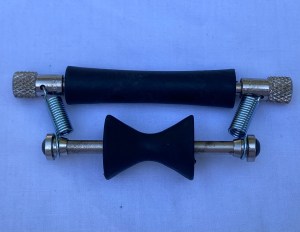
The Glider Capo
Let me first comment regarding the rolling, or gliding, of the capo up and down the neck. There is one video where a guitarist uses the thumb of his fretting hand to move the capo along the fret board. Others show a player using either the fretting hand or the picking hand to alter its position. I found that I need to use my picking hand to smoothly move the capo into proper position. This technique allowed me to keep the capo straight and parallel with the fret. (I could not accomplish this by using my thumb or fretting hand.) When glided into position, the Glider Capo wants to naturally rest about 1/4 inch (0.635cm) above the fret — a perfect position.

Glider Capo in position
The Glider Capo was tested for both string buzz and tuning stability on three guitars: a Rainsong Nashville Series jumbo (a carbon fiber six string), a Breedlove Pro Series dreadnought (solid, traditional woods, six string), and a Rainsong Concert Series 12 string jumbo (carbon fiber). D’Addario nickel-bronze light gauge strings (12 – 53) are on both six string guitars. For all testing, After application, the capo was first placed at position two, then glided to positions five, and seven on all three guitars. Right out of the gate let me state that I find that the Glider Capo CANNOT be used on a 12 string guitar! The problem here is with the capo’s inability to properly compress itself onto the higher gauge octave strings. There is significant buzzing, and these high octave strings go flat — significantly so for the fourth and fifth strings’ pairings. (I give my recommendation for a good capo for a 12 string near the close of this posting.)
String buzz is discussed first. The Glider Capo on the six string Rainsong Nashville jumbo gave no fret buzz at any of the three capoed positions. However, the Glider Capo caused on / off string buzzing on the sixth string at the Breedlove’s frets five and seven.
Tuning stability is next addressed. A Snark electronic tuner was used for all testings. Both the Rainsong Nashville Series jumbo and the Breedlove dreadnought were put in tune before the application of the capo. Placement began at fret two and tuning stability first tested here. The Glider Capo was then rolled to the fifth and then seventh positions where tuning stability was also tested. Using the Snark tuner, “distuning” was noted for both guitars at each position on all six strings by the number of “minute” increments flat or sharp from the “12 o’clock (in tune) position. Here are the results:
Breedlove Pro Series dreadnought:
Fret two: +1 minute sharp on string two (+1 total)
Fret five: +1 minute sharp on strings two and six (+2 total)
Fret seven: +1 minute sharp on strings two and six (+2 total)
Rainsong Nashville Series jumbo:
Fret two: +1 minute sharp on string one (+1 total)
Fret five: +1 minute sharp on strings one, two, and five (+ 3 total)
Fret seven: +1 minute sharp on strings one, two, and six (+3 total)
The total number of “minutes” sharp is quite minimal and proves insignificant when compered to the distunings produced by other capos with various grasping mechanisms that I previously tested and reviewed using very near identical methods. Given the rolling mechanism of the Glider Capo I was surprised with the results. I must conclude that the Glider Capo offers great tuning stability! In fact, it likely offers the best tuning stability of any capo I own. But, again, it cannot be used on a 12 string guitar for the reasons noted above. (I place here, my recommendation for a really good capo for a 12 string guitar. It is Dunlop’s Pivot Capo. The advantage it possesses is that this capo uses a dial-in resistance gear that can be adjusted for pressure at any position on the neck.)
An honest review seems to require note of a downside. Therefore, I must note one drawback, but this is purely my own subjective comment. The application of the Glider Capo to the neck is a bit clumsy given the needed technique by which it is applied. However, given its fantastic tuning stability, I can get over it.
As a “crazy capo guy,” I confidently recommend the Glider Capo for any player’s six string guitars — acoustic or electric. One can be purchased from Amazon for $34.99 USD. More information can be found at glidercapo.com as well as from tonalmusicinc@gmail.com. Tonal Music is located in Franklin, Tennessee.
Keep on playing,
Fr Irenaeus
Righteous Presentations
Posted: August 2, 2024 Filed under: The Eucharist and Living the Eucharist | Tags: alive to Christ and dead to sin, cleansing of sin by the Eucharist, commissioning of the Prophet Isaiah, freedom from sin in Christ, hungering and thirsting for righteousness, Isaiah 6: 8, Jesus Christ Conquers, present yourself to holiness, Romans 6: 1 - 7, Romans 6: 11 - 13, St Matthew 5: 6, we are freed from sin Leave a comment Our saving relationship in Christ demands that we present ourselves to God for service to him. The Greek verb paristaemi / paristano (present / offer) can be translated to mean “to place at one’s disposal.” With this understanding, I am reminded of the Isaiah. Upon his commission to God’s service, the prophet Isaiah presented himself to God. He placed himself in service to God: “Here am I. Lord. Send me” (Isaiah 6: 8). As Isaiah presented himself at God’s disposal after being cleansed by the coal of fire taken from the heavenly altar, so we, having been cleansed by baptism, faith, and the Eucharist, must present ourselves to God to be in his service.
However, in our former lives apart from faith in Christ and the newness of life that comes from him, we were unable to present ourselves to be in God’s service. St Paul comments on this in his epistle to the Roman faithful:
For as by one man’s [Adam’s] disobedience many were made sinners, so by one man’s [Christ’s] obedience many will be made righteous (Romans 5: 19).
St Paul continues,
What shall we say then? Are we to continue in sin that grace may abound? By no means! How can we who died to sin still live in it? Do you not know that all of us who have been baptized into Christ Jesus were baptized into his death? We were buried therefore with him by baptism into death, so that as Christ was raised from the dead by the glory of the Father, we too might walk in newness of life.
For if we have been united with him in a death like his, we shall certainly be united with him in a resurrection like his. We know that our former man was crucified with him so that the sinful body might be destroyed, and we might no longer be enslaved to sin. For he who has died is freed from sin (Romans 6: 1 – 7).
Thus, by our new life of freedom from sin, in Christ. We are no longer slaves to sin. We are now free to present ourselves for holy service to God. St Paul gives further instruction:
So you also must consider yourselves dead to sin and alive to God in Christ Jesus. Let not sin therefore reign in your mortal bodies, to make you obey their passions. Do not present [maede paristanete] your members to sin as as instruments of wickedness, but present [alla parastanete] yourselves to God as instruments of righteousness (Romans 6: 11 -13).
I am a sinner. I continue to struggle and fight against the sin and corruption that still indwells me, and it is only by cooperating with God’s grace that this can be done and sin overcome. But, I have known many of faith who have only an intellectual understanding of these words of St Paul. There seems to be a surrender — there is only an apparent minimal will to fight for the freedom given to us by Christ. There is no heart for battle to grow in purity. Perhaps the origin of this complacency comes from this bumper sticker mindset: “Christians aren’t perfect. We’re just forgiven!” This saying represents a truncated and reductionistic understanding of our salvation. We are forgiven, but that is not the sum total of our salvation. Our Lord speaks of the benefits of such struggle: “Blessed are those who hunger and thirst for righteousness, for they shall be satisfied” (St Matthew 5: 6).
Jesus Christ Conquers
Though, from time to time, we succumb to sin due to our weaknesses, We have been and continue to be cleansed by Christ as we battle sin. I return to the prophet Isaiah and the cleansing which came to him. The coal of fire which cleansed his lips is seen by the Church to be an Old Testament type for the Eucharist’s sanctifying power which comes to the faithful Christian in communion. A priest will say this after consuming the Body and Blood of Christ, “Behold this coal of fire has touched my lips and takes away my transgressions and cleanses me of my sin.” The same is true for every Christian who comes forward for the Sacrament. Though we may have fallen, we are set on our feet and made clean to continue to present ourselves to be in Christ’s service. Also, regarding the Eucharist, there is a message impressed upon the Lamb (the portion of the bread which becomes the Body of Christ by the operation of the Holy Spirit upon the simple bread): “Jesus Christ conquers.” His victory over sin and death is taken into our lives to nourish and empower us as we, by the Holy Spirit, present ourselves to God for our sanctification.
May these words of St Paul be of benefit: “For just as you once presented your members as slaves to uncleanness and to greater and greater lawlessness. Thus now present your members as slaves to righteousness which leads to sanctification” (Romans 6: 19).
In Christ,
Fr Irenaeus
Confessors, Martyrs, and Apostates
Posted: July 1, 2024 Filed under: Etcetera, The Eucharist and Living the Eucharist | Tags: Confessing Christ, Denying Christ, Hebrews 11: 35 -38, Hebrews 12: 1 - 2, Maccabees 1: 62 - 63, Matthew 10: 32 - 33, Panagia Pantassana wonder-working icon, persecution is coming, persecution is here, saints and their icons, St Nicholas Greek Orthodox Church in Tacoma Washington, the time of the Maccabees, We are surrounded by so great a cloud of witnesses, wonder-working icon of St Anna Leave a commentWe find these words in Hebrews 12: 1 “Therefore, since we are surrounded by so great a cloud of witnesses…” When you step into an Orthodox Church anywhere in the world you will step into the company of the “cloud of witnesses.” Look all around…there are saints to be seen and to be encountered by their icons. Also there may be present those saints who are unseen by us. For example, near the conclusion of the clergy’s entrance prayers in preparation for each Divine Liturgy (which occur just before our entrance into the sanctuary), we bow to each other and ask for forgiveness from each other. We bow to the faithful present, and even no one else is there, bow to those who may be present that cannot be seen.
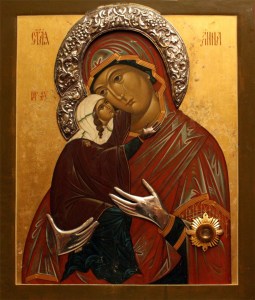
St Anna holding Mary
The saints who surround us are not passive spectators. They are active, and act for us, as they exist in Christ and act for him as servants, as they did while in this physical life. I offer two examples I have recently experienced. In October 2022 a wonder-working icon of St Anna (the mother of Mary, and grandmother of Jesus) was presented to the faithful at St Nicholas Greek Orthodox Church in Tacoma, Washington. After the completion of the akathist prayers, all venerated her icon. During this month, I was burdened by the reassignment of my dear friend, Fr Seraphim Majmudar, to an Orthodox Church in California. Upon my veneration of her icon, our Lord worked through her, and gave me release from the burden and grief regarding this upcoming event. Then most recently, during Pentecost last week (June 23, 2024) at the same St Nicholas Orthodox Church, the oil from the wonder-working icon of Mary called Panagia Pantassana (from Mt Athos’ Vatopedi Monastery) was applied to my very painful left knee (a meniscus tear?) by the parish’s new rector, Fr Anthony Cornett. Within several hours the pain had greatly diminished, and remains so to this day.
Of the saints who are surrounding us by their icons, some were martyrs, some were confessors, and some had their holy lives ending in peace. Regarding martyrs and confessors, we read this from Hebrews 11: 35 – 38:
…Some were tortured, refusing to accept release, that they might rise again to a better life. Others suffered mocking and scourging, and even chains and imprisonment. They were stoned, they were sawn in two, they were killed with the sword; they went about in skins of sheep and goats, destitute, afflicted, ill-treated — of whom the world was not worthy — wandering over deserts and mountains, and in dens and caves of the earth.
We should also learn of martyrs from the period of the Maccabees. During the evil reign of the evil Greek king Antiochus Epiphanes (a general of Alexander the Great), the Temple and Jerusalem were cruelly desecrated. Gentile cults were established. Many Jews capitulated and apostatized. Thousands of others remained faithful and became martyrs or confessors, and others became national heroes. Of martyrs of this era we find this in 1 Maccabees 1: 62 – 63:
But many in Israel stood firm and were resolved in their hearts not to eat unclean food. They chose rather to die rather than to be defiled by food or to profane the holy covenant; and they did die.
Moving to the twentieth century we have the brutal persecutions of the Soviet Union, and other communist countries, when and where thousands upon thousands became martyrs and confessors for their faith.
However, persecution is not found only in the past and elsewhere. We are not to think that we are, or will be, protected from persecution just because we live “in the West.” Look around you, “the West” is on life support. I can give examples from England. A Catholic woman was very recently arrested because she prayed (quietly and peacefully) the Rosary in public. Also, a man was arrested for reading the Bible (quietly and peacefully) on a park bench. At home in America, persecution is upon us, and gradually increasing month by month.
I now present St Matthew 10: 32 – 33:
Therefore, whoever shall confess me before men, I also shall confess him before my Father who is in the Heavens. But, whoever might deny me before men, I also shall deny him before my Father who is in the heavens.
In the the major litanies of the Divine Liturgy we find this prayer: “For our deliverance from all affliction, wrath, danger and necessity, let us pray to the Lord.” We also pray; “Help us, save us, have mercy on us, and keep / protect us by your grace.” We don’t want a climate of persecution, trouble, or adversity because we may fail. We may deny Christ in these situations. Further, we cannot fantasize that we will bravely become confessors in our day of trial. Though we pray that overt trials, persecutions, etc., not come our way, yet small trials, testings, and troubles come our way daily.
We cannot think that we will confess Christ during a time of great testing if we cannot confess Christ in a far lesser setting of testing! These lesser, mundane trials may come in the setting of family, work, traffic, school, or in the marketplace. When such small trials come our way, how do we respond? Do we confess Christ with joy, peace, prayer, blessing, and thanksgiving? If so, this is the response of faith and of the Holy Spirit working in our lives. If this is our choice and response, we CONFESS Christ! Or, do we respond with anger, cursing, and frustration? If so, this is the result of the corruption that still resides in us. If this is our choice and response, we DENY Christ!
We always have the power to confess Christ. Christ is in us, and we are in Christ — this is a relational union of God’s presence in us — and this is our salvation. We must determine in advance how we will respond. Our practice of smaller confessions will prepare us for true times of troubles.
Here is the text from Hebrews 12: 1 – 2:
Therefore, since we are surrounded by so great a cloud of witnesses, let us lay aside every weight, and sin which clings so closely, and let us run with perseverance the race that is set before us, looking to Jesus the pioneer and perfecter of our faith, who for the joy that was set before him endured the cross, despising the shame, and is seated at the right hand of the throne of God.
Thus, his Life and Light are to prevail in our lives. Hence, we are to confess Christ with kindness, patience, blessing, peace, and thanksgiving before all who witness these confessions of Christ. We are to confess Christ that we too may be saints!
The following is the corresponding sermon:
In Christ whom we confess,
Fr Irenaeus
GEAR REVIEW: DUNLOP PIVOT CAPO vs SHUBB CAPO ROYALE (A “CLINICAL” TESTING)
Posted: June 4, 2024 Filed under: Music and Guitars | Tags: Comparison of two adaptable capos, Dunlop Pivot Capo, Review of Dunlop Pivot Capo and Shubb Capo Royale, Shubb Capo Royale, statistical comparison of Dunlop Pivot Capo and Shubb Capo Royal Leave a commentIntroduction:

Dunlop Pivot Capo
In January, 2021, I reviewed two very, very good capos: Shubb’s Capo Royale and G7th’s Performance ART Capo. Three years later my quest perfect guitar capo is revived in this review of Dunlop’s Pivot Capo. Since January, 2021 I have routinely used Shubb’s Capo Royale on my guitars (both six and 12 string models) with great satisfaction. However, while again haunting Tacoma, Washington’s Ted Brown Music, I noticed the Dunlop Pivot Capo, and assumed it is Dunlop’s take on the adaptable capo. I quote from the capo’s packaging:
Precise Intonation: Patented self-centering neck pivot adapts to a variety of neck shapes for even tension and tuning stability.
Easy Adjustment: Low-resistance gear quickly dials in precise pressure.
Clarity & Sustain: Notes ring out longer and more clearly thanks to tone-enhancing mass and dense rubber padding.
Optimized Fret Pad: Accommodates fretboard radius to reduce string buzzing.

Shubb Capo Royale
I offer up Shubb’s Capo Royale claim:
The Shubb Capo is designed to reduce tuning problems. Its custom material presses the strings just like your fingertip. Its unique design closes onto the neck just life your hand. Its pressure is totally adjustable. The result: no retuning is necessary.
Similar claims, but will there be similar results? Given the similarity of the capos’ descriptions and the similarities between the G7th and the Shubb capos mentioned above, I posit that there will be no significance difference in tuning stability between the two capos. A statistical test will be used to test this hypothesis.
Materials / Methods:
I put the capos to the test on five different guitars using one Snark electronic tuner. All five guitars were tuned (standard tuning for all but one guitar in open D tuning as noted below) using the Snark tuner. Each capo was placed on frets 2, 5, and 7 on all five guitars, and all six stings were plucked. Each guitar was retuned before repositioning each capo at the above mentioned frets. “Distuning” was noted for each capo at each position (on all six strings) by the number of “minute” increments (flat and/or sharp noted by -1, or +2, for example) from the “12 o’clock” (the in tune) position on the tuner. Additionally, strings on the acoustics are of identical light gauge (12 – 53) D’Addario Nickel Bronze. Here are the results in terms of total “distuning minutes” at all three fret positions (again 2, 5, and 7).
Results:
Breedlove Pro Series D25/SRH acoustic dreadnought:
Shubb: +10 (at fret 2 = +1, fret 5 = +3, fret 7 = +6)
Dunlop: +3 (at fret 2 = 0, fret 5 = +1, fret 7 = +2)
Faith FG1RE PJE acoustic dreadnought (open D tuning):
Shubb: +18 (at fret 2 = +1, fret 5 = +4, fret 7 = +13)
Dunlop: +15 (at fret 2 = +2, fret 5 = +8, fret 7 = + 5)
Rainsong N-JM110N2 (Nashville Series) acoustic jumbo:
Shubb: +1 (at fret 2 = 0, fret 5 = 0, fret 7 = +1)
Dunlop: +5 (at fret 2 = +2, fret 5 = +2, fret 7 = +1)
Rainsong BI-JM1000N2 (Black Ice Series) acoustic jumbo:
Shubb: +5 (at fret 2 = +1, fret 5 = +1, fret 7 = +3)
Dunlop: +7 (at fret 2 = +4, fret 5 = +1, fret 7 = +2)
Paul Reed Smith (PRS) SE Starla solid body electric:
Shubb: +18 (at fret 2 = +1, fret 5 = +7, fret 7 = +10)
Dunlop: +17 (at fret 2 = +7, fret 5 = +6, fret 7 = +4)
Total “minutes” sharp:
Shubb: +52
Dunlop: +47
Discussion and Conclusion:

Equally good capos
Could there be a new champion among capos? The Dunlop Pivot Capo had 5 fewer sharps in total. With the above results the difference in count of “minutes sharp” was nearly identical for the Faith dreadnought and the PRS SE Starla. With the two carbon fiber Rainsong acoustics, the Shubb performed modestly better than the Dunlop, while the Dunlop performed better than the Shubb on the Breedlove acoustic.
With the above data, I want to examine the number of “minutes sharp” at the three capo positions on the four fretboards. The Shubb Capo Royale performed very well at fret two, but its performance diminished as this capo moved up the fretboard to higher positions. The Dunlop Pivot Capo also performed better at fret two, but not on the PRS SE. Its performance at frets 5 and 7 varied, but seemed more consistent, with all five guitars.
I am not a statistical nerd (perhaps I should not venture into such territory), but I ran a Two Sample T-test comparing the above results. I present the P-value: P = 0.8262. For a statistical difference to exist a P-value must be >/= 0.95. Thus, there is no statistical advantage for either of the capos. My hypothesis is upheld.
Regarding ease of use the Shubb has the quicker application to the fretboard due to the clamp on bar at the bottom of the capo. Tension adjustment can be altered as needed given the Shubb’s position on the neck, but it can become stiff as you move up a guitar’s neck. The Dunlop Pivot Capo’s mechanism of application and release must take place each time with resistance gear release, but is easily and quickly done.
Is there a new capo champion? Give the above P-value the answer is, “No.” Both are solid capos, and represent ongoing advancement ins capo design and production. Both capos would be an asset to any guitarist.
Keep on playing,
Fr Irenaeus
1988, Phil Keaggy, and My Evangelical Friend
Posted: May 24, 2024 Filed under: Etcetera, Music and Guitars | Tags: Eastern Orthodoxy and Evangelicalism, Phil Keaggy, Phil Keaggy and Sunday's Child, Phil Keaggy's "Blessed Be the Ties, Phil Keaggy's "I've Only Just Begun (Again)" 1 CommentThe year was 1988. I was living in Seattle, Washington. I was engaged to my wife, Janice, and was beginning my career as a clinical pharmacist at an area hospital. At the time I was an evangelical Christian. I had begun to study New Testament Greek at a local Lutheran College in preparation for further theological studies. While leading a “home group” associated with a large evangelical church, I sensed a call to ministry, (and learned I was OK with a guitar).
 Musically, with the exception of U2, the 1980s was a time when I listened primarily to Contemporary Christian Music (CCM). Some of CCM was fluff, some of it held a great deal of depth. Generally, the music was well written and well produced. Among the most gifted of CCM musicians was guitarist / vocalist Phil Keaggy. He was (and still is) a virtuoso guitarist gifted also with a fantastic tenor’s voice. His 1988 release of “Phil Keaggy and Sunday’s Child” (Myrrh Records), was a musical delight for me.
However, changes would soon take place. In the next decade, while studying at a Protestant seminary, I began a theological and spiritual journey that would take me to a “far land.” This journey held exciting and unnerving discoveries. By my studies I was led to sacramental and liturgical expressions of Christianity. I left evangelicalism behind. I also ditched CCM and everything associated with evangelicalism.
Let’s fast forward to April, 2024. While preparing for a trip with my wife, I selected a few CDs (yes…I know…) to play as we travelled more than 300 miles. For some reason I grabbed and dusted off a two volume set of Phil Keaggy’s music — an anthology — entitled “Time.” Included in this anthology were three tracks from his 1988 release noted above. These were “Tell Me How You Feel,” “Sunday’s Child,” and my favorite, “I’ve Only Just Begun (Again).” All three songs were written, or co-written by Mr. Keaggy. Such a selection would not have occurred a few years ago.
 This 36 year old recording of 13 tracks has resurfaced as a favorite CD. My ear picks up on some 60’s pop-rock vibe with jangly six- and 12-string electric guitars. My wife and I also noted a “McCartney-like” quality to his voice. None of the tracks are evangelical “praise songs”, though there is a low level evangelical preaching evident a few of the songs’ lyrics. Other songs comment on the matters of faith as it engages and is challenged by everyday life. Among these tracks, “Blessed Be the Ties,” speaks beautifully to the struggles and joys found in married / family life. I present its lyrics:
Out of the single life, into the family way — So many scripted lines, too many roles to play.ever a pressure pressing, ever an undertow. Why do the ties you’ve chosen slowly pull you low?
Over the things we love, into the still unknown — I had a dream last night I was finally left alone.Nothing to tie me down, no one to kiss goodnight — never again to feel your whisper pull me to your side.
And, oh, an emotion cries. Oh — sing blessed be the ties.
Under the veil He walks through the relentless chill, ever to bear your grief, ever rejected still.Out of the deep He pulls you into the arms you trust.Nothing can separate us from the ties that bind to you.
And, oh, as your spirits rise. Oh — sing, “Blessed be the ties.”
Stay with me. Never let go. Take me to your side. I am dreaming.
Oh — an emotion cries sing, “Blessed be the ties.”Blessed be the ties.
Now, allow me to back up a bit in time to explain why I am writing this posting about Mr. Keaggy, his recording, and my evangelical past. In April, 2023, an old friend sent me a text asking if I would want to renew / restore our friendship which had been neglected for more than a decade. We became estranged because we argued evangelical vs Orthodox theological differences. We were both stubborn and often parted in frustration and anger. I had been wanting to rebuild damaged bridges, but never was sure of how to start the needed conversation. I immediately responded to his text affirming my desire to renew the decades-old friendship. We no longer had any desire to prove who was right and who was wrong. He had begun to study Orthodox theology and came to understand and appreciate Orthodox teaching. I, on my part, since the darkness and deceptions from the COVID-19 debacle had been pored out on western countries, realized that I am to rejoice in light and truth wherever it is found — and yes, also in evangelicalism. I have come to this conclusion because when Christians of all traditions are hauled off to “the Gulag”, such differences will not matter too much.
On one get together, my friend, Colin, asked me, “When will we have unity?” My reply, “when we experience persecution.” This persecution is now upon us and increases monthly. Though ecclesial unity will not occur, bonds of trust and support must take place between those who reach out to one another in goodwill. This will be for survival of my Eastern Orthodox faith and his evangelical faith, and perhaps even our physical lives.
Colin and I get together routinely to play guitar, write an occasional song, and now have respectful and loving discussions of theology, family, and life in general over a few hours of “picking and grinning” and a shared bottle of a good red wine. I rejoice that he is again part of my life, and that his wife and my wife are now also renewing their friendship. Blessed be the ties!
Here are two links to his songs: “Blessed Be the Ties”
And “I’ve Only Just Begun (Again)”
In Christ, and in friendship with all of goodwill,
Fr Irenaeus
What Are We Thinking?
Posted: April 21, 2024 Filed under: Etcetera, The Eucharist and Living the Eucharist | Tags: Cleanse our thoughts, Fifth Sunday of Lent, Jesus Christ Conquers, Our thoughts determine our lives, Sanctify our thoughts, Set aright our minds, St Thaddeus of Vitovnica, Take every thought captive to obey Christ, the battle is in the mind, the Beatitudes 4 CommentsThe Gospel reading for the Fifth Sunday of Lent begins with Christ proclaiming to his disciples all that would soon happen to him:
Behold, we are going up to Jerusalem and the Son of Man will be handed over to the Chief Priests and Scribes, and they shall condemn him to death, and hand him over to the Gentiles, and they will ridicule him, beat him, spit on him, and will kill him. And on the third day he shall rise again (St Mark 10: 33 – 34).
The reading then comes to James’ and John’s request made to our Lord. They ask that one of them would to sit at his right, and one at his left when Christ comes into the glory of his Kingdom. Our Lord responds to their request,
…You do not know what you ask. Are you able to drink from the cup from which I drink? And the baptism in which I am baptized are you able to be baptized? (St Mark 10: 38)
James and John were attempting to order themselves with Christ according to the world system’s forms of power and authority. This, understandably, was a cause of offense to the other ten Apostles. Our Lord gives them all this instruction:
…You know that those who are supposed to rule over the Gentiles lord it over them, and their great men exercise authority over them. But it shall not be so among you; but whoever would be great among you must be your servant, and whoever would be first among you must be slave of all. For the Son of Man also came not to be served but to serve, and to give his life as a ransom for the many (St Mark 10: 42 – 25).
The Beatitudes also spell out a very different ethos to that of the world system. In the Sermon on the Mount we are informed that a poverty of spirit, mourning, meekness, righteousness, mercy, purity, and peace making are valued, and those exhibiting the qualities will be blessed by Jesus in his Kingdom s(see St Matthew 5: 1 – 11).
Based upon the request of James and John, I come to this point: the battle is in the mind. St Paul writes this: “We destroy arguments and every proud obstacle to the knowledge of God, and take every thought captive to obey Christ” (2 Corinthians 10: 5). We have this proper request from the “Prayer of the Hours: “…Set aright our minds; cleanse our thoughts…” Again, the battle, therefore, is in the mind!
Let me paraphrase Christ’s statement to James and John in the form of questions that can be directed to us: “What are you thinking?” “What am I thinking?” “What are you thinking?” “What are we thinking?”
 The Fifth Sunday of Lent focuses on the life St Mary of Egypt. A battle raged in her mind, her soul, and every part of her being. She was a slave to sin — especially sexual sin. She could be thought of as a sex-addict. Thus, in her mind, dopaminergic and serotonergic neurochemicals came into play which made her sin an addiction to her specific proclivities. She was directed to cross over the Jordan to work out her salvation with fear and trembling (Philippians 2: 12). In the Palestinian wilderness, she waged war against her passions, thought patterns, and habits by the power of the Weapon of the Cross. She, by the working of the Holy Spirit, defeated her sinful thoughts and manner of life, and holiness was worked into every part of her being. We call her a holy warrior, and our venerable mother among the saints.
 I am presently reading a book: Our Thoughts Determine Our Lives (The Life and Teachings of Elder Thaddeus of Vitovnica). Here are some quotes given by the saint who reposed in in Christ in 2003 in Serbia.
Our thoughts determine our whole life. If our thoughts are destructive, we will have no peace. If they are quiet, meek and simple, our life will be the same, and we will have peace within us. It will radiate from us and influence all beings around us — rational beings, animals, and even plants. Such is our ‘thought apparatus,’ which emits thoughts with which we influence all other beings (p 49).
If we have good thoughts and desires, these thoughts will give us peace and joy even in this life, and even more so in eternity (p 56).
Our life depends on the kind of thoughts we nurture. If our thoughts are peaceful, calm, meek and kind, then that is what our life is like. If our attention is turned to the circumstances in which we live, we are drawn into a whirlpool of thoughts and can have neither peace nor tranquility (p 63).
We cannot achieve salvation unless we change our thoughts and make them different…This is achieved by the work of Divine power in us. Our minds thus become deified, free of passions, and holy. Only a mind which has God within it and a constant remembrance of the Lord can be deified. By knowing that He is in us and we are in Him, we can move around like fish in the water. He is everywhere, and we, like fish, swim in Him (p 60).
St Thaddeus would, I think, confirm that the battle is in the mind.
Whether we are of faith or not, we are the captains of our consciousness. We are in control of our thoughts. But we who are in Christ, and have Christ in us, truly have even greater power over our thoughts. In Christ we lack nothing, and have no excuses. “Take every thought captive to obey Christ.” And we pray, “Set aright our minds; cleanse our thoughts!”
 Our minds are constantly active, and can wander seemingly at will. When a remote memory pops into my head, I ask, “Where did that come from?” To many people who are troubled by damaging thoughts I give an illustration I call “The Pond.” Picture a pond that has numerous over-hanging trees on its shore. In the autumn all the leaves fall and sink to the bottom of the pond. There they decompose. The decomposition process will from time to time release a bubble of gas and remain for a while on the water’s surface. Here’s the parallel: “Bubbles” (our thoughts) arise into our consciousness. If these “bubbles” are foul we are to pop them. Such thoughts do not, and should not, remain active in our minds. We have the power to replace them with blessings, prayers, and all that is holy and of God. We cannot let such toxic bubbles exist! This is a battle to engage — even if it occurs 100 times per day! We can successfully enter into this combat because we have the Three Persons of the Trinity indwelling us! Thus we are spiritually empowered and armed! We find this in Psalm 38: 21 – 22:
Do not forsake me, O Lord! O my God, be not far from me! Make haste to help me, O Lord, my salvation!
We are in this battle, this arena of spiritual combat. Where are our arenas? Where are our battle fields? For me, it is commonly in a retail setting — especially CostCO. (“One does not simply walk into CostCo!”) I can be impatient with the large number of customers that move at a snail’s pace, and with those who collect around the kiosks of food samples. To have victory in this field of battle, I must determine in advance how I will think and conduct myself! Before entering, I must determine to act with patience, and pray for all customers I encounter. Oh, and to smile!
Thus, all of when we enter our arenas, and our battlefields (we know where they are, and what they hold for us), we must determine in advance both thoughts and conduct. We must have a battle plan.
We are not alone in our struggles and battles. Our struggles are not unique to any of us. The saints had the same struggles, and by the power of the Holy Trinity working in them, by the prayers of the Mother of God, and the saints, they won their sanctification. And so can we! Let us call out the Christ, “Do not forsake me, O Lord! O my God, be not far from me! Make haste to help me, O Lord, my salvation!”
Here is a corresponding sermon:
In Christ who gives us victory,
Fr Irenaeus
Take Up Your Cross!
Posted: April 8, 2024 Filed under: The Eucharist and Living the Eucharist | Tags: "By this sign conquer!", "Get behind me Satan" (St Mark 8: 33), Cause of death by crucifixion, Consent or denial, dying to one's self, History of Crucifixion, St Mark 8:35 - 35, St Peter's Confession St Mark 8: 29b, Sunday of the Cross, Take up your cross, the Emperor St Constantine 1 CommentThis posting is made to correspond with the Sunday of the Cross which is the third Sunday of Great Lent in the Orthodox Church. On this Sunday Lent is half over, and its theme is to turn the mind to Holy Week’s events.
A brief history and explanation of crucifixion is given. It originated in Babylon / Assyria as a means of execution. The next to employ crucifixion was Alexander the Great, and it was practiced in the eastern regions of his empire. Then the Phoenicians picked it up. Later, crucifixion was passed on to and used by the Romans who perfected it. In the Roman Empire this method of execution was used for more than 500 years until outlawed by St Constantine in the fourth century.
Crucifixion was brutal, cruel and humiliating. It was feared and loathed. It was the form of execution for slaves, disgraced soldiers, and foreigners. The criminal’s time until death could range from a few hours (as in the case of our Lord) up to four days. Roman soldiers had to be present at the place of execution until the death of the victim was confirmed. To hasten death, the victims lower legs would be fractured, or the chest wall pierced by a spear (as in the case of our Lord). Hence, the claim by secularists and skeptics that on the Cross Christ merely “swooned” and revived in the tomb is ludicrous. How did the condemned die? First, blood loss and dehydration led to hypovolemic shock. Death followed from asphyxia, acute congestive heart failure, and cardiac arrest (the cessation of electrical activity in the heart).
Though once an object of horror, now the image of the Cross is sacred and holy to us, and is the symbol of the Christian. If you have this in mind you will see cruciform images all around you provided by the geometry of nature.
A few verses before the day’s Gospel reading we find these verses which come after St Peter’s famous and inspired confession, “You are the Christ” (as found in St Mark 8: 29):
And he began to teach them that it is necessary for the Son of Man to suffer much, and to be rejected by the elders, the chief priests, and the scribes and to be killed, and after three days to rise again. And he was speaking this openly. Then Peter took him aside and rebuked him. But, upon turning around and seeing his disciples, he rebuked Peter, saying, “Get behind me, Satan! For you do not have in mind the matters of God, but the matters of men” (St Mark 8: 31 – 33).
The day’s Gospel reading then begins,
And calling together the crowd along with his disciples, he said to them, “If anyone would follow after me, he is to deny himself, and to take up his cross and follow me. For whoever wishes to save his life, he shall lose it. But, whoever loses his life for my sake and of the Gospel, he shall save it” (St Mark 8: 34 – 35).
Briefly, I turn back to St Constantine. When a young man, he had a solid claim to be emperor. But, he had to defeat other contenders. His chief rival was Maxentius. His rival’s superior forces came against Constantine, and a decisive battle would soon take place. However, prior to the battle, Constantine had a vision of the Cross that came with the message, “By this sign, conquer!” The Cross was affixed to his soldiers’ shields, and Constantine defeated Maxentius’ forces at the Milvian Bridge.
“By this sign, conquer!” By the Cross Jesus conquered death — he destroyed death by his own death. The instrument of shameful execution became his weapon of victory!
Take note! By this same sign we conquer! It is important to note that we have union with Christ’s crucifixion. St Paul writes this in his letter to the Galatians:
For I, through the Law, died to the Law, in order that I might live to God. I was crucified together [sunestauromai] with Christ: I no longer live, but Christ lives in me. The life I now live in the flesh, I live by faith through the Son of God who loved me, and gave himself for me (Gal 2: 19 – 20).
“I was crucified together (sunestauromai) with Christ…” These words impart this reality of an ontological union with our crucified Lord, God, and Savior. When Christ died by crucifixion on the cross St. Paul was also there on the Cross in that moment. He, too, was suspended on that wood. And so are we who live today who have the same relational union with Jesus.
Thus, with this reality, it is imperative that we take up our crosses and follow Christ. For us, as it was for our Lord and the Cross, our own crosses are both instruments of death and weapons of victory. We must die to ourselves to gain his victory over sin and corruption that are still active in our lives. To do so, we must take up the little crosses placed in front of us each and every day. Those little crosses are the mundane things, the annoying, and irritating things and people we encounter every day.
Light and Life
Given this, we are to CONSENT to death! See such consent as the means to gain life — the LIFE of CHRIST! The little crosses are not to be avoided or ignored. What happens if we deny the death offered by these little crosses? By denying, we only allow darkness and corruption to remain active in our lives. We lose our lives and do not gain Christ!
Let me give an example of an every day cross. A little Cross can be the impatient driver that cuts in front of us on the freeway to make his or her exit. We now have the choice to consent to death or deny this cross. To deny this little cross would mean that one reacts in anger: a gesture is made, the horn is blown, and “French words” are spoken to the driver. This is just the action our Adversary wants from us. But, to consent and to take up this little cross means we bless the other driver and pray for him. Further, to live eucharistically, we can embrace this little cross a bit more by giving thanks for his action. This is because, by his “offense,” he now comes into our consciousness. By praying for blessing and protection to come to him, a portion of that remaining corruption in us is excised from us, and put to death. Added to this, the situation and the driver are carried to Christ. Redemption and transformation take place. That little cross became a weapon of victory.
Jesus Christ conquers
Again, by the determined actions of consent and thanksgiving for the little crosses that are presented to us, we die to ourselves. By such dying the life of Christ is poured into us. By taking up our small crosses, the victorious Gifts of his Body and Blood that were offered on the Cross are presented anew to humanity, all physical creatures, and to the entirety of the universe for their sanctification.
The following is a sermon that corresponds to the posting:
In Christ who destroyed death by death,
Fr Irenaeus
 Father Irenaeus Williams
The Healing of the Demoniac of Gadarenes and Advice for the “Last Days”
Posted: October 31, 2024 | Author: Fr. Irenaeus | Filed under: Etcetera, The Eucharist and Living the Eucharist | Tags: Are we in the Last Days?, Healing of the Gadarene Demoniac, spiritual preparations for difficult and troubling times, St Hilary of Poitiers' commentary of St Matthew 14: 22 - 33 | Leave a commentEven in this hideous condition he bore the image of God. The demons hated him. They humiliated him, physically harmed him, and gave him an unnatural, terrible strength. He was tormented by these evil beings who desired to destroy him.
This can be seen as a spiritual parallel for our days. If not outright possession of some, there is a horrific demonic influence taking place in much of popular culture and secular society. In these days, and those days that may be coming for us, just as Christ came to set the possessed man free, so we must ask Christ to more completely free us from the corruption and darkness of sin that remains in us. We must shun every form of evil (“Perverseness of heart shall be far from me; I will know nothing of evil” (Psalm 101/100: 4). And, as the liberated man was clothed and in his right mind, let us more completely be clothed in Christ and have his mindset. As the Prayer of the Hours asks of God, so let us ask, “…Sanctify our souls, purify our bodies, set aright our minds, and cleanse our thoughts.”
St Hilary takes the focus of this miracle to Last Days. (However, the Incarnation ushered in the Last Days.) He sees the disciples’ struggles paralleling the struggles of the Church. He writes,
Again, the Church has been in the “Last Days” since the Incarnation. Where are we today? Are we approaching or in the final chapter, or perhaps a trial run? I do not know. I do know that we find ourselves buffeted by the raging of the world system and its powerful — both seen and unseen. I do know that at all times we are to hold firm to Christ as the Church and as individual Christians. I do know that as we reach out to Christ he comes to us. I do know that we must be in preparation at all times to be in the presence of our Lord. We are to live a life of faith.
In these times I offer terse advice:
Offered, too, are these words of St Paul:
Here is the link to the corresponding sermon:
In Christ,
Fr Irenaeus