Interior Landscaping
Posted: February 15, 2016 Filed under: The Eucharist and Living the Eucharist | Tags: Eucharistic life, finding beauty, imitation of Christ, Mystical Supper, St. Paul, thanksgiving, transformation Leave a commentRare is the person who cannot appreciate the beauty of nature, especially in its wild, untouched forms and settings. It is blindness when the beauty of a creature cannot be appreciated. Such beauty exists in the flower  , the forest, the mountain, the stream, and the animal. There is the harsh beauty of the desert, and, I suppose, of the arctic as well. Nature’s gifts of beauty are to be found in all climates, temperate and tropical. Just step outside, open your eyes and marvel at the creation around you!
There is also a “natural” beauty that is created by human endeavor. An idea or vision can transform the natural landscape of creation into works of art. Here, we have the cultivation of something previously barren, or wild, into something habitable and enjoyable, and equally pleasing to the senses.
“It’s Just Human Nature…”
Posted: January 27, 2016 Filed under: The Eucharist and Living the Eucharist | Tags: confession, consequences of the fall, Eucharistic life, prayer without ceasing, real human nature, St. Paul Leave a commentIn the attempt to excuse any and all sorts of bad behavior, the phrase, “it’s just human nature,” is invoked. We all have heard it after the dust has settled from an outburst of anger, mischievous behavior, or perhaps something far worse. It’s an excuse used to make us feel better about ourselves. We don’t want to be seen as a monster. Rather, we just succumbed to “human nature.” Read the rest of this entry »
The Feast of Theophany: God Sanctifies Creation
Posted: January 5, 2016 Filed under: The Eucharist and Living the Eucharist | Tags: baptism, manifestation of the Triune God, sanctification of all creation by Jesus Christ's baptism in the Jordan River, St. John the Baptist, St. Paul, Theophany Leave a comment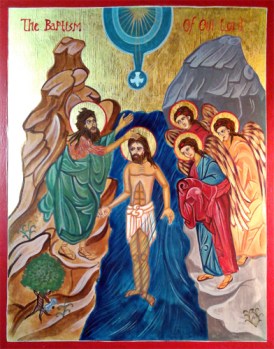 Each year, January 6 commemorates Jesus’ baptism in the Jordan River by St. John, the Forerunner, Prophet and Baptist. The Gospel text from St. Matthew reads,
Then Jesus came from Galilee to John at the Jordan to be baptized by him. And John tried to prevent Him, saying “I need to be baptized by You, and You are coming to me?” But Jesus answered and said to him, “Permit it to be so now, for thus it is fitting for us to fulfill all righteousness.” Then he allowed Him. When He had been baptized, Jesus came up immediately from the water; and behold, the heavens were opened to Him, and He saw the Spirit of God descending like a dove and alighting upon Him. And suddenly a voice came from heaven, saying, “This is My Beloved Son, in whom I am well pleased.” (Mt 3: 13 – 17)
Prepare the Way of the Lord!
Posted: January 3, 2016 Filed under: The Eucharist and Living the Eucharist | Tags: Genesis, re-creation in Christ, St. John the Baptist, St. Mark the Evangelist, Theophany Leave a commentThis Sunday, January 3, 2016 is the Sunday before Theophany. This Sunday sets the stage for Theophany, the baptism of Christ by The Baptist.
It is interesting to note how the Gospel writers begin their works. St. John begins with the pre-existence of Jesus Christ, the Word of God, as the second Person of the Trinity. Read the rest of this entry »
What is a New Year?
Posted: January 1, 2016 Filed under: The Eucharist and Living the Eucharist | Tags: concepts of time, ever present present, free will, philosophy of time, St. Paul, theory of time, time 1 CommentThe elderly woman was happy throughout our conversation, but her gaze went out to a point somewhere behind me when, in concluding the appointment, she added, “I sure hope the new year will be better than this one!” She exhaled and left my office with her daughter. It is a common comment and sentiment in December, and I gave it no thought until recently. Read the rest of this entry »
“Save the Babies and the Whales” or being Pro Pan-Life
Posted: December 19, 2015 Filed under: The Eucharist and Living the Eucharist | Tags: Advent, ethic of being, preservation of God’s creation, pro pan-life, St. Paul Leave a commentThis is not meant to be a seasonal posting. It has nothing to do with the “Happy Holidays” But, this posting is written in the last half of December, 2015. The Advent, or Nativity Fast, is in its final days. During Advent, Christians of liturgical and sacramental traditions are preparing for the celebration of the birth of Jesus Christ. The Nicene Creed informs us: “…who for us and for our salvation came down from heaven and was incarnate by the Holy Spirit and the Virgin Mary and made man…” The Creator of life was made manifest in the form of a baby. Christ came to give us life — new, redeemed life. He is the Giver of light and life and in this coming season I pray we extend our Lord’s light and life to all and all things. I pray we become advocates of life. Read the rest of this entry »
“The Eyes of the Righteous”
Posted: December 3, 2015 Filed under: The Eucharist and Living the Eucharist | Tags: Advent, re-creation in Christ, Rich Man and Lazarus, St. Onesimus, St. Paul Leave a commentIt is now the time of the Nativity Fast, also known as Advent. It is also known as the “Winter Fast,” or “Lesser Lent.” Like Lent, Advent is a penitential season. It is thus, a season of spiritual preparation. During Advent we prepare to perceive and receive Christ anew into our hearts and lives.
There are some similarities to Lent. The last Sunday before Lent is known as the “Sunday of the Last Judgment.” The Gospel reading for the day comes from St. Matthew 25: 31 – 46. In this reading we hear Jesus’ words: “…As you did it to the least of my brethren, you did it to me.” Who? The hungry, sick, naked, and imprisoned. As one reads along in the text, there is an element of surprise — even astonishment — in the query of the righteous. Read the rest of this entry »
To Become, You Must Do
Posted: December 1, 2015 Filed under: The Eucharist and Living the Eucharist | Tags: ethic of being, St. Paul, transformation Leave a comment
St. George the dragon-slayer
An axiom is set forth: “to do you must become, to become you must do.” An axiom is a proposition. The worth of it is self evident. I have used this axiom in sermons, papers, and as a guide for my own life for many years.
Let’s look at its first half: “to do you must become…” This involves an initiation. The initiation for the Christian is baptism. St. Paul informs us:
Therefore, we were buried together with him through baptism [dia tou baptismos] into death, in order just as Christ was raised from the dead through the glory of the Father, that also we might walk in newness of life (Romans 6: 4).
Our Heroic God, Our Fantastic Mission
Posted: November 10, 2015 Filed under: The Eucharist and Living the Eucharist | Tags: Doxacon, Eucharistic life, thanksgiving Leave a commentClergy keynote address of Doxacon Seattle 2015:
A look at God and our Christian life as Hero and Mission. Christ is the victor in the cosmic dimension. We are enchanted (enabled) to live out our lives Eucharisticly. Read the rest of this entry »
Practicing The Eucharist in the World (Part Four)
Posted: October 8, 2015 Filed under: The Eucharist and Living the Eucharist | Tags: St. Paul, The Eucharist: The Restoration of Relationship Leave a commentThe following paper was written in the year 2000. It was formative and powerful as all the pieces of everything I had been learning about the Eucharist were put together. It was written while a seminarian at Regent College in Vancouver, B. C., Canada. I was not yet an Orthodox Christian, let alone ordained. Note that the liturgical passages are mostly from western sources – I was a liturgical / sacramental western Christian at the time. Also, some of the citations are from Protestant authors – after all Regent College is an evangelical seminary, yet the quoted authors impart wisdom, and their insights were employed in this paper. It is a bit lengthy and will be posted in parts.
PRACTICING THE EUCHARIST IN THE WORLD
(PART FOUR)
+ * +
By means of the presence and the work of the Holy Spirit, the Eucharist transforms the people of God into priests who offer God to creation and creation to God. It also transforms us into a sacrament that bears Jesus Christ to the world, and into an offering of broken bread and poured out wine for the life of the world. Read the rest of this entry »
The Eucharist as Ecclesial Practice (Part Three)
Posted: October 7, 2015 Filed under: The Eucharist and Living the Eucharist | Tags: The Eucharist: The Restoration of Relationship Leave a comment+ * +
The following paper was written in the year 2000. It was formative and powerful as all the pieces of everything I had been learning about the Eucharist were put together. It was written while a seminarian at Regent College in Vancouver, B. C., Canada. I was not yet an Orthodox Christian, let alone ordained. Note that the liturgical passages are mostly from western sources – I was a liturgical / sacramental western Christian at the time. Also, some of the citations are from Protestant authors – after all Regent College is an evangelical seminary, yet the quoted authors impart wisdom, and their insights were employed in this paper. It is a bit lengthy and will be posted in parts.
THE EUCHARIST AS ECCLESIAL PRACTICE
(PART THREE)
+ * +
While breaking into this present brokeness, alienation, and chaos we are to see that all which is not yet finally gathered together has a secure promise. It is the Holy Spirit who makes all these mysteries real and present. The Holy Spirit is the Guarantor of this future: Read the rest of this entry »
The Eucharist: The Re-Presentation of the Recapitulation (Part Two)
Posted: October 6, 2015 Filed under: The Eucharist and Living the Eucharist | Tags: The Eucharist: The Restoration of Relationship Leave a comment+ * +
The following paper was written in the year 2000. It was formative and powerful as all the pieces of everything I had been learning about the Eucharist were put together. It was written while a seminarian at Regent College in Vancouver, B. C., Canada. I was not yet an Orthodox Christian, let alone ordained. Note that the liturgical passages are mostly from western sources – I was a liturgical / sacramental western Christian at the time. Also, some of the citations are from Protestant authors – after all Regent College is an evangelical seminary, yet the quoted authors impart wisdom, and their insights were employed in this paper. It is a bit lengthy and will be posted in parts.
THE EUCHARIST: THE RE-PRESENTATION OF THE RECAPITULATION
(PART TWO)
To participate in some activity, practice, or event is to experience that event. One cannot truly understand the sport of tennis until one actually plays the game. Unless one has had the exhilaration of hitting a crushing backhand winner, or knows the frustration of double-faulting at game point, one does not know tennis. In like manner so it is with Christ: one cannot know Christ until one participates in Christ, lives Christ, and walks as Christ walked – however faulty that may be at times. Read the rest of this entry »
The Eucharist: The Restoration of Relationship (Part One)
Posted: October 3, 2015 Filed under: The Eucharist and Living the Eucharist | Tags: The Eucharist: The Restoration of Relationship Leave a commentThe following paper was written in the 2000. It was formative and powerful as I was learning about the Eucharist. It was written while a seminarian at Regent College in Vancouver, B. C., Canada. I was not yet an Orthodox Christian, let alone ordained. Note that the liturgical passages are mostly from western sources – I was a liturgical / sacramental western Christian at the time. Also, some of the citations are from Protestant authors – after all Regent College is an evangelical seminary, yet the quoted authors impart wisdom, and their insights were employed in this paper. It is a bit lengthy and will be posted in parts.
THE EUCHARIST: THE RESTORATION OF RELATIONSHIP
+ * +
Then they heard the sound of the LORD God walking in the garden at the time of the evening breeze, and the man and his wife hid themselves from the presence of the LORD God among the trees of the garden. But the LORD God called to the man, and said to him, “Where are you?”
Naked and ashamed our first parents hid themselves. They withdrew; from loving communion with the One who created them for relationship. Here is sorrow. Here is loss and lostness. Their nakedness exposed their infidelity and their loss of covenantal, trusting relationship. Lost and scattered also was their relationship with all of creation: the priests ordained to maintain the holy structure and furnishings of creation had thrust it back into the deep, sorrowful groaning of chaos. Read the rest of this entry »
By This Sign Conquer!
Posted: September 14, 2015 Filed under: The Eucharist and Living the Eucharist | Tags: dying to self, Elevation of the Precious and Life-Giving Cross, Eucharistic life, spiritual power, transformation Leave a commentSeptember 14 commemorates the Elevation of the Precious and Life-Giving Cross, or commonly known as the Feast 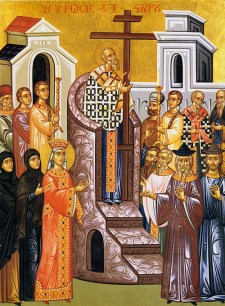 of the Holy Cross in the western church. In short, Emperor Constantine sent his mother, Empress Helen, to the Holy Land to find the Cross of Christ in Jerusalem in the year 326. The site was nearly forgotten due to the shameful desecration at the hands of previous pagan emperors. But, by Helen’s actions and those of the Patriarch of Jerusalem, St. Macarius, the site was located and the Cross of Christ was identified. Once again the Cross of Christ was elevated, but now to be venerated by the faithful.
However, St. Constantine had his own encounter with the Cross when he was a younger man, and not yet a Christian. Read the rest of this entry »
…And Become Thankful.
Posted: September 7, 2015 Filed under: The Eucharist and Living the Eucharist | Tags: Eucharistic life, prayer without ceasing, St. Paul, thanksgiving, transformation Leave a commentIn his letter to the Colossians, St. Paul writes,
Let the peace of Christ rule in your hearts, to which [peace] you were also called in one body: and become thankful [kai eucharistoi ginesthe]. (Colossians 3:15)
Being thankful and having the peace of Christ go hand in hand. Though it may seem an afterthought in the above verse, St. Paul likely puts emphasis on thanksgiving. In fact it can be argued that with thanksgiving first being given, peace comes with it, and both will reside in one’s heart in unison. Read the rest of this entry »
Life-Giving Grains
Posted: August 22, 2015 Filed under: The Eucharist and Living the Eucharist | Tags: dying to self, Eucharistic bread, the bread of life, transformation Leave a commentIn the twelfth chapter of St. John’s gospel we read these words of Jesus:
“Truly, truly, I say to you, unless the Grain of wheat falling into the earth should die, it remains alone. But if it should die, it bears much fruit.” (John 12: 24)
 Jesus says these words as he enters into the very last days of his earthly life in human flesh. His betrayal, trial, and crucifixion await him. The Grain of Wheat dies and is entombed. Three days later he rises from death in a glorified physical body. His death leads to the fruit, the new Grain, of eternal life for all who place their faith in Christ and follow him.
Our knowledge of the Eucharist should make us think of the eucharistic Bread when we read John 12: 24. Jesus is the Grain. In His resurrection all life is Read the rest of this entry »
A Commentary on a Prayer for the Eucharistic Life
Posted: August 15, 2015 Filed under: The Eucharist and Living the Eucharist | Tags: Christ the High Priest, Eucharistic life, prayer, St. Paul, thanksgiving, transformation Leave a commentFather, I pray this day I would be living the eucharistic life which is in accordance to your will for me in Christ Jesus. Thus, by the Holy Spirit may I be giving thanks in, with, and for all things, in order that I might bear Christ to all and all things, and that I might bear all and all things to Christ Jesus; that I might be self-giving and other-receiving; that I might live as broken bread and poured out wine for the life of the world and the sake of all things to the praise and glory of your name.
1 Thes 5: 18 reads, “Give thanks in all things: for this is the will of God for you in Christ Jesus.” St. Paul writes in all things (en panti) in the Greek dative case. The dative case, essentially, shows relationship. Read the rest of this entry »
A Prayer for the Eucharistic Life
Posted: August 10, 2015 Filed under: The Eucharist and Living the Eucharist | Tags: Eucharistic life, prayer, thanksgiving 1 CommentFather, I pray this day I would be living the eucharistic life which is in accordance to your will for me in Christ Jesus. Thus, by the Holy Spirit may I be giving thanks in, with, and for all things in order that I might bear Christ to all and all things, and that I might bear all and all things to Christ Jesus; that I might be self-giving and other-receiving; that I might live as broken bread and poured out wine for the life of the world and the sake of all things, to the praise and glory of your Name. Amen.
The Touch of Jesus, and the Touch of His Saints
Posted: August 10, 2015 Filed under: The Eucharist and Living the Eucharist | Tags: miraculous healing, St. Paul, St. Seraphim of Sarov, Theosis Leave a commentSt. Seraphim of Sarov, arguably, is the most  popular of Russian saints. July 19 marks the celebration of the first uncovering of the relics of St. Seraphim. This event took place in the year 1903 in Imperial Russia. That day in Imperial Russia, 70 years after his repose, or death, the physical presence of his relics brought about miraculous healings among those present.
The primary gospel reading of this Sunday came from St. Matthew’s Gospel (Mt 9: 27 – 35). In this reading we hear of the healing of two blind men Read the rest of this entry »
 Father Irenaeus Williams
Eucharistic Lessons from “To Sir, With Love”
Posted: February 23, 2016 | Author: Fr. Irenaeus | Filed under: The Eucharist and Living the Eucharist | Tags: eucharistic perspective on To Sir With Love, Eucharistic response, thanksgiving, To Sir With Love commentary, transformation, transformation in To Sir With Love | 1 CommentMy wife and I are self-confessed Anglophiles and “Celtophiles.” If it’s British, etc., generally, we’re hooked. BBC rules in our household media choices. Additionally, even though just a child in the Sixties, I love the music of the British Invasion, thus, I am constantly listening to the Beatles, the Kinks, and other groups and performers of the era. A few years ago I purchased the movie, To Sir, With Love (1967 trailer). “Blimey, I ‘ad to!” It was set in the mid-sixties! In London! Read the rest of this entry »