Christus Victor – A Primer (Part One)
Posted: July 24, 2017 Filed under: Etcetera, The Eucharist and Living the Eucharist | Tags: A primer for Christus Victor, Christus Victor as model of atonement, Christus Victor as model of salvation, Explanation of Christus Victor as model of salvation Leave a commentINTRODUCTION

Anselm of Canterbury
Cur Deus Homo? , or, “why did God become man?” This is the historic question asked by Anselm of Canterbury. In answering this question, he set forth the typical western, and has arguably become the dominant Protestant, view of salvation. By extension, his answer puts forward the typical (again dominant Protestant) view of salvation — substitutionary atonement. Here, God the Son became human to satisfy the Father’s just demand for satisfaction for humanity’s rebellion against his will. God the Father pours out his wrath against humanity on his Son — Jesus dies a horrid death and the Father is satisfied. From this humanity’s sin debt is paid by Christ, and we are in a legal right standing with God the Father — we have peace with God. To the Eastern Church, this is foreign, and somewhat repulsive. As a historic, and ancient, alternative the Eastern Church puts forth the model of salvation known as Christus Victor. A primer is set forth in the following postings.
SUNDAY OF THE PARALYTIC (FOURTH SUNDAY OF PASCHA)
Posted: May 6, 2017 Filed under: The Eucharist and Living the Eucharist | Tags: Healing of the paralytic at the Sheep Pool, John 15: 1 - 15, Sunday of the Paralytic, the healing of the paralytic, walking in newness of life of the resurrection 3 CommentsPrior to today’s theme, we have read of the witnesses to Christ’s resurrection: the apostle St. Thomas, and then the myrrh bearing women. These two Sundays’ themes declare to us the fact of the resurrection. Today’s theme is quite different: we are asked to confront the weaknesses and sins which remain in our lives in light of our Lord’s resurrection. This day, we return to a lenten-like consciousness to bring our lives in line with Christ’s light and life.
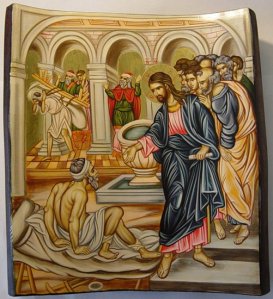 The gospel reading comes from John 5: 1 – 15. We have a description of the Sheep Pool in Jerusalem, and we are informed the pool was surrounded by the ill, the blind, the paralyzed, and the crippled. They all waited for the pool’s water to be “disturbed” by an angel: the first one in upon the disturbance was cured. Among those near the pool was a paralytic who “was ill for 38 years.” Jesus approaches the man (whose name is not given) and asks him: “Do you want to be healed?” (John 5: 6). This man then explains his dilemma: “I have no man that could cast me into the pool when the water is disturbed. While I am going another descends into the pool before me” (John 5: 7). Jesus then acts to heal him apart from the pool’s water. “Jesus says to him, ‘arise, take up you mat and walk.’ And immediately the man became healed and took up his mat and walked” (John 5: 8 – 9).
Thomas Sunday: Believing Without Seeing
Posted: April 20, 2017 Filed under: The Eucharist and Living the Eucharist | Tags: "Living God" to prove God, Acting as Christ, Faith increased by faithful action, imitation of Christ, John 20: 19 - 25 and St. Thomas, Thomas Sunday Leave a comment The Agape Vespers, which close the first day of the Feast of Feasts, put forward the Gospel reading of John 20: 19 – 25. In this passage, Jesus appears to the disciples in his glorified body. He commissions them as his apostles, exhales the Holy Spirit to them, and then is gone. Thomas was absent. Upon his return the others declare to him their experience, and proclaim the resurrection of Jesus. But, Thomas doubts: “Unless I cast my finger into the nail wholes in his hands, and cast my hand into his side [wound from the roman’s spear], I shall not believe” (John 20: 25). His doubts will last only another week:
And after eight days his disciples were inside and Thomas was with them. While the doors were locked, Jesus came and stood in their midst and said, “Peace to you.” Then he says to Thomas, “Place your finger here and behold my hands and cast you hand into my side, and do not be faithless, but faithful!” Thomas answered and said to him, “My Lord and my God!” (John 20: 26 – 28).
Joy, Gratitude, and Trust: A Priest’s Reflections on Psalm 15 (MT 16)
Posted: April 5, 2017 Filed under: The Eucharist and Living the Eucharist | Tags: Psalm 15 (LXX), Psalm 16 (MT) Leave a comment Joy, gratitude (or thankfulness), and trust are attitudes of faith. These are not optional, but are essential. By the exercise of these attitudes, they are strengthened within our lives and become attributes. By such exercise, faith is increased in our lives. The exercise of these attitudes also leads to deeper prayer, charity, and discipline, and other virtues of our faith. Psalm 15, according to the Septuagint accounting of the Psalms, Psalm 16 by the Masoretic accounting (common in western traditions), is an inspired declaration of joy, gratitude and trust.
Forgiveness Sunday
Posted: February 25, 2017 Filed under: The Eucharist and Living the Eucharist | Tags: Forgive to be forgiven, Forgiveness as lenten discipline, Forgiveness Sunday, Give thanks in all things, Lenten revival by forgiving 2 CommentsWhen the Church comes to Forgiveness Sunday, she is at the very threshold of Lent. Lent begins the next day, and we then walk in its themes, hymns, and preparations for the coming glorious day of Pascha. During the weeks of Lent, we are not to be grumbling about its disciplines. Even more, we are not to be gloomy and downcast. No, we are to engage Lent with a joyful, thankful energy. Why? Because we are to engage these weeks working with the Holy Spirit that we might be revived spiritually.
Sunday of the Prodigal Son
Posted: February 11, 2017 Filed under: Etcetera, The Eucharist and Living the Eucharist | Tags: restoration of the Prodigal Son to relationship with his father, Sacrament of Confession, Sunday of the Prodigal Son, The Prodigal Son and the Sacrament of Confession, the Sacrament of Confession restores prodigal sons and daughters to relationship with God, We all can be Prodigal Sons and Daughters 1 CommentThe Sunday of the Prodigal Son is the second pre-Lenten Sunday. The gospel reading for the day, is of course, from St. Luke’s account of Jesus’ parable. This parable is well known — even among those who embrace secularism and have never heard from, or read from, the Scriptures.
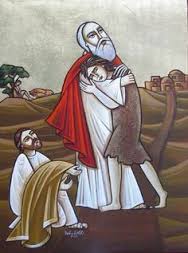 As we all know, a father’s youngest, selfish, and ungrateful son shockingly asks his father for his portion of his inheritance while his father is still alive. The father agrees and gives it to this son. The son of course leaves for a distant country where he squanders his wealth in immoral living. He comes to poverty, and a famine hits this land. He is forced to the despicable role of tending swine. He awakens to his condition and repents. He plans to return to his father, family, and home, but as a hireling — he is no longer worthy of sonship. His rehearsed confession before his father is composed, “I have sinned before heaven, and before you!” He journeys home in shame. However, his father graciously embraces his repentant son. The son is clothed, welcomed, and feasted back into the company of the family — as a son! All is forgiven, and all is restored!
Mary’s Christmas Offering
Posted: December 26, 2016 Filed under: The Eucharist and Living the Eucharist | Tags: Christ is born to be consumed in the Eucharist, Christ's teaching on the Eucharist in John chapter six, John 6: 48 -51 and the Eucharist, Mary offers her Son by laying him in a manger, Mary's offering of Christ in Bethlehem, Mary's one priestly action Leave a comment In the Orthodox Church Christmas is also known the Feast of the Nativity of our Lord and Savior Jesus Christ. Rightly, we focus on our Lord’s birth. Rightly, we celebrate the birth of God in human flesh. The other person of note is Christ’s mother, Mary. In the Church’s theology she is called Theotokos, meaning Bearer of God. She gave birth to God because God took flesh from her.
St. Luke gives us the birth narrative:
In those days a decree went out from Caesar Augustus that all the world should be enrolled…And all went to be enrolled, each to his own city. And Joseph also went up from Galilee, from the city of Nazareth, to Judea, to the city of David, which is called Bethlehem…And while they were there, the time came for her to be delivered. And she bore her firstborn son, and she clothed him and laid him to bed in a feeding trough (Luke 2: 1, 3, 4, 6 – 7).
Sacrifice, Priesthood, and Solidarity
Posted: December 22, 2016 Filed under: The Eucharist and Living the Eucharist | Tags: Acting in solidarity with all as God's priests, Commentary on Luke 22:19 - 20, Eucharist is a re-presentation of Christ's sacrifice on the cross, Jesus as High Priest, Jesus' actions in the Last Supper as found in Luke 22: 19 -20, Priesthood of all believers, Words of Institution in Luke 22: 19 - 20 Leave a comment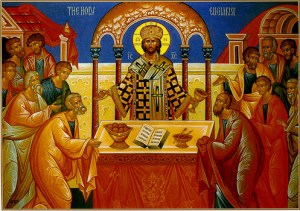 A passage from St. Paul’s epistle to the Hebrews regarding Jesus Christ as our High Priest reads,
For such a High Priest was fitting for us, who is holy, harmless, undefiled, separated from sinners, and has become higher than the heavens; who does not need daily, as those high priests, to offer up sacrifices, first for His own sins and then for the people’s, for this He did once for all when He offered up Himself (Heb 7: 26 — 27).
The phrase in the above text of interest is “once for all” coming from the Greek word ephapax. This word has brought about a good deal of argument from Protestants. Let me make it clear: it is not the Eastern Orthodox position, nor Roman Catholic position, that the bloodless sacrifice of the Divine Liturgy (or the Latin Mass) is a re-offering of Christ. In other words Christ is NOT sacrificed again, as far too many ill-informed Protestants teach about our understanding of this sacrament. No, the sacrifice of Christ was done once, and done for all! It is very clear in the Orthodox Church’s prayers found in the anaphora and elsewhere in the Eucharistic prayers, that the offering of the Eucharist is a thanksgiving offering, reasonable, and bloodless. The prayers of the Eucharist make this very clear — Christ’s once for all sacrifice is RE-presented to us by the Eucharist!
Sunday of the Forefathers of Christ
Posted: December 16, 2016 Filed under: The Eucharist and Living the Eucharist | Tags: Banquet of the Kingdom of God, Invation to the Banquet of the Kingdom of God, living as priests of God, Luke 14: 16 - 24, spiritual excuses, Sunday of the Forefathers Leave a comment When Christmas is about two weeks away the Church commemorates the ancestors of Christ. On this Sunday Abraham, Isaac, Jacob, David and many other men and women are remembered and honored. All were flawed, but all proved, in the end, to be faithful. One by one their lives of faith in the flesh led to the birth of Christ who took flesh from their daughter, Mary. Here in their numbers we find a family. This lineage begins with Abraham and Sarah, expands into multitudes, and then is compressed to one young virgin from whom the One prophesied about takes flesh. From him we have another expansion into the multitudes of all who have faith in Jesus Christ. In our numbers we, too, are incorporated by adoption into this family of faith.
Temple and Seed
Posted: October 16, 2016 Filed under: The Eucharist and Living the Eucharist | Tags: 2 Corinthians 6: 16 - 17, Christian as Temple of God, God dwelling among his people, Hearing the Word of God, Let us attend to God's Word, Parable of the Sower, selective hearing, Union with God as salvation Leave a comment The scriptural readings for the 17th day after Pentecost are 2 Corinthians 6: 16 – 7:1, and the St. Luke 8: 5 -15, or the epistle and gospel respectively. From the epistle we read St. Paul’s words which he, in part, takes from both the Law and Prophets:
For you are the temple of the living God, just as God said, “I shall indwell and walk among them, I shall be their God, and they shall be my people” (2 Cor 6: 16).
Thus, the Triune God desires relationship with humanity. The Creator desires communion with his creatures. St. Paul is in agreement with St. John’s recording of Jesus’ words found in his High Priestly Prayer: “in order that all might be one, just as you, Father are in me and I in you, in order that even they might be in us…” (John 17: 21). Our salvation is not simply a juridical reality — a legal absolving of guilt. Christian salvation is a relational union with God: Father, Son, and Holy Spirit. Then, Jesus speaks of this union with himself by the Eucharist: “The one who is eating my flesh and drinking my blood abides in me, and I in him” (John 6: 56).
“Now is the Day of Salvation”
Posted: October 10, 2016 Filed under: The Eucharist and Living the Eucharist | Tags: 2 Corinthians 6: 2, Ephesians Ephesians 1: 9 - 10, Eucharist as manifestation of the Recapitulation, Gathering around Christ in the Eucharist, Luke 7: 11 - 16, Raising of the Widow of Nain's Son, Recapitulation Leave a commentThe Old Testament Scriptures speak of an acceptable hour. St. Paul also uses this phrase to declare the importance — even urgency — of reconciliation to God. He writes this quoting the prophet Isaiah: “‘In the acceptable time I heard you, and in the day of salvation I helped you.’ Behold, now is the acceptable time, behold now is the day of salvation!” (2 Cor 6: 2).
 I had the privilege of serving The Divine Liturgy at St. Katherine’s Church in Pullman, Washington on October 9, 2016. The above passage came from the epistle reading of the day (2 Cor 6: 1—10). The epistle preceded the Gospel reading which relays the account of Jesus’ raising to life the only son of the widow of the city of Nain (Luke 7: 11 — 16). In this gospel pericope there are two very contrasting gatherings and processions. Here we have the description of the first gathering: “And it happened in the next day while he was going to the city of Nain, and his disciples and a great crowd were going with him (Luke 7: 11).” This gathering is assembled around Jesus. This gathering is assembled around his Life and Light. The other gathering has assembled for a quite different purpose. “Now as he drew near the city gate, there was a burial procession of mother’s dead only son, and she was a widow, and a great crowd was together with her” (Luke 7: 12). This assembly gathered around death and grief.
“If I Am Lifted Up…”
Posted: September 14, 2016 Filed under: The Eucharist and Living the Eucharist | Tags: dying to self, Dying to the world system, Feast of the Elevation of the Precious and Life-giving Cross, Giving thanks for crosses in out lives, Little crosses, Take up your cross Leave a comment September 14 marks the commemoration of the rediscovery of the Cross of Christ in Jerusalem in the fourth century. This feast day is known as the Elevation of the Precious and Life Giving Cross in the Orthodox Church. For the Christian, the Cross of Christ is always and every day to be understood as precious and life giving. As it was elevated in Jerusalem by the city’s patriarch, St. Marcarius, so today’s 21st century Christian is to elevate the Cross in his or her consciousness. Further, the Cross is not to comfort, but to challenge, to alarm, and even offend — even more, to bring about death. St. Paul writes of this: “The message of the Cross is foolishness to those who are perishing, but for those who are being saved it is the power of God” (1 Cor 1: 18).
That We Might See
Posted: August 29, 2016 Filed under: Etcetera, The Eucharist and Living the Eucharist | Tags: a dog's love and acceptance, eyesight of the child, Mt 9: 27 - 30, restoration of spiritual eyesight, seeing with the eyes of Christ, sight without prejudice, spiritual eyesight, the human through the eyes of a dog, the sight of innocence Leave a comment The lectionary for seventh Sunday after Pentecost gives us the Gospel account of the healing of two blind men. The duo follow Jesus and cry out to him, “Have mercy on us, Son of David!” Upon entering a house these two men approach Jesus. Jesus says to them, “Do you believe that I am able to do this?” They reply, “Yes, Lord.” Then “[Jesus] touched their eyes saying, ‘According to your faith let this be for you.’ “And their eyes were opened” (Mt 9: 27 — 30). For these two men the first object they see is their Healer, their Savior — the One who is God Incarnate. How blessed were those four eyes!
Others of us were born sighted. The first object we laid eyes on (however imperfectly as newborns) was likely the face of our mother, itself also a blessing. As sighted infants and then children we took in the creation around us with frequent awe and wonder. We saw creation through eyes of innocence. As a child I had eyes that took no account of the size of my friends’ houses, the cars their parents drove, and took no care of the occupation of father or mother.
The Longest Day of the Year
Posted: June 23, 2016 Filed under: The Eucharist and Living the Eucharist | Tags: acting in soldarity, compression of time, experience of time, solidarity 1 Comment
Foxglove
The patients of the anticoagulation and diabetes clinic in which I work often make statements which prompt some reflection. “Well,” he said, “today is the longest day of the year.” He referred to the summer solstice. This day holds out the longest period of daylight of the year. This day is not longer than any other day — it lasts only 24 hours. However, this particular day holds some degree of dread for me. With the very next day those wonderful, lingering, warm daylight hours begin to gradually shrink. They shrink to the dim, gloom, and dark of late autumn and winter (I live in western Washington).
The Myrrh Bearing Women
Posted: May 17, 2016 Filed under: The Eucharist and Living the Eucharist | Tags: imitation of Christ, Myrrh Bearing Women, preparing for death by living in Christ, the reality of Christ's resurrection in our lives Leave a comment The third Sunday of Pascha commemorates the women who came to Jesus’ tomb to anoint his corpse. These are the Myrrh Bearing Women. While wondering who would role away the stone from the door of the tomb for them, they witness an astounding site: the stone has been removed, a “young man” clothed in a white robe sits and addresses them: “Do not marvel! You seek Jesus of Nazareth who was crucified. He is risen! He is not here. See the place where they laid him” (Mark 16: 6). Expecting the ordinary in a tomb, they encounter the extraordinary.
Lazarus, Come Out!
Posted: April 23, 2016 Filed under: The Eucharist and Living the Eucharist | Tags: Christian as mediator, Lazarus, Lazarus Saturday, Mary as mediator, Participants in God's works Leave a comment
Raising of Lazarus by Andrea Fordice
In the Orthodox Church, Lazarus Saturday marks the end of Lent. This day commemorates the resurrection of Jesus’ friend from the dead by Jesus’ command to the corpse, “Lazarus, come out!” The resurrection of Lazarus occurs a week before Jesus’ own death and resurrection. This miracle prefigures our Lord’s resurrection, and vividly demonstrates Jesus’ deity and authority — here authority over death itself.
The account of Lazarus’ resurrection takes up the majority of the eleventh chapter of St. John’s gospel (Jn 11: 1 — 44). There is a detail in St. John’s account of Lazarus’ resurrection that has always stuck out for me. Jesus comes to Lazarus’ tomb. Its entrance is secured by a large stone (Jn 11: 38).
Three Tabernacles Of God
Posted: April 11, 2016 Filed under: The Eucharist and Living the Eucharist | Tags: Annunciation, Christ indwells the Christian, Christian as Tabernacle and Temple of God, Christians as Bearers of Christ, Eucharist as Tabernacle of Christ, Feast of the Annunciation, Mary Tabernacle of God, Real presence of Christ in the Eucharist Leave a comment+ MARY AS TABERNACLE +
March 25 of every year marks and commemorates the Annunciation.

Icon of the Annunciation
This is the day in which the Archangel Gabriel informs Mary of God’s plan and purpose for her: that she will conceive and bear the Son of God. With her response of obedience to Gabriel’s words, “Behold the handmaiden of the Lord. May it be done to me according to your word” (Luke 1: 38a), Mary ushers in the salvation of humanity and creation: God the Son — her Creator — enters into creation as a creature to be its Savior:
And in answering, the angel said to her, ‘The Spirit of God will come upon [epeleusetai] you, and the power of the Most High will overshadow [episkiasei] you, therefore the One begotten is holy and shall be called the Son of God” (Luke 1: 35).
Life on Mars? (Part Two)
Posted: March 25, 2016 Filed under: The Eucharist and Living the Eucharist | Tags: conversion as movement into a new culture, David Bowie "Life on Mars?", Ephesians 1: 7 - 10, ethic of being, John 8: 3 - 11, Life on Mars?, Recapitulation, Recapitulation as theology of atonement, the basis of existence, the source of relationship, Welcoming the alien and the exile, Welcoming the disaffected into the Church Leave a comment “Is there life on Mars?”, asks the late David Bowie. Bowie’s question isn’t about the prospects of extraterrestrial life on the fourth planet from the sun. Bowie’s question can be rephrased in this way: “Is there rational, meaningful life on Earth?” Many of Bowie’s songs were about those who were misfits, the disaffected, and the lonely, wandering outcasts of the greater, “normal” society around them. We have this before us in the first verse of “Life on Mars?”, Read the rest of this entry »
Life on Mars? (Part One)
Posted: March 1, 2016 Filed under: The Eucharist and Living the Eucharist | Tags: Life on Mars?, Orthodox Christian speculation of extraterrestrial life, our priestly call, the basis of existence, the source of relationship Leave a commentIn honor of his passing, the title of this posting comes from David Bowie’s song, “Life on Mars?” Lyrically, the song is both meaningful and quirky, and the refrain of the song furthers the question, “Is there life on Mars?” But, Bowie’s song has nothing to do with this first of two postings with the same title.
“Is there life on Mars?” The origin of the question of this first part of posting comes from another source: the mid-late nineteenth century telescopic observation of Italian astronomer Giovanni Schiaparelli. He observed canali on the Martian surface, yet never proposed any cause for his observation. Others also observed the same phenomenon, or so they thought. The appearance of canals was proven decades later to be an optical illusion when better telescopes were developed in the early twentieth century. However, in the latter decades of the nineteenth century, speculation of a civilization on Mars emerged in more popular articles. Such a fiction persisted until proven impossible when the harsh physical conditions on the Red Planet were discovered in the early twentieth century. Read the rest of this entry »
 Father Irenaeus Williams
Sunday of the Man Born Blind: God’s Work Manifested
Posted: May 27, 2017 | Author: Fr. Irenaeus | Filed under: The Eucharist and Living the Eucharist | Tags: Commentary on the Healing of the Man Born Blind in John 9: 1 - 38, giving thanks for difficulties, God's healing manifested in difficulties and troubles, God's love manifested in difficulties, Sacramental images in the healing of the man born blind, Sunday of the Man Born Blind | Leave a commentWe have asked this question, “Why me? Why did this happen to me?” We have heard others ask the question as well. The common, unthinking — usually unspoken — answer is “I don’t know.” But, it reveals more of the person when an addendum is added to the question: “Why didn’t this happen to someone else?” To this question the answer is, “To whom would you have this happen? To whom would you wish your misfortune?” No one wants difficulties, hardships, misfortunes, or suffering. But, though unwanted, they come our way and mess up our happy lives. Thus, when the question is asked, “Why me?”, let our answer be, “In order that the work of God might be manifested in me!” When we give this answer, we answer in faith. Further, we bring to life St. Paul’s teaching: “Rejoice always. Pray constantly. Give thanks in all things, for this is the will of God for you in Christ Jesus” (1 Thes 5: 16 – 18). With this answer and purpose in mind, I wish to offer this understanding of this day’s gospel.
Read the rest of this entry »