“Othering” Others – The Sunday of the Publican and the Pharisee
Posted: February 3, 2026 Filed under: self-giving and other receiving, The Eucharist and Living the Eucharist | Tags: author Richard Flyer, discerning the Body of Christ in 1 Corinthians 11: 27 -28, healing and preventing divisions in the Church, Jesus' parable of the Publican and the Pharisee in Luke 18: 9 - 14, othering others, the Lamb of the Eucharist Leave a comment The Parable of the Publican and the Pharisee is found in St Luke 18: 9 – 14. Our Lord directed this parable’s message to those “Who trusted in themselves that they were righteous and despised others” (St Luke 18: 9).
There is, of course, a stark contrast between the two men of the parable. We have the Pharisee: “I thank you that I am not like other men, extortioners, unjust, adulterers, or even like this tax collector. I fast twice a week, I give tithes of all that I get” (St Luke 18: 11b – 12). The pharisee, of course, had contempt for all who were not like himself — or rather perceived himself to be. He stood apart from all others in the Temple. He did not pray to God, he only praised himself.
In contrast we have the tax collector:
But the tax collector, standing far off, would not even lift up his eyes to heaven, but beat his breast, saying, “God, be merciful to me a sinner!” (St Luke 18: 13).
By this response, our Lord gives approval to the tax collector’s plea:
I tell you, this man went down to his house justified rather than the other; for every one who exalts himself will be humbled, but he who humbles himself will be exalted (St Luke 18: 14).
Though the pharisee’s behavior and attitude are to be rejected, it is far too easy to overlook and ignore the pharisee in us — the pharisee that raises his ugly head and speaks with similarly contemptible and prideful words.
Here is the focus of this posting: maintaining unity among the Christian faithful. It is easy — too easy — for us to separate ourselves from those whom we see as “other” and inferior to ourselves — those who do not meet our exalted standards and insights. It is easy for the healthy to separate themselves from the chronically ill; the affluent who look down on the poor; the educated and sophisticated who look down on the simple and the “unwashed masses;” the urban to look down on those in rural areas; those in rural areas to despise the city-dweller. This list can go on and on, and would include political positions and allegiances. We can find examples that apply to our own self-righteousness, false confidences, and pride.
As we all should know, we live in a secular society that is extremely divided where factions hate each other. By some means this is a manufactured condition with a strategy of divide and conquer. Be sure that its architecture and construction comes from the one who is the enemy of our souls and of our Lord. They are all anti-human. Plainly there are “-ologies”, “-isms”, and “-alities” which are false and evil. They are designed to deceive us and threaten our souls and unity in Christ. These are to be rightly rejected when they are contrary to the teachings of the Church. Such lies are to be confronted and opposed with unwavering resolve, and also with the unwavering love of God.
We encounter division and enmity. But, could it be possible that we in our own hearts and minds are “othering” our brothers and sisters. “othering” — we have the coinage of a new term. I think it comes from an acquaintance of mine and author Richard Flyer, and he makes this observation:
Long before today’s culture wars, we’ve been programmed to see through a lens of separation — to divide before we related, to organize around what sets us apart rather than what binds us together…this is what I call the Culture of Separation — a world so consumed by its righteous battles that is forgets relationship itself. We condemn those who “other” others while easily othering them in return.
Could it be even remotely possible that we may be a pharisee “othering” a supposed tax collector in this Temple of God? I must speak to myself when this question is asked as well as the reader of this posting.
With today’s Sunday of the Publican and the Pharisee, we are one Sunday closer to Great Lent, and one Sunday closer to the brilliant glory of Pascha!
There were divisions in the Church of the first century, and St Paul addressed those in his epistles. The greatest societal division of the era was that of Jew and Gentile. Throughout is his epistles, St Paul declares that such divisions were abolished by Christ:
Therefore, remember that at one time you Gentiles in the flesh, called the uncircumcision by what is called the circumcision, which is made in the flesh by hands — remember that you were at that time separated from Christ, alienated from the commonwealth of Israel, and strangers to the covenants of promise, having no hope and without God in the world. But, now in Christ Jesus you who once were far off have been brought near by the blood of Christ. For he is our peace, who has made us both one, and has broken down the dividing wall of hostility, by abolishing in his flesh the law of commandments and ordinances, that he might create in himself one now man in place of the two, so making peace, and might reconcile us both to God in one body through the cross, thereby bringing the hostility to an end (Ephesians 2: 11: 16).
Unity in Christ and the in the Holy Trinity is not just to be a lofty ideal, but our reality. We are to have unity in being just as does the Holy Trinity. Of this unity the Divine Liturgy informs us: “It is meet and right to worship the Father, and the Son, and the Holy Spirit: the Trinity one in essence and undivided.”
A priest at his ordination has a cube shaped piece of bread which will become the Body of Christ, and it is called the Lamb. It is placed in his hand by his bishop. By his bishop he is given the charge to care for and uphold the integrity of the Body of Christ: the Body of Christ of the Eucharist, and the Body of Christ which is composed by the faithful assembled for the Divine Liturgy. Regarding both holy Bodies of Christ St Paul has written,
Whoever, therefore, eats the bread or drinks the cup of the Lord in an unworthy manner will be guilty of profaning the body and blood of the Lord. Let a man examine himself, and so eat of the bread and drink of the cup. For any on who eats and drinks without discerning the body eats and drinks judgment upon himself (1 Corinthians 11: 27 – 28).
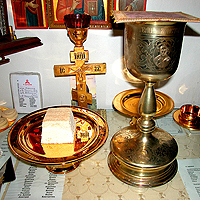 The Eucharist is our common offering. We offer it together to God. We are to offer it together in unity with, and love for one another. We are all sinners gathered together in this hospital which is the Church. Since we are sinners in the ongoing, healing process of sanctification, there will be occasional conflicts. St Paul states somewhere that we are “to put up with one another!” You are to put up with me, and I with you (even if you are a New York Yankees fan, and even if you do not like the Beatles!)
It is by the Eucharist that Christ abides in us, and we in him (see St John 6: 56). This is a spiritual, ontological reality. It is not to be kept to ourselves. We are to live in a way that is eucharistic, meaning we are to unfold Christ who indwells us to one another, and to all and all things. We are to be self-giving and other receiving — just as Jesus gives himself anew to us by the Eucharist, and also receives us again to himself by this holy Sacrament. Given this, we are not to other others!
As we move together to and through another Great Lent, let us seek unity in humility, and with love for one another in self-giving and other-receiving relationships. Additionally, let’s have in our hearts and on our tongues the words of the Publican: “God, be merciful to me a sinner!” (St Luke 18: 13).
The following is the corresponding sermon given at St Nicholas Greek Orthodox Church on February 1, 2026:
In Christ,
Fr Irenaeus
Receiving Sight
Posted: January 19, 2026 Filed under: The Eucharist and Living the Eucharist Leave a commentThis posting discusses Jesus’ healing, and gift of sight, to a blind man on the road to Jericho. This account is found in St Luke 18: 35 – 43.
For the blind man, the day started out like every other day. He sat begging on the side of the road to Jericho. Yet, that day would be unlike any other day of his life because Jesus and his disciples were passing by. He cries out: “‘Jesus, Son of David, mercy me!’” (St Luke 18: 38). “Mercy me!” seems to be an antiquated, or odd, translation of the blind man’s eleeson me! Modern translations would use the term “have mercy on me!” But, this misses the significance of the root of the verb eleeo. The Greek word for oil is elaion. The verb eleeo, in addition to an act of mercy, or forgiveness, offers the meaning, “Heal me!” “Pour a balm upon me!” It was his request to have God’s grace to come upon him.
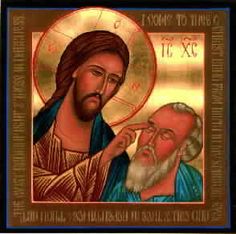 The crowd tried to silence him — to prevent him from interacting with Jesus (St Luke 18: 39).. After all, he was just an unimportant, faceless, blind beggar. He refuses to be discouraged. He cries out all the more: “‘Son of David, mercy me!’” (St Luke 18: 39). Jesus responds, “‘What do you wish me to do for you?’ And he said, ‘Lord, that I might see.’ And Jesus said to him: ‘See. Your faith has saved you’” (St Luke 18: 41 – 42). We read of the result:
And immediately he saw, and he followed him glorifying God. And all the people upon seeing this gave praise to God (St Luke 18: 43).
It is important to know that giving, or restoring, sight was the unique healing gift of the Messiah. The blind man knew this as we read his address to Jesus with the Messianic title, Son of David.
Given this, we should see ourselves as the blind man. Once we sat, as he did, in spiritual blindness and poverty. When we were catechumens, or are now blessed to be catechumens, the Church, in the Divine Liturgy prays, “That he [God] may reveal to them the Gospel of Righteousness.”
We all moved from the category of catechumen to that of faithful when were baptized and crismated. We were illumined. Thus, we could now see spiritually, and live as Christians. But, consider this: in every Divine Liturgy before the reading of the Gospel this prayer is said,
Illumine our hearts, O Master who loves mankind, with the pure light of your divine knowledge. Open the eyes of our mind to the understanding of your gospel teachings. Implant also in us the fear of your blessed commandments, that, trampling down all carnal desires, we may enter upon a spiritual manner of living, both thinking and doing such things as are well-pleasing unto you. For you are the illumination of our souls and bodies, O Christ our God, and unto you we ascribe glory, together with your Father, who is from everlasting, and your all-holy, good, and life-creating Spirit, now and ever and unto ages of ages.
Now, from this prayer we are to learn that our illumination and the opening of the eyes of our mind is an ongoing process. This is to be a continual reopening of the eyes of our mind that we grow in our spiritual life, “…both thinking and doing such things as are well-pleasing unto you.”
Our salvation is not a “one and done” event, not is it a once and for all single occurrence. It, again, is a process! Our salvation requires an ever ongoing renewal and correction. Think of the ongoing checking of our physical sight by an optometrist or an ophthalmologist. Upon the results of an examination of vision, one may be given necessary prescriptions to take to an optician for correction of eye sight. This makes me think of another Gospel account of Jesus’ healing of a blind man — one who lived in Bethsaida:
And they came to Bethsaida. And some people brought to him a blind man, and begged him to touch him. And he took the blind man by the hand, and led him out of the village; and when he had spit on his eyes and laid his hands upon him, he asked him, “Do you see anything?” And he looked up and said, “I see men; but thy look like trees walking.” Then again he laid his hands upon his eyes and he looked intently and was restored, and saw everything clearly. And he sent him away to his home, saying, “Do not even enter the village” (St Mark 8: 22 – 26).
Our salvation is a spiritual life demanding growth and maturation. It involves ongoing confession and repentance. When we stumble and fall we get up again by the supporting hand of God who is saving us. It is an ongoing faith filled consumption of the Body and Blood of Christ by the Eucharist. By this Sacrament we are cleansed, by which we receive Jesus’ Light and Life and gain his victory over sin, darkness, death, and alienation — and spiritual blindness.

Light and Life
Quoting from a portion of the Prayer of the Hours, there is the needed continual cooperation with God to “sanctify our souls, purify our bodies, set aright our minds, and cleanse our thoughts.” Allow me to suggest we may also pray, “Lord, be my eyes to see your path and walk in your ways. Let me see with the eyes of a child; with eyes made pure by your all-holy Body and Blood.”
With the eyes of faith we are enabled to see any situation to be an opportunity where we, “Rejoice always. Pray constantly. Give thanks in, with, and for all things, for this is the will of God for you in Christ Jesus” (1 Thessalonians 5: 16 – 18). All this is to be done to the glory of God: Father, Son, and Holy Spirit!
The following is a corresponding sermon given January 18, 2026 at Holy Resurrection Orthodox Church, Tacoma, Washington:
In Christ,
Fr Irenaeus
St Ambrose of Milan and the Thankful Leper
Posted: December 9, 2025 Filed under: The Eucharist and Living the Eucharist | Tags: "Let us go forth in peace", 1 Thessalonians 5: 16 - 18, become Eucharists, Become thankful Col 3: 15, give thanks for all things, Hypostatic Union, living eucharistically, Real Presence, St Ambrose of Milan, St John 6: 50 -51, St Luke 17: 13 - 19, The Eucharist is a re-presentation of the Incarnation, the Eucharist is the Body and Blood of Christ, The Healing of Ten Lepers, the one thankful leper, transubstantiation and Monophysitism Leave a commentEvery year on December 7 the Orthodox Church commemorates St Ambrose of Milan. He was bishop of Milan in the fourth century and is, of course, a saint of the Church. One of his works, The Mysteries, was extremely important for my conversion to the Orthodox Church, and subsequent ordination to the deaconate and then the priesthood.
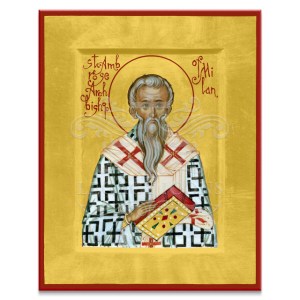
St Ambrose of Milan
This work taught me, when I was a Protestant, that Holy Communion — the Eucharist — gives to the communicant the true, all-holy, and precious Body and Blood of the incarnate God, our Lord and Savior Jesus Christ. This epiphany occurred in 1992 when I was a student at a Protestant seminary. Upon this revelation I was undone — my “apple cart was tipped over.” I experienced a “paradigm shift.” I went “through the looking glass.” I had to ask some fundamental questions, among them being, “What is salvation? Are we saved by more than faith alone?” “What is reality?” My dualistic understanding of matter and spirit was shattered — they are not separated by a great chasm, they intermingle with one another.
Specifically, I was confronted by these sentences found in The Mysteries:
Perhaps you may say: “I see something else; how do you tell me that I receive the Body of Christ?” (9: 50).
It has been proven that the sacraments of the Church are more ancient; now realize that they are more powerful. In very fact it is a marvelous thing that God rained manna on the fathers, and they were fed by daily nourishment form heaven. Therefore, it is said: “Man has eaten the bread of angels.” But yet all those who ate that bread died in the desert, but this food which you receive, this living bread which came down from heaven, furnishes the substance of eternal life, and whoever eats this bread “will not die forever;” for it is the body of Christ (9: 49).
St Ambrose quotes from the sixth chapter of St John’s Gospel, and more specifically the Bread of Life discourse that took place in the synagogue of Capernaum. I had to read from St John’s sixth chapter myself over and over for the message of these verses to sink into my mind (I still refer to them quite frequently).
Your fathers ate the Manna in the wilderness and died. This is the Bread which is coming down from heaven [katabainon], in order that if someone might eat of it might not die. I am the Living Bread which came down [katabas] from heaven. If someone might eat of this Bread he shall live forever, and the Bread which I will give is my Flesh in behalf of the world (St John 6: 49 -51).
St John uses two different participle forms of the Greek verb katabainein, “to come down,” or “to descend.”
-
- Katabainon — substantival present passive form. The present tense, or aspect, of a Greek verb implies an ongoing activity — no ending of the action is demanded. This means there is a Bread which is continually coming down from heaven.
- Katabas — a substantival aorist active form. The aorist declares an action is completed. With this participle, our Lord refers to the Bread which is his Body which came down from heaven only once. Katabas, thus, refers to his physical Body of the Incarnation that stood before those assembled in the synagogue.

The Living Bread
Again, St John 6: 50 informs us that there is a Bread which is continually coming down from heaven. Our Lord then defines and clarifies what and who this Bread is in 6:51. He most clearly states that this Bread which is continually descending from heaven is none other than his physical body of the Incarnation — the body that came down — once and for all which will be broken and given for the life of the world. They are one and the same!
Perhaps one who denies this truth might think, “Well, by the time of St Ambrose the Church became confused about this matter and many others as well.” Wrong! 250 years earlier St Ignatius of Antioch — himself a disciple of St John — gave to the church of Smyrna of these words regarding the Eucharist:
They [false teachers] abstain from the Eucharist and prayer, because they do not confess the Eucharist to be the Flesh [sarka – a feminine noun] of our Savior Jesus Christ. The Flesh [taen, feminine article – sarka is its antecedent] which suffered for our sins, the Flesh [taen, feminine article– again sarka is the antecedent] which, by the goodness of the Father, was raised (Ignatius to the Smyrnaeans VII: 1).
The Apostolic Tradition of the Church, from St John the Apostle, through St Ignatius (early second century), through St Ambrose of Milan (fourth century), to this very day has always taught that by the Eucharist the Church is given our Lord’s Body and Blood. To deny this is to deny the faith of the One, Holy, Catholic, and Apostolic Church! To deny this truth is to imply that St John who observed, heard, and touched our Lord — the Incarnate Logos (see 1 John 1: 1- 5) is a liar. And you accuse all the Fathers of the Church to be liars as well.
Hence, from all of this, especially from St John’s words, we are to understand that the Eucharist is a re-presentation of the Incarnation. All that is of Christ — all that he is, and all that he did and accomplished for our salvation — are re-presented anew to us. A re-presentation of the Incarnation means that the hypostatic union also applies to the Eucharist. Regarding Jesus of Nazareth the hypostatic union means that he is fully God and fully man. These two natures are in an indivisible union in the one Person of Jesus, yet the two natures are not to be confused. Then, regarding the Eucharist, it is fully Jesus’ Body and Blood and fully bread and wine — two “natures” exist in an indivisible union, yet they are not to be confused. (As an aside, The Roman Catholic understanding of transubstantiation is a bit reminiscent of the error of Monophysitism — that there is only one nature of Jesus. Thus, transubstantiation states there is only one nature of the Eucharist: there is only Body and Blood, the bread and wine are simply incidentals. With the teaching of transubstantiation the Eucharist is a bit misunderstood.)
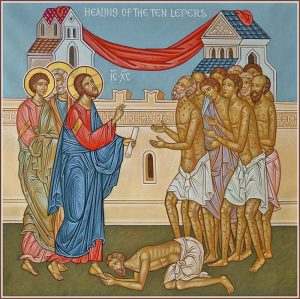 In addition to the commemoration of St Ambrose of Milan, the day’s Gospel reading presents to the Church the account of the healing of ten lepers. All were healed, but only one returns to worship and give thanks to Jesus for his healing:
Then one of them, when he saw that he was healed, turned back and was glorifying God with a loud voice; and he fell on his face at Jesus’ feet, giving thanks to him. Now, he was a Samaritan. Now, in answering, Jesus said, “Were not ten cleansed? Where are the nine? Was no one found returning to give glory to God but this foreigner?” And he said to him, “Rise and go on your way; your faith has saved you!” (St Luke 17: 15 – 19).
Only one healed leper gave thanks to God. Therefore, only one lived eucharistically.
Living eucharistically: what do I mean by this phrase? The Greek word eucharistia means thanksgiving. St Paul gives this command to the Colossian church: “And become thankful [kai eucharistoi ginesthe] (Colossians 3:15). You can also say it this way, “Become Eucharists!”
When the Divine Liturgy comes to its conclusion a priest descends the solea and declares this: “Let us go forth in peace!” These words are not simply a command to direct us as we reenter the world. These words give a commissioning, and a new liturgy begins with the empowering of the Eucharist that moves us to our departures. St Paul writes,
Rejoice always. Pray constantly. Give thanks [eucharisteite] in, with, and for all things: for this is the will of God for you in Christ Jesus (1 Thes 5 – 16 – 18).
By giving thanks for not only the good and pleasant things of life, but also for the difficult and unpleasant things (and people) we live eucharistically. Thus, if we live eucharistically we incarnate all we encounter — we bear Christ into all things and for all things. Thus there can be transformations, and we are certainly formed more completely into the image of God, and Christ is more fully formed in us. We are living Eucharists in the world, and we act as the thankful leper who glorified God!
In Christ,
Fr Irenaeus
Walking Upright
Posted: December 2, 2025 Filed under: Etcetera, The Eucharist and Living the Eucharist | Tags: 1 Corinthians 4: 14 - 16, begotten of God, St Andrew the First Called, St John 1: 35 - 51, St Luke 13: 10 - 17, St Paul calls himself "Father", St Paul fathered the church of Corinth, the cursed serpent's realm, The healing of the bent over woman, The thematic focus of St John's Prologue 1: 11 - 13 1 CommentThe Gospel text for the 25th Sunday after Pentecost comes from St Luke 13: 10 – 17. From the text we read about the healing of a woman who was bent over double by a spirit for 18 long years. She was suffering due to the work of the enemy:
And he [Jesus] was teaching in one of the Synagogues on the Sabbath. And behold there was a woman who was having a spirit of weakness for 18 years, and she was bent over double and was unable to completely straighten up (St Luke 13: 10 – 11).
 Her posture was bent down at an approximate angle of 90 degrees. Thus, her gaze was essentially always downward unless she inclined her head upward to see (and perhaps that was done with difficulty). She looked to the ground to the stones and dirt. Thus, her gaze was directed to decay: the earth and soil are made from the breakdown, or decay of stone and organic substances. She looked down upon the byproducts of death. Therefore, spiritually speaking, her gaze was set to the realm of the serpent:
The Lord God said to the serpent, “Because you have done this, [the deceiving of Eve] cursed are you above all cattle, and above all wild animals; upon your belly you shall go, and dust you shall eat all the days of your life (Genesis 3: 14).
Although the woman’s condition was a physical ailment the spiritual parallel is evident: Apart from Christ and a life of faith and repentance we are all bent over double with our eyes fixed upon the Serpent’s realm of decay and death. But Jesus intervened,
Upon seeing her, Jesus called and said to her, “Woman, you are released from your weakness.” And he placed his hands on her and immediately she straightened up and glorified God (St Luke 13: 12 – 13).
With this healing her gaze was in a forward direction. She now clearly saw our Lord and praised God for her healing. She could now look upon God’s creation around her, and look up to the heavens. She now moved and lived without pain.
So, we come to our spiritual condition — apart from Christ we are bent over double and gaze down upon death and decay; upon sin, darkness, and alienation. By being in Christ by faith and Sacrament we stank upright and can look upon him with the eyes of faith. But, when we look away from his ways and stray from him we have begun to be doubled over and gaze upon death and decay once more. But, we are given the Sacrament of Confession’s spiritual chiropractic treatment to set us straight again.
 Every year, on November 30, we also commemorate the Apostle Andrew — the First Called of the Apostles (St John 1: 35 – 51 is the Gospel text for his feast day). He too, as he walked with our Lord, was spiritually straightened up. In Christ, with Christ, and for Christ he gazed upon him and learned from him. He, together with the other apostles, gave us the Apostolic Tradition which has guided the Orthodox Church for 2,000 years.
By the Apostolic Tradition we are taught by the Scriptures and those who interpret them by this holy Tradition. This Apostolic Tradition gives us other gifts. We worship The Triune God in the Divine Liturgy and all the services of the Church. We enter into the Sacramental life of the Faith, especially by receiving the Body and Blood of our Lord in and by the Eucharist. We are given examples of godly, holy living by the lives of the saints. In the epistle set for the day, St Paul has written this for us:
I do not write this to make you ashamed, but to admonish you as my beloved children. For though you have countless guides in Christ, you do not have many fathers. For in Christ Jesus through the Gospel I begot [egenneesa] you. Therefore, I exhort you — become imitators of me (1 Corinthians 4: 14 – 16).
St Paul’s use of the verb translated begot / fathered can take us back to the Prologue of St John’s Gospel. The Prologue is found in the Gospel’s first chapter and consists of verses 1 – 18. These verses are constructed in a very specific way to lead us to the center and focus of the Prologue’s message:
Unto his own things [ta idia – the things of creation] he came, and his own [oi idioi – his fellow Jews] did not receive him. But as many as received him, he gave to them authority to become children of God, to those who believe in his name. They, not from blood, nor the from the will of the flesh or the will of a man, were begotten [egenneetheesan] from God (St John 1: 11 – 13).
These verses inform us that we are the children of God. We are the children of a spiritual family of faith. And as any family has defining appearances and characteristics, so are we to have defining spiritual characteristics that, for example, are found in the Beatitudes (see St Matthew 5: 1 – 12).
By being in Christ we stand up straight. We look forward to clearly see and follow along the path of Christ. Also, in addition to the Scriptures, we can take the guidance of the Apostles and the saints as we move confidently in the ways of the Apostolic Tradition which, in part, was set out by St Andrew the First Called.
Here is the corresponding sermon given at St Jacob of Alaska Orthodox Church in Bend, Oregon on 11/30/25:
In Christ,
Fr Irenaeus
Moving in a New Creation
Posted: November 11, 2025 Filed under: The Eucharist and Living the Eucharist Leave a comment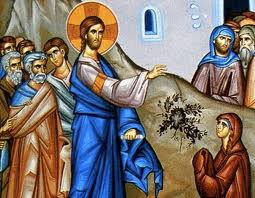 From the day of November 9, 2025 we have the assigned Gospel reading of St Luke 8: 40 – 56. We read about two miracles. The first miracle presents to us a woman with an ongoing menorrhagia who is healed by touching the hem of Jesus’ garment. She had spent her living on physicians without receiving healing. This points out the futility of the ways of the world system and many of its methods — no matter how well intentioned they may be. The second miracle involves Jairus’ daughter who died, but was brought back to life by Christ’s words: “Child, arise!” (St Luke 8 54). Those who were assembled to mourn for the girl laughed at Jesus. They could neither understand who was in their presence, nor comprehend his power to work miracles, especially his power over death. There was no room for him as they understood the ways of the flesh and of the world system.
Let’s turn to the reading to the day’s designated epistle: Galatians 6: 11 – 18. In this epistle, St Paul battles the false teaching of the Judaizers and urges the Galatian church to ignore their errors. The Judaizers were actively compelling Gentile male converts to receive circumcision, and follow in the now obsolete Jewish traditions, and to conform their lives to the Mosaic Law. St Paul informs us of their motivation: to avoid persecution for the sake of the Cross of Christ. (To avoid persecution is a strong motivation for apostasy). On top of this, those circumcised, who could not keep the Law, also wanted to boast in this marking of their flesh: As a sign of their pride in being Jews.
St Paul will not boast in anything of his past, or in anything the world system values, or holds in esteem. He will boast only in the Cross of our Lord Jesus Christ:
For far be it from me to glory except in the cross of our Lord Jesus Christ, by which the world has been crucified to me, and I to the world (Galatians 6: 14)
For St Paul, the values of the world system, its conventional wisdom, and its categories now — by being in Christ — have no hold on him because he is dead to them. “For in Christ Jesus circumcision is nothing, as it is with uncircumcision, but a new creation” (Galatians 6: 15). Elsewhere St Paul has written,
And he died for all, that those who live might live no longer for themselves but for him who for their sake died and was raised. From now on, therefore, we regard no one according to the flesh; even though we once regarded Christ according to the flesh, we regard him thus no longer. Therefore, if any one is in Christ, he is a new creation. The old has passed away, behold all things [ta panta meaning everything of creation] have become new (2 Corinthians 5: 15 – 17).
St Paul gives us more information:
And he is before all things, and in him all things [ta panta] stand in their proper orders. He is the head of the body, the Church. He is the beginning, the first-born from the dead in order that he might become pre-eminent in everything. Because in him all the fullness [to pleroma] was pleased to dwell, and through him to reconcile all things in him, whether the things on earth or the things in heaven — making peace through the blood of his Cross (Colossians 1: 17 – 20).
(N.B.: The reading from Colossians 1: 19 and its use of pleroma differs greatly from the use of to pleroma in 2: 9 which reads “because in him all the fullness of the Godhead dwells bodily (pan to pleroma tes theotetos somatikos).
All things are reconciled in peace through and unto Christ Jesus. Since all things stand in their orders in Christ, this means all things have, according to and as is appropriate for their species, a share in the resurrection and in glorification bestowed upon all by Christ. “Behold, all things have become new.” By and in Christ a new world, a new creation, a new “economy” (meaning house rules) exist — “the old has passed away.” We have been removed from a black and white existence. We have been moved away from a world of stagnate air and water; of mold and toxins. We have been moved into an existence of color, life, light, liberty, and victory which is in, by, and from Christ. We are in Christ and are new. These are our new realities in him:
…to make the word of God fully known, the mystery hidden for ages and generations but now made manifest to his saints. To them God chose to make known how great among the Gentiles are the riches of the glory of this mystery, which is Christ in you, the hope of glory (Colossians 1: 26 – 27).
St Paul, therefore, gives this instruction to the Colossians: “As, therefore, you received Christ Jesus the Lord, in him walk” (Colossians 2: 6).
 We walk. We do not stand still. We are to be active in Christ. As Christians we are not to be living a sedentary life which would lead to spiritual atrophy. Let me provide an illustration. On my property is a miniature kiwi vine. Let it stand for the mindset and ways of the world system. Its vines, tendrils, reach out for any stationary object: trees, bushes, fence posts. The tendrils form a spiral around the captured object. If the object was able to move, it could not. It is trapped in the unrelenting grip of the vine. So it would be for a Christian who is not active in the faith: entrapment.
We must walk in the ways of Christ. We must walk away from, shun, and throw away the reasonings and ways of the world system — its economies. We must walk — conduct our lives — in Christ, in his ways and economies, in his new creation. For ourselves, one another, and for all and all things, let all of our movements be to the glory of God: Father, Son, and Holy Spirit.
The following is the corresponding sermon given at Holy Resurrection Orthodox Church, Tacoma WA on November 2, 2025:
In Christ by whom all things are new,
Fr Irenaeus
Leaving Behind and Following
Posted: October 14, 2025 Filed under: The Eucharist and Living the Eucharist | Tags: 2 Corinthians 5: 17, Being a new creation in Christ, Colossians 3: 1 - 17, fruit of the Spirit, Galatians 5: 16 - 24, Hebrews 12: 1 - 2, Jesus Christ Conquers, laying aside every weight and sin which clings so closely, Leaving behind all things, living the Beatitudes, St Luke 5: 1-11 Leave a commentThe text for this posting comes from St Luke 5: 1 – 11, and the subject matter of these verses is the calling of three Apostles: Simon Peter, James, and John. The concluding verse reads as follows,
And after putting their boats to the land, and leaving all things, they followed him (St Luke 5: 11).
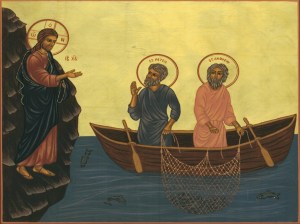 Simon Peter, James, and John set down their livelihoods. They left everything to follow Christ. Their calling as Apostles (as with all the Apostles) was unique. None of us has such a calling to apostleship. Very few of us will receive a call to the monastic life, though some may choose a life of simplicity apart from monasticism.
However, all Christians are called to follow Christ in holiness of life, in purity of heart, and in peace and repentance. Most of us here have families, jobs / careers, and other responsibilities that prohibit us from abandoning these ties and obligations entrusted to us. Yet, as part of our call to follow Christ, there are things to be left behind and abandoned. I turn to a few New Testament passages from St Paul’s epistles.
HEBREWS 12: 1 – 2:
Therefore, since we are surrounded by so great a cloud of witnesses, let us also lay aside every weight, and sin which clings so closely, and let us run with perseverance the race that is set before us, looking to Jesus the pioneer and perfecter of our faith, who for the joy that was set before him endured the cross, despising the shame, and is seated at the right hand of the throne of God.
GALATIANS 5: 16 – 24:
But I say, walk by the Spirit, and do not gratify the desires of the flesh. For the desires of the flesh are against the Spirit, and the desires of the Spirit are against the flesh; for these are opposed to each other, to prevent you from doing what you would. But if you are led by the Spirit you are not under the Law. Now the works of the flesh are plain: immorality, impurity, licentiousness, idolatry, sorcery, enmity, strife, jealousy, anger, selfishness, dissension, party spirit, envy, drunkenness, carousing, and the like. I warn you, as I warned you before, that those who do such things shall not inherit the Kingdom of God. But the fruit of the Spirit is love, joy, peace, patience, kindness, goodness, faithfulness, gentleness, self-control; against such there is no law. And those who belong to Christ Jesus have crucified the flesh with its passions and desires.
COLOSSIANS 3: 1 – 6; 12 – 17:
If then you have been raised with Christ, seek the things that are above, where Christ is seated at the right hand of God. Set your minds on things that are above, not on things that are on earth. For you have died, and your life is hidden with Christ in God. When Christ who is our life appears, then you also will appear with him in glory. Put to death what is earthly in you: immorality, impurity, passion, evil desire, and covetousness, which is idolatry. On account of these the wrath of God is coming…Put on then, as God’s chosen ones, holy and beloved, compassion, kindness, humility, meekness, and patience, forbearing one another, forgiving each other; as the Lord has forgiven you, so you also must forgive. And over all these put on love, which binds everything together in perfect harmony. And let the peace of Christ rule in your hearts, to which indeed you were called in the one body. And become thankful. Let the word of Christ dwell in you richly, as you teach and admonish one another in all wisdom, and as you sing psalms, hymns and spiritual songs with thankfulness in your hearts to God. And whatever you do, in word or deed, do everything in the name of the Lord Jesus, giving thanks to God the Father through him.
2 CORINTHIANS 5: 17:
So then if someone is in Christ, he is a new creation. The old things passed away, and behold all things have become new.
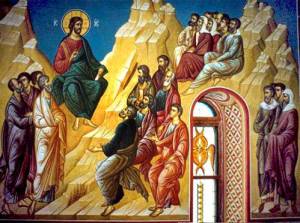 Since we are a new creation in Christ we are, therefore, to conduct our lives as Christ wills, and by the Holy Spirit to conform our lives to this reality. Added to this we are citizens of the Kingdom of Heaven. Every citizen of a country, every ethnicity, whether Serbians, Greeks, English, Americans, Russians, Mexicans, etc., have unique languages, cuisines, and cultural customs and mannerisms by which they are known and recognized. Therefore, as citizens of the Kingdom of Heaven — we who are in Christ — must have cultural mannerisms which declare our heavenly citizenship. I turn to the Beatitudes to flesh out this point. The Beatitudes are not lofty, unattainable ideals. On the contrary, they are spiritual virtues that are to be worked into our lives. These are the cultural characteristics by which we live and are recognized — they declare our heavenly citizenship.
ST MATTHEW 5: 1 – 16:
And upon seeing the crowd, he went up the mountain, and after he sat down his disciples approached him. He the opened his mouth and taught them, saying:
“Blessed are the poor in spirit, for theirs is the Kingdom of Heaven.
“Blessed are those who are mourning, for they shall be comforted.
“Blessed are the meek, for they shall inherit the earth.
“Blessed are those who are hungering and thirsting after righteousness, for they shall be satisfied.
“Blessed are the merciful, for they shall receive mercy.
“Blessed are the pure in heart, for they shall see God.
“Blessed are the peacemakers, for they shall be called the sons of God.
“Blessed are those who are persecuted for the sake of righteousness, for theirs is the Kingdom of Heaven.
“Blessed are you whenever they insult you, persecute you and speak all manner of evil against you falsely for my sake. Rejoice and be glad for great is your reward in heaven, for thus they persecuted the prophets who came before you.
“You are the salt of the earth; but if salt has lost its taste, how shall its saltiness be restored? It is no longer good for anything except to be thrown out and trodden under foot. You are the light of the world. A city set on a hill cannot be hidden. Nor do men light a lamp and set it under a bushel, but on a stand, and it gives light to all in the house. Let your light so shine before men, that they may see your good works and give glory to your Father who is in heaven.”
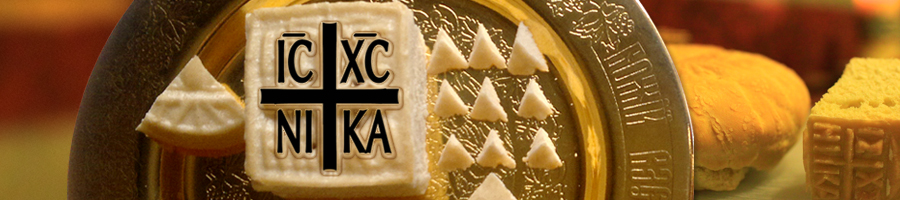
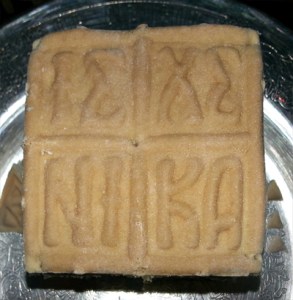
 As did Peter, James, and John, we too are to put our boats onto the land, leave what is contrary to the Christian life and follow our Lord. Such a life is a struggle, and we are to engage in this contest with the will to win — as can only be done by the work of the Holy Spirit in our lives. Come to the Sacraments. Especially come to the Eucharist with intention and with a purpose. There is a message is impressed into the surface of the Lamb, the piece of bread which will become his Body: in a cruciform arrangement one reads IC XC NIKA. This means Jesus (IC) Christ (XC) conquers (the Greek verb nika — conquers). Over what did, and does, Jesus conquer? He was, and is, victorious over sin, death, darkness, and alienation. Thus, pray that his victory over sin, death, darkness, and alienation comes into our lives, and that these are replaced with his holiness, life, light, and relationship. We pray that he gives to us his cleansing and victory. Pray also that his victories in our lives cause us to put our boats to the land, and lay aside every weight, and sin that clings so closely, and follow our Lord more fully.
The following is a corresponding sermon given at St Sava Serbian Orthodox Church on October 12, 2025:
In Christ,
Sanctification Under Our Rooves
Posted: July 11, 2025 Filed under: Etcetera, The Eucharist and Living the Eucharist | Tags: 1 Thessalonians 5: 15 - 24, becoming god-like, becoming whole and complete, divination, experiencing God, The centurion's confession of faith in Mt 8: 5 - 13, The Centurion's faith, Theosis Leave a commentSANCTIFICATION UNDER OUR ROOVES
In the sixth chapter of his letter to the Church in Rome, St Paul notes the contrasts between their lives before coming to faith in Christ and their lives after faith and baptism in Christ. The contrast shows their previous lives as Roman pagans bound them as slaves to sin, but their union with Christ binds them as slaves to righteousness (Romans 8: 18). St Paul continues,
When you were slaves of sin, you were free in regard to righteousness. But, then, what return did you get from the things of which you are now ashamed? The end of those things is death. But, now that you have been set free from sin and have become slaves of God, the return you get is sanctification and its end, eternal life (Romans 8: 20 – 22).
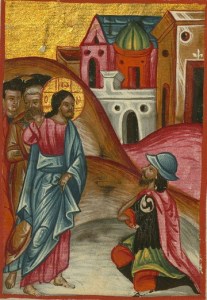 Sanctification, or the attainment of holiness, is the primary theme of this posting. But, I present a slight detour: the Fourth Sunday of St Matthew’s Gospel readings informs us of the faithful Centurion who approaches Jesus asking that he heal his servant who is paralyzed and is suffering terribly (St Matthew 8: 5 – 6). Jesus agrees to heal the servant. The Centurion then says these words to our Lord:
Upon answering, the Centurion said, Lord, I am not worthy that you should enter under my roof, but only say the word and my servant shall be healed (St Matthew 8: 8).
Jesus marvels at his answer and says, “Truly I say to you, not even in Israel have I found such faith (St Matthew 8: 10).

St Photini
“I am not worthy!” No one is worthy. No one is ever worthy of the salvation and grace given to us by Christ. In the Gospels we find example after example of the unworthy whom Christ called, healed, showed mercy, and to whom he extended his salvation and holiness. We can recall the woman with an ongoing menorrhagia who unworthily was healed by touching the hem Jesus’ garment. We read of the unworthy and sinful tax collectors who were called by Jesus to follow him (Matthew the Apostle and Zacchaeus who became a bishop). We know the sinful and unworthy Samaritan woman who entered into our Lord’s renewing, life-giving water — she would become an evangelist and martyr whom we know as St Photinia. We are to remember St Peter who said, “Depart from me, for I am a sinful man, O Lord!” St Luke 5: 8b).
There are numerous others, and we are to count ourselves among them, for we too are unworthy sinners who can echo the Centurion’s words: “I am not worthy that you should enter under my roof!” Isn’t it the case that we hesitate to have people come to our homes because of accumulated clutter, dirty dishes in the sink, or the miraculous breeding of “dust bunnies” in the unswept corners? In spite of the fact that the maid never shows up to tidy up for us, our Lord already knows the condition both of our homes and our souls. More importantly, he is not afraid of the situation of our “interior domestic environment.” He is ready to go to work to clean us up and make us a fitting habitation for his presence in our lives — no matter how many cleanings it takes.
No one is ever worthy, but we must ready ourselves for the work that he will do in our lives — the works of sanctification of purification. “Blessed are the pure in heart, for they shall see God” (St Matthew 5: 8). The Beatitudes — the listing of spiritual attributes — are not to be seen as lofty, unattainable ideals. Rather, they are all to be worked into us as evidence of the sanctifying work God is to be doing in our lives — if we allow this work to be done.
I continue with the subject of sanctification, especially those who came from a Protestant tradition where we first encountered Christ. While a student at a Protestant seminary, I took a course on the writings and theology/soteriology of Martin Luther. In one of his works he wrote this to describe our spiritual state as he understood it: “We are piles of dung covered over with pure snow.” For him, that was the Christian’s condition, apparently to be understood to be static, unchanging. Orthodoxy sees the picture differently: We are piles of dung covered by pure snow which is to penetrate the dung and transform it to a top soil which is to bring forth the Fruits of the Spirit (see Galatians 5: 22 – 24).
Luther was quite nuanced, but the majority of Protestants understand salvation to be in essence a juridical pronouncement of innocence: When Jesus took upon himself the penalty of our sins, it was to declare our legal innocence before God the Father. This is for the Protestant what is called justification. The problem is that this can become an abstraction where sanctification is optional. Most Protestants properly deny this, but the constructed bifurcation of salvation between justification and sanctification is not easily resolved. Salvation can become static and reduced to a bumper sticker: “Christians aren’t perfect, they are simply forgiven.” Our Lord tells us the opposite: “You, therefore, must be perfect (or whole / complete) as your heavenly Father is perfect (whole / complete)” (St Matthew 5: 48). This is why St Paul gives us this from his letter to the Philippians: “…work out your own salvation with fear and trembling; for God is at work in you, both to will and to work for his good pleasure” (Philippians 2: 12b – 13). This does not mean we earn our salvation by works of the Law, but we are to cooperate with God’s working in our lives so that the pure snow of salvation transforms us into valuable top soil which, in turn, produces the Fruits of the Spirit.
This brings us to the salvific model of theosis. Theosis — this process of salvation — means that we human sinners become god-like. We do NOT become God, just god-like. Divinization is a process of purification. It is an ongoing spiritual work of the Holy Spirit to restore us to be pure and true image bearers of God.
As a process there are steps to be taken as we “work out our own salvation with fear and trembling.” In his book Theosis: the True Purpose of Human Life, Archimandrite George Kapsanis informs us of the required conditions and steps for engaging this process. The first is humility (which is an ongoing process itself):
Thus, the beginning of the path towards theosis is humility, i.e., the acknowledgement that the purpose of our life is outside ourselves, and that it is with our Father, our Maker and Creator. Humility is likewise needed to see that we are sick, that we are full of weaknesses and prey to passions (p. 43).
The next he outlines is the need for asceticism:
The Holy Fathers also tell us that theosis proceeds in stages, from the lowest to the highest. Once we have acquired humility [a process itself] we embark, with repentance and much patience, on the daily struggle in Christ, putting into practice His holy commandments in order to cleanse ourselves from the passions (p. 44).
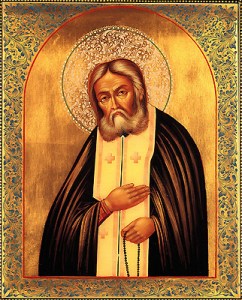
St. Seraphim of Sarov
The Archimandrite tells us that there are three parts of the soul to be cleansed of the passions: 1) the intellect which is cleansed by a watchfulness and guarding of the mind where we are “keeping the good thoughts and rejecting the bad” (p. 47). We are to understand that we are the captains of our consciousness, and we are to take every thought captive that would bring damage to our souls. 2) The passionate part of the soul is cleansed by love. 3) “Finally, the desiring part is cleansed by self-control” (p. 44). Self denial is to take place. We are to deny ourselves excessive food and drink, and other sensual activities which could bring harm to us.
The third requirement involves participation in the life of the Church, the Holy Sacraments of Confession and the Eucharist. Both Sacraments cleanse us, but the Eucharist additionally gives us Jesus’ victory over sin, darkness, alienation, and death when we consume his Body and Blood. Then, also, the prayers of the Church — primarily the Jesus Prayer which we can employ in any setting: “Lord, Jesus Christ, Son of God, have mercy on me a sinner.”
None of here today at Holy Resurrection Orthodox Church are monastics [where the sermon was given]. We do not have such a calling, though some present may be called to that in the future if it is God’s will. But, we can enter into this process of theosis in our “secular lives” at home, school, work, or the market place. Acknowledging this fact Archimandrite George offers this to the non-monastic Christian:
This [theosis], however, is the purpose and the great aim of our lives. How far we get is not the most important thing. What is important is the struggle itself, which God blesses abundantly, both in the present age and in the age to come (p.57).
In conclusion St Paul offers this regarding sanctifying activities, and God’s pledge to bring about our sanctification and purification:
See that no one repays evil for evil, but always pursue the good both for one another and for all. Rejoice always. Pray constantly. Give Thanks in, with, and for all things for this is the will of God for you in Christ Jesus. Do not restrain the Spirit; do not despise prophecy. Test all things; hold fast the good, avoid every appearance of evil. Now, may the God of peace himself sanctify you completely, and keep your spirit, soul, and body sound and blameless in the presence of our Lord Jesus Christ. the one who is calling you is faithful, and he will do this (1 Thessalonians 5: 15 – 24).
The following is the corresponding sermon given 7/6/25:
In Christ who calls us to sanctification,
Fr Irenaeus
Hungering and Thirsting for Righteousness
Posted: May 20, 2025 Filed under: The Eucharist and Living the Eucharist | Tags: a prayer to live eucharistically before the world, a prayer to live the eucharistic life, Christ is the Water of Life, hungering and thirsting for righteousness, Jesus' conversation with the Samaritan Woman, St John 4: 10 - 15, St Photina (the Samaritan Woman), Water of Life Leave a commentEvery year the Orthodox Church commemorates the Samaritan Women, who we now know as St Photina, who encountered Jesus at Jacob’s Well near the Samaritan town of Sychar. She came to the well at midday to avoid the looks of scorn, and the rejection she would experience form those gathered in the cool of the morning to draw from the well. In this privacy her life was changed as she enters into conversation with Jesus: “‘Give me a drink,’” asks Jesus (St John 4: 7). She replies, “‘How is it that you, a Jew, ask a drink of me, a woman of Samaria?’ for Jews have no dealings with Samaritans” (St John 4: 9). A discussion about water, thirst, and eternal life then begins between the two of them:
Jesus answered her, “If you knew the gift of God, and who it is that is saying to you, ‘Give me a drink,’ you would have asked him and he would have given you living water” The woman said to him, “Sir, you have nothing to draw with, and the well is deep; where do you get that living water? Are you greater than our father Jacob, who gave us the well, and drank from it himself, and his sons, and his cattle?” Jesus said to her, “Every one who drinks of this water will thirst again, but whoever drinks of the water that I shall give him will never thirst; the water that I shall give him will become in him a spring of water welling up to eternal life.” The woman said to him, “Sir, give me this water, that I may not thirst, nor come here to draw” (St John 4: 10 – 15).
The hymns from the Mid-feast of Pascha and today also speak of spiritual waters that only come from God. We have this troparion of the Paschal Mid-feast:
In the middle of the Feast, O Savior, fill my thirsting soul with the waters of godliness, as You did cry to all: If anyone thirsts let him come to me and drink. O Christ God, Fountain of our life, glory to You!
Next, we have today’s kontakion:
The Samaritan Woman came to the well in faith: she saw You, the Water of Wisdom, and drank abundantly. She inherited the Kingdom on high, and is ever glorified.
Her interaction with Christ continued and he revealed himself to be the Christ whom she and her fellow Samaritans awaited: “I who speak to you am he” (St John 4: 26). She accepts this, and with this revelation, she takes in her first draw from this Water. New Water brings forth new life, and her journey in, with, and for Christ begins. She takes her leave and informs the inhabitants of Sychar that she has met the Christ.
After she leaves, Jesus’ disciples return and the subject of food arises upon their arrival. Rather than material food purchased in a market, Jesus informs them:
Meanwhile, the disciples begged him, saying, “Rabbi, eat.” But, he said to them, “I have food to eat of which you do not know…My food is to do the will of him who sent me, and to accomplish his work” (St John 31, 34).
Our Lord speaks of such Water and Food in the Sermon on the Mount: “Blessed are those who are hungering and thirsting for righteousness because they will be satisfied” (St Matthew 5: 6).
St Photina, the Samaritan Woman, drank the Water and ate the Food of which Jesus spoke. In Carthage she was an evangelist where she lived with two sons and her sisters — all martyrs and saints. We read of her final witness before Nero:
After this Nero had her brought to him and asked if she would now relent and offer sacrifice to the idols. Saint Photina spit in the face of the emperor, and laughing at him, said, “O most impious of the blind, you profligate and stupid man! do you think me so deluded that I would consent to renounce my Lord Christ and instead offer sacrifice to idols as blind as you” Hearing such words, Nero gave orders to again throw the martyr down the well, where she surrendered her soul to God (oca.org).
Thus, St Photina was victorious. She was nourished by the Food of Christ. She was refreshed by drinking from the Well which is Christ. She, too, as are we, was nourished by our Lord’s all holy Body and Blood of the Eucharist. From this Sacrament we all receive cleansing from sin, and victory over sin, darkness, alienation, and death, and his promise of everlasting which comes only from him.
 Today, and with every Divine Liturgy, purposefully and prayerfully come to the Eucharist while giving thanks for his miraculous, sacramental presence before us. The Eucharist gives us guidance for our lives as we pursue the satisfaction of Christ’s righteousness which we are to manifest by our lives to this darkened and depraved world. St Paul gives this instruction: “Give thanks in, with, and for all things for this is the will of God for you in Christ Jesus” (1Thessalonians 5: 18). And from this verse I present to you a prayer to assist our living the Eucharist, and thus living Christ, before the world and the cosmos:
Heavenly Father, I pray this day I would be living the eucharistic life which is in accordance with your will for me in Christ Jesus. Thus, by the Holy Spirit may I be giving thanks in, with, and for all things, in order that I might bear Christ to all and for all things, and bear all and all things to Christ Jesus. Also, that I would be self-giving and other-receiving, and come to live as broken bread and poured out wine for the life of the world and the sake of all things, to the praise and glory of your Name. Amen.
Also, here is another hymn for the day’s theme:
Come and let us drink a new drink, not one marvelously issuing from a barren rock, but one that Christ from the tomb pours out, incorruption’s very source. For we are established in him.
St Photina, pray for us that we may be satisfied as we hunger and thirst for righteousness!
The following is the corresponding sermon given at St Sophia Greek Orthodox Church (Bellingham, WA):
In Christ,
Fr Irenaeus
Purity of Heart
Posted: May 5, 2025 Filed under: The Eucharist and Living the Eucharist | Tags: "Create in me a clean heart", Pascha, Purity of heart, putting on the new man, Romans 6: 6, spiritual game plans, St John 6: 53 -56, the Myrrh Bearing Women Leave a comment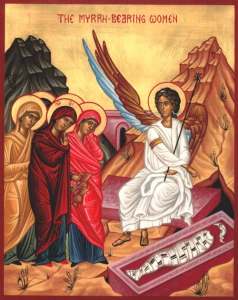 On the morning of the Resurrection, certain women disciples of Jesus went to his tomb to anoint his body with the traditional myrrh. They encountered into an astonishing and alarming site: The immense stone which sealed Jesus’ tomb had been rolled away. Inside the tomb they encounter a “young man” clothed in white sitting at the right side where Jesus had been laid. He addressed and informed them:
…Do not be alarmed: You seek Jesus of Nazareth who was crucified. He is risen! Behold the place where they laid him.
A troparion of the day declares this:
The angel came to the myrrh bearing women at the tomb said: Myrrh is proper for the dead; but Christ has shown himself a stranger to corruption! So proclaim: the Lord is risen, granting the world great mercy.
The Myrrh Bearing Women were expecting the expected, but they found the unexpected. They came to the tomb expecting to find a corpse, but encountered the Miracle of miracles: “Christ is risen from the dead!” Did they know of the raising of the son of the widow of Nain? They surely witnessed the raising of Lazarus from the dead and his emergence from his tomb.
The witnessing of these two miracles done by our Lord brought about shock and awe to those present at these miracles. Likewise, the experience of the Myrrh Bearing Women brought to them an equal response, and how could they wrap their minds around this news?
However, after 2,000 years we know the story. It’s old news: we’ve read the book and seen the movie. Therefore, we treat it as well known history. The element of awe is no longer there for us. So, I want to give you and me a cold slap in the face. We who are asleep need a major jolt of spiritual caffeine! Let’s review a theological and ontological fact given to us by St Paul:
We were buried, therefore, with him by baptism into death, so that as Christ was raised from the dead by the glory of the Father, that we too might walk in newness of life (Romans 6: 6).
We are also united to his resurrection. Therefore, we share in his new miraculous life. It is to be our understood reality by which we live. Hence, in his epistles he gives us further instruction:
If then you have been raised with Christ [the construction of the phrase assumes the positive], seek the things that are above, where Christ is seated at the right hand of God. Set your minds on things that are above, not on things that are on earth. For you have died, and your life is hidden with Christ in God. When Christ who is our life appears, then you also will appear with him in glory (Colossians 3: 1 – 4)
Given these facts, St Paul then explains to us the need for the corresponding lives we are to live,
Put to death, therefore, what is earthly in you: immorality, impurity, evil desire, and covetousness, which is idolatry. On account of these the wrath of God is coming. In these you once walked, when you lived in them. But now put them all away: anger, wrath, malice, slander, and foul talk from your mouth. Do not lie to one another, seeing that you have put off the old man with his practices and have put on the new man, who is being renewed in knowledge after the image of his creator…Put on then, as God’s chosen ones, holy and beloved, compassion, kindness, lowliness, meekness, and patience, if one of you has a complaint against another, forgiving each other; as the Lord has forgiven you, so you must forgive. And over all these put on love, which binds everything together in perfect harmony. And let the peace of Christ rule in your hearts, to which indeed you were called in the one body. And become thankful (Colossians 3: 5 – 10, 12 – 17).
Be reminded, then of this hymn of Pascha: “Thy Resurrection, O Christ our Savior, the angels in heaven sing — enable us on earth to glorify thee in purity of heart!” Purity of heart — our Lord states this: “Blessed are the pure in heart, because they will see God (St Matthew 5: 8). The holy king David gives us this:
Create in me a clean heart, O God, and put a new and right spirit within me…Restore to me the joy of your salvation, and uphold me with a willing spirit (Psalm 50/51: 10, 12).
Consider the Eucharist. Here is another sacramental and ontological reality which is to have us pursue purity of heart:
Therefore, Jesus said to them, “Truly, truly, I say to you, unless you eat the flesh of the Son of Man and drink his blood you do not have life in yourselves. The one who is eating my flesh and is drinking my blood has eternal life, and I shall raise him in the Last Day. For my flesh is true food, and my blood is true drink. The one who is eating my flesh and drinking my blood abides in me and I in him (John 6: 53 — 56).
Jesus’ resurrected life is worked into our mortal being by faithfully consuming his Body and Blood given to us via Communion. He indwells us, and we are in him. Thus, we become his body, and must live out Christ’s life before the world.
“Enable us to glorify thee in purity of heart!” That’s nice, you may say, but how? I can speak only from my own experience and from the lessons which I have learned. Let me begin with this statement which comes from St Paul: The struggle is in the mind. We read this from the Prayer of the Hours: “…Set aright our minds; cleanse our thoughts.” Therefore, we must throw away habitual thoughts that continue to keep us in the trap of habitually impure actions that are contrary to our existence in Christ Jesus.
Jesus Christ Conquers
We know the people, circumstances, settings, etc., which trigger automatic responses. These automatic responses arise from the corruption, or impurity that still resides within us. Thus, we need to have a holy game plan which can be used to overcome such habits. I inform you of one of my triggers: shopping. In a store, especially a large and busy store, I can become impatient, irritated, and generally cranky. So, while I am in the parking lot, still in my car, I must inform myself of my game plan: I will choose to be patient, peaceful, and joyful. I must inform myself to pray for all I will encounter and ask God’s blessing to be upon all I pass by — my fellow shoppers (who may be impatient, irritated, etc.). These words from St Paul also form my game plan:
See that no one pays back evil for evil, but always pursue the good both for one another and for all. Rejoice always. Pray constantly. Give thanks in, with, and for all things for this is the will of God for you in Christ Jesus (1 Thessalonians 5: 15 – 18).
Choose to seek the good for all. Choose to rejoice, even if you may not feel inclined to do so given the circumstances. Choose to pray in all settings, and in every hour. Choose to give thanks even in a negative or challenging setting; and within the company of people who my be inpatient, irritable, and cranky. By doing so we extend Christ himself into the space and time we occupy. By choosing to implement such a game plan we bear Christ to all, and we form Christ within us — the one who is the source of our purity of heart. Thus, we imitate Christ and become Christ-like.
By our lives lived in concert with Christ, and as we pursue purity of heart, we can ask the Myrrh Bearing Women to pray for us. Living in his purity, let us surprise the Myrrh Bearing Women with our growing purity of heart!
The following is a corresponding sermon:
In Christ,
Fr Irenaeus
Do We Know Who We Are?
Posted: April 7, 2025 Filed under: The Eucharist and Living the Eucharist | Tags: Fifth Sunday of Lent, living eucharistically, St John 6: 54 and 56, St Mark 10: 33-34, St Mary of Egypt, The Beatitudes and the ethos of the Church, The Cup of Salvation Leave a commentFor the Fifth Sunday of Lent the day’s Gospel reading comes from St Mark 10: 32 -45. In the first verses of this pericope, Jesus, his disciples, and a crowd were going to Jerusalem. He takes his Apostles aside and informs them, for the third time, of his soon to occur death and resurrection:
Behold, we are going up to Jerusalem and the Son of Man will be handed over to the Chief Priests and Scribes, and they shall condemn him to death, and hand him over to the Gentiles, and they will ridicule him, beat him, spit on him, and will kill him. And on the third day he shall rise again (St Mark 10: 33 – 34).
Apparently James and John were not listening, or, were still unable to comprehend Jesus’ true purpose and destiny. They were scheming to have Jesus grant them special privilege and a position of authority not to be offered to the other Apostles. They informed the Lord of their request: “Grant us to sit, one at your right hand and one at your left, in your glory” (St Mark 10: 37).
Jesus corrects them:
But Jesus said to them, “You do not know what you are asking. Are you able to drink the cup that I drink, or to be baptized with the baptism with which I am baptized?” And they said to him, “We are able.” And Jesus said to them, “The cup that I drink you will drink; and with the baptism with which I am baptized, you will be baptized; but to sit at my right hand or at my left is not mine to grant, but it is for those for whom it has been prepared” (St Mark 10: 38 – 40).
(Here, the cup and baptism to which Jesus refers is his betrayal, torture, and death by crucifixion — to which they journeyed. And, yes, James and John, and countless others through the centuries would, and are, and will, be facing certain betrayal, imprisonment, torment, and death for their faith in Christ.)
Sermon on the Mount
In a few more verses, Jesus will turn their concepts of authority and rank upside down. He teaches them that the greatest among them is to be the servant of all, and that the one who desires to be first must be the slave. Our Lord also upends the world system’s understanding of what constitutes blessedness in life: The Beatitudes (St Matthew 5: 1 – 11).
Blessed are the poor in spirit, because theirs is the Kingdom of Heaven:
The poor in spirit does not refer to those who exist in abject poverty, but refers to those who are dependent upon God for their being. It also reflects the necessity of a society of sharing and cooperation among all for mutual well being, which is to be first and foremost expressed by the Church that we may be a shining light on a hill.
Blessed are those who are mourning, because they will be comforted:
Christ refers to those who mourn not only for life’s downward turns, but also mourn for their sins and they dark state of affairs existing in this world system. Christ informs us that in this world will will have tribulation, and we all know that life isn’t fair.
Blessed are the meek, because they shall inherit the earth (land):
In the world system, it was and still is, the dark reality that the powerful and the cunning take the land and the possessions of the poor who cannot stand against such proud aggression. But this will not be so in the Kingdom of Heaven.
Blessed are those who are hungering and thirsting after righteousness, because they will be satisfied:
This is a somewhat pivotal verse. It refers to the first three virtues as well as those that follow. If we follow Jesus and walk in his ways, we will be satisfied with his righteousness, and come to have less regard for worldly things.
Blessed are the merciful, because they will obtain mercy:
This speaks to forgiveness and graciousness which is to be exhibited by our lives. Remember this: The yardstick by which we measure others, by it we will be measured.
Blessed are the pure in heart, because they shall see God:
The citizens of the Kingdom of God are to have pure hearts to see God. So, we are to establish purity in our lives. We are to construct a pure environment in our homes and minds:
I will give heed to the way that is blameless…I will walk with integrity of heart within my house. I will not set before my eyes anything that is base…Perverseness of heart shall be far from me; I will no nothing of evil (Psalm 102/101: 2 – 4)
For further formation of purity we have this portion of prayer which comes from the Prayer of the Hours: “…Sanctify our souls, purify our bodies; set aright our minds and cleanse our thoughts.”
Blessed are the peace-makers because they shall be called the sons of God:
St Seraphim and Sarov gives us this nugget of truth: If you obtain peace, you will bring peace to thousands. St Thaddeus of Vitovnica instructs us to maintain peace in every setting by controlling our thoughts:
Our life depends on the kind of thoughts we nurture. If our thoughts are peaceful, calm, meek and kind, then that is what our life is like. If our attention is turned to the circumstances in which we live, we are drawn into a whirlpool of thoughts and can have neither peace nor tranquility (p 63).
Blessed are those who are persecuted for the sake of righteousness, because theirs is the Kingdom of Heaven. Blessed are you when men revile you, persecute you, and speak falsely all manner of evil against you for on my account. Rejoice and be glad, for great is you reward in heaven — for so they treated the prophets who came before you:
The confessors and martyrs drank from Christ’s cup and were baptized into his baptism. In these days, we cannot think we will escape this cup and baptism.
The Beatitudes are not just lofty, hopeful ideals. They are to be embedded in our lives that we may embody Christ to all and all things.
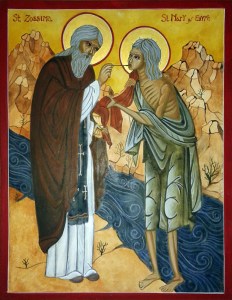
St. Mary of Egypt
On this fifth Sunday of Lent we honor one of the greatest and inspiring saints, at least in my opinion: our Mother among the saints Mary of Egypt. She overcame, by the Holy Spirit and the Cross of our Lord, sexual addiction. She fought against the deep corruption of sin that dwelt in her, and the demons who would keep her enslaved and entrapped in them. She was pushed by the Spirit into the wilderness to do battle. Her solitude gave her the battlefield of victory.
To attain these virtues of the Beatitudes requires our own volitional struggle. (Think of the struggles of St Mary of Egypt and ask for her intercessions before our Lord for our own victories.) We will and must fight for our own purity. It is and will be a battle, but remember these words from Psalm 103/102: 13 – 14
As a father pities his children, so the Lord pities those who fear him. For he know our frame, and remembers that we are dust
Therefore, do not despair! Our God is patient and will always come to our aid.
Now, let me change gears and subject matter as we approach Pascha, the Feast of feasts. To make this shift, I pose a question: “Do we know who and what we are?” First of all, we are image bearers of God — we are icons — we are to present God to all and all things. If we speak and act in godly ways then we tell the truth about God. If not, then we tell lies about God. We are also prophets, vice-regents, and priests. I will focus on the priestly aspect of our being. One of the best definitions of being a priest is this: one who bears God to all, and bears all back to God by prayer, word, and action.
You may object — I am a sinner, and you are a sinner. Of course we are, but God acts through us in spite of our imperfections as he remains at work in us.
I shift gears again. Let’s return to Jesus’ Cup from which he was to drink as noted in the verses found above. This Cup is the same as that given to his Apostles in the Upper Room: “…This Cup is the New Covenant in my Blood, which is being poured out in your behalf” (St Luke 22: 20). This is the same Cup given to us for our salvation.
So now we come to the Eucharist: our rational, bloodless sacrifice of praise and thanksgiving. Each communion also accomplishes this for the one receiving it in faith:
The one who is eating my Flesh and is drinking my Blood has eternal life, and I shall raise him in the Last Day…The one who is eating my Flesh and is drinking my Blood, abides in me, and I in him” (St John 6: 54, 56).
With each Eucharist consumed we have both continued cleansing, and the life of Christ and union with him is strengthened within us. We receive his Light and Life, and his victory over sin, death, darkness, and alienation.
Near the very end of the Divine Liturgy this admonition gives us our mission to the world: “Let us go forth in peace!” We are empowered to bear Christ into this troubled and darkened world by practicing Christ’s mercy, humility, peacefulness, and purity among all and all things. It is him we bear as we act (even imperfectly and inconsistently) in his behalf as his priests. Thus, we are to live eucharistically. St Paul tells us how we are to conduct ourselves eucharistically every day:
Do not repay evil for evil, but always pursue the good both for one another and for all. Rejoice always. Pray constantly. Give thanks in, with, and for all things, for this is the will of God for you in Christ Jesus (1 Thessalonians 5: 15 -18).
I pray this inspires us in some way to enter into our upcoming Pascha with new spiritual insights and strength. I pray this that we bear the resurrected, victorious Christ to the world. “Thy resurrection, O Christ our Savior, the angels in heaven sing. Enable us on earth to glorify Thee in purity of heart.”
In Christ,
Fr Irenaeus
The Victorious and Life-giving Cross
Posted: March 24, 2025 Filed under: The Eucharist and Living the Eucharist Leave a commentI present a hymn sung every Matins (Orthros), and is said by a priest or deacon every Divine Liturgy. It reads,
Having beheld the Resurrection of Christ, let us worship the holy Lord Jesus, the only sinless one. We venerate your Cross, O Christ, and we praise and glorify your holy Resurrection; for you are our God, and we know no other than you; we call on your name. Come all you faithful, let us venerate Christ’s holy Resurrection! For through the Cross joy has come into all the world. Let us ever bless the Lord, praising his Holy Resurrection, for by enduring the Cross for us, he has destroyed death by death.
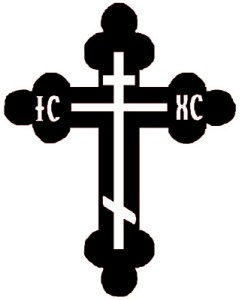 In the slavic liturgical tradition for the Third Sunday of Lent, the Sunday of the Cross, a blessing Cross is beautifully decorated with flowers placed all around it. Many Orthodox Churches have a splinter of the True Cross, upon which Jesus was crucified, contained within a small reliquary which is placed upon the cross that will be venerated. These venerations occur at the conclusion of Matins and the Divine Liturgy of this Sunday.
Though originally the cross was a horrifying instrument of execution, now, for the faithful Christian, it is the object of Christ’s victory over death. The cross is adored by Christians; it is the symbol of our faith. We wear the cross. It is displayed in our homes. The eyes of faith even see its shape and form in objects of nature. But, we are not to see it void of its power becoming only an empty token or ornament.
This is a portion of the Gospel reading for the day:
And after turning to the crowd, together with his disciples, he said to them, “Whoever wishes to follow me is to deny himself, and is to take up his cross and follow me. For whoever wishes to save his life, shall lose it; whoever loses his life for my sake and of the Gospel, this one shall shall save it (St Mark 8: 34 – 35).
Again, quoting the hymn noted above, we have, “For by enduring the Cross, he has destroyed death by death.” For us, the Cross of Christ, though the symbol of our faith, it is to remain an instrument of death. By this, I mean that the crosses we take up are to destroy those necrotic sins which inhabit our lives. These sins are also like cancers. In any person, even though otherwise health there are little “colonies” of cancers. These colonies are called “cancer in situ,” meaning “ cancer in place”, or in its setting within our bodies. Technically, they are non-threatening (our immune systems destroy them) unless given the opportunity to “awaken” and become an eruptive, active, and life-threatening cancerous tumor.
In a similar fashion, there are sins that abide in us in situ. And like a physical cancerous tumor, they are to cut out and destroyed. In this case the Cross is the scalpel and is life saving for our souls.
Where do we find the crosses we are to bear? How often do we come upon them? We find them every day and here, there, and everywhere. Every day we are to take up our cross by faith to put to death the in situ sins that abide in us. For example, if we are tempted to become angry we have this choice: we can deny the cross and give into anger, or we can come by faith to the cross and keep our peace. Here, we can pray, “Make haste to help me, O Lord, my salvation” (Psalm 39/38: 22). We can also say the Jesus Prayer. And, even counting to ten (possibly very slowly) can also be used by our Lord. Also, during this season of Lent, we could be tempted to break our fast, or give into gluttony. Or we can take up our cross and ignore the urge to eat and continue life-giving abstinence. Here, we can say the same prayers, and we can also tell ourselves that “I can wait for 15 more minutes before I eat. After this brief time out, then a longer interval can be proposed. Also, we can busy ourselves with a physical activity, and the urge to eat will pass.
Both of these examples involve an exercise of the will. We always have this choice: Do we deny ourselves and move to the cross, or do we let the cancer of sin grow a little bit more?
Jesus Christ Conquers
Just before the conclusion of the Divine Liturgy of this Sunday of the Cross the assemble faithful venerate the cross placed before them. This is not to be done mindlessly and robotically. With our venerations, we need to pray that the life-giving power of the Cross be ours. We are to take it into ourselves. And the crosses we wear, when in need, we should press them to our chests and pray for its victory to be ours. Additionally, There is another way in which we take up the Cross, which should be known by every Orthodox Christian. Impressed onto the surface of the bread that will become the Body of Christ, called the Lamb, is an image of the Cross. Above the arms of the cross are the Greek letters IC (an abbreviation for Jesus) on its right, and XC (an abbreviation for Christ) on its left. Below each arm is half of the Greek word nika, meaning “[he] conquers”. The two letters NI appear on its right, and KA on its left. When put together, we have the message, “Jesus Christ conquers!”
Thus, each time we consume the Body and Blood of Christ his Victory enters into every part of our being! By so doing we are given the spiritual power to conquer the cancer, or death of sin residing in situ within us. And more, by consuming Christ’s Body and Blood with spiritual and faithful purpose, we are given the power to embody Christ before the world and the entirety of creation which resides in sin, death, darkness, and alienation from God.
In conclusion, allow me to add this message from history. Prior to his decisive battle with his rival Maxentius, Constantine (not yet St Constantine) saw a vision of the Cross in the sky above him. The voice of the Lord came to him saying, “By this sign, Conquer!” Crosses were, in some manner, placed upon the shields of his soldiers. St Constantine was victorious. Therefore, let us afix ourselves to our crosses, and by them be victorious!
In Christ who is ever victorious,
Fr Irenaeus
Icons, Veneration, Presence, and Contact
Posted: March 10, 2025 Filed under: Etcetera, The Eucharist and Living the Eucharist | Tags: iconodules, icons offer contact to the spiritual realm, Icons offer presence, reverence of icons, Sunday or Orthodoxy, the Iconoclastic controversy, Triumph of the Church over iconoclasm, veneration of icons is not idolatry Leave a comment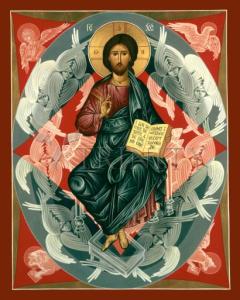
Christ Enthroned
The Sunday of Orthodoxy is the first Sunday of Lent. This is an annual commemoration of the triumph of the Orthodoxy Church over the heresy of iconoclasm. Iconoclasm involved the destruction of the icons of the Church. Those who destroyed icons were called iconoclasts, or “icon breakers.” Those who preserved and defended the Church’s use of icons were the iconodules, meaning “venerators of icons.” This controversy lasted over 120 years, and it wasn’t pretty.
For non-Orthodox Christians, and even some Roman Catholics this is no big deal: Icons are not found in, for example, Protestant churches. Protestant history involved, and still is involved in some form of iconoclasm. Here, they are foreign, and are objects of suspicion. Hence, Orthodox Christians are accused, falsely, of idolatry.
For several years now, there has been thousands of conversions to the Orthodox Church. Those who begin to explore the Church have many questions. Among them are questions about icons. Protestant objections to icons and their purpose in the Orthodox Church must be explained. Let me be clear: Orthodox Christians do NOT worship icons. We do not worship wood and paint. We worship only the Triune God: Father, Son, and Holy Spirit. St John of Damascus explains this point for us:
Concerning the charge of idolatry: Icons are not idols but symbols [in ancient understanding, the symbol contains within itself that which is symbolized], therefore when an Orthodox venerates an icon, he is not guilty of idolatry. He is not worshipping that pictured, but merely venerating it. Such veneration is not directed toward wood, paint or stone [mosaics], but towards the person depicted. Therefore, relative honor is shown to material objects, but worship is due God.
Icons…protect the full and proper doctrine of the Incarnation. While God cannot be represented in his eternal nature [his essence]…He can be depicted simply because he took on human flesh. Of him who took a material body, material images can be made. In so taking a material body, God proved that matter can be redeemed. He deified matter, making it spirit-bearing, and so if flesh can be a medium for the Spirit, so can wood and paint, although in a different fashion.
I do not worship matter, but the Creator of matter, who for my sake became material and deigned to dwell in matter who through matter effected my salvation.
Venerate and veneration are not commonly used words. A definition is put forth. When someone is venerated, respect and honor are shown to the person. The act of veneration of an icon is done by making the Sign of the Cross before, bowing toward it, and then kissing the icon (generally the right hand of the one depicted in the icon).
 Recently, a young Protestant man visited St Nicholas Orthodox Church in Tacoma, Washington. He was troubled by these actions and asked me to explain them to him. I used the illustration of a young child and a photograph of her grandfather. Such a young child may kiss the photo of her grandfather. She is expressing her love for the man; she is not worshipping him. Even at a young age she knows that the photograph is not her grandfather, but, simply, his image presented to her by the photograph. Again, she is expressing her love for him. In like manner, an Orthodox Christian’s veneration of an icon shows one’s love for the person presented to him, or her, by the icon.
I used purposefully the word presented. The one depicted by the icon, whether Christ, his Mother, or a saint, is presented to the one venerating the image. Its presentation offers presence. When Christ is depicted by an icon there is a sacramental presence of him which is offered to the one who venerates his icon. It involves a touch-point: the love and honor expressed by the act of veneration is passed along to Christ. There is a spiritual communication from the material of the icon to Christ himself, or to anyone presented by an icon.
Let me develop this idea with another illustration. I am writing this posting using, of course, the word processing program of my computer. To access this program, I touched the “icon” which presents the program to me. I have accessed the electronic workings of the program. So, as with the computer icon, so it is analogous with the icon of Christ: I have a point of contact with him, and my honor and love are passed on to him in this sacramental manner of contact.
Note the two tears under the eye.
This sacramental, or spiritual, communication is not just a one-way road. Christ and his saints, especially Mary his Mother, communicate to the faithful via their icons. These communications are understood as miracles. For example, at St Anne Orthodox Church in Corvallis, Oregon (where I have served the Diving Liturgy many times), an icon of Mary brought forth a physical, liquid tear from her left eye. This event was captured by a photograph which is placed next to the actual miraculous icon.
Let me add this. Quantum physicists tell us that an electron, or some part of an atom (which is material), can occupy two places at once, and have some degree of communication across this separation in space and time. Furthermore, that which is spiritual and that which is material are not separated from each other in some dualistic existence as taught by some theologians and philosophers from past centuries. Rather, the spiritual and the material are in constant communication, contact, and in continual relationship with each other. Thus, we can understand the Sacraments and sacramental objects such is icons.
In conclusion, reality is not confined to the explanations offered by philosophers, false prophets, naturalists, and materialist. And I can’t resist…I quote Cat Stevens, “Oh baby, baby, it’s a wild world!”
In Christ who became matter for our salvation,
Fr Irenaeus
This Is My Body…This Is My Blood
Posted: February 26, 2025 Filed under: The Eucharist and Living the Eucharist | Tags: anamnesis, Christ continually gives his Body and pours out his Blood via the Eucharist, Christ re-presents himself in the Eucharist, entrance into the Kingdom of God, Eucharistic presence of Christ, St John 6: 50 -51, St Luke 22: 19 - 20, St Luke's account of the Last Supper, the present Greek participle, The Words of Institution Leave a commentThe words and actions of Jesus in the Last Supper are examined in this posting. St Luke’s account will be the Gospel examined since it contains the greatest amount of detail and information. Of primary interest is Jesus’ use of two Greek verbal participles which are highlighted by italics and underlined:
And after taking bread and giving thanks, he broke it and gave it to them saying, “This is my body which is being given (didomenon) in behalf of you: do this in my remembrance (anamnesin). And likewise the cup after the dinner, saying, “This is the cup of the new covenant in my blood, which is being poured out (ekchunomenon) in behalf of you (St Luke 22: 19 – 20).

The Last Supper
St Luke uses two present, passive participles in the above passage: didomenon (is being given), and ekchunomenon (is being poured out). Participles are “semi-verbs” — they occupy a middle ground between verbs and nouns/adjectives/adverbs. Regarding the verbal significance of the above participles, Greek verbs (and subsequently, participles) tell far more than when an action occurred, that is, in the past, or in present, or will occur in the future. Greek verbs also inform us of the quality of action. This quality of action is called aspect. In these verses we have present passive forms. Regarding the present aspect, we are to know that the quality of the action implies an ongoing action:
The present tense is basically linear or durative, ongoing in its kind of action. The durative notion may be expressed graphically by an unbroken line ( _____ ), since the action is simply continuous (James A. Hewett, New Testament Greek — A Beginning and Intermediate Grammar, Henderiskson, 1986).
The above two participles impart a number of meanings to the two verses. At first glance, the ongoing quality is necessary to correspond to the continual, repetitive tradition of offering the Eucharist (Communion) to Christians over the centuries since Christ’s institution of this Sacrament — his Body is continually being given, and his Blood continues to be poured out to the faithful.
However, the continual giving of his Body and pouring out of his Blood represent far more than a simple memorial. Jesus’ words signify a re-presentation of himself to the Church with every Eucharist. How do we know this? To answer this question, let’s turn to St John’s Gospel, and specifically the sixth chapter:
This is the bread which is coming down (katabainon) from heaven, in order that if someone might eat of it might also not perish. I am the living bread which came down (katabas) from heaven: if ever someone might eat of this bread he shall live forever, and the bread which I shall give is my flesh in behalf of the life of the world (St John 6: 50 – 51).
The above present active participle, katabainon, points to ongoing, continual “coming down, or descending”. Thus, there is a Bread which is continually coming down from heaven. Our Lord then defines and clarifies what and who this Bread is in 6:51. He most clearly states that this continually nourishing Bread is none other that his physical body of the Incarnation — the body that came down — katabas (aorist participle — a completed action) — and which will be broken and given for the life of the world. They are one and the same! Hence, the Eucharist is a re-presentation of the entirety of the Incarnation to the Christian faithful!
Let’s move back to the participles found in St Luke. Again, they state that he is giving himself, and is pouring out himself for our salvation in an ongoing, continual manner. More specifically, Jesus’ words and actions in the Upper Room put into action his self-giving sacrifice on the Cross. They put into action his burial. They put into action his resurrection and ascension. They put into action his second coming in his glory.
To be examined next is St Luke’s use of the Greek word, anamnesis. It can be translated as “remembrance.” But it means far more than a memory from, let’s say, a past vacation. It means a “calling into presence.” It is an invocation calling upon God’s presence to be with us as we worship. This invocation begins with the first words of the Divine Liturgy: “Blessed is the Kingdom of the Father, and of the Son, and of the Holy Spirit, now and ever and unto ages of ages.” We thus, invoke and enter into the Kingdom of God. The three Persons of the Holy Trinity are with us as are the saints who are alive in Christ. Also gathered around us are all the events of our salvation as is summarized with these words of the Divine Liturgy that come just before the bread and wine, our Gifts, are offered to God:
Remembering this saving commandment and all those things which have come to pass for us: the Cross, the Tomb, the Resurrection on the third day, the Ascension into heaven, the Sitting at the right hand, and the second and glorious Coming.
Therefore, all of Christ — his Person and every action of his, past, present, and future — is re-presented to the Church. He and they envelope all who are present in worship. St Luke, by his use of anamnesis, informs us that the Gifts of bread and wine are far more than an empty token. I conclude with these words of Christ as presented to us in the Divine Liturgy:
Take! Eat! This is my Body which is broken for you for the remission of sins. And likewise, after supper, he took the cup saying: Drink of it, all of you! This is my Blood of the New Covenant which is being poured out for you and for many, for the remission of sins!
In Christ,
Fr Irenaeus
Gear Review of Two Yoke Capos: Shubb Fine Tune Royale F1g VS D’Addario Cradle Capo
Posted: January 1, 2025 Filed under: Etcetera, Music and Guitars, The Eucharist and Living the Eucharist | Tags: D'Addario Cradle Capo reviewed, Review of Shubb Fine Tune F1 yoke capo vs D'Addario Cradle Capo, Shubb Fine Tune F1 capo reviewed, varieties of guitar capos, Yoke-style guitar capos reviewed Leave a commentAs I have reviewed a number of capos over the years I have learned a good deal about them. The primary lesson learned is that not all capos are alike. There are capos of inferior and superior design. I have found that a good capo is determined by its design — specifically how a given capo applies pressure on the strings to the fretboard.
There are functionally four styles of capos:
-
- Strap and Toggle Capos. A strap or toggle using an elastic strap is wrapped around the guitar’s neck to apply the downward pressure on the strings.
- Trigger / Spring Capos. This class of capo is likely the most commonly used capo. A spring mechanism applies the needed downward pressure. With the trigger and spring capos there is the additional lateral pressure which brings the strings out of tune.
- Adjustable Screw Capos. This style offers a “clasping” mechanism for attachment to the neck. After application, a screw is tightened to apply direct square pressure onto the strings.
- Yoke Capos. These are very similar to the adjustable screw capos. They have an arm which is released for application to the neck. This style, too, is tightened by the screw to supply pressure on the strings. The yoke style offers direct, square pressure on all strings.

Top: Shubb Fine Tune Royale F1g, Bottom: D’Addario Cradle Capo
As the title states, I will compare two yoke-style capos: the Shubb Fine Tune Capo Royale F1g, and D’Addario’s Cradle Capo. I add the manufacturers’ claims and descriptions for both capos.
Shubb Fine Tune Royale F1g:
…We are confident that it is the most accurate capo in the world…it can remain on the guitar (behind the nut) when not in use.
Its innovative adjusting knob makes it the most ergonomic screw-operated capo. The knob maintains a fixed relationship with the frame, for improved ease of use, and for the lowest profile when stored behind the nut. The knob’s six surfaces are numbered, providing a visual reference to more easily and accurately reproduce your ideal pressure. Greater contact area between screw, frame, and knob ensures that the fit will never become loose and sloppy. Specially developed rubber padding adds resilience to the capo’s closing action for finer control, and being absolutely inert, it will not mark an instrument. Improved jeweler’s style latch prevents accidental opening. Carefully machined to the closest thread tolerance.
D’Addario Cradle Capo:
Even tension. Always ready…With its stainless steel, self-centering design, the Cradle Capo ensures even tension across the fretboard. Its adjustable micrometer lets you dial in the perfect pressure, while allowing the freedom for quick transitions and the ability to stay on the guitar, even when not in use.
Hypothesis: Given identical design and mechanism I posit that both capos will offer near identical tuning stability as well (as no string buzzing). A two-tail T-test will be used to “objectively” test my hypothesis. Both T and P values will be presented for assessment. The meaning of both values will be explained.
Material and Methods: I put the capos to the test on three different guitars. The same Snark “Super Tight” electronic tuner is used for all testings. All three guitars were tuned to standard tuning. Each capo was placed sequentially on frets 2, 5, and 7 on all three guitars. All six stings were plucked to assess tuning stability. Each guitar was retuned before repositioning each capo at the above mentioned frets. Any “distuning” caused by the capos was noted for each capo at each position (on all six strings) by the number of “minute” increments (flat and/or sharp noted by, for example, -1 for flat, or +2 for sharp) from the “12 o’clock” (the “in tune” position) on the tuner. There were a total of 108 testings. Also, both Rainsong guitars possess the N2 style neck.
Results: Here are the results in terms of total “distuning minutes” at all three fret positions (again 2, 5, and 7).
Rainsong N-JM1100N2 (Nashville Series) acoustic jumbo:
Shubb: +8 (at fret 2 = +1, 5 strings in tune; fret 5 = +3, 3 in tune; fret 7 = +4, 2 in tune)
D’Addario: +8 (at fret 2 = +1, 5 strings in tune; fret 5 = +4, 2 in tune; fret 7 = +3, 3 in tune)
Rainsong BI-JM1000N2 (Black Ice Series) acoustic jumbo:
Shubb: +11 (at fret 2 = +2, 4 strings in tune; fret 5 = +4, 2 in tune; fret 7 = +5, 1 in tune)
D’Addario: +12 (at fret 2 = +4, 2 strings in tune; fret 5 = +4, 2 in tune; fret 7 = +4, 2 in tune)
Paul Reed Smith (PRS) SE Starla solid body electric:
Shubb: +6 (at fret 2 = +2, 4 strings in tune; fret 5 = +2, 4 in tune; fret 7 = +2, 4 in tune)
D’Addario: +16 (at fret 2 = +3, 3 strings in tune; fret 5 = +6, none in tune; fret 7 = +7 none in tune)
Total “minutes” sharp:
Shubb: +25 of 54 total string position testings
D’Addario: +36 of 54 total string position testings
T = – 1.94: This states that a moderate difference exists in tuning stability between the two yoke-style capos. My hypothesis that there would be no tuning difference is to be rejected.
P value = 0.054: For a proven statistical difference, the P value has to be </= 0.05. The value of 0.054, though it approaches statistical significance, only indicates that the difference in tuning stability shows a “trending” to a superior tuning stability. Thus, it also informs me that I am to reject my hypothesis.
Discussion and Conclusion:
First, neither yoke capo caused any string buzzing at any position tested. Given the difference in the number of “sharp minutes” between the two yoke capos, I am to conclude that the Shubb Fine Tune Royale F1g capo shows a trend to be moderately superior to the D’Addario Cradle Capo in terms of tuning stability.

The winner: Shubb Fine Tune Royale F1g
What, then, might explain this trend? The “rubber / plastic” material that comes in contact with the strings is identical in width (7 mm). Their lengths differ by 1.0 mm, (Shubb 48 mm, D’Addario 49mm). Subjectively, the density of the rubber material feels the same. Could weight cause the difference affecting results? The Shubb capo weighs 38 grams while the D’Addario capo weighs 23 grams. I am uncertain about the significance of this difference. The only other variable that could explain this difference could be the tightening mechanism which presses upward from the back of the neck: the Shubb mechanism feels more sturdy, and likely offers a more secure pressure.
Given the two yoke-style capos, I will choose to use the Shubb Fine Tune Royale capo on my guitars. Both capos are more expensive than any of the other varieties of capos noted above: Shubb = $80 – 85 (Shubb direct purchase); D’Addario = $69.99 (Reverb), but as it is said, “You get what you pay for,” if you find it necessary to add either capo to your gear bag.
Keep on playing!
Fr Irenaeus
Every Good and Perfect Gift
Posted: December 24, 2024 Filed under: Etcetera, The Eucharist and Living the Eucharist Leave a comment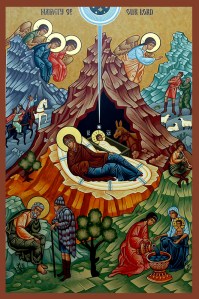 Near the conclusion of every Divine Liturgy is “The Prayer Before the Ambo.” A portion of it reads, “For every good gift and every perfect gift is from above, coming down from you, the Father of Lights.” This, of course, has as its source St James 1: 17.
Gifts and gift giving are part of the Christmas tradition, but any gift given by a human being to another pales in comparison to the Gift that is truly good and perfect which came down from the Father of Lights, that is his gift of Jesus:
For God so loved the world that he gave his only-begotten Son, that whoever believes in him should not perish but have eternal life (St John 3: 16).
The Father’s Gift, his Son, is God of God, Light of Light, true God of true God, begotten not made, of one essence with the Father.
Gifts are to give delight, joy, and gratitude. That is certainly the case when one thinks of a gift given from a parent, spouse, or friend. Yet, isn’t it also the case, though, that such gifts are generally and eventually forgotten. They are no longer valued, and ultimately discarded.
“For every good gift and every perfect gift is from above, coming down from you, the Father of Lights.” However, some gifts that may come from the Father of Lights may not be received by us initially with delight, joy, and gratitude.
Can a good and perfect gift from the Father of Lights be difficult to receive with delight, joy, and gratitude? The answer is, yes. But, the wisdom of faith must alter our perspective and perception. With the eyes of faith and wisdom a difficult and troubling gift can be received into one’s heart. I recall two such gifts. One was very challenging, the other was less difficult to receive, but both gifts permanently changed my life for the better.
During the Fall of October, 1997 I received a challenging and harsh gift. I was working as a clinical pharmacist at a hospital located in south King County in Washington State. For much of my life I had a problem with anger. Occasionally, such anger flashed for a moment and then receded. But in one case, anger exploded. I was, rightly, called on the carpet. I was suspended without pay for five days, then had to have repeated counseling sessions for an indefinite time. My first reaction was to reject this gift. I applied for another position at another area hospital. I justified myself not realizing that anger, once and for all, had to dramatically diminish in my life. St James informs us:
Know this, my beloved brethren. Let every man be quick to hear, slow to speak, slow to anger, for the anger of man does not work the righteousness of God (St James 1: 19 – 20).
But, while I was suspended and grumbling, I received a message: “Submit, then you will have victory.” And, so I did. And, of course, I entered into victory — the monster was reduced to a tiny mouse (well, in my case, at least a modestly sized rat). The counseling sessions came to an early end. Relationships were mended, and I moved through the rest of my time at this hospital with joy and humor.
The second gift also occurred while working at the same hospital in May, 2002. I had just completed my seminary education. During this time I sensed an inconsistency in my life. I had discovered the Eucharist and embraced it whole heartedly. But, I was missing something: What I had in my head had not yet moved truly into my heart. I did not yet receive all things into my being with thanksgiving.
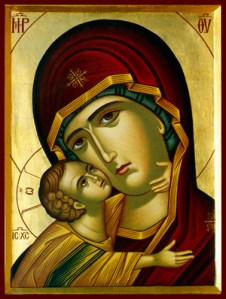 The day was beautiful in the morning sun. As I was walking from my car to the hospital, I asked God to help connect my head to my heart. For some reason I had to work in the central pharmacy with all of its given challenges. It was an exceptionally stressful day. The phones were ringing off their hooks. I felt the tension and stress all others felt. The phone by my desk rang and and I engaged the surrounding irritation. But, another message came my way: “Say thank you!” I said thank you for the annoying phone call which was a gift in disguise. At the other end of the phone was the most annoying nurse in the hospital. I listened to her express her trouble. I went to the medical floor she worked on and solved her problem. Not only was the problem solved, but my attitude about her changed — she suddenly became “delightful”, or as close as she could be to this state of being. My head and heart were united by this gift’s insight to the Eucharist (which means thanksgiving) — I am to give thanks for all things, circumstances, and people.
With this spiritual insight, all events, situations, and people — however difficult — can be received as gifts from the Father of Lights. Even, pain, illness, etc., can be received as gifts, and the power of prayer and thanksgiving transforms them to empowering gifts. We have this instruction from St Paul to his spiritual son, Timothy:
For everything created by God is good, and nothing is to be rejected if it is received with thanksgiving, for it is consecrated through the word of God and prayer (1 Timothy 4: 4 – 5).
All things, thus, can be seen as gifts from the Father of Lights. For all matters and circumstances that come our way, I present words for St Paul by which I try to live every day. I use them to guide me that I might walk in the ways of our Lord:
Rejoice always. Pray constantly. Give thanks in, with, and for all things; for this is the will of God for you in Christ Jesus (1 Thessalonians 5: 16 – 18).
And so it is Christmas! We have prepared ourselves once more to receive the Divine Infant — the Good and Perfect Gift from the Father of Lights into our hearts. We do this so that Jesus can be formed within. Thus, all things can be seen as gifts for the Father of Lights. All such gifts when received from the Father of Lights with gratitude will further form Christ in us, so that we might bear Christ into all settings of life. If we do this, then every day will offer a touch of Christmas!
Christ is born! Glorify him!
Here is an abbreviated homily that corresponds to this posting:
In Christ, and in every good and perfect gift from the Father of Lights,
Fr Irenaeus
Union with Christ and the Parable of the Rich Fool
Posted: November 19, 2024 Filed under: The Eucharist and Living the Eucharist | Tags: all things are held in Christ by his Incarnation, baptism unites us to Christ's death and resurrection, Be rich towards God, be self-giving and other-receiving, Christians are participants in the divine nature, Galatians 2: 20 Christ lives in me, Recapitulation, Romans 6: 3 - 5 and baptism, set your mind on things above, St John 15: 3 -4, St John 6: 53 -56, the metaphor of the Branches and the Vine, the mystery of Christ in us - the hope of glory, the Parable of the Rich Fool, theosis as a model of salvation, through the Eucharist Christ abides in us and we in Christ, Union in Christ, we are seated in Christ in the heavens Col 3: 1 -4, we bear Christ to the world, we beat Christ to creation 2 Comments Throughout his epistles St Paul writes about his, and our, union with Christ. By this union Christ indwells us, and we indwell Christ. The epistle reading for the ninth Sunday of St Luke comes from his letter to the Galatians. We have this verse:
I was crucified together with Christ. I no longer live, but Christ lives in me. The life I now live in the flesh, I live by faith in the Son of God who loved me and gave himself up for me (Gal 2: 20).
With this verse, St Paul states he was co-crucified with Christ. How did this come about, and by what means? The answer comes from baptism — both his and ours:
Or are you ignorant that everyone who was baptized in Christ Jesus, was baptized into his death? Therefore, we were buried together with him through baptism [dia tou baptismatos – showing agency] unto death in order that just as Christ was raised from death through the glory of the Father, so that we might walk in newness of life. For if we were conformed to the likeness of his death, even more we shall be united with his resurrection (Romans 6: 3 – 5).
St Paul teaches we also have union with his resurrection. We have been joined, or united, to Christ’s resurrection.
In addition to baptism, the sacrament of the Eucharist also brings about this union with our Lord:
Therefore, Jesus said to them, “Truly, truly I say to you unless you eat the flesh of the Son of Man and drink his blood you have no life in you. The one who is eating my flesh and is drinking my blood has eternal life, and I shall raise him in the last day. For my flesh is true food, and my blood is true drink. The one who is eating my flesh and is drinking my blood abides in me and I in him (St John 6: 53 – 56).
We also maintain this union with Christ by conducting our lives according to his teachings. St John records these words of Jesus from the metaphor of the Vine and the Branches:
Already you are clean by the word which I have spoken to you. Abide in me, and I in you. Just as the branch is not able to bear fruit on its own unless it should abide in the vine, likewise neither can you, unless you abide in me (St John 15: 3 – 4).
Our salvation consists not only of the forgiveness of sins. Though this forgiveness is foundational, there is more to salvation. It is ultimately, and in its fullest form, a relational union by, in, with, and for Christ. In his letter to the Colossians, St Paul gives us a summary statement:
…the mystery which has been hidden from the ages and generations, but now has been manifested to his saints. To them God chose to declare how great among the Gentile are the riches of the glory of this mystery, which is Christ in you, the hope of glory (Colossians 1: 26 – 27).
This leads us to the salvific model of theosis. As this union is worked, or penetrates, into the entirety of our being, we are partakers of the divine nature, and we become godly, and godlike. Christ is formed within us because we carry within us God the Son.
Furthermore, St Paul instructs us that this union exists even beyond our present physical condition:
If, therefore you have been raised together with Christ [the Greek construction affirms the positive], seek the things above, where Christ is seated at the right hand of the Father. Set your mind on the things above, not on the things of earth. For we died, and our life has been hidden together in Christ in God. Whenever Christ is manifested, who is your life, then also you shall be manifested together with in in glory (Colossians 3: 1 – 4).
Even now, St Paul declares, we are seated together with Christ and will experience our resurrection by this ontological union! I offer a listing of these facts about our salvation:
+ Christ lives in us, and we live for him.
+ We were crucified together with Christ by our baptism
+ We were raised together with Christ by our baptism
+ If we are eating and drinking his Body and Blood we abide in Christ and he in us.
+ If we by faith conduct our lives according to the teaching of Christ we abide in him and he in us.
+ We are hidden together with Christ in the heavens.
+ Christ is in us — the hope of glory
This union in Christ represents just a part of a greater union which extends far beyond ourselves. St Paul informs us of what is called recapitulation:
[I am] declaring to you the mystery of his will, according to his good pleasure, which he set forth in him for the plan for the fullness of the ages, to gather together all thing in Christ — those things in the heavens and those things upon the earth (Ephesians 1: 9 – 10).
Hence, I expand upon recapitulation. Jesus becomes a creature by assembling his human body from the elements of carbon, nitrogen, sulfur, oxygen, etc., in the uterus of Mary. Thus, as a microcosm of creation, Christ has gathered together everything and everyone into himself. By this he has undone the shattering and scattering of all things into death, darkness, sin, and alienation when Eve disobeyed and Adam capitulated which led to the sin that occurred in the Garden. Adam and Eve were to be the stewards for the care of all creation. They were to serve it as priests, vice regents, and prophets of God for all of creation. They failed. Christ succeeded. He overcame death and granted life for all and all things by his resurrection. By his ascension into heaven all things are held together in him in his glorified body.
This union with Christ demands that we walk in newness of life, and in this newness of life bear Christ to all of humanity and all of creation. This will mean an ongoing struggle of our will to be conformed to his will and ways. But, we are empowered by the Holy Spirit (who also abides in us) who works with us to overcome our sins as we choose to cooperate with him.
Let’s now move to St Luke’s Gospel reading for the day. It gives us The Parable of the Rich Fool. This parable tells us what we are not to do in this life. There is a background for today’s reading which is from St Luke 12: 13 – 15. An outline is presented,
A man asks Jesus to judge between him and his brother for a proper division of the inheritance.
Jesus replies: “Man, who made me judge or divider over you? Take heed, and beware of all covetousness; for a man’s life does not consist in the abundance of his possessions.”
 Now we move to the Rich Fool: He had an abundance of crops from his harvest. It was so great that it could not be properly stored. He tears down the old, and builds new barns and granaries to hold the abundance. So far we have no foul. However, this changes when we discover this internal monologue: “Soul, you have ample good laid up for many years; take your ease eat, drink, and be merry!” (St Luke 12: 19). So, here we have the foul: He saw his harvest and wealth to be exclusively for his own enjoyment. God replies to his folly:
Fool! This night your soul is required of you. And the these you have prepared, whose will they be? So is he who lays up treasure for himself, and is not rich toward God (St Luke 12: 19 – 20).
So what can be said about The Rich Fool: He could have partied and feasted with the blind, the lame, the poor — those who could never repay him. He could have given from his surplus to feed those in need. He could have shared from the profits of sales with the poor of his synagogue. Like the Rich Man who ignored Lazarus, all he had to do was give of himself and of his wealth to bring aid and comfort to another.
With our salvation — our relational union in, with, and for Christ — we are to conduct ourselves according to his teachings.
Work out your own salvation with fear and trembling; for God is at work in you, both to will and to work according to his good pleasure” (Philippians 2: 12b – 13).
As noted above, we are to set our minds on things above — things which will last, and not on the things of this world system which will perish. We can make a summary with this instruction: Be self-giving and other receiving!
Here is a corresponding sermon given at St Nicholas Greek Orthodox Church in Tacoma, WA given on 11/17/24:
In Christ,
Fr Irenaeus
Your Neighbor is Here, There, and Everywhere
Posted: November 11, 2024 Filed under: Etcetera, The Eucharist and Living the Eucharist | Tags: living the Beatitudes, loving your neighbor as yourself, Parable of the Good Samaritan, spiritual bandages and medicines Leave a commentThis posting examines the parable of the Good Samaritan which is found in St Luke 10: 25 -37. It begins with a dialogue between Jesus and an expert in the Mosaic Law.
The lawyer tests Jesus: “What must I do to inherit eternal life?”
Jesus in reply (also testing him): “What is written in the law? How do you read it?”
The lawyer gives his reply: “You shall love the Lord your God with all your heart, with all your soul, with all your strength, with all your mind, and your neighbor as yourself.
Jesus: “You have answered correctly. Do this and you shall live.”
The lawyer, wishing to justify himself, asks, “And who is my neighbor?”
 We now move to a brief summary of the parable. As we all know, those who occupy a similar religious office as the lawyer, are cast as the villains because they ignore and pass by the injured man in need of rescue. Then Jesus gives a twist to the plot; the hero is an unexpected and despised — in the mind of the lawyer — Samaritan who stops to help to the man.
The despised Samaritan exhibits compassion: He binds his wounds, and also medicates the wounds with oil and wine. He then takes him to an inn for further care, and extends the care of the injured man with his own money to compensate the innkeeper.
The epistle reading that accompanies the Gospel reading from St Luke comes from Galatians 1: 11 – 19. The subject is St Paul’s calling to be an Apostle. From Galatians 1: 15 – 16 we read this: “But he who set me apart from my mother’s womb, and had called me through his grace, revealed his Son to me that I might preach the Good News of him to the Gentiles.” He was set apart, and called to be an Apostle and given a defining ministry that continues for us to this day.
Though we are not called to be an Apostle as he, the 12, and the 70 were called, we have a calling! In his first epistle, St Peter writes,
But as he who called you is holy; be holy yourselves in all your conduct; since it is written, “You shall be holy, for I am holy (1 Peter 1: 15 – 16).
St Paul informs us of our ministry that results from our baptism — a ministry of works of faith. Regarding works that arise from faith in Christ, St Paul informs us of this in Philippians 2: 12b – 13:
Work out your own salvation with fear and trembling; for God is at work in you, both to will and to work for his good pleasure.
He writes this as well in his letter to the Ephesians:
For by grace you have been saved through faith; and this is not of your own doing, it is the gift of God — not because of works, lest any man should boast. For we are his workmanship, created in Christ Jesus for good works, which God prepared beforehand, that we should walk [peripataesomen] in them (Ephesians 2: 8 – 10).
When St Paul uses the word walk it is to be understood that it refers to how a Christian is to be conducting his / her life, and how we are to conform our thoughts and actions to match and imitate Christ. Essentially, as the lawyer correctly notes, “We are to love our neighbors as ourselves.”
I pose a question: Where do we find our neighbor? As Sir Paul might answer, they are here, there, and everywhere. The walking wounded are all around us — here, there, and everywhere.
What are our bandages, oils, and wines? Before I offer my attempt to answer this question, let me put forward this admonition from St Paul, “Now, I urge you brethren, to warn the idle…” (1 Thessalonians 5: 14). With this, let the focus be on spiritual idleness. There is a saying: “Comfort the afflicted; afflict the comfortable. Also, there are times we need to be lovingly disturbed in a way to move us more deeply into the ways of Christ. However, we are to cause no one and no thing distress by acting or speaking out of anger, irritation, or annoyance. Rather, you and I are to seek to relieve the distress of others, and all things, by living according to the Beatitudes:
The Beatitudes — they are not given by Christ to be spiritual ideals — they are to be embodied. They are to be worked into our lives by living them. As per one of my favorite axioms: We must do to become.
I return to my question posed above. What are our bandages and medicines? The are love, kindness, prayer, mercy, humility, giving assistance (among many other treatment options). Yes, even smiling can provide a soothing balm.
Do this, and we shall live!
In Christ,
Fr Irenaeus
The Seventh Ecumenical Council and Being an Icon
Posted: October 14, 2024 Filed under: Etcetera, The Eucharist and Living the Eucharist | Tags: Being an icon, humans are living icons, humans bear the image of God, iconoclast, iconodules, Icons declare the Incarnation, Orthodox Christians venerate icons, Orthodox Icons are not idols, St John of Damascus, the Seventh Ecumenical Council, venerating icons Leave a commentThe seventh ecumenical council was convened in 787 by Emperor Contantine VI and Empress Irene. It was attended by 308 bishops and presided by Tarasios of Constantanople. Addressed was the iconoclastic controversy. There were two parties: the iconoclasts, or “icon breakers”, and the iconodules, or the “venerators of icons.”

Christ the Good Shepherd
Many issues were at play, among them the Christian attitude towards matter, and the nature of redemption and salvation. Its history was varied and complex, but was influenced by Muslims and Jews who were profoundly opposed to any expression of “spiritual reality” by “physical, material expressions.” Also there were always “puritans” in the Church who saw all material and physical expressions of the faith as a potential for the occurrence of idolatry.
Here are three quotes from St John of Damascus who informs us of the Orthodox teaching concerning icons:
Concerning the charge of idolatry: Icons are not idols but symbols, therefore when an Orthodox venerates an icon, he is not guilty of idolatry. He is not worshipping that pictured, but merely venerating it. Such veneration is not directed toward wood, or paint or stone, but towards the person depicted. Therefore, relative honor is shown to material objects, but worship is due to God.
We do not make obeisance to the nature of wood, but we revere and do obeisance to Him who was crucified on the Cross…When the two beams of the Cross are joined together I adore the figure because of Christ who was crucified on the Cross, but if the beams are separated, I throw them away and burn them.
Icons are necessary and essential because they protect the full and proper doctrine of the Incarnation. While God cannot be represented in his eternal nature [his essence]…He can be depicted simply because He took on human flesh. Of Him who took a material body, material images can be made. In so taking a material body, God proved that matter can be redeemed. He deified matter, making it spirit-bearing, and so if flesh can be a medium for the Spirit, so can wood and paint, although in a different fashion.
However, the iconoclastic heretics forgot ONE main truth which they seem to have ignored. At the core of the argument for the making and veneration / honoring of icons is this: there has always been a material manifestation of the invisible God. Regarding all humanity we read this from Genesis 1:26, 27:
Then God said, ‘Let us make man in our image [eikon] and likeness…so God created man in his own image, in the image of God he created him; male and female he created them.
Next we have these passages from the New Testament regarding Christ:
In many and various ways God spoke of old to our fathers by the prophets; but in these last days he has spoken to us by a Son, whom he appointed the heir of all things, through whom he created the ages. He reflects the glory of God and bears the very stamp of his nature… (Hebrews 1: 1 – 3)
He is the image of the invisible God…(Colossians 1: 15a)
And the Word became flesh and tabernacled among us, full of grace and truth; we beheld his glory, glory as the only-begotten Son of the Father (John 1: 14).
That which was from the beginning, which we have heard, which we have seen with our eyes, which we have looked upon and touched with our hands, concerning the word of life — the life was made manifest and we saw it, and testify to it, and proclaim to you the eternal life which was with the Father and was made manifest to us (1 John 1: 1 – 2).
St John of Damascus summarizes for us:
I do not worship matter, but the Creator of matter, who for my sake became material and deigned to dwell in matter, who through matter effected my salvation.
Now I bring forward a shift to ethics, or moral theology. Here are words from Exodus regarding both God and images:
I am the LORD your God, who brought you out of the land of Egypt, out of the house of bondage. You shall have no other Gods but me. You shall not make for yourself a graven image, or any likeness of anything that is in the heavens above, or that is in the earth beneath, or that is in the water under the earth; you shall not bow down to serve them…You shall not take the name of the LORD your God in vain; for the LORD will not hold him guiltless who takes his name in vain.
These first three commandments uphold for Israel the integrity of God for them. “You shall love the LORD your God with all your heart, and with all your soul, and with all your mind” (St Matthew 22: 37). The other seven commandments are to uphold the integrity of the image bearers of God and their relationship with one another, and with God their LORD: “You shall love your neighbor as yourself” (St Matthew 22: 39).
Why couldn’t the Jews from an image of God? Because the Icon of God, Jesus, had not yet been revealed to them, “And the Word became flesh and tabernacled among us.” I again quote from St John of Damascus:
I do not worship matter, but the Creator of matter, who for my sake became material and deigned to dwell in matter, who through matter effected my salvation.
 The first iconoclast did not appear in the eastern empire in the 7th or 8th century, but in the Garden of Eden! The serpent was the first iconoclast. Truly, the Serpent was the first iconoclast: he deceived and marred those who were created in the image of God. Though the image of God was not lost, the integrity was lost. Humanity lost communion with God, and with the creation they were to serve as God’s vice-regents and priests. Rather than serving and cultivating creation in love, its exploitation began. Rather than upholding the dignity of humanity, humans began to degrade other humans.
The complaint of the Psalmist truly was the complaint of all humanity:
The enemy has pursued me. He has crushed my life to the ground, and has made me sit in darkness like those long dead” (LXX Psalm142, MT Psalm 143).
Jesus Christ Conquers
We were not left alone to never ending lament and sorrow. God intervened and rescued us from such darkness, bondage, and alienation. We were delivered from sin and its death. We were liberated by the one God-man “commando raid” of the Incarnate God, Jesus Christ, who is the image and likeness of God (“…If you have seen me, you have seen the Father…” John 14: 9). Christ came as our Victor. He liberated us. He re-created us. He restored the image of God in us. He exalted us even beyond our original status.
The image of God has been restored, and is being restored in us as we exist in relational union in Christ, and cooperate with the Holy Spirit who sanctifies us. We are 3-D icons. We are living, moving, breathing icons and priests. As such icons and priests we declare to all of creation, by our actions, what God is like.
Hence, we are given an ethic in the category of an ethic of being. By this ethic we are to understand this: we are to bear God to all creation by holy actions and prayers and words of blessing, and bear creation to God by our prayers and offerings. We are to work with God to uphold, and restore the image of God in one another as we love and serve one another. St Paul instructs us:
Do not repay evil for evil, but pursue the good both for one another and for all. Rejoice always. Pray constantly. Give thanks in, with, and for all things, for this is the will of God for you in Christ Jesus (1Thessalonians 5: 15 – 18).
Thus, we are either truthful icons demonstrating God’s love to humanity and creation, or we are false icons that tell lies about what God is like. We are either iconodules or we are iconoclasts.
Here is the corresponding sermon:
In Christ who is the Icon of the invisible God,
Fr Irenaeus
Living in the Underground
Posted: September 27, 2024 Filed under: The Eucharist and Living the Eucharist | Tags: acting by faith without thought of benefit, becoming "sons of the Most High", becoming compassionate, do to others as you would have others do to you, growing in compassion, lend without expecting repayment, living in a parallel society, love your enemies, St Luke 6: 31-36, St Matthew 5: 1-49, subverting the world system, the "economy" of the Kingdom of Heaven, the Beatitudes and living counter culturally Leave a commentThe underground. For me, the thought of the “underground” brings images of underground resistance fighters secretly operating to fight an oppressive tyrant. In any case, those who “live in the underground” conduct their lives around an alternative set of rules to achieve a desired goal.
Our Lord Jesus Christ has also constructed an alternative society — an underground movement. Here, those who are of the Church are to live lives that are in profound contrast to those who live according to the world system. Much of the sixth chapter of St Luke’s Gospel spells out, in part, how we who live in the alternative society of the Church are to conduct lives:
As you wish men to do to you, do so to them. If you love those who love you, what benefit of grace is that to you? For even sinners love those who love them. If you do good to those who do good to you, what benefit of grace is that to you? For even sinners do the same. And if you should lend to those whom you hope to receive back, what benefit of grace is that? Even sinners lend to sinners in order to receive back what is lent. Rather, love your enemies, do good and lend not expecting anything in return, and your reward shall be great, and you will be sons of the Most High, because he is good to the ungrateful and the evil. Become compassionate just as your Father is compassionate (St Luke 6: 31 – 36).
The Sermon on the Mount
Both St Luke (see St Luke 6: 20 – 49) and St Matthew (see St Matthew 5: 1 – 48) offer behaviors that are of the underground life of the Church — ways of thought and living that are stark alternatives to the “economies” (the Greek word means “how a house is managed”) of the world system. The teachings of our Lord in these scriptural passages invert and subvert the “economies” of the world system. By them, a behavioral counter culture of the Kingdom of Heaven is established. Undoing, defeating, subverting the world system is not accomplished by operating by the same methods. We do not fight fire with fire. St Paul offers a corresponding, definitive rule:
Do not repay evil for evil, but always pursue the good both for one another and for all. Rejoice always. Pray constantly. Give thanks for all things for this is the will of God for you in Christ Jesus (1 Thes 5: 15 – 18).
“Become compassionate just as your Father is compassionate.” This is not just to be a goal, but it is to be our reality! Several years age while hearing a man’s confession he stated he wished to be compassionate, “but I just don’t feel like being compassionate.” I responded by telling him that we don’t wait for a feeling to act for good. It may never come. Rather, I suggested that he “do compassion” and you will become compassionate. I added, “Look for common situations your life to do compassionate things.”
George Harrison
A better term for an underground society is a parallel society — it offers a more constructive foundation for action. In the parallel society which is the Church — as we faithfully follow Christ’s teachings — we will love those who hate us. We will do good and extend ourselves to others without thought of compensation. We, by doing, will become who we are to be in Christ. However, we have to start out with small steps that are realistic and obtainable. For example, if one only know three guitar chords one cannot expect to play the Beatles’ Here Comes the Sun. But, by practicing and expanding one’s “guitar chops” in “the woodshed”— one day one will be able to play George Harrison’s wonderful and beautiful song. Similarly, regarding works of faith, we start out small and work our way up as we, by faith, cooperate with the Holy Spirit and grow in his ways.
Now, I present a thematic shift — a shift to thoughts and how we think. This shift is important since our thoughts will determine how we act and form our lives. From the Prayer of the Hours we have this: “…Sanctify our souls, purify our bodies, set aright our minds, cleanse our thoughts.” Along with this, I offer words from Elder Thaddeus of Vitovnica:
Our life depends on the kind of thoughts we nurture. If our thoughts are peaceful, calm, meek, and kind, then that is what our life is like. If our attention is turned to the circumstances in which we live, we are drawn into a whirlpool of thoughts and can have neither peace nor tranquility.
Light and Life
Also, please allow me to present an exercise that will improve our thoughts and increase compassionate, merciful, and peaceful mindsets and actions. When driving in town take notice of pedestrians and pray that they be blessed, that God’s mercy come upon them, and they be drawn into the Light and Life of Christ. The same can be done in any situation or setting. I believe such simple spiritual exercises will lead us to think and act in ways to the benefit of others so that, in turn, we attain our Lord’s will for our lives: “Become compassionate just as your Father is compassionate…and become sons of the Most High.”
In Christ while living in The Underground,
Fr Irenaeus
Here is a link to “Here Comes the Sun”
 Father Irenaeus Williams
The Healing of the Demoniac of Gadarenes and Advice for the “Last Days”
Posted: October 31, 2024 | Author: Fr. Irenaeus | Filed under: Etcetera, The Eucharist and Living the Eucharist | Tags: Are we in the Last Days?, Healing of the Gadarene Demoniac, spiritual preparations for difficult and troubling times, St Hilary of Poitiers' commentary of St Matthew 14: 22 - 33 | Leave a commentEven in this hideous condition he bore the image of God. The demons hated him. They humiliated him, physically harmed him, and gave him an unnatural, terrible strength. He was tormented by these evil beings who desired to destroy him.
This can be seen as a spiritual parallel for our days. If not outright possession of some, there is a horrific demonic influence taking place in much of popular culture and secular society. In these days, and those days that may be coming for us, just as Christ came to set the possessed man free, so we must ask Christ to more completely free us from the corruption and darkness of sin that remains in us. We must shun every form of evil (“Perverseness of heart shall be far from me; I will know nothing of evil” (Psalm 101/100: 4). And, as the liberated man was clothed and in his right mind, let us more completely be clothed in Christ and have his mindset. As the Prayer of the Hours asks of God, so let us ask, “…Sanctify our souls, purify our bodies, set aright our minds, and cleanse our thoughts.”
St Hilary takes the focus of this miracle to Last Days. (However, the Incarnation ushered in the Last Days.) He sees the disciples’ struggles paralleling the struggles of the Church. He writes,
Again, the Church has been in the “Last Days” since the Incarnation. Where are we today? Are we approaching or in the final chapter, or perhaps a trial run? I do not know. I do know that we find ourselves buffeted by the raging of the world system and its powerful — both seen and unseen. I do know that at all times we are to hold firm to Christ as the Church and as individual Christians. I do know that as we reach out to Christ he comes to us. I do know that we must be in preparation at all times to be in the presence of our Lord. We are to live a life of faith.
In these times I offer terse advice:
Offered, too, are these words of St Paul:
Here is the link to the corresponding sermon:
In Christ,
Fr Irenaeus