“Othering” Others – The Sunday of the Publican and the Pharisee
Posted: February 3, 2026 Filed under: self-giving and other receiving, The Eucharist and Living the Eucharist | Tags: author Richard Flyer, discerning the Body of Christ in 1 Corinthians 11: 27 -28, healing and preventing divisions in the Church, Jesus' parable of the Publican and the Pharisee in Luke 18: 9 - 14, othering others, the Lamb of the Eucharist Leave a comment The Parable of the Publican and the Pharisee is found in St Luke 18: 9 – 14. Our Lord directed this parable’s message to those “Who trusted in themselves that they were righteous and despised others” (St Luke 18: 9).
There is, of course, a stark contrast between the two men of the parable. We have the Pharisee: “I thank you that I am not like other men, extortioners, unjust, adulterers, or even like this tax collector. I fast twice a week, I give tithes of all that I get” (St Luke 18: 11b – 12). The pharisee, of course, had contempt for all who were not like himself — or rather perceived himself to be. He stood apart from all others in the Temple. He did not pray to God, he only praised himself.
In contrast we have the tax collector:
But the tax collector, standing far off, would not even lift up his eyes to heaven, but beat his breast, saying, “God, be merciful to me a sinner!” (St Luke 18: 13).
By this response, our Lord gives approval to the tax collector’s plea:
I tell you, this man went down to his house justified rather than the other; for every one who exalts himself will be humbled, but he who humbles himself will be exalted (St Luke 18: 14).
Though the pharisee’s behavior and attitude are to be rejected, it is far too easy to overlook and ignore the pharisee in us — the pharisee that raises his ugly head and speaks with similarly contemptible and prideful words.
Here is the focus of this posting: maintaining unity among the Christian faithful. It is easy — too easy — for us to separate ourselves from those whom we see as “other” and inferior to ourselves — those who do not meet our exalted standards and insights. It is easy for the healthy to separate themselves from the chronically ill; the affluent who look down on the poor; the educated and sophisticated who look down on the simple and the “unwashed masses;” the urban to look down on those in rural areas; those in rural areas to despise the city-dweller. This list can go on and on, and would include political positions and allegiances. We can find examples that apply to our own self-righteousness, false confidences, and pride.
As we all should know, we live in a secular society that is extremely divided where factions hate each other. By some means this is a manufactured condition with a strategy of divide and conquer. Be sure that its architecture and construction comes from the one who is the enemy of our souls and of our Lord. They are all anti-human. Plainly there are “-ologies”, “-isms”, and “-alities” which are false and evil. They are designed to deceive us and threaten our souls and unity in Christ. These are to be rightly rejected when they are contrary to the teachings of the Church. Such lies are to be confronted and opposed with unwavering resolve, and also with the unwavering love of God.
We encounter division and enmity. But, could it be possible that we in our own hearts and minds are “othering” our brothers and sisters. “othering” — we have the coinage of a new term. I think it comes from an acquaintance of mine and author Richard Flyer, and he makes this observation:
Long before today’s culture wars, we’ve been programmed to see through a lens of separation — to divide before we related, to organize around what sets us apart rather than what binds us together…this is what I call the Culture of Separation — a world so consumed by its righteous battles that is forgets relationship itself. We condemn those who “other” others while easily othering them in return.
Could it be even remotely possible that we may be a pharisee “othering” a supposed tax collector in this Temple of God? I must speak to myself when this question is asked as well as the reader of this posting.
With today’s Sunday of the Publican and the Pharisee, we are one Sunday closer to Great Lent, and one Sunday closer to the brilliant glory of Pascha!
There were divisions in the Church of the first century, and St Paul addressed those in his epistles. The greatest societal division of the era was that of Jew and Gentile. Throughout is his epistles, St Paul declares that such divisions were abolished by Christ:
Therefore, remember that at one time you Gentiles in the flesh, called the uncircumcision by what is called the circumcision, which is made in the flesh by hands — remember that you were at that time separated from Christ, alienated from the commonwealth of Israel, and strangers to the covenants of promise, having no hope and without God in the world. But, now in Christ Jesus you who once were far off have been brought near by the blood of Christ. For he is our peace, who has made us both one, and has broken down the dividing wall of hostility, by abolishing in his flesh the law of commandments and ordinances, that he might create in himself one now man in place of the two, so making peace, and might reconcile us both to God in one body through the cross, thereby bringing the hostility to an end (Ephesians 2: 11: 16).
Unity in Christ and the in the Holy Trinity is not just to be a lofty ideal, but our reality. We are to have unity in being just as does the Holy Trinity. Of this unity the Divine Liturgy informs us: “It is meet and right to worship the Father, and the Son, and the Holy Spirit: the Trinity one in essence and undivided.”
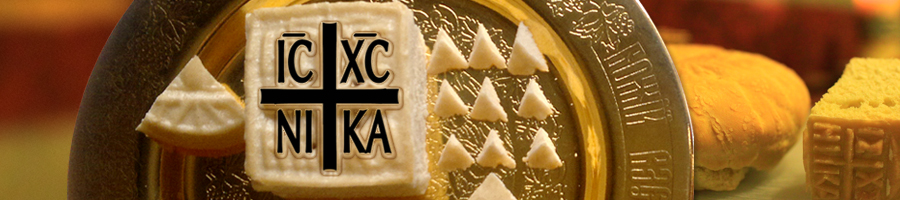
A priest at his ordination has a cube shaped piece of bread which will become the Body of Christ, and it is called the Lamb. It is placed in his hand by his bishop. By his bishop he is given the charge to care for and uphold the integrity of the Body of Christ: the Body of Christ of the Eucharist, and the Body of Christ which is composed by the faithful assembled for the Divine Liturgy. Regarding both holy Bodies of Christ St Paul has written,
Whoever, therefore, eats the bread or drinks the cup of the Lord in an unworthy manner will be guilty of profaning the body and blood of the Lord. Let a man examine himself, and so eat of the bread and drink of the cup. For any on who eats and drinks without discerning the body eats and drinks judgment upon himself (1 Corinthians 11: 27 – 28).
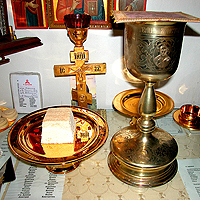 The Eucharist is our common offering. We offer it together to God. We are to offer it together in unity with, and love for one another. We are all sinners gathered together in this hospital which is the Church. Since we are sinners in the ongoing, healing process of sanctification, there will be occasional conflicts. St Paul states somewhere that we are “to put up with one another!” You are to put up with me, and I with you (even if you are a New York Yankees fan, and even if you do not like the Beatles!)
It is by the Eucharist that Christ abides in us, and we in him (see St John 6: 56). This is a spiritual, ontological reality. It is not to be kept to ourselves. We are to live in a way that is eucharistic, meaning we are to unfold Christ who indwells us to one another, and to all and all things. We are to be self-giving and other receiving — just as Jesus gives himself anew to us by the Eucharist, and also receives us again to himself by this holy Sacrament. Given this, we are not to other others!
As we move together to and through another Great Lent, let us seek unity in humility, and with love for one another in self-giving and other-receiving relationships. Additionally, let’s have in our hearts and on our tongues the words of the Publican: “God, be merciful to me a sinner!” (St Luke 18: 13).
The following is the corresponding sermon given at St Nicholas Greek Orthodox Church on February 1, 2026:
In Christ,
Fr Irenaeus
 Father Irenaeus Williams