Receiving Sight
Posted: January 19, 2026 Filed under: The Eucharist and Living the Eucharist Leave a commentThis posting discusses Jesus’ healing, and gift of sight, to a blind man on the road to Jericho. This account is found in St Luke 18: 35 – 43.
For the blind man, the day started out like every other day. He sat begging on the side of the road to Jericho. Yet, that day would be unlike any other day of his life because Jesus and his disciples were passing by. He cries out: “‘Jesus, Son of David, mercy me!’” (St Luke 18: 38). “Mercy me!” seems to be an antiquated, or odd, translation of the blind man’s eleeson me! Modern translations would use the term “have mercy on me!” But, this misses the significance of the root of the verb eleeo. The Greek word for oil is elaion. The verb eleeo, in addition to an act of mercy, or forgiveness, offers the meaning, “Heal me!” “Pour a balm upon me!” It was his request to have God’s grace to come upon him.
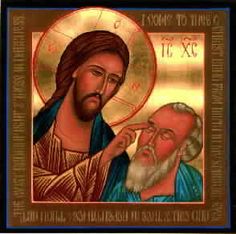 The crowd tried to silence him — to prevent him from interacting with Jesus (St Luke 18: 39).. After all, he was just an unimportant, faceless, blind beggar. He refuses to be discouraged. He cries out all the more: “‘Son of David, mercy me!’” (St Luke 18: 39). Jesus responds, “‘What do you wish me to do for you?’ And he said, ‘Lord, that I might see.’ And Jesus said to him: ‘See. Your faith has saved you’” (St Luke 18: 41 – 42). We read of the result:
And immediately he saw, and he followed him glorifying God. And all the people upon seeing this gave praise to God (St Luke 18: 43).
It is important to know that giving, or restoring, sight was the unique healing gift of the Messiah. The blind man knew this as we read his address to Jesus with the Messianic title, Son of David.
Given this, we should see ourselves as the blind man. Once we sat, as he did, in spiritual blindness and poverty. When we were catechumens, or are now blessed to be catechumens, the Church, in the Divine Liturgy prays, “That he [God] may reveal to them the Gospel of Righteousness.”
We all moved from the category of catechumen to that of faithful when were baptized and crismated. We were illumined. Thus, we could now see spiritually, and live as Christians. But, consider this: in every Divine Liturgy before the reading of the Gospel this prayer is said,
Illumine our hearts, O Master who loves mankind, with the pure light of your divine knowledge. Open the eyes of our mind to the understanding of your gospel teachings. Implant also in us the fear of your blessed commandments, that, trampling down all carnal desires, we may enter upon a spiritual manner of living, both thinking and doing such things as are well-pleasing unto you. For you are the illumination of our souls and bodies, O Christ our God, and unto you we ascribe glory, together with your Father, who is from everlasting, and your all-holy, good, and life-creating Spirit, now and ever and unto ages of ages.
Now, from this prayer we are to learn that our illumination and the opening of the eyes of our mind is an ongoing process. This is to be a continual reopening of the eyes of our mind that we grow in our spiritual life, “…both thinking and doing such things as are well-pleasing unto you.”
Our salvation is not a “one and done” event, not is it a once and for all single occurrence. It, again, is a process! Our salvation requires an ever ongoing renewal and correction. Think of the ongoing checking of our physical sight by an optometrist or an ophthalmologist. Upon the results of an examination of vision, one may be given necessary prescriptions to take to an optician for correction of eye sight. This makes me think of another Gospel account of Jesus’ healing of a blind man — one who lived in Bethsaida:
And they came to Bethsaida. And some people brought to him a blind man, and begged him to touch him. And he took the blind man by the hand, and led him out of the village; and when he had spit on his eyes and laid his hands upon him, he asked him, “Do you see anything?” And he looked up and said, “I see men; but thy look like trees walking.” Then again he laid his hands upon his eyes and he looked intently and was restored, and saw everything clearly. And he sent him away to his home, saying, “Do not even enter the village” (St Mark 8: 22 – 26).
Our salvation is a spiritual life demanding growth and maturation. It involves ongoing confession and repentance. When we stumble and fall we get up again by the supporting hand of God who is saving us. It is an ongoing faith filled consumption of the Body and Blood of Christ by the Eucharist. By this Sacrament we are cleansed, by which we receive Jesus’ Light and Life and gain his victory over sin, darkness, death, and alienation — and spiritual blindness.

Light and Life
Quoting from a portion of the Prayer of the Hours, there is the needed continual cooperation with God to “sanctify our souls, purify our bodies, set aright our minds, and cleanse our thoughts.” Allow me to suggest we may also pray, “Lord, be my eyes to see your path and walk in your ways. Let me see with the eyes of a child; with eyes made pure by your all-holy Body and Blood.”
With the eyes of faith we are enabled to see any situation to be an opportunity where we, “Rejoice always. Pray constantly. Give thanks in, with, and for all things, for this is the will of God for you in Christ Jesus” (1 Thessalonians 5: 16 – 18). All this is to be done to the glory of God: Father, Son, and Holy Spirit!
The following is a corresponding sermon given January 18, 2026 at Holy Resurrection Orthodox Church, Tacoma, Washington:
In Christ,
Fr Irenaeus
 Father Irenaeus Williams