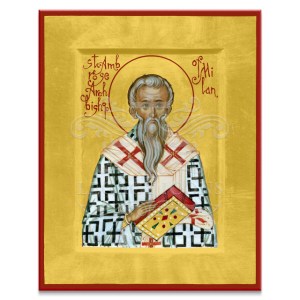
St Ambrose of Milan and the Thankful Leper
Posted: December 9, 2025 Filed under: The Eucharist and Living the Eucharist | Tags: "Let us go forth in peace", 1 Thessalonians 5: 16 - 18, become Eucharists, Become thankful Col 3: 15, give thanks for all things, Hypostatic Union, living eucharistically, Real Presence, St Ambrose of Milan, St John 6: 50 -51, St Luke 17: 13 - 19, The Eucharist is a re-presentation of the Incarnation, the Eucharist is the Body and Blood of Christ, The Healing of Ten Lepers, the one thankful leper, transubstantiation and Monophysitism Leave a commentEvery year on December 7 the Orthodox Church commemorates St Ambrose of Milan. He was bishop of Milan in the fourth century and is, of course, a saint of the Church. One of his works, The Mysteries, was extremely important for my conversion to the Orthodox Church, and subsequent ordination to the deaconate and then the priesthood.
St Ambrose of Milan
This work taught me, when I was a Protestant, that Holy Communion — the Eucharist — gives to the communicant the true, all-holy, and precious Body and Blood of the incarnate God, our Lord and Savior Jesus Christ. This epiphany occurred in 1992 when I was a student at a Protestant seminary. Upon this revelation I was undone — my “apple cart was tipped over.” I experienced a “paradigm shift.” I went “through the looking glass.” I had to ask some fundamental questions, among them being, “What is salvation? Are we saved by more than faith alone?” “What is reality?” My dualistic understanding of matter and spirit was shattered — they are not separated by a great chasm, they intermingle with one another.
Specifically, I was confronted by these sentences found in The Mysteries:
Perhaps you may say: “I see something else; how do you tell me that I receive the Body of Christ?” (9: 50).
It has been proven that the sacraments of the Church are more ancient; now realize that they are more powerful. In very fact it is a marvelous thing that God rained manna on the fathers, and they were fed by daily nourishment form heaven. Therefore, it is said: “Man has eaten the bread of angels.” But yet all those who ate that bread died in the desert, but this food which you receive, this living bread which came down from heaven, furnishes the substance of eternal life, and whoever eats this bread “will not die forever;” for it is the body of Christ (9: 49).
St Ambrose quotes from the sixth chapter of St John’s Gospel, and more specifically the Bread of Life discourse that took place in the synagogue of Capernaum. I had to read from St John’s sixth chapter myself over and over for the message of these verses to sink into my mind (I still refer to them quite frequently).
Your fathers ate the Manna in the wilderness and died. This is the Bread which is coming down from heaven [katabainon], in order that if someone might eat of it might not die. I am the Living Bread which came down [katabas] from heaven. If someone might eat of this Bread he shall live forever, and the Bread which I will give is my Flesh in behalf of the world (St John 6: 49 -51).
St John uses two different participle forms of the Greek verb katabainein, “to come down,” or “to descend.”
-
- Katabainon — substantival present passive form. The present tense, or aspect, of a Greek verb implies an ongoing activity — no ending of the action is demanded. This means there is a Bread which is continually coming down from heaven.
- Katabas — a substantival aorist active form. The aorist declares an action is completed. With this participle, our Lord refers to the Bread which is his Body which came down from heaven only once. Katabas, thus, refers to his physical Body of the Incarnation that stood before those assembled in the synagogue.

The Living Bread
Again, St John 6: 50 informs us that there is a Bread which is continually coming down from heaven. Our Lord then defines and clarifies what and who this Bread is in 6:51. He most clearly states that this Bread which is continually descending from heaven is none other than his physical body of the Incarnation — the body that came down — once and for all which will be broken and given for the life of the world. They are one and the same!
Perhaps one who denies this truth might think, “Well, by the time of St Ambrose the Church became confused about this matter and many others as well.” Wrong! 250 years earlier St Ignatius of Antioch — himself a disciple of St John — gave to the church of Smyrna of these words regarding the Eucharist:
They [false teachers] abstain from the Eucharist and prayer, because they do not confess the Eucharist to be the Flesh [sarka – a feminine noun] of our Savior Jesus Christ. The Flesh [taen, feminine article – sarka is its antecedent] which suffered for our sins, the Flesh [taen, feminine article– again sarka is the antecedent] which, by the goodness of the Father, was raised (Ignatius to the Smyrnaeans VII: 1).
The Apostolic Tradition of the Church, from St John the Apostle, through St Ignatius (early second century), through St Ambrose of Milan (fourth century), to this very day has always taught that by the Eucharist the Church is given our Lord’s Body and Blood. To deny this is to deny the faith of the One, Holy, Catholic, and Apostolic Church! To deny this truth is to imply that St John who observed, heard, and touched our Lord — the Incarnate Logos (see 1 John 1: 1- 5) is a liar. And you accuse all the Fathers of the Church to be liars as well.
Hence, from all of this, especially from St John’s words, we are to understand that the Eucharist is a re-presentation of the Incarnation. All that is of Christ — all that he is, and all that he did and accomplished for our salvation — are re-presented anew to us. A re-presentation of the Incarnation means that the hypostatic union also applies to the Eucharist. Regarding Jesus of Nazareth the hypostatic union means that he is fully God and fully man. These two natures are in an indivisible union in the one Person of Jesus, yet the two natures are not to be confused. Then, regarding the Eucharist, it is fully Jesus’ Body and Blood and fully bread and wine — two “natures” exist in an indivisible union, yet they are not to be confused. (As an aside, The Roman Catholic understanding of transubstantiation is a bit reminiscent of the error of Monophysitism — that there is only one nature of Jesus. Thus, transubstantiation states there is only one nature of the Eucharist: there is only Body and Blood, the bread and wine are simply incidentals. With the teaching of transubstantiation the Eucharist is a bit misunderstood.)
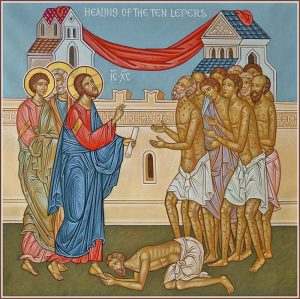 In addition to the commemoration of St Ambrose of Milan, the day’s Gospel reading presents to the Church the account of the healing of ten lepers. All were healed, but only one returns to worship and give thanks to Jesus for his healing:
Then one of them, when he saw that he was healed, turned back and was glorifying God with a loud voice; and he fell on his face at Jesus’ feet, giving thanks to him. Now, he was a Samaritan. Now, in answering, Jesus said, “Were not ten cleansed? Where are the nine? Was no one found returning to give glory to God but this foreigner?” And he said to him, “Rise and go on your way; your faith has saved you!” (St Luke 17: 15 – 19).
Only one healed leper gave thanks to God. Therefore, only one lived eucharistically.
Living eucharistically: what do I mean by this phrase? The Greek word eucharistia means thanksgiving. St Paul gives this command to the Colossian church: “And become thankful [kai eucharistoi ginesthe] (Colossians 3:15). You can also say it this way, “Become Eucharists!”
When the Divine Liturgy comes to its conclusion a priest descends the solea and declares this: “Let us go forth in peace!” These words are not simply a command to direct us as we reenter the world. These words give a commissioning, and a new liturgy begins with the empowering of the Eucharist that moves us to our departures. St Paul writes,
Rejoice always. Pray constantly. Give thanks [eucharisteite] in, with, and for all things: for this is the will of God for you in Christ Jesus (1 Thes 5 – 16 – 18).
By giving thanks for not only the good and pleasant things of life, but also for the difficult and unpleasant things (and people) we live eucharistically. Thus, if we live eucharistically we incarnate all we encounter — we bear Christ into all things and for all things. Thus there can be transformations, and we are certainly formed more completely into the image of God, and Christ is more fully formed in us. We are living Eucharists in the world, and we act as the thankful leper who glorified God!
In Christ,
Fr Irenaeus
Walking Upright
Posted: December 2, 2025 Filed under: Etcetera, The Eucharist and Living the Eucharist | Tags: 1 Corinthians 4: 14 - 16, begotten of God, St Andrew the First Called, St John 1: 35 - 51, St Luke 13: 10 - 17, St Paul calls himself "Father", St Paul fathered the church of Corinth, the cursed serpent's realm, The healing of the bent over woman, The thematic focus of St John's Prologue 1: 11 - 13 1 CommentThe Gospel text for the 25th Sunday after Pentecost comes from St Luke 13: 10 – 17. From the text we read about the healing of a woman who was bent over double by a spirit for 18 long years. She was suffering due to the work of the enemy:
And he [Jesus] was teaching in one of the Synagogues on the Sabbath. And behold there was a woman who was having a spirit of weakness for 18 years, and she was bent over double and was unable to completely straighten up (St Luke 13: 10 – 11).
 Her posture was bent down at an approximate angle of 90 degrees. Thus, her gaze was essentially always downward unless she inclined her head upward to see (and perhaps that was done with difficulty). She looked to the ground to the stones and dirt. Thus, her gaze was directed to decay: the earth and soil are made from the breakdown, or decay of stone and organic substances. She looked down upon the byproducts of death. Therefore, spiritually speaking, her gaze was set to the realm of the serpent:
The Lord God said to the serpent, “Because you have done this, [the deceiving of Eve] cursed are you above all cattle, and above all wild animals; upon your belly you shall go, and dust you shall eat all the days of your life (Genesis 3: 14).
Although the woman’s condition was a physical ailment the spiritual parallel is evident: Apart from Christ and a life of faith and repentance we are all bent over double with our eyes fixed upon the Serpent’s realm of decay and death. But Jesus intervened,
Upon seeing her, Jesus called and said to her, “Woman, you are released from your weakness.” And he placed his hands on her and immediately she straightened up and glorified God (St Luke 13: 12 – 13).
With this healing her gaze was in a forward direction. She now clearly saw our Lord and praised God for her healing. She could now look upon God’s creation around her, and look up to the heavens. She now moved and lived without pain.
So, we come to our spiritual condition — apart from Christ we are bent over double and gaze down upon death and decay; upon sin, darkness, and alienation. By being in Christ by faith and Sacrament we stank upright and can look upon him with the eyes of faith. But, when we look away from his ways and stray from him we have begun to be doubled over and gaze upon death and decay once more. But, we are given the Sacrament of Confession’s spiritual chiropractic treatment to set us straight again.
 Every year, on November 30, we also commemorate the Apostle Andrew — the First Called of the Apostles (St John 1: 35 – 51 is the Gospel text for his feast day). He too, as he walked with our Lord, was spiritually straightened up. In Christ, with Christ, and for Christ he gazed upon him and learned from him. He, together with the other apostles, gave us the Apostolic Tradition which has guided the Orthodox Church for 2,000 years.
By the Apostolic Tradition we are taught by the Scriptures and those who interpret them by this holy Tradition. This Apostolic Tradition gives us other gifts. We worship The Triune God in the Divine Liturgy and all the services of the Church. We enter into the Sacramental life of the Faith, especially by receiving the Body and Blood of our Lord in and by the Eucharist. We are given examples of godly, holy living by the lives of the saints. In the epistle set for the day, St Paul has written this for us:
I do not write this to make you ashamed, but to admonish you as my beloved children. For though you have countless guides in Christ, you do not have many fathers. For in Christ Jesus through the Gospel I begot [egenneesa] you. Therefore, I exhort you — become imitators of me (1 Corinthians 4: 14 – 16).
St Paul’s use of the verb translated begot / fathered can take us back to the Prologue of St John’s Gospel. The Prologue is found in the Gospel’s first chapter and consists of verses 1 – 18. These verses are constructed in a very specific way to lead us to the center and focus of the Prologue’s message:
Unto his own things [ta idia – the things of creation] he came, and his own [oi idioi – his fellow Jews] did not receive him. But as many as received him, he gave to them authority to become children of God, to those who believe in his name. They, not from blood, nor the from the will of the flesh or the will of a man, were begotten [egenneetheesan] from God (St John 1: 11 – 13).
These verses inform us that we are the children of God. We are the children of a spiritual family of faith. And as any family has defining appearances and characteristics, so are we to have defining spiritual characteristics that, for example, are found in the Beatitudes (see St Matthew 5: 1 – 12).
By being in Christ we stand up straight. We look forward to clearly see and follow along the path of Christ. Also, in addition to the Scriptures, we can take the guidance of the Apostles and the saints as we move confidently in the ways of the Apostolic Tradition which, in part, was set out by St Andrew the First Called.
Here is the corresponding sermon given at St Jacob of Alaska Orthodox Church in Bend, Oregon on 11/30/25:
In Christ,
Fr Irenaeus
 Father Irenaeus Williams