The Scandalous Actions of the Unmerciful Servant
Posted: August 25, 2025 Filed under: Etcetera | Tags: 1 Corinthians 9: 2 - 12, blessed are the peacemakers, Christ indwells us, Elder Thaddeus of Vitovnika, humility and fasting, humility and obedience, humility and peacefulness, meekness and humility, obstacle and scandal, Parable of the Unmerciful Servant, Purity of heart, St Matthew 18: 23 -35 Leave a comment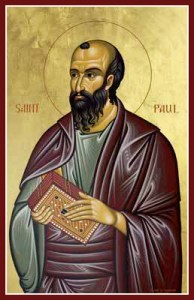 The subject matter of this posting concerns, in part, the Parable of the Unmerciful Servant found in St Matthew 18: 23 – 35 (the Gospel reading for the 12th Sunday of Matthew in the Orthodox Church). But, it is needed to first look at St Paul’s words from the days Epistle reading from 1 Corinthians 9: 2 – 12. The Corinthian church was a “problem child” for him. In these verses he reminds them that as an Apostle he has the right to earn a living from his apostolic ministry. He makes his case from the Old Testament:
For it is written in the Law of Moses [Deuteronomy 25:4], “You shall not muzzle an ox when it is treading out the grain.” Is it for oxen that God is concerned? Does he not speak entirely for our sake? It was written for our sake, because the plowman should plow in hope and the thresher thresh in hope of a share in the crop. If we have sown spiritual good among you, is it too much to reap your material benefits? If others share this rightful claim upon you, do not we still more? Nevertheless, we have not made use of this right, but we endure anything rather than put an obstacle in the way of the Gospel (1 Corinthians 9: 9 – 12).
To put up an obstacle, or hinderance is similar to causing a scandal. In the Scriptures a scandal means to create a cause for stumbling, a turning away from faith, or to be led into sin.
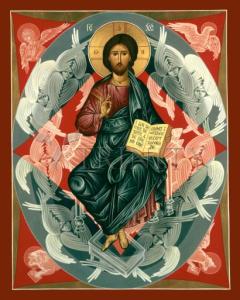 The Parable of the Unmerciful Servant tells of an occasion of scandalous behavior. We should all know the story. The servant of a king is called in to settle his debt with the king. The servant owes such a huge debt that it cannot be paid back, but he begs the king for mercy, and assures him he will be repaid. Out of pity for his servant he is released and forgiven the debt. However, the newly forgiven servant did not learn a lesson from his master. He comes upon a fellow servant who owes him money — a tiny fraction of what he owed the king. This wicked servant would not forgive his fellow servant’s debt and has him thrown into prison. The act of cruelty was witnessed by their fellow servants and was reported to the king. Jesus related the fate of the wicked servant:
In anger the king delivered this servant to the jailers till he should pay all his debt. So, also my heavenly Father will do to each one of you unless you forgive your brother’s sin from your heart (St Matthew 18: 34 – 35).
Of course, the big picture is that the extent of our sins is similar to the massive, unpayable debt of the unmerciful servant. Yet, through Christ, all is forgiven. Our debt is cancelled. Hence, as we move in forgiveness as did Christ our Savior, we must forgive others as we were forgiven by God.
More can be learned from this parable. The wicked servant did not exhibit either both mercy or humility. On the contrary, he exhibited pride and arrogance. These hideous traits brought about scandal and his own demise.
There are consequences for bringing about causes for stumbling and obstacles to the formation of faith and its continuation of formation in the Christian. Our Lord informs us:
Whoever humbles himself like this child, he is the greatest in heaven. Whoever receives one such child in my name receives me; but whoever causes one of these little ones who believe in me to sin, it would be better for him to have a millstone fastened round his neck and to be drowned in the sea. Woe to the world for temptations to sin! For it is necessary for temptations to come, but woe to the man by whom the temptation comes! St Matthew 18: 4 – 7).
It is good that our words and actions do not bring about obstacles to faith, or causes of stumbling into sin. St Paul advises this: “Avoid every appearance of evil” (1 Thessalonians 5: 22). Better it is that our words and actions draw people to the Faith:
You are the light of the world. A city set on a hill cannot be hidden. Nor do men light a lamp and put it under a bushel, but on a stand, and it gives light to all in the house. Let your light so shine before men, that they may see your good works and give glory to your Father who is in heaven (St Matthew 5: 14 – 16).
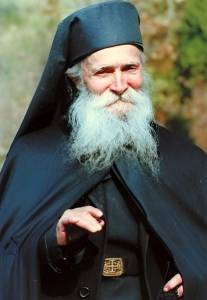
Elder Thaddeus
Christ, of course, is the Light of the World. He is Light and Life. He indwells us, so any light we shine has him as its source. The Beatitudes immediately precede those words of Christ (St Matthew 5: 1 – 12). Let’s look at three of these spiritual virtues. In so doing I will be quoting from Our Thoughts Determine Our Lives (St Herman of Alaska Brotherhood, 2009, 2022) which is a collection of the sayings of Elder Thaddeus of Vitovnika.
Meekness / Humility. “Blessed are the meek, for they will inherit the earth” (St Matthew 5:5). The Elder instructs us:
I had a desire to learn about the inner life of those who had lived a perfect life here on earth and who were glorified by God both here and in eternity. It was then that I realized, as the Holy Fathers themselves explained, that the perfection of the Christian life consist of extreme humility (p 87).
Meekness means having a heart that is humbled and peaceful…A proud person is never satisfied; everything bothers him, and he follows his own will. We must be obedient to the will of God in order to learn humility and meekness while we are still in this life, while there is still time. A heart that is full of love thinks not of itself, but of others. It prays for all living things and for the whole world (p 89).
The Elder makes the connection between humility and peacefulness:
When we can stay calm when someone attacks us from all sides, when we can keep our inner peace in spite of that person’s rudeness, then our soul will become meek and humble and we will live this life with a full understanding of it (p 88).
He makes a connection between humility and obedience:
Humility is a Divine property and the perfection of the Christian life. It is attained through obedience. He who is not obedient cannot have humility…Our humility is in proportion to our obedience (p 89).
There is a connection between humility and fasting:
When the body is humbled, our thoughts become more peaceful too. This is the purpose of fasting…It is impossible to unite with God when the stomach is full, for full stomach causes many cares and worries. All our thoughts, all our emotions, and all our will must be concentrated. When they are not, we are restless and lose our peace (p 136).
Peacefulness. “Blessed are the peacemakers, because they will be called the sons of God” (St Matthew 5: 9).
The Elder is asked what is the most important this in one’s spiritual life? He answers,
To guard the peace in our hearts. Do not let this peace be disturbed at any cost. Peace should reign in our hearts — peace and silence…practice standing before the Lord. This means being unceasingly aware that we are standing in the presence of the Lord and that He is watching us all the time. We must learn to awake with the Lord and go to sleep with Him, and eat, work, and walk with Him. The Lord is present everywhere in all things (pp 142 – 143).
Control of our thoughts is the key to such peace:
Our life depends on the kind of thoughts we nurture. If our thoughts are peaceful, calm, meek, and kind, then that is what our life is like. If our attention is turned to the circumstances in which we live, we are drawn into a whirlpool of thoughts and can have neither peace nor tranquility (p 63).
Purity of Heart. “Blessed are the pure in heart, because they will see God” (St Matthew 5: 8). From the Prayer of the Hours we read, “Sanctify our souls, purify our bodies, set aright our minds, and cleanse our thoughts.” Thus, our thoughts bring not only peace, but purity into our hearts, minds, and lives. With this said, we must understand that humility, peacefulness, and purity come from communion with God. The Elder states this,
Communion with God means that God has made His abode in us and that His energy is working in us. Our spirit puts on God and He governs all our feelings, our will, and our mind. We are then like a tool in His hands. He moves our thoughts, desires, and feelings and directs our words and the work of our hands (p 143).
Even though we are not as spiritually advanced as Elder Thaddeus, we now, in this hour, lack nothing. For Christ indwells us. The Holy Spirit and the Father indwell us. This is an ontological union and reality, and it exists in us all at this present hour. All we have to do is participate in his ways. We are participants in the divine nature, and it is active in us — if we so yield ourselves to his will and walk in his ways.
This brings us to the concept of theosis — the spiritual process of divinization where we become godlike. We do NOT become God, but godlike. We become the true image bearers of God we were, and are, intended to be from the moment of humanity’s creation. I offer the words of Archimandrite George Kapsanis,
All this [theosis], does not come about immediately. If an Orthodox Christian gradually struggles throughout his life with the Church, with humility, repentance, prayer, and the Holy Sacraments, by the Grace of God he may be sanctified and deified.
This, however, is the purpose and the great aim of our lives. How far we get is not the most important thing. What is important is the struggle itself, which God blesses abundantly, both in the present age and in the age to come.
As always I offer the very helpful words of St Paul which I, imperfectly, try to follow and by which conform my sinful life:
Rejoice always. Pray constantly. Give thanks in, with, and for all things for this is the will of God for you in Christ Jesus (1 Thessalonians 5: 16 -18).
Presented here is the corresponding sermon given at Holy Resurrection Orthodox Church, Tacoma, Washington on August 24, 2025:
In Christ,
Fr Irenaeus
 Father Irenaeus Williams