Hungering and Thirsting for Righteousness
Posted: May 20, 2025 Filed under: The Eucharist and Living the Eucharist | Tags: a prayer to live eucharistically before the world, a prayer to live the eucharistic life, Christ is the Water of Life, hungering and thirsting for righteousness, Jesus' conversation with the Samaritan Woman, St John 4: 10 - 15, St Photina (the Samaritan Woman), Water of Life Leave a comment Every year the Orthodox Church commemorates the Samaritan Women, who we now know as St Photina, who encountered Jesus at Jacob’s Well near the Samaritan town of Sychar. She came to the well at midday to avoid the looks of scorn, and the rejection she would experience form those gathered in the cool of the morning to draw from the well. In this privacy her life was changed as she enters into conversation with Jesus: “‘Give me a drink,’” asks Jesus (St John 4: 7). She replies, “‘How is it that you, a Jew, ask a drink of me, a woman of Samaria?’ for Jews have no dealings with Samaritans” (St John 4: 9). A discussion about water, thirst, and eternal life then begins between the two of them:
Jesus answered her, “If you knew the gift of God, and who it is that is saying to you, ‘Give me a drink,’ you would have asked him and he would have given you living water” The woman said to him, “Sir, you have nothing to draw with, and the well is deep; where do you get that living water? Are you greater than our father Jacob, who gave us the well, and drank from it himself, and his sons, and his cattle?” Jesus said to her, “Every one who drinks of this water will thirst again, but whoever drinks of the water that I shall give him will never thirst; the water that I shall give him will become in him a spring of water welling up to eternal life.” The woman said to him, “Sir, give me this water, that I may not thirst, nor come here to draw” (St John 4: 10 – 15).
The hymns from the Mid-feast of Pascha and today also speak of spiritual waters that only come from God. We have this troparion of the Paschal Mid-feast:
In the middle of the Feast, O Savior, fill my thirsting soul with the waters of godliness, as You did cry to all: If anyone thirsts let him come to me and drink. O Christ God, Fountain of our life, glory to You!
Next, we have today’s kontakion:
The Samaritan Woman came to the well in faith: she saw You, the Water of Wisdom, and drank abundantly. She inherited the Kingdom on high, and is ever glorified.
Her interaction with Christ continued and he revealed himself to be the Christ whom she and her fellow Samaritans awaited: “I who speak to you am he” (St John 4: 26). She accepts this, and with this revelation, she takes in her first draw from this Water. New Water brings forth new life, and her journey in, with, and for Christ begins. She takes her leave and informs the inhabitants of Sychar that she has met the Christ.
After she leaves, Jesus’ disciples return and the subject of food arises upon their arrival. Rather than material food purchased in a market, Jesus informs them:
Meanwhile, the disciples begged him, saying, “Rabbi, eat.” But, he said to them, “I have food to eat of which you do not know…My food is to do the will of him who sent me, and to accomplish his work” (St John 31, 34).
Our Lord speaks of such Water and Food in the Sermon on the Mount: “Blessed are those who are hungering and thirsting for righteousness because they will be satisfied” (St Matthew 5: 6).
St Photina, the Samaritan Woman, drank the Water and ate the Food of which Jesus spoke. In Carthage she was an evangelist where she lived with two sons and her sisters — all martyrs and saints. We read of her final witness before Nero:
After this Nero had her brought to him and asked if she would now relent and offer sacrifice to the idols. Saint Photina spit in the face of the emperor, and laughing at him, said, “O most impious of the blind, you profligate and stupid man! do you think me so deluded that I would consent to renounce my Lord Christ and instead offer sacrifice to idols as blind as you” Hearing such words, Nero gave orders to again throw the martyr down the well, where she surrendered her soul to God (oca.org).
Thus, St Photina was victorious. She was nourished by the Food of Christ. She was refreshed by drinking from the Well which is Christ. She, too, as are we, was nourished by our Lord’s all holy Body and Blood of the Eucharist. From this Sacrament we all receive cleansing from sin, and victory over sin, darkness, alienation, and death, and his promise of everlasting which comes only from him.
 Today, and with every Divine Liturgy, purposefully and prayerfully come to the Eucharist while giving thanks for his miraculous, sacramental presence before us. The Eucharist gives us guidance for our lives as we pursue the satisfaction of Christ’s righteousness which we are to manifest by our lives to this darkened and depraved world. St Paul gives this instruction: “Give thanks in, with, and for all things for this is the will of God for you in Christ Jesus” (1Thessalonians 5: 18). And from this verse I present to you a prayer to assist our living the Eucharist, and thus living Christ, before the world and the cosmos:
Heavenly Father, I pray this day I would be living the eucharistic life which is in accordance with your will for me in Christ Jesus. Thus, by the Holy Spirit may I be giving thanks in, with, and for all things, in order that I might bear Christ to all and for all things, and bear all and all things to Christ Jesus. Also, that I would be self-giving and other-receiving, and come to live as broken bread and poured out wine for the life of the world and the sake of all things, to the praise and glory of your Name. Amen.
Also, here is another hymn for the day’s theme:
Come and let us drink a new drink, not one marvelously issuing from a barren rock, but one that Christ from the tomb pours out, incorruption’s very source. For we are established in him.
St Photina, pray for us that we may be satisfied as we hunger and thirst for righteousness!
The following is the corresponding sermon given at St Sophia Greek Orthodox Church (Bellingham, WA):
In Christ,
Fr Irenaeus
Purity of Heart
Posted: May 5, 2025 Filed under: The Eucharist and Living the Eucharist | Tags: "Create in me a clean heart", Pascha, Purity of heart, putting on the new man, Romans 6: 6, spiritual game plans, St John 6: 53 -56, the Myrrh Bearing Women Leave a comment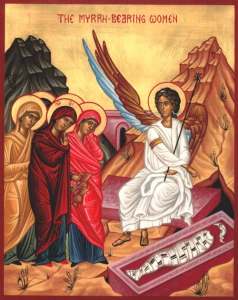 On the morning of the Resurrection, certain women disciples of Jesus went to his tomb to anoint his body with the traditional myrrh. They encountered into an astonishing and alarming site: The immense stone which sealed Jesus’ tomb had been rolled away. Inside the tomb they encounter a “young man” clothed in white sitting at the right side where Jesus had been laid. He addressed and informed them:
…Do not be alarmed: You seek Jesus of Nazareth who was crucified. He is risen! Behold the place where they laid him.
A troparion of the day declares this:
The angel came to the myrrh bearing women at the tomb said: Myrrh is proper for the dead; but Christ has shown himself a stranger to corruption! So proclaim: the Lord is risen, granting the world great mercy.
The Myrrh Bearing Women were expecting the expected, but they found the unexpected. They came to the tomb expecting to find a corpse, but encountered the Miracle of miracles: “Christ is risen from the dead!” Did they know of the raising of the son of the widow of Nain? They surely witnessed the raising of Lazarus from the dead and his emergence from his tomb.
The witnessing of these two miracles done by our Lord brought about shock and awe to those present at these miracles. Likewise, the experience of the Myrrh Bearing Women brought to them an equal response, and how could they wrap their minds around this news?
However, after 2,000 years we know the story. It’s old news: we’ve read the book and seen the movie. Therefore, we treat it as well known history. The element of awe is no longer there for us. So, I want to give you and me a cold slap in the face. We who are asleep need a major jolt of spiritual caffeine! Let’s review a theological and ontological fact given to us by St Paul:
We were buried, therefore, with him by baptism into death, so that as Christ was raised from the dead by the glory of the Father, that we too might walk in newness of life (Romans 6: 6).
We are also united to his resurrection. Therefore, we share in his new miraculous life. It is to be our understood reality by which we live. Hence, in his epistles he gives us further instruction:
If then you have been raised with Christ [the construction of the phrase assumes the positive], seek the things that are above, where Christ is seated at the right hand of God. Set your minds on things that are above, not on things that are on earth. For you have died, and your life is hidden with Christ in God. When Christ who is our life appears, then you also will appear with him in glory (Colossians 3: 1 – 4)
Given these facts, St Paul then explains to us the need for the corresponding lives we are to live,
Put to death, therefore, what is earthly in you: immorality, impurity, evil desire, and covetousness, which is idolatry. On account of these the wrath of God is coming. In these you once walked, when you lived in them. But now put them all away: anger, wrath, malice, slander, and foul talk from your mouth. Do not lie to one another, seeing that you have put off the old man with his practices and have put on the new man, who is being renewed in knowledge after the image of his creator…Put on then, as God’s chosen ones, holy and beloved, compassion, kindness, lowliness, meekness, and patience, if one of you has a complaint against another, forgiving each other; as the Lord has forgiven you, so you must forgive. And over all these put on love, which binds everything together in perfect harmony. And let the peace of Christ rule in your hearts, to which indeed you were called in the one body. And become thankful (Colossians 3: 5 – 10, 12 – 17).
Be reminded, then of this hymn of Pascha: “Thy Resurrection, O Christ our Savior, the angels in heaven sing — enable us on earth to glorify thee in purity of heart!” Purity of heart — our Lord states this: “Blessed are the pure in heart, because they will see God (St Matthew 5: 8). The holy king David gives us this:
Create in me a clean heart, O God, and put a new and right spirit within me…Restore to me the joy of your salvation, and uphold me with a willing spirit (Psalm 50/51: 10, 12).
 Consider the Eucharist. Here is another sacramental and ontological reality which is to have us pursue purity of heart:
Therefore, Jesus said to them, “Truly, truly, I say to you, unless you eat the flesh of the Son of Man and drink his blood you do not have life in yourselves. The one who is eating my flesh and is drinking my blood has eternal life, and I shall raise him in the Last Day. For my flesh is true food, and my blood is true drink. The one who is eating my flesh and drinking my blood abides in me and I in him (John 6: 53 — 56).
Jesus’ resurrected life is worked into our mortal being by faithfully consuming his Body and Blood given to us via Communion. He indwells us, and we are in him. Thus, we become his body, and must live out Christ’s life before the world.
“Enable us to glorify thee in purity of heart!” That’s nice, you may say, but how? I can speak only from my own experience and from the lessons which I have learned. Let me begin with this statement which comes from St Paul: The struggle is in the mind. We read this from the Prayer of the Hours: “…Set aright our minds; cleanse our thoughts.” Therefore, we must throw away habitual thoughts that continue to keep us in the trap of habitually impure actions that are contrary to our existence in Christ Jesus.

Jesus Christ Conquers
We know the people, circumstances, settings, etc., which trigger automatic responses. These automatic responses arise from the corruption, or impurity that still resides within us. Thus, we need to have a holy game plan which can be used to overcome such habits. I inform you of one of my triggers: shopping. In a store, especially a large and busy store, I can become impatient, irritated, and generally cranky. So, while I am in the parking lot, still in my car, I must inform myself of my game plan: I will choose to be patient, peaceful, and joyful. I must inform myself to pray for all I will encounter and ask God’s blessing to be upon all I pass by — my fellow shoppers (who may be impatient, irritated, etc.). These words from St Paul also form my game plan:
See that no one pays back evil for evil, but always pursue the good both for one another and for all. Rejoice always. Pray constantly. Give thanks in, with, and for all things for this is the will of God for you in Christ Jesus (1 Thessalonians 5: 15 – 18).
Choose to seek the good for all. Choose to rejoice, even if you may not feel inclined to do so given the circumstances. Choose to pray in all settings, and in every hour. Choose to give thanks even in a negative or challenging setting; and within the company of people who my be inpatient, irritable, and cranky. By doing so we extend Christ himself into the space and time we occupy. By choosing to implement such a game plan we bear Christ to all, and we form Christ within us — the one who is the source of our purity of heart. Thus, we imitate Christ and become Christ-like.
By our lives lived in concert with Christ, and as we pursue purity of heart, we can ask the Myrrh Bearing Women to pray for us. Living in his purity, let us surprise the Myrrh Bearing Women with our growing purity of heart!
The following is a corresponding sermon:
In Christ,
Fr Irenaeus
 Father Irenaeus Williams