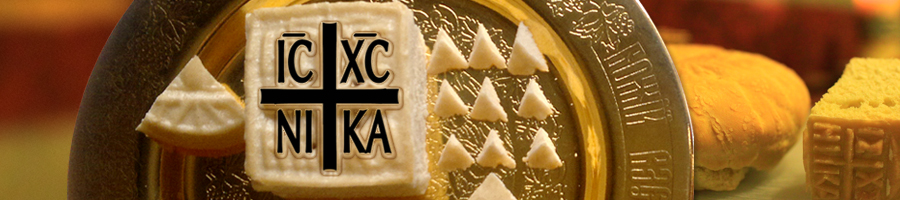
Do We Know Who We Are?
Posted: April 7, 2025 Filed under: The Eucharist and Living the Eucharist | Tags: Fifth Sunday of Lent, living eucharistically, St John 6: 54 and 56, St Mark 10: 33-34, St Mary of Egypt, The Beatitudes and the ethos of the Church, The Cup of Salvation Leave a commentFor the Fifth Sunday of Lent the day’s Gospel reading comes from St Mark 10: 32 -45. In the first verses of this pericope, Jesus, his disciples, and a crowd were going to Jerusalem. He takes his Apostles aside and informs them, for the third time, of his soon to occur death and resurrection:
Behold, we are going up to Jerusalem and the Son of Man will be handed over to the Chief Priests and Scribes, and they shall condemn him to death, and hand him over to the Gentiles, and they will ridicule him, beat him, spit on him, and will kill him. And on the third day he shall rise again (St Mark 10: 33 – 34).
Apparently James and John were not listening, or, were still unable to comprehend Jesus’ true purpose and destiny. They were scheming to have Jesus grant them special privilege and a position of authority not to be offered to the other Apostles. They informed the Lord of their request: “Grant us to sit, one at your right hand and one at your left, in your glory” (St Mark 10: 37).
Jesus corrects them:
But Jesus said to them, “You do not know what you are asking. Are you able to drink the cup that I drink, or to be baptized with the baptism with which I am baptized?” And they said to him, “We are able.” And Jesus said to them, “The cup that I drink you will drink; and with the baptism with which I am baptized, you will be baptized; but to sit at my right hand or at my left is not mine to grant, but it is for those for whom it has been prepared” (St Mark 10: 38 – 40).
(Here, the cup and baptism to which Jesus refers is his betrayal, torture, and death by crucifixion — to which they journeyed. And, yes, James and John, and countless others through the centuries would, and are, and will, be facing certain betrayal, imprisonment, torment, and death for their faith in Christ.)
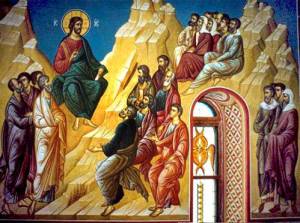
Sermon on the Mount
In a few more verses, Jesus will turn their concepts of authority and rank upside down. He teaches them that the greatest among them is to be the servant of all, and that the one who desires to be first must be the slave. Our Lord also upends the world system’s understanding of what constitutes blessedness in life: The Beatitudes (St Matthew 5: 1 – 11).
Blessed are the poor in spirit, because theirs is the Kingdom of Heaven:
The poor in spirit does not refer to those who exist in abject poverty, but refers to those who are dependent upon God for their being. It also reflects the necessity of a society of sharing and cooperation among all for mutual well being, which is to be first and foremost expressed by the Church that we may be a shining light on a hill.
Blessed are those who are mourning, because they will be comforted:
Christ refers to those who mourn not only for life’s downward turns, but also mourn for their sins and they dark state of affairs existing in this world system. Christ informs us that in this world will will have tribulation, and we all know that life isn’t fair.
Blessed are the meek, because they shall inherit the earth (land):
In the world system, it was and still is, the dark reality that the powerful and the cunning take the land and the possessions of the poor who cannot stand against such proud aggression. But this will not be so in the Kingdom of Heaven.
Blessed are those who are hungering and thirsting after righteousness, because they will be satisfied:
This is a somewhat pivotal verse. It refers to the first three virtues as well as those that follow. If we follow Jesus and walk in his ways, we will be satisfied with his righteousness, and come to have less regard for worldly things.
Blessed are the merciful, because they will obtain mercy:
This speaks to forgiveness and graciousness which is to be exhibited by our lives. Remember this: The yardstick by which we measure others, by it we will be measured.
Blessed are the pure in heart, because they shall see God:
The citizens of the Kingdom of God are to have pure hearts to see God. So, we are to establish purity in our lives. We are to construct a pure environment in our homes and minds:
I will give heed to the way that is blameless…I will walk with integrity of heart within my house. I will not set before my eyes anything that is base…Perverseness of heart shall be far from me; I will no nothing of evil (Psalm 102/101: 2 – 4)
For further formation of purity we have this portion of prayer which comes from the Prayer of the Hours: “…Sanctify our souls, purify our bodies; set aright our minds and cleanse our thoughts.”
Blessed are the peace-makers because they shall be called the sons of God:
St Seraphim and Sarov gives us this nugget of truth: If you obtain peace, you will bring peace to thousands. St Thaddeus of Vitovnica instructs us to maintain peace in every setting by controlling our thoughts:
Our life depends on the kind of thoughts we nurture. If our thoughts are peaceful, calm, meek and kind, then that is what our life is like. If our attention is turned to the circumstances in which we live, we are drawn into a whirlpool of thoughts and can have neither peace nor tranquility (p 63).
Blessed are those who are persecuted for the sake of righteousness, because theirs is the Kingdom of Heaven. Blessed are you when men revile you, persecute you, and speak falsely all manner of evil against you for on my account. Rejoice and be glad, for great is you reward in heaven — for so they treated the prophets who came before you:
The confessors and martyrs drank from Christ’s cup and were baptized into his baptism. In these days, we cannot think we will escape this cup and baptism.
The Beatitudes are not just lofty, hopeful ideals. They are to be embedded in our lives that we may embody Christ to all and all things.
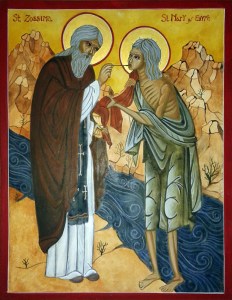
St. Mary of Egypt
On this fifth Sunday of Lent we honor one of the greatest and inspiring saints, at least in my opinion: our Mother among the saints Mary of Egypt. She overcame, by the Holy Spirit and the Cross of our Lord, sexual addiction. She fought against the deep corruption of sin that dwelt in her, and the demons who would keep her enslaved and entrapped in them. She was pushed by the Spirit into the wilderness to do battle. Her solitude gave her the battlefield of victory.
To attain these virtues of the Beatitudes requires our own volitional struggle. (Think of the struggles of St Mary of Egypt and ask for her intercessions before our Lord for our own victories.) We will and must fight for our own purity. It is and will be a battle, but remember these words from Psalm 103/102: 13 – 14
As a father pities his children, so the Lord pities those who fear him. For he know our frame, and remembers that we are dust
Therefore, do not despair! Our God is patient and will always come to our aid.
Now, let me change gears and subject matter as we approach Pascha, the Feast of feasts. To make this shift, I pose a question: “Do we know who and what we are?” First of all, we are image bearers of God — we are icons — we are to present God to all and all things. If we speak and act in godly ways then we tell the truth about God. If not, then we tell lies about God. We are also prophets, vice-regents, and priests. I will focus on the priestly aspect of our being. One of the best definitions of being a priest is this: one who bears God to all, and bears all back to God by prayer, word, and action.
You may object — I am a sinner, and you are a sinner. Of course we are, but God acts through us in spite of our imperfections as he remains at work in us.
 I shift gears again. Let’s return to Jesus’ Cup from which he was to drink as noted in the verses found above. This Cup is the same as that given to his Apostles in the Upper Room: “…This Cup is the New Covenant in my Blood, which is being poured out in your behalf” (St Luke 22: 20). This is the same Cup given to us for our salvation.
So now we come to the Eucharist: our rational, bloodless sacrifice of praise and thanksgiving. Each communion also accomplishes this for the one receiving it in faith:
The one who is eating my Flesh and is drinking my Blood has eternal life, and I shall raise him in the Last Day…The one who is eating my Flesh and is drinking my Blood, abides in me, and I in him” (St John 6: 54, 56).
With each Eucharist consumed we have both continued cleansing, and the life of Christ and union with him is strengthened within us. We receive his Light and Life, and his victory over sin, death, darkness, and alienation.
Near the very end of the Divine Liturgy this admonition gives us our mission to the world: “Let us go forth in peace!” We are empowered to bear Christ into this troubled and darkened world by practicing Christ’s mercy, humility, peacefulness, and purity among all and all things. It is him we bear as we act (even imperfectly and inconsistently) in his behalf as his priests. Thus, we are to live eucharistically. St Paul tells us how we are to conduct ourselves eucharistically every day:
Do not repay evil for evil, but always pursue the good both for one another and for all. Rejoice always. Pray constantly. Give thanks in, with, and for all things, for this is the will of God for you in Christ Jesus (1 Thessalonians 5: 15 -18).
I pray this inspires us in some way to enter into our upcoming Pascha with new spiritual insights and strength. I pray this that we bear the resurrected, victorious Christ to the world. “Thy resurrection, O Christ our Savior, the angels in heaven sing. Enable us on earth to glorify Thee in purity of heart.”
In Christ,
Fr Irenaeus
 Father Irenaeus Williams