The Victorious and Life-giving Cross
Posted: March 24, 2025 Filed under: The Eucharist and Living the Eucharist Leave a commentI present a hymn sung every Matins (Orthros), and is said by a priest or deacon every Divine Liturgy. It reads,
Having beheld the Resurrection of Christ, let us worship the holy Lord Jesus, the only sinless one. We venerate your Cross, O Christ, and we praise and glorify your holy Resurrection; for you are our God, and we know no other than you; we call on your name. Come all you faithful, let us venerate Christ’s holy Resurrection! For through the Cross joy has come into all the world. Let us ever bless the Lord, praising his Holy Resurrection, for by enduring the Cross for us, he has destroyed death by death.
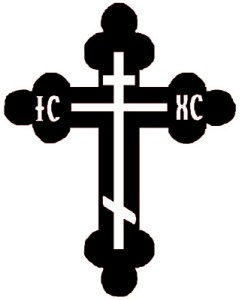 In the slavic liturgical tradition for the Third Sunday of Lent, the Sunday of the Cross, a blessing Cross is beautifully decorated with flowers placed all around it. Many Orthodox Churches have a splinter of the True Cross, upon which Jesus was crucified, contained within a small reliquary which is placed upon the cross that will be venerated. These venerations occur at the conclusion of Matins and the Divine Liturgy of this Sunday.
Though originally the cross was a horrifying instrument of execution, now, for the faithful Christian, it is the object of Christ’s victory over death. The cross is adored by Christians; it is the symbol of our faith. We wear the cross. It is displayed in our homes. The eyes of faith even see its shape and form in objects of nature. But, we are not to see it void of its power becoming only an empty token or ornament.
This is a portion of the Gospel reading for the day:
And after turning to the crowd, together with his disciples, he said to them, “Whoever wishes to follow me is to deny himself, and is to take up his cross and follow me. For whoever wishes to save his life, shall lose it; whoever loses his life for my sake and of the Gospel, this one shall shall save it (St Mark 8: 34 – 35).
Again, quoting the hymn noted above, we have, “For by enduring the Cross, he has destroyed death by death.” For us, the Cross of Christ, though the symbol of our faith, it is to remain an instrument of death. By this, I mean that the crosses we take up are to destroy those necrotic sins which inhabit our lives. These sins are also like cancers. In any person, even though otherwise health there are little “colonies” of cancers. These colonies are called “cancer in situ,” meaning “ cancer in place”, or in its setting within our bodies. Technically, they are non-threatening (our immune systems destroy them) unless given the opportunity to “awaken” and become an eruptive, active, and life-threatening cancerous tumor.
In a similar fashion, there are sins that abide in us in situ. And like a physical cancerous tumor, they are to cut out and destroyed. In this case the Cross is the scalpel and is life saving for our souls.
Where do we find the crosses we are to bear? How often do we come upon them? We find them every day and here, there, and everywhere. Every day we are to take up our cross by faith to put to death the in situ sins that abide in us. For example, if we are tempted to become angry we have this choice: we can deny the cross and give into anger, or we can come by faith to the cross and keep our peace. Here, we can pray, “Make haste to help me, O Lord, my salvation” (Psalm 39/38: 22). We can also say the Jesus Prayer. And, even counting to ten (possibly very slowly) can also be used by our Lord. Also, during this season of Lent, we could be tempted to break our fast, or give into gluttony. Or we can take up our cross and ignore the urge to eat and continue life-giving abstinence. Here, we can say the same prayers, and we can also tell ourselves that “I can wait for 15 more minutes before I eat. After this brief time out, then a longer interval can be proposed. Also, we can busy ourselves with a physical activity, and the urge to eat will pass.
Both of these examples involve an exercise of the will. We always have this choice: Do we deny ourselves and move to the cross, or do we let the cancer of sin grow a little bit more?
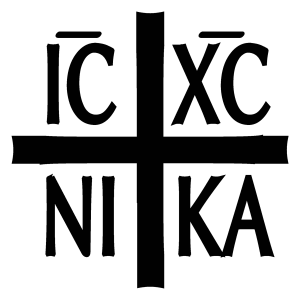
Jesus Christ Conquers
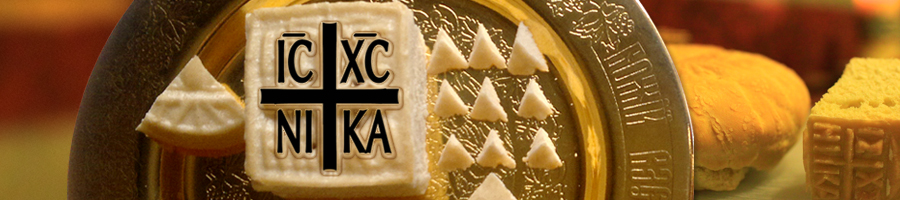
Just before the conclusion of the Divine Liturgy of this Sunday of the Cross the assemble faithful venerate the cross placed before them. This is not to be done mindlessly and robotically. With our venerations, we need to pray that the life-giving power of the Cross be ours. We are to take it into ourselves. And the crosses we wear, when in need, we should press them to our chests and pray for its victory to be ours. Additionally, There is another way in which we take up the Cross, which should be known by every Orthodox Christian. Impressed onto the surface of the bread that will become the Body of Christ, called the Lamb, is an image of the Cross. Above the arms of the cross are the Greek letters IC (an abbreviation for Jesus) on its right, and XC (an abbreviation for Christ) on its left. Below each arm is half of the Greek word nika, meaning “[he] conquers”. The two letters NI appear on its right, and KA on its left. When put together, we have the message, “Jesus Christ conquers!”
Thus, each time we consume the Body and Blood of Christ his Victory enters into every part of our being! By so doing we are given the spiritual power to conquer the cancer, or death of sin residing in situ within us. And more, by consuming Christ’s Body and Blood with spiritual and faithful purpose, we are given the power to embody Christ before the world and the entirety of creation which resides in sin, death, darkness, and alienation from God.
In conclusion, allow me to add this message from history. Prior to his decisive battle with his rival Maxentius, Constantine (not yet St Constantine) saw a vision of the Cross in the sky above him. The voice of the Lord came to him saying, “By this sign, Conquer!” Crosses were, in some manner, placed upon the shields of his soldiers. St Constantine was victorious. Therefore, let us afix ourselves to our crosses, and by them be victorious!
In Christ who is ever victorious,
Fr Irenaeus
 Father Irenaeus Williams