Sunday of the Publican and the Pharisee 2.0
Posted: February 24, 2024 Filed under: Etcetera, The Eucharist and Living the Eucharist | Tags: Exalt yourself and be humbled, humble yourself and be exalted St Luke 18: 14, Preparing for Great Lent, St Luke 18: 9 - 14, Sunday of the Publican and the Pharisee, The Parable of the Publican and the Pharisee Leave a comment With the parable of the Publican and the Pharisee we in the Orthodox Church know that Great Lent is one week closer. This parable is found in St Luke 18: 9 -14. Our Lord directed this parable to those whom had a false self confidence that they were righteous and despised others (St Luke 18: 9). The day’s Gospel reading continues, “two men went up to the Temple to pray, one a Pharisee and the other a tax collector” (St Luke 18: 10). The verses that follow demonstrate the differences in the two men. We read this about the Pharisee:
The Pharisee stood by himself and prayed these things: “God, I thank you that I am not like other men — greedy, unjust, adulterers, or even like this tax collector. I fast twice a week and give tithes from all that I get” (St Luke 18: 11 – 12).
The Pharisee, of course, had contempt for all who were not like himself — or rather — perceived himself to be. It is Christ’s intention for the hearer o the parable to be shocked by the Pharisee’s stance. First, he stood apart from all others in the Temple. Second, he did not pray to God, he only praised himself. His arrogance left no room for God’s presence. Though Christ states that people should listen to the Pharisees, they were not to do as they did.
Though the Pharisee’s behavior and attitude are terrible and to be rejected, it is far too easy to not see the Pharisee that raises his ugly head in each of us from time to time. It is easy for the healthy to look down on the ill, and the affluent to look down on the poor. It is far too easy for the educated and the sophisticated to look down on the “unwashed masses” and those seen as simple; the urban to snub their noses at the rural. Such examples can go on and on, and we can find examples that apply to our own false confidence and pride. An excerpt from the Prayer of St Ephraim the Syrian is to speak to all of us, and in all of the Church’s seasons: “Yes, my God and King, grant me to see my own transgressions and not to judge my brother…”
In stark contrast we have the tax collector:
And the tax collector stood from afar and would not lift his eyes to heaven. He beat his chest saying, “God be merciful (ilasthaeti) to me a sinner” (St Luke 18: 13).
 Note the tax collector’s word. It is not the more common eleao with its imperative form of eleaeson, or “have mercy”. He uses the word ilaskomai in the imperative form ilasthaeti — he is asking not only or mercy, but also, “bring about my forgiveness,” or “take away my sin.” This request was answered for all of humanity when Christ gave himself up on the Cross to take away our sins. The words of John the Baptist ring true: “Behold the Lamb of God who takes away the sin of the world” (St John 1: 29).
Christ our Righteous Judge gives his verdict regarding these two men:
I say to you that this man [tax collector] went down to his home having been justified rather than the other. For everyone who exalts himself will be humbled, but the one who humbles himself will be exalted (St Luke 18: 14).
The kontakion for the day is to give us further guidance:
Let us flee from the pride of the Pharisee! Let us learn humility from the Publican’s tears! Let us cry to our Savior: “Have mercy on us, O Only Merciful One!”
In Christ,
Fr Irenaeus
The Meeting in the Temple, St Simeon, and Candlemas
Posted: February 3, 2024 Filed under: Etcetera, The Eucharist and Living the Eucharist | Tags: Candlemas, Light and Life of Christ, St Anna the Prophetess, St Simeon, take the Light of Christ into your life, The Feast of the Meeting in the Temple, the light of the world, you are the light of the world Leave a comment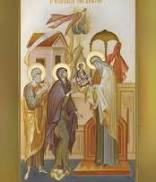
Icon of the Meeting in the Temple
Every February 2 we have the Feast of the Meeting in the Temple. We meet two holy, elderly prophets: St Simeon and St Anna. Yet, apart from the Holy Family, St Simeon’s role in the presentation of Jesus in the Temple as part of the Law is key. This elderly saint and prophet gave the Church a valuable hymn as it is recorded in St Luke’s Gospel:
Now in peace dismiss your servant, because my eyes have seen your salvation which you prepared before the face of all people: A Light for revelation to the Gentiles, and the glory of your people Israel (St Luke 2: 29 -32).
St Simeon said these words as he held his long awaited Savior in his arms as Sts Mary and Joseph took in the moment and his prophecy.
Light is clearly the primary theme of this second major feast of the Church year. Just over 30 years later we have Jesus’ own words about himself:
I am the Light of the world: the who follows me shall never walk in the darkness, but shall have the Light of Life (St John 8: 12).

Light and Life
Once, and not too long ago, there was a world lit only by fire — by candle, torch, or fire in the hearth. Darkness likely may have seemed darker, and those who walked and prowled in it even more dangerous. So. light had to have been more precious in those days. The fire for a home had to be maintained and safeguarded. The Light of Christ is by far the most precious Light of all lights, and it is to be maintained and safeguarded with in us with even greater vigor and vigilance.
The Light of Christ has always been sung and praised by the Church. “O Gladsome Light” is one of the oldest hymns of the Church, possibly going back to our earliest days. It is sung as part of every vespers service:
O Gladsome Light of the holy glory of the immortal Father: heavenly, holy, blessed Jesus Christ. Now that we have come to the setting of the sun, and behold the light of evening we praise God: Father, Son, and Holy Spirit. For meet it is at all times to worship you in voices of praise, O Son of God and giver of life. Therefore, all the world does glorify you!
Given this hymn, it is easy to understand why in every Orthodox service candle light is seen throughout the nave and in the sanctuary. These candles made from beeswax (the bees, too, offer their gifts) signify many things. But they always witness to the Light of Christ.
 This feast day is also called Candlemas — candles are blessed this day for their use throughout the year. After the candles are blessed, the faithful in attendance each receive and light a candle. Its flame is kept for the duration of the Divine Liturgy (or at least as long as it lasts). All physical lighting illuminates a room or a house. The Light of Christ is the brilliant Light that dispels the darkness in our souls where sin and lies may find shelter and persist in bringing about spiritual ruin and disease. If permitted to shine, the Light of Christ illumines and brings healing to those formerly dark places. Additionally, Jesus says this as recorded in the Gospel of St Matthew:
You are the light of the world…Thus let your light shine before men, so that they might see your good works, and might glorify your Father who is in the heavens (St Matthew 5: 14, 16).
During the Divine Liturgy of this feast day, the faithful hold their candles. The flame signifies the fire of the Holy Spirit. The flame’s light signifies the life giving Light of Christ. Let us take this Flame and Light into our lives. Let us continually do this to dispel the dark corners remaining in us where sin, corruption, and lies hide. Let his Light shine that these horrors may be excised from our lives. Also, in and by all that we do in Christ Jesus our Lord, God, and Savior, let us bring his Light to this darkened and depraved world.
St Simeon and St Anna, pray for us!
In Christ who is the Light of the world,
Fr Irenaeus
 Father Irenaeus Williams