
A Re-evaluation of Status
Posted: August 28, 2023 Filed under: Etcetera | Tags: 1 Cor 1: 26 - 29, concern about wealth and power, Dante's Inferno, Mt 5: 1 - 12 the Beatitudes, Niccolo Machiavelli, seeing with spiritual eyes, The Beatitudes as qualities of citizens of the Kingdom of Heaven Leave a comment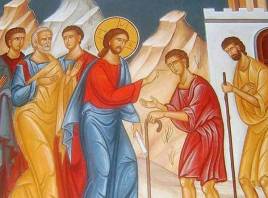
Healing of the Two Blind Men
For Saturday, August 27,2023 the Gospel reading was from St Matthew 20: 29 -34 which gives the account of the healing of two blind men. The passage can be summarized in this manner. As Jesus left Jericho with a crowd following him, two blind men who sat by the road called out “Lord, Son of David, have mercy on us.” Jesus touched their eyes and they could see. The formerly blind men now had physical sight. And with sight they followed Christ on his way to Jerusalem.
Although physical sight is valuable, spiritual sight is even more valuable. This is better understood from St John’s account of Jesus healing the man bourn blind (St John 9: 1 – 41). Our Lord offers this statement: “…For judgment I came into this world, in order that those who do not see might see, and those who see might become blind” (St John 9: 39). Putting it another way, we are to understand that those with only natural sight might see with new spiritual eyes, but those who cling stubbornly to natural, physical sight might become blind — no spiritual sight can be given to them. We find this in a kontakion for the Sunday of the Man Born Blind (the 6th Sunday of Pascha):
I come to you, O Christ, blind from birth in my spiritual eyes, and call to you in repentance: You are the most radiant Light of those in darkness!
With spiritual sight given by God we can now truly PERCEIVE!
We now move to the epistle reading for the Saturday which comes from St Paul’s first epistle to the Corinthians:
For consider [blepete] your calling, brethren, that not many of you were wise according to the flesh, not many were powerful, not many were of noble birth. But God selected the foolish things of the world, in order that the wise of this world might be put to shame. And God selected the weak of the world in order that he might shame the strong. And the low-born and the despised were selected by God, also the things which are not in order to abolish the things which are. All this so that no one might boast before God in the flesh (1 Cor 1: 26 – 29).
“Blepete.“ This Greek verb is in the imperative form — it is a command to the Corinthian Church. The word can be most commonly translated as “see” or “look at”. It can also be translated “consider” or “regard.” According to St Paul, we are to consider, or observe, that we are of the “lesser things” of the world. We are a people not regarded as important by those who see with “cosmopolitan eyes” – eyes that see only through the lens of the world system. IF we think of ourselves as belonging in the company of the sophisticates, the powerful, the important of the world, we DO NOT perceive ourselves properly. IF we want to belong among the sophisticated of the world, then we exist as “friends of the world” and thus “at enmity with God” (St James 4:4).
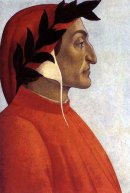
Dante Alighieri
Regarding the perils of worldly status, I give two historical illustrations from the late Medieval era and then of the Renaissance era of Italy. The first comes from Dante Alighieri who wrote The Inferno. He had become a man of faith when he penned the classic. But, he was formerly involved in the politics of Florence. He apparently turned away from the power circles of Florence and noted the dangers of such power: he puts the political “movers and shakers” of Florence — the power elite of his day — in the inferno upon their death. Niccolo Machiavelli provides the second example. Mr Machiavelli had stated that he wanted no part of Heaven because there would be no powerful, sophisticated people there. There would be no intrigue and no exiting conversation. He concluded that he would be bored in Heaven and would, seemingly, prefer Hell.
Then, I provide this autobiographical account. I was once a young man. I had begun my career as a clinical pharmacist. I was a single man in those days. Though a Christian at the time, yet I wanted to live among and be associated with the professional classes. I wanted no part of the working man’s world. If you wanted to sell me something, “snob appeal” worked nearly every time. I have matured and have changed my mind. I have no desire for the Inferno!
I do not imply that all who are wealthy and occupy political office are damned. And I do fully appreciate that we of the Western World are wealthy in light of others and of other eras. However, not many of us were wise, powerful, or of wealthy, elite birth. This tells us we are to see ourselves with eyes that let us value things very differently! Further, with this proper self-evaluation and awareness, we are to live according to the Beatitudes:
Sermon on the Mount
Upon seeing the crowds, he ascended the mountain. After he sat down his disciples approached him. He opened his mouth and taught them, saying: Blessed are the poor in spirit, for theirs is the Kingdom of Heaven. Blessed are those who mourn, because they shall be comforted. Blessed are the meek [humble], because they shall inherit the earth [land]. Blessed are those who hunger and thirst after righteousness, because they shall be satisfied. Blessed are the merciful, because they shall obtain mercy. Blessed are the pure in heart, because they shall see God. Blessed are the peacemakers, because they shall be called the sons of God. Blessed are those who are persecuted for righteousness’ sake, because theirs is the Kingdom of Heaven. Blessed are you whenever men revile and persecute you falsely for my sake, because your reward is great in Heaven, for so they persecuted the prophets who came before you (St Matthew 5: 1 – 12).
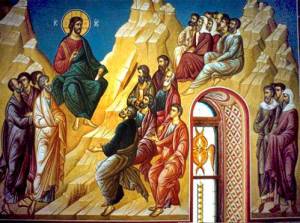
The Beatitudes overturn the conventional wisdom of both the ancient and modern worlds. The Beatitudes are to be the personal qualities and characteristics of those who work to be the citizens of the Kingdom of Heaven!
Every August 26 the Orthodox Church commemorates the martyrs Adrian and his wife Natalia. A hymn honoring Adrian reads,
You regarded faith as an imperishable treasure, O most blessed one, abandoning the ungodliness of your fathers and walking in the footsteps of the Master. You were enriched with divine gifts, O glorious Adrian. Pray to Christ God for the salvation of our souls.
We are living in darkened, depraved days. Our faith is openly despised and persecution is truly beginning. We cannot be friends of the world system. By our faith in God, We are to exert greater effort, and even double ours efforts, to cultivate the characteristics of the Beatitudes. By doing so and becoming such we become friends of God and, again, citizens of the Kingdom of Heaven. We then walk with Christ together with the saints.
The following is a corresponding sermon:
In Christ,
Fr Irenaeus
A Cricket Keeping Common Time
Posted: August 5, 2023 Filed under: Animal Welfare, The Eucharist and Living the Eucharist | Tags: a cricket keeping time, Abbey Road, appreciation of animals, blessing God's creatures, cricket's "voice", living in solidarity with all of God's creatures, musicality of birds, The Beatles' "Sun King" Leave a commentDecades ago, as a younger man, I had an indifference to many creatures, and some I loathed. As I have grown older, and hopefully have increased in faith, I have developed a greater and increasing appreciation for all of God’s creatures. Now, as I walk through my property, I bless the animals that I see on any given path.
 Birds, dogs, and cats all have voices and vocalizations — they vary greatly. I have become somewhat attune to two of my dogs’ vocabularies. I can discern a few meanings by now: “the food bowl is empty,” “water is needed”, and “I need to go out” stand out among other messages. The variety of bird songs and voices also have wonderful variations. Finches, pine siskens, and junkoes are the more vocal of the all the species I encounter. During summer evenings one of the species (or maybe all three) have “chat times” that are quite remarkable. They assemble in a tree and sound like a choir! (My anthropomorphic interpretation is that they are discussing their days and sharing news before their night’s sleep.) There is a musical quality to God’s singers and musicians. Even a psalmist has commented on this:
Even the sparrow finds a home, and the swallow a nest for herself where she may lay her young at your altars, O Lord of hosts, my King and my God. Blessed are those who dwell in your house, ever singing your praise! (Psalm 84 / 83: 3 – 4).

Abbey Road Cover
During late July, 2023 while visiting my mother in southeastern Washington, I slept on her couch with a window open to let in the cool evening air. After a few moments, I heard the sound of a cricket, or similar insect. God’s tiny percussionist was keeping perfect common (4/4) time at a rate of 100 beats per minute. A metronome could not do better, and the tone of the beat held was certainly superior to the mechanical quality of such a devise.I recorded its “beat” twice, the first for about 3.5 minutes duration, and the second for just over five minutes. My intention is to use it as a natural metronome, and even use it as a background for a future composition. Though any work of my own would never be of the quality of the cricket included on the Beatles’ “Sun King” found on Abbey Road, I will do my best to honor this cricket’s musicianship.
With this appreciation of the cricket’s perfect keeping of common time, I hope that I and all of the faithful in Christ can see the potential (and need) for harmonic interactive relationships with all of God’s creatures and creation. This hope isn’t based upon some sappy sentiment. Somewhere, Saint Paisios noted that as holiness increases in one’s life a love for all of God’s creatures increases — to the point of birds and animals will be drawn to a saintly presence (I think of St Blaise, St Seraphim of Sarov, and St Francis). I also have this hope because as we move through the perilous times in which we now find ourselves we will be able to show love, extend peace, give thanks, and live in solidarity with all and all things. By living in this manner we will be sanctifying the world to the glory of God.
In Christ, and someday in perfect common time,
Fr Irenaeus
Perceiving, Valuing, and Ordering Christ in Our Lives
Posted: August 4, 2023 Filed under: The Eucharist and Living the Eucharist | Tags: becoming confessors, Dying to self and gaining Christ, perceiving Christ, Receiving the Holy Spirit, spiritual sight gives spiritual understanding, Taking up one's cross Leave a commentThe Gospel reading for Saturday, July 22, 2023 came from St Matthew 10: 37 – 11:1. This posting concentrates on verses 37 – 39 which read,
The one who loves father and mother more than me, is not worthy. And the one who loves son or daughter more than me is not worthy. And who does not take up his cross and follow after me is not worthy. The one who finds his life will lose it, and the one who loses his life for my sake shall find it (St Matthew 10: 37 – 39).
 We are to love Christ more than family members. This is not a hyperbolic statement! The nearest and dearest relationships in our lives are to be subordinated to Christ. We are to take up our own crosses. The cross is an instrument of death, of execution. The Christian is to sacrifice self (one’s life) which is entangled in this world system that we might gain spiritual life — life in the eternity of the Kingdom of God. In other words, we are to make assessments and order matters from lesser to greater cost, and from lesser to greater value. Our lives in our economic system teach us that the quality of our investments determine the amount of “interest” paid.
The next day’s Gospel (the Seventh Sunday of Matthew) comes from St Matthew 9:27 – 35. In it we read of two blind men who as Christ to give them sight. Jesus asked them, “Do you believe I am able to do this?” They answer in the affirmative, and they received sight. They saw God Incarnate, their Lord and Savior. Then Jesus gives them one command, “See that no one knows of this!” (St Matthew 9: 30). They did not obey Jesus’ “gag order”, but told everyone in the region of their healing by Christ.
 So, are we like the two blind men? Are we as disobedient? Are we unwilling to deny self in the most obvious thing that is right in front of us? Or will we do a proper accounting and accept Christ and subordinate our will to his will? We may put up the objection, “But it’s so insignificant!” However, the reality is that it right in front of us, and to gain Christ in this matter we are to die to self. We are to take up this little cross and, thus, gain Christ. These little, mundane, and seemingly insignificant things, when released to Christ always lead to incremental spiritual gains. Our incremental deaths to self will, in time, accumulate to greater gains in our lives in Christ. If we cannot die to self, i.e., obey, in the little things required of us, how could we die to the greater things that could be demanded of us in the future?
We need this discipline because we live in perilous times. Events in politics and economics may very soon confront us with such choices. What “parent” or “child” (the valued things of this world) will we be called upon to release to Christ? What might be the crosses we may be called upon to take up, thus losing self, but gaining Christ? We need to be prepared to be confessors in this age.
Upon receiving our sight and seeing Christ do we truly perceive him for who he is and properly heed his call? Or, we we act like the two blind men who, upon receiving sight, looked at Christ, but did not perceive him as their God, Lord, and savior and then disobeyed.
St Paul writes this in his epistle to the Romans: “Therefore, I make known to you that no one speaking by the Spirit of God calls Jesus accursed, and no one can say Jesus is Lord except by the Holy Spirit” (Romans 12: 3). By the sacrament of Chrismation the Holy Spirit is received: “The seal of the gift of the Holy Spirit!” In every Divine Liturgy there is the portion called the epiclesis:
Again we offer unto Thee this reasonable and bloodless worship, and ask Thee, and pray Thee, and supplicate Thee: Send down Thy Holy Spirit upon us and upon these Gifts [bread and wine] here offered.
 With these words the bishop / priest invokes the Holy Spirit to come upon the bread and wine to make them the Body and Blood of Christ, and that the faithful assembled that day may receive anew the Holy Spirit. These two petitions are made that by the Holy Spirit — upon consuming Christ’s Body and Blood — Christ may be more completely formed within us. And, thus, we may be empowered to perceive Christ with comprehending spiritual eyes, and die to ourselves that we have eternal life in Christ.
In Christ,
Fr Irenaeus
 Father Irenaeus Williams