Shubb Capo Royale vs G7th Performance ART: A Comparative Review
Posted: January 2, 2021 Filed under: Music and Guitars | Tags: Review of both Shubb Capo Royale and G7th Performance ART capo, Review of G7th Performance ART capo, Review of Shubb Capo Royale Leave a comment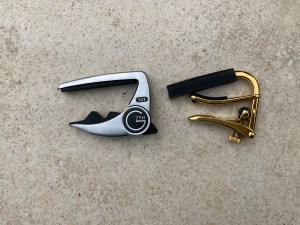
G7th Performance 3 ART and Shubb Capo Royale capos
My quest for the perfect capo continues. I search because the two primary problems with capos still exist: string buzz and loss of tune upon application. A few months ago my first capo review involved a comparison of three G7th capos: G7th Nashville, G7th Performance, and G7th Performance 3 ART. String buzzing when a capo is applied was the problem addressed. The G7th Performance 3 ART makes the claim that its Adaptive Radius Technology provides “…buzz-free use.” The claim was held up when compared to the other G7th capos. With G7th’s most recent product, there was only one buzz recorded which contrasted to multiple buzzes with two other capos made by “The Capo Company.” The string buzz contest was settled, in this posting maintenance of tuning is addressed. Two capos which boast the ability to keep your guitar in tune when applied to the fret board are compared this day: the Shubb Capo Royale, and G7th’s Performance 3 ART
Let’s begin with the claim set forth by G7th:
The Performance 3 is the culmination of years of designing, tweaking, and improving — but most importantly, listening to guitarists and their views on what a capo SHOULD do. Now, coupling our Unique Tension Control system with the ground-breaking ART [Adaptive Radius Technology] string pad mechanism gives a near-perfect capo experience.
The ART system within the top bar of G7th Performance 3 capos adapts to the true curvature over your strings and fretboard, exerting completely even pressure across all the strings — setting a new standard of in-tune, buzz-free use. It gives you the maximum tuning stability with the minimum possible tension in EVERY position, on ANY guitar neck.
Next, we have the Shubb claim:
The Shubb Capo is designed to reduce tuning problems. Its custom material presses the strings just like your fingertip. Its unique design closes onto the neck just like your hand. Its pressure is totally adjustable. The result: no retuning is necessary.
Similar claims, but will there be similar results? I put the capos to the test on five different guitars using one Snark electronic tuner. All five guitars were tuned (standard tuning) using the Snark tuner. Then, each capo was placed on frets 2, 5, and 7 on all five guitars. Each guitar was retuned before repositioning each capo at the above mentioned frets. “Distuning” was noted for each capo at each position by the number of “minute” increments (flat and/or sharp noted by -1, or +2, for example) from the “12 o’clock” position on the tuner. Here are the results in terms of total “distuning minutes” at all three fret positions (again 2, 5, and 7).
Breedlove Pro Series D25/SRH acoustic dreadnought:
Shubb: +9 (all sharp) G7th ART: +6 (all sharp)
Faith FG1RE PJE acoustic dreadnought:
Shubb: +20 (all sharp) G7th ART: +10 (all sharp)
Yamaha A5R ARE acoustic dreadnought:
Shubb: +13 (all sharp) G7th ART: +16 (all sharp)
Taylor Grand Pacific 317e acoustic dreadnought:
Shubb: 0 G7th ART: +4 (all sharp)
Ibanez Talman Prestige solid body electric:
Shubb: +4 (all sharp) G7th ART: +9 (all sharp)
Totals:
Shubb: +46 minutes sharp / G7th ART: +45 minutes sharp
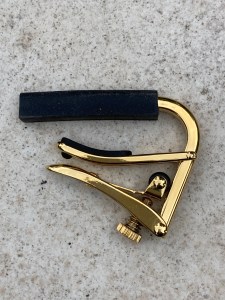
Shubb Capo Royale
In conclusion, I was pleased with the tuning stability provided by both capos. I will NOT run the results through a Chi Square statistical analysis, but I would guess by the results there would be no statistical difference between the two. Further, the minor distunings at all five fret positions would not be audibly noticeable except, perhaps, to someone blessed with perfect pitch. My experience with tuning issues with other capos allows me to express the opinion that both capos live up to their respective claims. However, I would give the Shubb Capo Royale the nod given its price of $20.85 (Amazon) compared to the G7th ART’s price of $49.99 (Amazon). Plus, with its slim gold-plated presentation, the Shubb just looks cooler!
Keep on playing!
Fr. Irenaeus
 Father Irenaeus Williams
Through the Narrow Door
Posted: January 30, 2021 | Author: Fr. Irenaeus | Filed under: Etcetera, The Eucharist and Living the Eucharist | Tags: commentary on Luke 13: 23 - 29, Enter through the Narrow Door, struggling against presumption, struggling for the faith, Struggling in the faith, struggling together in faith | Leave a commentTheir holiness didn’t come about by binge-watching a Netflix or BritBox serials ad infinitum, ad nauseum. The formation of Christ in their lives came with difficulty, great struggle, and many frustrations, as they moved to ultimate victory in our Lord, God, and Savior, Jesus Christ.
In the thirteenth chapter of St. Luke’s gospel we read this: “And someone said to him, ‘will those who are saved be few?’ And he said to them, ‘Struggle [agonizesthe] to enter through the narrow door, because many, I tell you, will seek to enter and will not able to enter.’” (Luke 13:23 – 24). The Greek verb found in the text, agonizesthai, can be translated “to struggle”, “to fight”, to “compete” (as an athlete). Think of great athletes and musicians who succeeded in accomplishing their goals. There were tears of anguish, setbacks, failures, aches and pains. But they continued in discipline and struggle that others wouldn’t (or couldn’t) attempt. Their rewards were their recognized victories.
As we move on in the gospel text, Jesus continues,
Jesus speaks against those who presume — in this case many Jews of his day. But such deadly presumption is found elsewhere and among others today, perhaps even in ourselves. No matter who we are, where we live, or what we do, we cannot presume that all things will “be just be fine.”
Jesus Christ conquers
Again we must struggle and fight — against such lazy presumption — to grow in faith, purity, and love. We must all struggle in accordance with the measure of faith given to us. Also, we must understand that while we compete in this struggle we will fall down and fail many times. When this happens we have the sacrament of Confession by which God lifts us up and cleanses us to continue on our way through the narrow door. We are also given the Liturgy’s movement to the Eucharist where, by the Body and Blood of Christ, we are, by faith, nourished spiritually, cleansed and forgiven, and we receive our Lord’s Light, Life, and Victory to continue on through the narrow door. We must know that, by faith, God empowers us by his presence within us: “Work out your own salvation with fear and trembling: for it is God who is working in you to will and to work in behalf of his good pleasure” (Phil 2: 12 – 13).
Additionally, we are also struggling and competing together — not against one another — but for one another. We encourage and help each other by our prayers and presence while we struggle to enter through the narrow door to enter into the Kingdom of God.
In Christ,
Fr. Irenaeus